Refrigerated Prep Table Sizing Guide
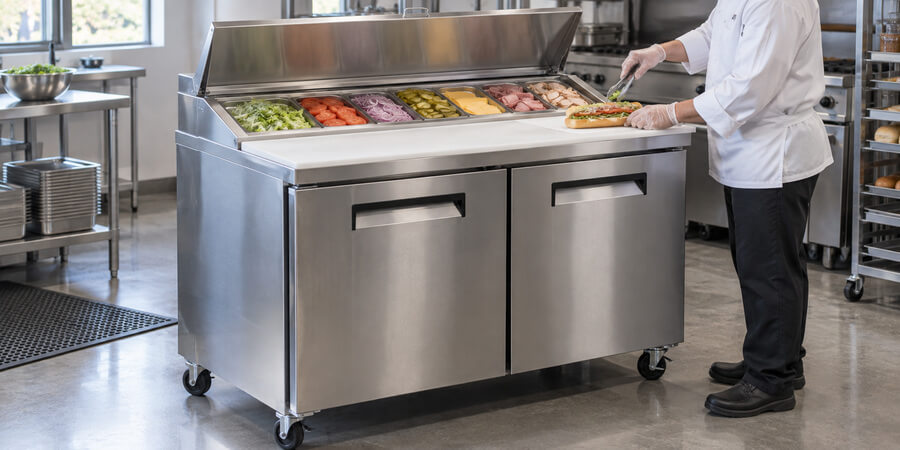
Table of Contents
How to size a prep table by width, door and drawer count, pan capacity, rail type and cutting board depth
A refrigerated prep table is bought by the inch and used by the pan. Those two numbers are linked, and almost every sizing mistake comes from shopping one without counting the other.
This guide covers the width ladder, standard top against mega top, the sandwich rail against the pizza rail, cutting board depth, how the rail stays cold, and a method for counting the pans you actually need.
What a Refrigerated Prep Table Is
It is two pieces of equipment in one footprint. A refrigerated prep table is a low cold cabinet with a chilled ingredient rail built into the top and a cutting board across the front. The rail holds portioned toppings in food pans at service temperature, the cabinet below holds backup stock, and the board between them is where the item gets built.
It is not a worktop refrigerator and it is not an undercounter unit. A worktop refrigerator is a cold cabinet with a flat stainless work surface and no pan rail; an undercounter refrigerator is cold storage sized to slide beneath a counter. The prep table is the only one of the three that holds open product at the point of assembly, which is what NSF/ANSI 7 calls an open food product application.
The rail decides everything else. Pan count, pan size and board depth are the three specs that separate one table from another at the same width.
What the Right Prep Table Buys the Kitchen
A station instead of a trip. With toppings in the rail and backup below, an assembly cook works a single pivot rather than walking to a reach-in between items. During a rush that is worth more than any other feature on the spec sheet.
Cold holding you can defend to an inspector. The FDA Food Code requires time and temperature control for safety food to be held at 41°F or less, and spec sheets publish pan and cabinet temperatures in the low to middle thirties. Section 4-301.11 separately requires holding equipment sufficient in capacity to reach those temperatures, so the right size is a compliance question too.
A menu you can widen without widening the kitchen. Mega top construction fits more pans across the same table width, so adding a topping line means changing the top type rather than finding another two feet of floor.
Less product in the trash. Toppings held in a chilled rail under an insulated lid last the shift instead of warming in a hotel pan on the counter, and a station that is cold to the Code's number does not have to be emptied every four hours. Waste falls and the cleaning schedule stretches at the same time.
A cold base that earns its own keep. The cabinet under the rail runs from single-digit cubic feet at the narrow end into the twenties at the wide end, so the station replaces an undercounter unit rather than sitting beside one.
The Width Ladder: Doors, Drawers and Pan Count
Width is the first decision, and door count and pan count follow it. The ladder below is read off live listings, where every title carries the width, the base configuration and the pan count together.
| Width: | Base configuration: | Standard top pans: | Mega top pans: |
| 27 to 28 inches | One door, or two drawers | 6 to 8 sixth-size | 12 sixth-size |
| 32 inches | One door, or two drawers | Not offered at this width | 12 sixth-size |
| 36 inches | Two doors | 8 to 10 sixth-size | 15 sixth-size |
| 46 to 48 inches | Two doors, or four drawers | 8 to 12 sixth-size | 18 sixth-size |
| 60 to 64 inches | Two doors, one door with two drawers, or four drawers | 10 to 16 sixth-size | 24 sixth-size |
| 72 inches | Three doors, or six drawers | 18 sixth-size | 30 sixth-size |
Pan count is not fixed by width, and that surprises buyers. The same width appears with several rail configurations, because a maker will trade pan count for pan depth or for a deeper board. Read the pan count in the title rather than assuming it from the inches.
Door count climbs in whole sections. A section is roughly two feet of cabinet, so a narrow unit gets one door, the middle of the ladder two, and only the widest three. Drawer models run two drawers per section, which is why a full-width drawer unit shows six.
Standard Top or Mega Top
This is the most consequential choice on the order, and it is not a size upgrade. It is a different rail.
A standard top keeps the rail shallow and the footprint tight. Pans sit in a single run behind the board and the lid closes flat over them, which suits an operation with a settled topping count.
A mega top extends the rail back to fit a second row. Pan count roughly doubles at the same width, which is why the ladder shows thirty pans in the same seventy-two inches a standard top fills with eighteen. Some mega tops mix sizes, running sixth-size pans alongside a few ninth-size wells for garnishes.
The trade is depth, reach and rotation. A deeper rail means a longer reach to a back row that sees less traffic, so it is where product ages if rotation is sloppy. Buy the mega top for topping variety, not for storage.
Sandwich and Salad or Pizza Prep
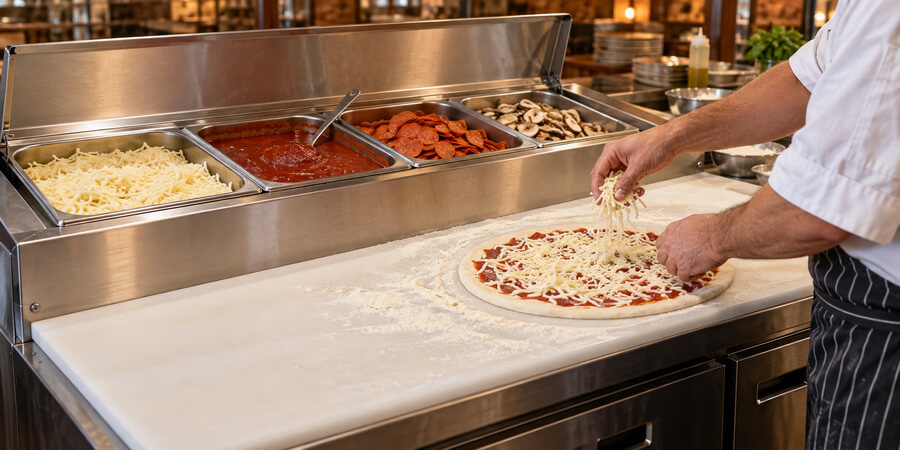
Both are refrigerated tables with rails, and they are not interchangeable. Pan size is the tell.
| What changes: | Sandwich and salad prep: | Pizza prep: |
| Rail pan size | Sixth-size, with ninth-size on some mega tops | Third-size, with full-size on wide rails |
| Cutting board depth | About 9 to 17 inches | About 19 inches |
| Rail geometry | Flat rail behind the board | Angled rail on many makes, tilted toward the cook |
| Width range in the catalog | 27 to 72 inches | 44 inches to just under 120 inches |
| Cabinet depth range | Low thirties, some into the mid thirties | Low thirties to high thirties |
| Height range | Low thirties to mid forties | High thirties to mid fifties |
Pizza prep is built around the dough, not the toppings. The board has to take a stretched skin, which is why it runs roughly twice as deep, and the rail takes third-size and full-size pans of sauce, cheese and toppings that get scooped rather than tonged.
A sandwich table will not do pizza work. A shallow board cannot hold a skin, and sixth-size pans cannot hold a shift of shredded cheese. Pizza listings also filter by left mount and right mount, because at these widths the compressor end decides which side of the make line sheds its hot air.
Cutting Board Width, Depth and Material
The board is the work surface and the part of the table that wears out first.
Depth is set by the job, not by preference. Sandwich and salad tables ship with boards roughly nine to seventeen inches deep, pizza tables around nineteen and a half. Some makes offer a deeper board at the same table width, so check before taking the standard one.
Thickness comes in two grades. Replacement boards are catalogued at half an inch and three quarters of an inch, and the thicker board takes more resurfacings before it is retired.
The material is high-density white polyethylene, and it is meant to be removed. Boards lift off for cleaning rather than being cleaned in place. Food Code section 4-501.12 requires cutting surfaces subject to scratching and scoring to be resurfaced when they can no longer be effectively cleaned and sanitized, or discarded if they cannot. Replacements are catalogued by the model they fit, including crumb-catcher versions with a lipped front edge, in the refrigeration cutting boards range. A station with no spare board loses a shift when the first one fails.
How the Rail Stays Cold: Airflow, Lids and Ambient
An open rail full of pans is a harder refrigeration problem than a closed box, and this is where makes differ.
Forced air is the common answer and spec sheets describe it plainly. Manufacturer literature names patented forced-air designs, low-velocity high-volume airflow, and concentrated airflow arranged to move around the pans rather than across the top of them. A low-velocity design holds pans cold without drying the product in them.
Cold wall rails are the alternative on some lines. Where forced air circulates chilled air around the pan wells, a cold wall rail chills the well surfaces themselves. Both are sold on the same model families, so it is a specification to ask about rather than a tier of quality.
The lid is refrigeration equipment, not a dust cover. Foam-insulated stainless lids and hoods are standard and night covers are sold as an accessory. Closing the lid during downtime is the cheapest thing anyone can do for rail temperature and compressor duty cycle.
Ambient is a published limit and kitchens routinely break it. Installation manuals instruct the installer not to place the unit where the temperature runs over 100°F or below 50°F, and warn that high ambient temperature results in much lower cooling efficiency. A prep table parked at the end of a cookline is living in the worst air in the building. Food Code section 4-205.10 treats equipment certified to a recognized American National Standard by an accredited program as complying with the Code, which is what an ANSI/NSF-7 listing for open food product buys.
Cold Holding and What the Food Code Requires
The temperature rule is short. The equipment rules around it are the ones operators forget.
| Requirement: | What it says: | Food Code section: |
| Cold holding | Time and temperature control for safety food held at 41°F or less | 3-501.16(A)(2) |
| Equipment capacity | Holding equipment sufficient in number and capacity to hit those temperatures | 4-301.11 |
| Thermometer | Sensor placed to read the warmest part of the unit, with an integral or permanently affixed display that is easy to view | 4-204.112 |
| Food-contact surfaces | Cleaned throughout the day at least every 4 hours | 4-602.11(C) |
| The 24-hour alternative | Every 24 hours instead, where the refrigerated area holds at 41°F or less and the frequency is documented | 4-602.11(D)(2) |
| Equipment condition | Doors, seals, hinges, fasteners and kick plates kept intact, tight and adjusted per the manufacturer's specification | 4-501.11(B) |
| Cutting surfaces | Resurfaced when they can no longer be cleaned and sanitized, or discarded | 4-501.12 |
| Fixed equipment | Spaced for cleaning along the sides, behind and above, or sealed to adjoining equipment and walls | 4-402.11(A) |
| Floor-mounted equipment | Sealed to the floor or elevated on legs giving at least 6 inches of clearance | 4-402.12(A) |
| Certification | Equipment certified to a recognized standard by an ANSI-accredited program is deemed to comply | 4-205.10 |
The 4-hour rule is what pushes operators toward a colder rail. Food-contact surfaces touching time and temperature control for safety food get cleaned at least every four hours, unless the refrigerated area holds at 41°F or less and the longer frequency is documented. Holding the rail properly cold buys the 24-hour schedule.
Doors, Drawers or Both
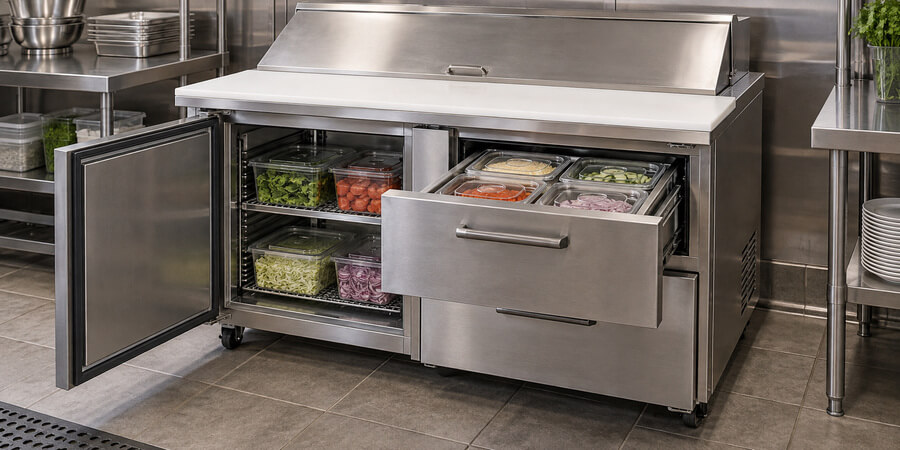
The base is where the second half of the money goes, and the layouts solve different problems.
Doors buy volume and flexibility. A hinged section takes full cases, sheet pans and odd containers, and it is the cheaper way to buy cubic feet. It also asks a cook to bend and reach past the cabinet front.
Drawers buy speed and portion discipline. Two drawers per section pull product out to the cook instead of sending the cook in. They cost more per section and hold less, because the drawer body and slides take space a shelf would not.
Combination bases are common and usually correct. Listings carry door-and-drawer configurations at the wider sizes, giving bulk storage on one section and fast picks on another. A menu with two or three fast movers and a long tail matches that layout exactly.
Self-closing doors and magnetic gaskets pay back. Spec sheets publish one-piece magnetic gaskets removable without tools, snap-in magnetic gaskets, and self-closing doors with a stay-open feature. A door that closes itself is the difference between the published holding temperature and an argument about it.
Casters, Clearance and Installation
This equipment is heavy, it breathes through a condenser, and it has to move to be cleaned behind.
| Item: | Published requirement: | Where it applies: |
| Ambient range | Not above 100°F and not below 50°F | Manufacturer installation manual |
| Rear clearance | Rear of the unit no less than 5 inches from the wall | Manufacturer installation manual |
| Floor | Strong enough for the cabinet plus contents, and level front to back and side to side | Manufacturer installation manual |
| Electrical | 115 volts, 60 Hz, single phase, dedicated outlet, no extension cord, plug accessible without moving the unit | Manufacturer installation manual and spec sheets |
| Current draw | Roughly two to six amps depending on width and configuration | Manufacturer spec sheets |
| Mobility | 6-inch legs or casters standard, commonly two with brakes; seismic and flanged legs offered | Manufacturer spec sheets |
| Before loading | Run the unit 24 hours before use | Manufacturer installation manual |
| In service | Front wheels locked while the unit is in use | Manufacturer installation manual |
Clearance is a refrigeration requirement before it is a cleaning one. A condenser with a wall against it recirculates its own hot air, and the first symptom is a rail that will not hold on the busiest afternoon of the year. Give it the published gap and keep it empty.
Casters and legs are a choice, not an afterthought. Casters let a heavy table roll out for cleaning behind, which is what Food Code section 4-402.11 asks for; legs give the six inches section 4-402.12 accepts instead of sealing the unit to the floor. Wheels and feet sit in the refrigeration legs and casters range. An overshelf changes working height and lid clearance, so decide on one from the refrigeration overshelves and service shelves range before the table ships rather than retrofitting it.
Count Your Pans: Sizing by Menu and Volume
The method that gets the size right starts on the menu rather than on a tape measure.
Step one: list every ingredient that has to live in the rail. Not in the cabinet, in the rail. Proteins, cheeses, cut vegetables, pickles, dressings, sauces and garnishes each need a pan, and the vegan and spicy versions count separately.
Step two: decide which need a full sixth-size pan and which can share a ninth. Anything you go through in a shift wants a full pan and a backup below. Garnishes used by the pinch take the smaller well on a mega top.
Step three: add a quarter for the pans you have not thought of. Specials, a seasonal item, the sauce a regular asks for. Then read that total back through the ladder and take the narrowest width that carries it.
| Service style: | What sets the size: | Top type to shop: | Width band to shop: |
| Sandwich counter or deli | Protein and cheese variety, plus dressings | Standard top unless the topping list is long | Middle of the ladder |
| Salad bar or salad line | Ingredient count, always higher than it looks | Mega top | Upper half of the ladder |
| Pizza make line | Dough handling room and third-size topping pans | Pizza prep format | Wide, from the pizza ladder |
| Taco or burrito line | Held proteins plus a long garnish tail | Mega top | Upper half of the ladder |
| Cafe, food truck or satellite station | Two or three items, tight floor | Standard top | Bottom of the ladder |
Buy the pans deliberately. Tables ship with pans included, commonly sixth-size at four or six inches deep, and the deeper pan holds more but sits further into the cold well. Spares, colanders and lids come from the plastic food pans range, and the wider food pans and accessories range covers stainless and adapter bars.
If the count comes out just over a width, go up. The next size costs a few inches of wall; running a rail over capacity costs a cook a trip on every ticket.
Cleaning, Gaskets and Condenser Care
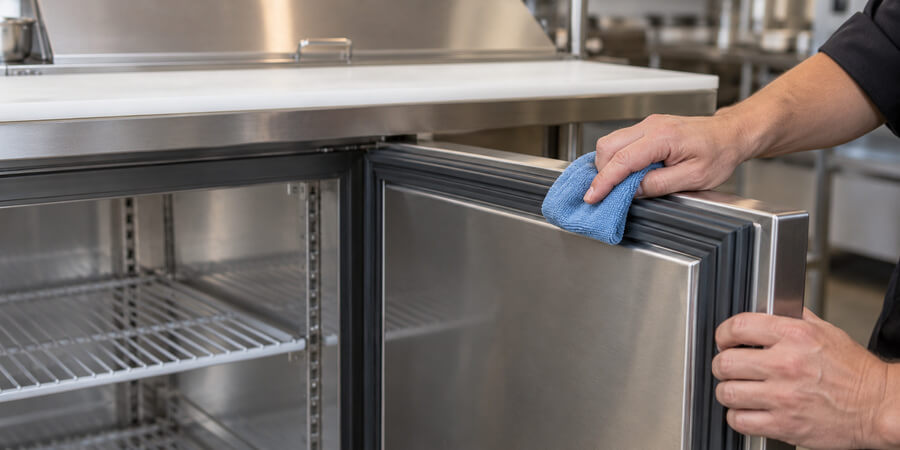
Three items decide whether this table still holds temperature in year five.
The condenser is the one that fails quietly. Manuals instruct the operator to keep the condenser coil free of dust, and a coil packed with flour or grease raises cabinet temperature slowly enough that nobody notices until product is warm. Put it on a schedule with the hood cleaning.
Gaskets are cleaned frequently and replaced without ceremony. Manuals call for cleaning the door gasket frequently to maintain proper sealing, and the Food Code requires seals, hinges and fasteners kept intact, tight and adjusted to the manufacturer's specification. A gasket that no longer grips is a compressor running all night. Replacements sit in the refrigeration parts and accessories range.
Interior and exterior get warm water and soap, never an abrasive. Manuals are explicit that abrasive cleaners scratch the surface. Pan rails and supports pull out for washing, and the drain pan underneath needs emptying periodically.
Frequently Asked Questions
What is the difference between a prep table and a worktop refrigerator?
A prep table has a refrigerated pan rail and a cutting board built into the top, so open product is held where it is assembled. A worktop refrigerator has a flat stainless work surface and no rail at all.
What size refrigerated prep table do I need?
Count the rail first. List every ingredient that needs a pan, add about a quarter for the ones you have not thought of, then read that total back through the width ladder and take the narrowest table that carries it.
What is the difference between a standard top and a mega top?
A standard top holds a single run of pans behind the board. A mega top extends the rail back for a second row, roughly doubling pan capacity at the same width. It is for topping variety, not storage.
How many pans does a 48-inch prep table hold?
It depends on the top type. Listings at that width carry standard tops in the eight to twelve sixth-size pan range and mega tops at eighteen, so read the pan count rather than inferring it from the width.
Can I use a sandwich prep table for pizza?
Not well. Pizza tables use third-size and full-size rail pans and a board around nineteen and a half inches deep, because a stretched skin needs room. A sandwich board runs roughly half that.
What temperature should a refrigerated prep table hold?
The FDA Food Code requires time and temperature control for safety food to be held at 41°F or less. Spec sheets publish pan and cabinet temperatures in the low to middle thirties, which is the band to aim for.
Should I buy doors or drawers?
Doors give more usable volume for less money and take full cases. Drawers bring product out to the cook at higher cost and lower capacity. Wider sizes offer both.
How deep is the cutting board on a prep table?
Sandwich and salad tables ship with boards roughly nine to seventeen inches deep, pizza tables around nineteen and a half. Replacements are catalogued at half-inch and three-quarter-inch thickness, and the thicker board survives more resurfacings.
How much clearance does a prep table need?
Installation manuals call for the rear of the unit to sit no less than five inches from the wall, away from hot corners and stoves, on a level floor strong enough for the loaded cabinet. The Food Code separately wants it spaced for cleaning or sealed, and on legs giving at least six inches of clearance if it is not on casters.
Do the rail lids have to stay closed?
During downtime, yes. The insulated lid is part of the refrigeration system, not a dust cover, and night covers are sold as an accessory for that reason.
Shop Refrigerated Prep Tables
Settle four things and the order writes itself. Count the pans the menu needs in the rail, which decides standard top against mega top. Pick the format, sandwich and salad or pizza, because pan size and board depth follow. Choose the base, doors for volume or drawers for speed. Then measure the wall run, the clearance behind and the height under any overshelf. Compare what fits across the sandwich and salad prep refrigerators range, the pizza prep tables and refrigerators range, or the full refrigerated food prep tables selection. Where the rail is not what you need, a worktop refrigerator gives a flat cold work surface, an undercounter refrigerator gives storage under a counter, a chef base puts refrigerated drawers under cookline equipment, and the wider commercial refrigeration equipment selection covers everything else cold.
Related Guides & Resources
- Commercial Refrigeration Guide - How the refrigeration formats differ, for deciding whether a prep table is the right box at all.
- Chef Base Guide - Refrigerated equipment stands, for the cookline half of the cold storage plan.
- Hotel Pan Sizes - Pan dimensions, depths and capacity charts, for turning a rail pan count into real volume.
- Walk-In Cooler and Freezer Sizing Guide - Bulk cold storage sizing, for the backup stock a prep table base cannot hold.
Share This!