Hotel Pan Sizes: Dimensions, Depths & Capacity Charts
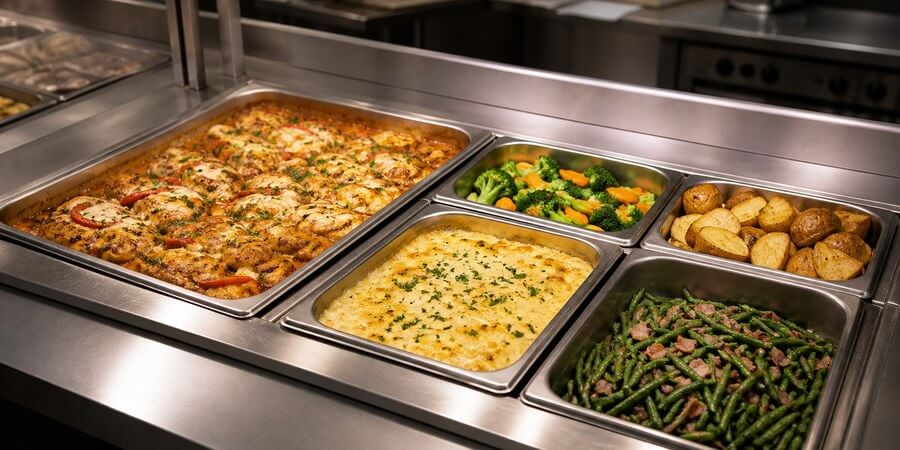
Table of Contents
Every standard size from full to ninth pan - what each one measures, what it holds, and which combinations fill a well
Every hotel pan size is a fraction of one standard footprint: the full-size pan, nominally 12" x 20". A half pan is half that footprint, a third pan is a third, and so on down to the ninth pan - which is why two halves, three thirds, or nine ninths all drop into the same full-size opening. This guide charts every standard size with its dimensions, depths, and real-world capacity, shows the combination layouts that fill a steam table well, and clears up the two things the industry never states plainly: why published dimensions for the "same" pan differ, and why capacity numbers disagree from one chart to the next.
One footprint, every size: how the 12" x 20" system works
Hotel pans - also sold as steam table pans, food pans, service pans, or counter pans - are the rare piece of foodservice equipment that is genuinely standardized. If you are looking for the shallow baking trays instead, those run on a separate 26" x 18" system - see our sheet pan sizes guide. Equipment manufacturers design steam tables, prep rails, holding cabinets, chafers, and transport carriers around the full-size 12" x 20" opening, so any combination of fractional pans that adds up to a full footprint fits that same opening.
One detail explains most of the confusion around pan measurements: the rim. A hotel pan hangs by its flanged rim, which overhangs the body of the pan. Sizes are quoted two ways - the nominal body size (a full pan is "12 x 20") and the actual outer rim size (that same pan measures about 12 3/4" x 20 3/4" across the flange). Neither number is wrong; they describe different edges of the same pan. On fractional pans, manufacturers trim the overhang along the edges where pans sit side by side, which is why a half pan's actual rim measures about 12 3/4" x 10 3/8" - a full 3/4" of overhang on the outer edge, less on the shared edge, so that two halves still fit one opening. When one chart says a half pan is "12 x 10" and another says "12 3/4 x 10 3/8," they are describing the same pan.
Hotel pan size chart
| Pan size: | Nominal footprint: | Per full-size opening: | Gastronorm equivalent (mm): |
| Full (1/1) | 12" x 20" | 1 | GN 1/1 - 325 x 530 |
| Two-thirds (2/3) | 12" x 13 1/3" | 1 (paired with a third pan) | GN 2/3 - 354 x 325 |
| Half (1/2) | 12" x 10" | 2 | GN 1/2 - 325 x 265 |
| Half-long (2/4) | 6 3/8" x 20 7/8" | 2 | GN 2/4 - 530 x 162 |
| Third (1/3) | 12" x 6 2/3" | 3 | GN 1/3 - 325 x 176 |
| Quarter (1/4) | 6" x 10" | 4 | GN 1/4 - 265 x 163 |
| Sixth (1/6) | 6" x 6 2/3" | 6 | GN 1/6 - 176 x 162 |
| Ninth (1/9) | 4" x 6 2/3" | 9 | GN 1/9 - 176 x 108 |
A few less common sizes round out the system: the double pan (2/1) spans two full-size openings, the eighth pan (1/8) is a US-only size with no Gastronorm equivalent, and the tiny eighteenth pan (1/18) shows up mostly in European prep setups. Most operations build their entire service line from the eight sizes in the chart.
Which sizes earn their keep depends on the station. Full and two-thirds pans carry entrees and high-volume sides; halves and thirds handle standard sides and soups; quarters and sixths dominate sandwich and salad prep rails; ninth pans hold garnishes, dressings, and toppings. Browse the full range of steam table pans and hotel pans by size, depth, and gauge to see what fits your line.
Depths and capacities: why the published numbers disagree
Standard hotel pan depths are 2 1/2", 4", and 6". Shallow 1 1/4" pans exist for display and prep-rail toppings, and 8" extra-deep pans exist for bulk storage in full and half sizes, but the 2 1/2"-4"-6" ladder covers nearly every application. You may also hear depths called by their trade codes - a "200 pan" is the shallow 2 1/2" pan, a "400" is 4" deep, a "600" is 6" deep. The code comes from old manufacturer stock numbering based on nominal depth, which is also why a "200" pan actually measures about 2 1/2".
Capacity is where published charts genuinely contradict each other - one major chart lists a full-size 4" pan at about 8 quarts, another at just over 11, and manufacturer spec sheets run higher still. The reason is that there is no agreed fill basis: some charts quote brimful capacity, others quote a working capacity of roughly 80% of brimful, and none of them say so on the page. The ranges below span the major published charts - plan with the low end for hot service, since food holds better and travels more safely an inch below the rim:
| Pan size: | 2 1/2" deep: | 4" deep: | 6" deep: |
| Full | 5 - 6.5 qt | 8 - 11 qt | 17 - 21 qt |
| Two-thirds | 4.5 - 5.5 qt | 7.5 - 9.5 qt | 11 - 12.5 qt |
| Half | 3.5 - 4.5 qt | 5.5 - 6.5 qt | 8 - 9.5 qt |
| Half-long | 3 - 3.5 qt | 5 - 6 qt | 7 - 8.5 qt |
| Third | 2 - 2.5 qt | 3.5 - 4 qt | 5 - 6 qt |
| Quarter | 1.5 - 2 qt | 2.5 - 3 qt | 3.5 - 4.5 qt |
| Sixth | 1 - 1.2 qt | 1.5 - 2 qt | 2 - 2.5 qt |
| Ninth | ~0.6 qt | ~1 qt | - |
For translating quarts into servings on a buffet line, our chafing dish guide covers serving math for full, half, and third pans in hot service - chafers use these same pans, so the numbers carry over directly.
Combination layouts that fill a full-size well
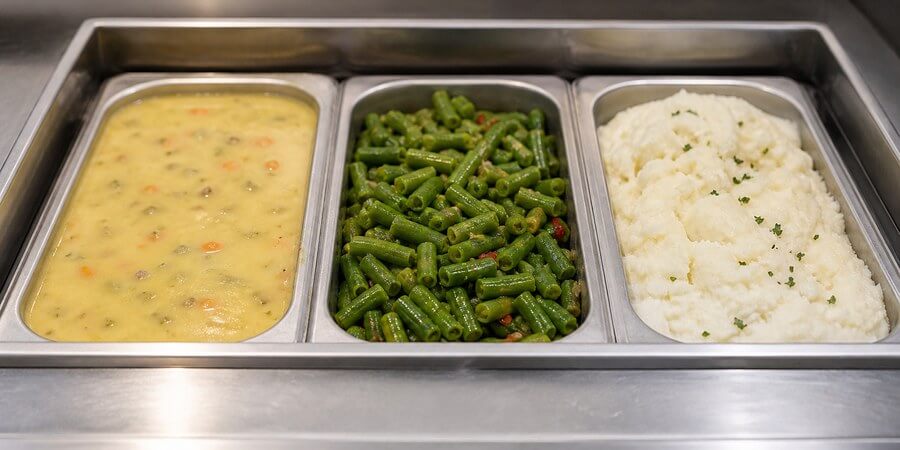
The fractional system means one steam table well - or one full-size slot in a prep rail or holding cabinet - can be configured dozens of ways. Every layout that sums to one full footprint works:
- 2 half pans - two entrees, or entree plus high-volume side
- 3 third pans - the classic soup-and-sides lineup
- 4 quarter pans - varied sides at lower volume
- 6 sixth pans - sandwich and taco bar territory
- 9 ninth pans - maximum variety for toppings and garnishes
- Two-thirds + third - one big entree, one side, no wasted space
- Half + 2 quarter pans - a workhorse buffet layout
- Third + 2 sixth pans, or third + 3 ninth pans - a third-pan slot subdivides the same way a full opening does
Mixed layouts smaller than the full opening need support: adapter bars span the well so smaller pans have a rim to hang from, and false bottoms keep food elevated above its drippings. Both live in our steam table pan accessories category alongside lids in every configuration - solid, slotted for serving spoons, hinged, and dome.
On the equipment side, commercial steam tables are sized by the well: a 2-well table holds two full-size pans or any fractional mix that adds up to two full footprints, a 5-well table holds five, and so on. Wet-heat tables also need water pans and spillage pans beneath the food pans - one detail worth remembering at order time, because the food pans and the water pans below them are separate purchases.
Choosing depth, perforation, and material
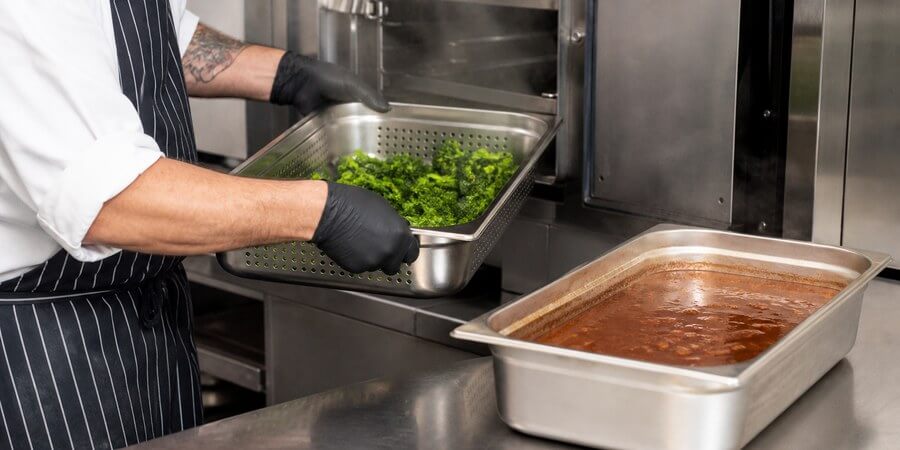
Depth follows the food and the turnover. Shallow 2 1/2" pans heat through fastest and suit high-turnover items, delicate proteins that crush under their own weight, and anything you batch-cook in small waves for freshness. The 4" pan is the all-purpose workhorse - deep enough for volume, shallow enough to serve from cleanly. Deep 6" pans belong to soups, stews, sauces, and bulk storage. For hot holding, shallower usually beats deeper: food above 135°F holds quality longer in a shallow pan because the serving line reaches the bottom before the food fades.
Solid vs. perforated. Solid pans contain liquids; that is most of the line. Perforated pans drain and breathe - they steam vegetables in combi ovens and pressure steamers, drain fried foods, and keep anything held over moisture from going soggy. If your kitchen runs steam cooking equipment, our commercial kitchen steam equipment guide covers the steamers and combi ovens these pans drop into, with capacities quoted in full-size pans.
Stainless gauge. Commercial hotel pans run from 22 gauge (the heavy-duty standard - remember that lower gauge means thicker steel) to 24 and 25 gauge economy weights. Heavier pans resist denting and warping through years of daily service; lighter pans cost less and weigh less, which caterers hauling pans to off-site events genuinely appreciate. High-volume kitchens should stay at 22 gauge for anything that sees heat.
Beyond stainless. Plastic food pans in the same fractional sizes handle cold storage and prep - clear polycarbonate for visibility, economical polypropylene for cold and dry use, and high-heat formulations for holding. For faster cleanup on the hot line, disposable food pan liners fit standard pan sizes and go in the trash instead of the dish pit.
US vs. Gastronorm: close, not identical
Europe sizes the same family of pans under the Gastronorm (GN) standard, in millimeters - GN 1/1 measures 325 x 530 mm, which works out to about 12.8" x 20.9". That is close enough to the US 12" x 20" system that GN pans generally sit in US equipment openings, and some US-market pans are actually built to GN dimensions. But close is not identical: rim widths and corner radii differ between the two standards and between manufacturers, which matters most in tight-fit situations - adapter bars, notched prep-rail cutouts, and equipment that clamps or seals against the pan rim. Published advice genuinely splits on whether the systems are interchangeable, and the honest answer is: usually in an open well, not reliably in a tight fit. When restocking, match what your equipment was designed for, and test one pan before buying forty.
Frequently Asked Questions
What are the standard hotel pan sizes?
Eight sizes cover nearly all commercial use: full (12" x 20" nominal), two-thirds, half, half-long, third, quarter, sixth, and ninth. Each is a fraction of the full-size footprint, so combinations that add up to one full pan - two halves, three thirds, nine ninths - all fit the same opening. Standard depths are 2 1/2", 4", and 6".
Why is it called a hotel pan?
The name traces to European hotels that served large groups at fixed meal times and needed durable, standardized pans to prep, hold, and serve at volume. The name stuck industry-wide, and today "hotel pan," "steam table pan," "food pan," "service pan," and "counter pan" all describe the same standardized family.
Why is a hotel pan called a 200 pan?
The number is a depth code from old manufacturer stock numbering: a 200 pan is the shallow pan (nominally 2", actually about 2 1/2" deep), a 400 pan is 4" deep, and a 600 pan is 6" deep. Knowing the code helps when reading spec sheets or fielding orders written in kitchen shorthand.
How many quarts does a full-size hotel pan hold?
Depends on depth and on how the chart you read defines "full": published figures for a full-size 4" pan range from about 8 quarts to over 11, because some charts quote brimful capacity and others quote a working fill of roughly 80%. Plan with the working number - about 8 quarts at 4" deep, 5 to 6.5 at 2 1/2", and 17 or more at 6".
How many hotel pans fit in a steam table?
One full-size pan per well, or any fractional combination adding up to it. A 3-well steam table can run three full pans, six halves, nine thirds, or any mix - two fulls plus a half-and-two-quarters well is a common buffet setup. Fractional layouts need adapter bars for the smaller pans to hang from.
Are hotel pans and steam table pans the same thing?
Yes. Hotel pan, steam table pan, food pan, service pan, and counter pan are interchangeable names for the same standardized pans. Listings sometimes use different names for different depths or materials, but the sizing system is one and the same.
Will a 9" x 13" baking dish work in a steam table?
No - and not because of capacity. Hotel pans hang from a flanged rim engineered to rest on the well's edges or on adapter bars; a household baking dish has no such rim and no standard footprint, so it cannot sit securely or seal the well. By volume, a 9" x 13" dish is closest to a half pan, which is the right substitution.
Are US and Gastronorm pans interchangeable?
In an open well, usually - GN 1/1 (325 x 530 mm) is within an inch of the US full-size footprint. In tight-fit applications like adapter bars, notched rails, and clamp-style transport equipment, rim and corner differences between the standards can cause real problems. Match the standard your equipment was built for and test before buying in bulk.
What depth of pan should I use on a buffet line?
For most hot food, 2 1/2" or 4". Shallow pans hold quality better - the line reaches the bottom sooner, so food is replaced while still fresh - and swapping a shallow pan mid-service is lighter and safer. Save 6" pans for soups, stews, and sauces, where depth is the point.
What are perforated hotel pans for?
Anything that needs drainage or steam circulation: steaming vegetables in a combi oven or steamer, draining fried food, and holding items above collected moisture so they stay crisp. A perforated pan usually nests inside or above a solid pan that catches the liquid.
Related Resources
- Chafing Dish Guide - Chafer sizes, fuel, and serving math for the full, half, and third pans they hold
- Commercial Kitchen Steam Equipment Guide - The steamers and combi ovens sized in full-size pan capacity
- Commercial Cooking Release Products Guide - Liners, sheets, and release products that speed up pan cleanup
- Refrigerated Prep Table Sizing Guide - The rails and cold bases these pans drop into, sized by pan count.
Share This!