Cutting Board Color Code Guide
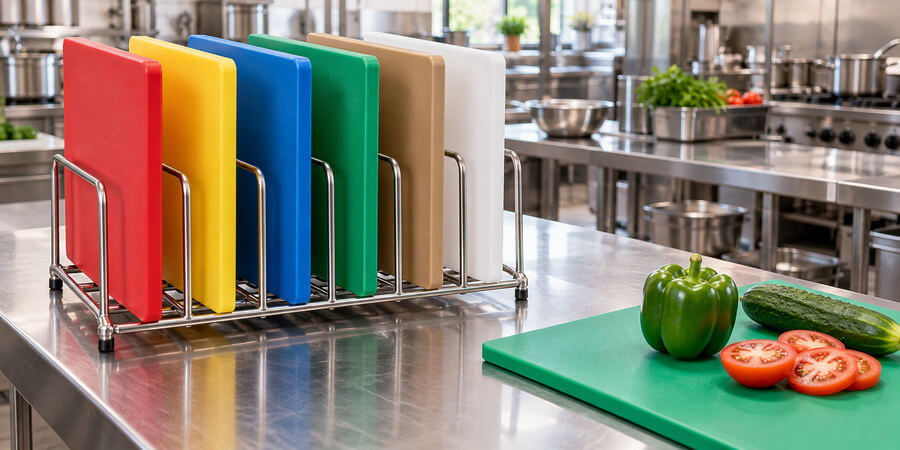
Table of Contents
How to assign a board color to every food group and pick the material, size and thickness each station needs
A color-coded board system is the cheapest food safety control a kitchen can install. It costs a set of boards and one training shift, and it turns cross-contamination from something a cook has to remember into something a cook can see.
This guide covers what the colors mean, what the Food Code actually requires, how the materials differ, which size and thickness bands to stock, how to set the system up on a real line, how to clean and sanitize it, and how the color-coded sanitizing pails fit the same logic.
What the Color-Code System Is
It is a visual shortcut for keeping foods apart. Each color is assigned one food group and the crew learns the assignment once. A cook reaching for the yellow board knows it has only ever seen raw poultry, and a manager walking the line can see whether raw chicken is being cut on the produce board. The information lives in the color rather than in anyone's memory.
It is an industry convention, not a law. This is the most misunderstood thing about color coding, so it belongs first. No US regulation prescribes a color scheme. The USDA's Food Safety and Inspection Service states that its regulations do not require or prescribe any color-coding system for the cutting boards or utensils used by an official establishment, and food safety guidance calls the scheme a voluntary standard operating procedure rather than a rule. The FDA Food Code requires separation and cleaning; how you get there is your program's business.
Assignments vary by operator and by country. The common system has been in the trade long enough to feel official, but no strict rule says which color goes on which product, and kitchens reassign colors to suit their menus. UK and US guidance overlap without matching. The version below is the most common US convention and the one this assortment is built around.
Which means the color is a label, and the label has to be true. The moment a board gets used off-assignment because it was the only clean one in reach, the control fails quietly and no inspector will catch it. Everything in the setup section exists to make the right board the easiest one to grab.
What a Color-Coded Board System Buys the Kitchen
A control that survives a bad shift. The Food Code asks that raw animal foods be kept separate from ready-to-eat food and from each other, and it accepts separate equipment for each type as one way to do it. Colors turn that requirement into a habit that holds at eight o'clock on a Friday when nobody is thinking about compliance.
An allergen answer you can show a guest. A dedicated board for allergen-controlled work is the difference between telling a guest with a nut allergy that you are careful and showing them the station that proves it.
A faster inspection. Inspectors read a kitchen's systems before its thermometers. A rack of correctly assigned boards, a red sanitizer bucket with a test strip beside it and a crew that can name the colors answers half the cross-contamination conversation before it starts.
Less rework, and training that takes minutes. When a board's history is visible, nobody throws out a pan of prepped salad because they are unsure what was cut on that surface an hour ago. And a new cook learns six colors in one shift, in any language, without reading a manual, which is why the system spread through the trade without a regulation behind it.
The Six-Color Chart
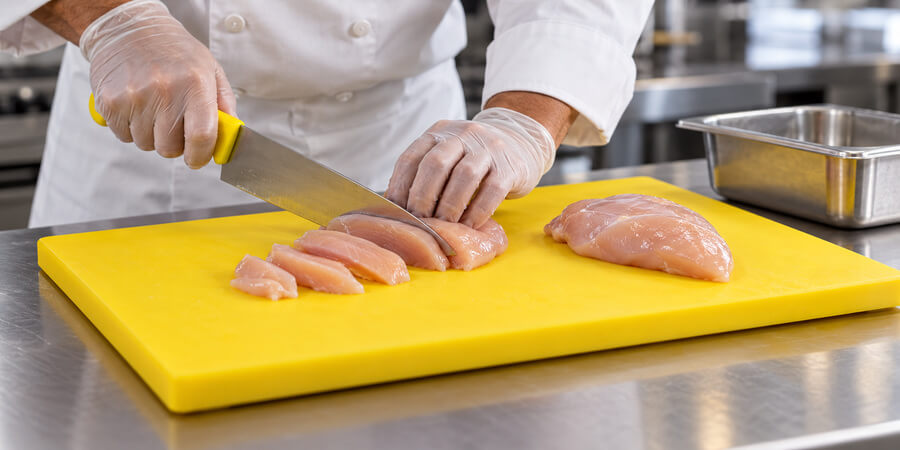
The convention below is the common US assignment, matched to the colors stocked here. Purple is a common seventh color, for allergen-controlled work.
| Color: | Food group: | Station it lives on: | Notes: |
| Red | Raw beef, pork, lamb and other raw meats | Butcher block, protein prep | The board that must never touch ready-to-eat food |
| Yellow | Raw poultry: chicken, turkey, duck | Protein prep, breading station | Kept separate from red, not just from produce |
| Blue | Raw fish, shellfish and other seafood | Fish station, raw bar, oyster work | Wet work, so a retention groove earns its keep |
| Green | Fruits, vegetables and salads | Produce prep, salad line, garde manger | The highest-volume board in most kitchens |
| Tan or brown | Cooked meats: roast beef, patties, ham | Carving station, slicer, cooked holding | The ready-to-eat board; the shop stocks both tan and brown |
| White | Dairy, cheese, bakery and pastry | Bakery bench, cheese prep, garnish | Also the default for general dry work |
| Purple | Allergen-controlled and free-from work | Dedicated allergen station | A convention rather than part of the classic six |
Read the chart as a starting point, then write yours down. A documented house scheme everyone follows beats a textbook scheme half the crew guesses at.
What the Food Code Actually Requires
The colors are optional. Everything in this table is not. These are the requirements a color system is built to satisfy, quoted by section so you can take them to an inspection.
| Requirement: | What it says: | Food Code section: |
| Separate the raw types | Raw beef, fish, lamb, pork and poultry separated from each other and from ready-to-eat food, using separate equipment for each type or arranging equipment so cross contamination is prevented | 3-302.11(A)(1) and (A)(2) |
| Clean at every changeover | Cleaned before each use with a different type of raw animal food, and each time work changes from raw foods to ready-to-eat foods | 4-602.11(A)(1) and (A)(2) |
| The four-hour rule | Surfaces used with time and temperature control for safety food cleaned at least every 4 hours | 4-602.11(C) |
| Resurface or discard | Boards subject to scratching and scoring resurfaced if they can no longer be effectively cleaned and sanitized, discarded if they cannot be resurfaced | 4-501.12 |
| Wood, conditionally | Wood may not be a food-contact surface, except hard maple or an equivalently hard, close-grained wood for cutting boards and blocks | 4-101.17(A) and (B)(1) |
| Wiping cloth buckets | Cloths held between uses in sanitizer at the 4-501.114 concentration, laundered daily, free of food debris, container off the floor; raw-food cloths kept separate | 3-304.14(B) to (E) |
| Air-dry, then store clean | Air-dried rather than cloth dried, then stored at least 6 inches off the floor, self-draining | 4-901.11, 4-903.11 |
Notice what 4-602.11(A)(1) does to a single-board kitchen. Cleaning is required before each use with a different type of raw animal food, so going from beef to chicken on one board means a full wash, rinse and sanitize mid-shift, every time. Separate boards are what make the requirement survivable on a line.
And notice what certification buys. Under 4-205.10, equipment certified to a recognized American National Standard by an accredited program is deemed to comply with the material and design parts of the chapter. Cutting boards fall inside the scope of NSF/ANSI 51, the food equipment materials standard, which sets cleanability, corrosion, impact, abrasion and heat requirements and is where wood is accepted in the food zone for boards specifically. A listing mark is the shortest route to that conversation.
Board Materials Compared
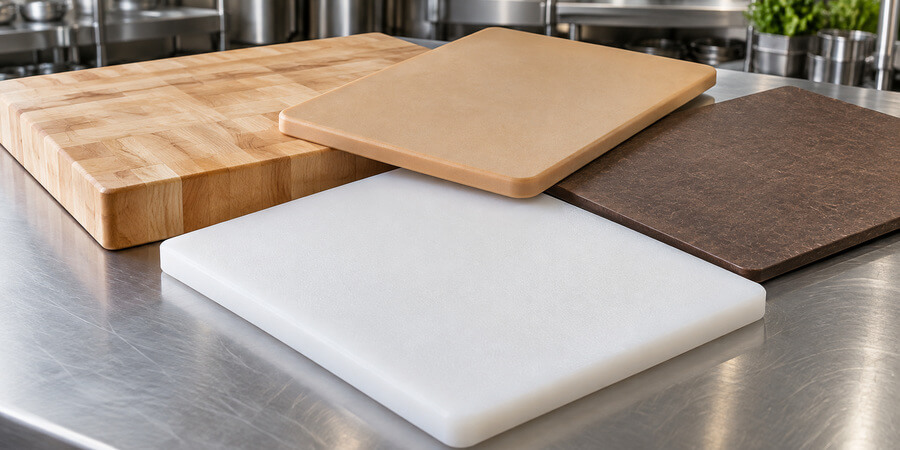
Color is available across several materials, and the material decides how the board lives rather than how it is labeled. All five below appear in the catalog.
| Material: | Knife-friendliness: | Dishwasher: | Certification: | Resurfacing: | Weight: |
| Polyethylene and HDPE | Forgiving; the trade standard | Yes, rated for machines to 200°F | Listed to NSF/ANSI 51 | Replaced when scoring is deep, not sanded | Light |
| Polypropylene, co-polymer and thermoplastic | Similar to HDPE, slightly harder | Yes | Listed by the maker | Replaced, not resurfaced | Light to medium |
| Synthetic rubber | Highest; a resilient compound that spares knife edges | No, hand wash only | Tested and certified by NSF International | Sanded flat as needed, which is the point | Heaviest for its size |
| Hard maple and close-grained hardwood | Very good | Never, and never soaked either | Hard rock maple certified for food service | Fine grit sanding with the grain, plus oil and cream | Heavy |
| Paper and wood-fiber composite | Good; scores slightly and spares the edge | Yes | NSF certified | Not resurfaced, and no oiling needed | Light |
Plastic is the right default for a color system, and that is not a compromise. Polyethylene and its cousins take a commercial dish machine, come in every color in the chart, and cost little enough that assigning six of them to six food groups is reasonable. They score, and scoring is what retires them under 4-501.12.
Rubber is the upgrade for a station that cuts all day. The compound is resilient rather than hard, so it spares an edge longer and can be sanded back to flat instead of thrown away. The trade-off is weight and hand washing only, making it a butcher or fish board rather than one riding a dish rack six times a shift.
Wood is legal, specific and demanding. The Food Code permits hard maple or an equivalently hard, close-grained wood for boards and blocks, and nothing softer. It never sees a dishwasher and never sits under standing liquid, because brine, water and blood swell the surface, soften the wood and weaken the glued joints. In exchange it is the best carving surface and the only one that belongs in front of a guest. Maintenance is real: regular conditioning oil, board cream to seal, and fine grit sanding with the grain. Oils, creams, sealers and applicators are stocked alongside the racks.
Composite splits the difference. Paper and wood fiber hardened with resin gives a dense, nonporous surface that scores slightly, needs no conditioning and still goes in the machine: wood on a carving station, plastic in the dish pit.
Sizes and Thicknesses Worth Stocking
Board size is set by the station rather than the food group, so a colored set is usually one size repeated. The bands below are the ones the catalog publishes.
| Dimension: | Band: | What the band suits: |
| Width | 8 to 24 inches | Bar and garnish work at the low end; above that the everyday prep board and the usual color-coded set size |
| Width | 25 to 40 inches | Butcher and carving work, high-volume produce |
| Width | 44 to 93 inches | Table-length boards, prep counters and griddle rails |
| Depth | 6 to 15 inches | Bar rails at the low end, standard prep depth above |
| Depth | 16 to 35 inches | Butcher and carving work at the low end, block and prep-table depth above |
| Thickness | 1/2 inch | The standard across plastic and rubber |
| Thickness | 3/4 to 1 inch | Heavier plastic and rubber for chopping; more sandings before retirement |
| Thickness | 1-1/2 inches and up | Hard maple boards, chopping blocks and butcher blocks |
The middle width band is where a color set belongs. It fits a standard prep counter, clears a dish machine rack, and carries every color in the chart. Take the set in one size so boards are interchangeable between stations and the rack holds them evenly.
Thickness is a resurfacing budget on rubber and wood, and nothing more on plastic. A thicker rubber board takes more sandings before retirement and a thick maple block absorbs years of scraping, while on plastic extra thickness buys rigidity rather than a longer life. Check the largest board against the warewashing sink too: 4-301.12(B) requires compartments large enough to immerse the largest equipment, and a board that will not go in the sink is a board that gets wiped instead of washed.
Built-in boards are a different purchase. The removable board across the front of a refrigerated prep table is sized to the model rather than the station, and it lives in the refrigeration cutting boards range in half-inch and three-quarter-inch grades, almost always white.
Setting Up the System on a Real Line
A color system fails on logistics, not on theory. Five things make it stick.
Map colors to stations, not to a poster. Walk the line and write down which food groups get cut where; if produce is prepped at two stations you need two green boards. A board that lives at its station gets used correctly, while a board in a communal stack gets used by whoever is closest. Buy a spare of the busy colors too, because the four-hour cleaning rule guarantees a mid-shift trip to warewashing.
Store them vertically, on a rack, at the station. The Food Code wants clean equipment in a clean dry location, at least 6 inches off the floor, self-draining so it air-dries. A slotted rack does all three and makes a wrong-colored board in the wrong slot visible from across the kitchen. Racks in six-slot and ten-slot configurations, plus non-slip mats and board brushes, sit in the cutting board racks and accessories range.
Label the slot, not just the board. The color labels the board; the rack slot and the station need labels too, so a clean board comes back to the same place every time. Labels from the day of the week stickers and product labels range mark a shelf or a rack as easily as a pan.
Extend the color logic to the tools. Board brushes, tongs and bus tubs come in the chart's colors, and some kitchens run color-coded knife handles on the same scheme so blade and board match at each station; buy those as a station kit rather than piecemeal from the kitchen knives range.
Train on the exceptions. Everyone learns raw chicken goes on yellow. What needs teaching is the changeover: what to do when the yellow board is in the dish pit, what to do with an unlabeled board on the counter, and why the tan board never sees raw product. Gloves, probe wipes and the rest of the program live in the food safety items range.
Replace on condition, not on a calendar. There is no fixed service life for a board, because wear depends on the station and the knife work. The Food Code's test is functional: a scored board gets resurfaced if it can no longer be effectively cleaned and sanitized, and discarded if it cannot be resurfaced. Retire a plastic board when knife grooves hold soil after a proper wash; sand rubber or maple back to flat before it gets there.
Cleaning, Sanitizing and Resurfacing
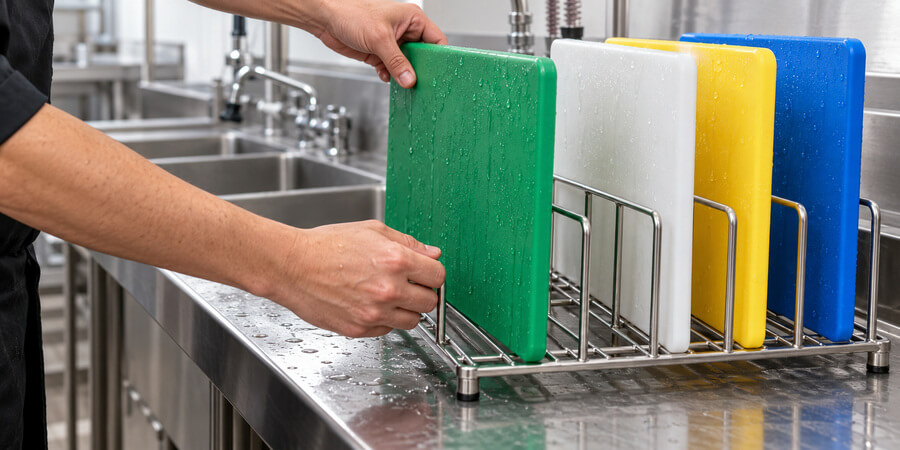
This is the half of the system that does the actual work. The colors keep foods apart between cleanings; cleaning and sanitizing is what resets the board.
Wash, rinse, sanitize, air-dry, in that order. A three-compartment sink exists because those are separate steps, and 4-301.12(A) requires at least three compartments for manually washing, rinsing and sanitizing. Manual wash water is held at 110°F or the temperature on the cleaning agent's label; the board then gets hot water immersion or a chemical solution, and air-dries after, never cloth dried. Plastic and composite can take a commercial machine instead, which is the practical reason most color systems are built in plastic, while rubber and maple make the three-compartment routine the default. Sink layouts sit in the commercial sinks range.
The sanitizer table is not negotiable, and it is short. Concentration, temperature and contact time work together, and getting one wrong voids the other two.
| Method | Concentration | Minimum solution temperature | Minimum contact time | Food Code section |
| Hot water immersion, manual | Not applicable | 171°F | 30 seconds | 4-501.111, 4-703.11(A) |
| Chlorine, pH 10 or less | 25 to 49 mg/L | 120°F | 10 seconds | 4-501.114(A), 4-703.11(C)(1) |
| Chlorine, pH 10 or less | 50 to 99 mg/L | 100°F | 7 seconds at 50 mg/L | 4-501.114(A), 4-703.11(C)(2) |
| Chlorine, pH 8 or less | 50 to 99 mg/L | 75°F | 7 seconds at 50 mg/L | 4-501.114(A), 4-703.11(C)(2) |
| Chlorine, any pH to 10 | 100 mg/L | 55°F | 10 seconds | 4-501.114(A), 4-703.11(C)(1) |
| Iodine, pH 5.0 or less | 12.5 to 25 mg/L | 68°F | 30 seconds | 4-501.114(B), 4-703.11(C)(3) |
| Quaternary ammonium | Per the EPA-registered label, in water of 500 mg/L hardness or less | 75°F | 30 seconds | 4-501.114(C), 4-703.11(C)(3) |
Measure the solution; do not eyeball it. Section 4-501.116 requires the concentration to be accurately determined with a test kit or other device, so the strip is a citation rather than good practice, and strength drifts as food soil loads the solution. Concentrates and manual sanitizers come from the manual dish washing detergents and sanitizing chemicals range, and machine chemistry from the warewashing chemicals range.
Resurfacing is a repair, not a rescue. Rubber is sanded flat; maple takes fine grit sandpaper worked with the grain, then oil, then cream left overnight. Neither restores a board past cleanability, and 4-501.12 is clear that a board which cannot be resurfaced gets discarded. Do it on a slow morning, never mid-shift.
Color-Coded Sanitizing Pails and Wiping-Cloth Buckets
Same system, same reasoning, one aisle over. If the boards are color-coded and the buckets are not, the crew is carrying contamination around in a pail.
The bucket is regulated even though the board's color is not. Cloths for wiping equipment surfaces are held between uses in a chemical sanitizer at the concentrations in the table above, laundered daily, and kept free of food debris and visible soil, with the container off the floor. And cloths used on surfaces that touch raw animal foods are kept separate from all others, which is the point at which one bucket stops being enough.
Red is sanitizer and green is detergent, as the trade stocks it. The pail convention is narrower than the board convention: red for sanitizer and disinfectant, green for detergent and soap, with blue appearing occasionally as a third solution. Printed labels and molded graduation marks are common, so a pail tells you what is in it and how much, which is the same job the board's color does. Capacities run from three quarts for spot cleaning to eight quarts for a station bucket, in the sanitizing pails range.
Change the solution when it stops being solution. There is no fixed interval in hours. What matters is that the concentration tests correct on a strip and the solution stays free of food debris and visible soil. A bucket that has cleaned a protein station all afternoon fails the second test first.
Stage a bucket per zone, not one for the kitchen. A single shared bucket at the dish pit means cooks wipe with whatever is nearest, defeating the separation requirement. One at the raw station and one at the ready-to-eat station, both labeled and off the floor, is what the Code describes. Caddies, cloths and floor stands come from the janitorial supplies range.
Frequently Asked Questions
What color cutting board is for raw chicken?
Yellow, under the common US convention. Poultry gets its own color rather than sharing red with beef and pork, because the Food Code requires raw animal foods separated from each other by type, not just from produce.
Is the cutting board color code required by law?
No. The USDA's Food Safety and Inspection Service states that its regulations do not require or prescribe any color-coding system for cutting boards or utensils. What is required is separation, cleaning between changeovers and sanitizing after cleaning. Colors are a voluntary way of meeting those requirements, and the most common one.
What is the safest cutting board material?
There is no single answer, and the honest test is the Food Code's own: a food-contact material must be safe, durable, nonabsorbent, smooth, easily cleanable and resistant to pitting, chipping, scratching and scoring. Plastic, synthetic rubber, hard close-grained maple and paper composite all clear that bar. Which is safest in your kitchen depends on whether the board gets machine washed, how deeply it scores, and whether anyone maintains it.
Are titanium cutting boards good?
We do not stock titanium boards, so this guide does not rate them. Put any unfamiliar material to the same questions: is it listed to a recognized food equipment materials standard, does it stay smooth and nonabsorbent in use, can it be cleaned and sanitized once scored, and can it be resurfaced or must it be discarded.
How often should I replace a cutting board?
On condition, not on a schedule. There is no fixed service life for a board. The Food Code's test is whether a scratched and scored board can still be effectively cleaned and sanitized: resurface it if it can be resurfaced, discard it if it cannot. Retire a plastic board when the knife grooves hold soil after a proper wash.
Do I need a separate board for cooked food?
Yes, and it is the board people forget. Surfaces have to be cleaned each time work changes from raw foods to ready-to-eat foods, and cooked meat is ready-to-eat. A dedicated tan or brown board for the carving station and slicer removes that changeover from the shift.
What color should the sanitizer bucket be?
Red is the trade convention for sanitizer and disinfectant, green for detergent and soap. Unlike the board colors, what goes in the bucket is regulated: cloths are held between uses in sanitizer at the Code's concentrations, the solution stays free of food debris and visible soil, the container sits off the floor, and cloths used on raw animal food surfaces are kept separate.
What is the purple cutting board for?
Allergen-controlled and free-from preparation. It sits outside the classic six and is a convention rather than a standard, but it has become the common way to mark a dedicated station for gluten-free, nut-free and similar work, where the point is that nothing else has touched the surface.
Shop Cutting Boards and Color-Coded Sets
Four decisions get you to the right order. Write down which food groups are cut at which station, which fixes how many boards and in which colors. Pick the material by how the board gets washed and whether anyone will maintain it. Take one size for the whole set so boards move between stations. Then add the storage and the buckets, because a system without a rack and a labeled pail is just a set of boards. Compare colors, materials and sizes across the cutting boards range, and browse the wider cutting boards and accessories selection for racks, mats, brushes and refinishing supplies.
Related Guides & Resources
- Food Safety Guide - Procedures, compliance and equipment standards, for the program the board colors sit inside.
- Cleaning, Sanitizing, Disinfecting: What's the Difference - The three words operators use interchangeably and should not.
- Commercial Dishwasher Guide - High-temperature against low-temperature machines, for deciding how boards get washed.
- Refrigerated Prep Table Sizing Guide - Widths, pans and doors, including built-in board depths.
Share This!