Food Safety Guide
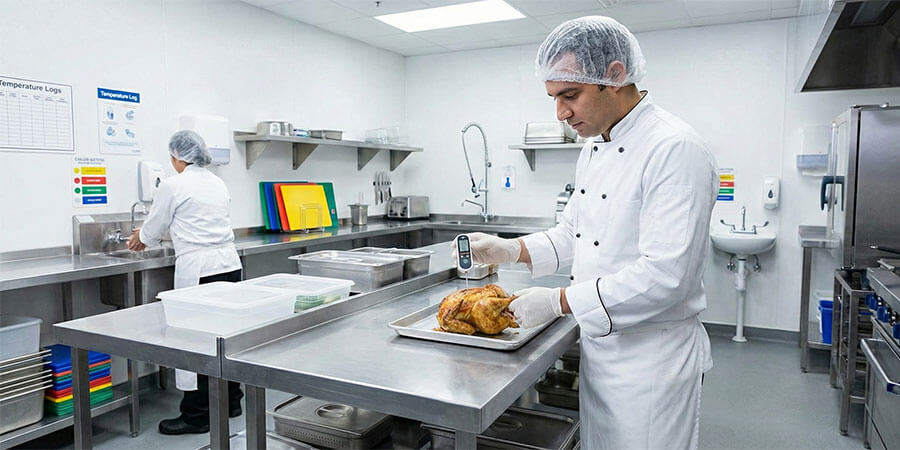
Table of Contents
Implement essential food safety protocols and compliance standards for professional foodservice operations
Food safety is the foundation of every successful foodservice operation, protecting both customers from foodborne illness and businesses from costly legal and regulatory failures. Implementing a comprehensive food safety program requires a systematic approach to every phase of the food lifecycle - from the moment raw ingredients arrive at the loading dock to the final presentation on the guest's plate. This guide provides a step-by-step framework for managing receiving, storage, preparation, cooking, and sanitation, ensuring your facility meets ServSafe and HACCP standards while maintaining peak operational efficiency.
Maintaining a rigorous food safety program is more than just a regulatory requirement; it is a critical component of brand protection and operational excellence. In a professional kitchen, the margin for error is slim, as bacteria can multiply rapidly within the "Danger Zone" of 40°F to 140°F. A single lapse in temperature control or a cross-contamination event can lead to widespread illness, devastating a restaurant's reputation and bottom line. By standardizing procedures and utilizing the right equipment, operators can create a culture of safety that becomes second nature to every team member.
The success of a food safety initiative depends on the integration of three core elements: trained personnel, standardized processes, and reliable equipment. Whether you are managing a small independent cafe or a high-volume institutional cafeteria, the principles of Hazard Analysis Critical Control Points (HACCP) remain the same. This guide breaks down the complex landscape of food safety into actionable phases, providing the checklists and technical specifications needed to maintain a compliant and safe environment.
Food Safety Process Phases
Phase 1: Receiving & Storage
The food safety lifecycle begins at the loading dock, where every delivery must be inspected for temperature integrity and packaging quality. Staff should use calibrated food thermometers to verify that refrigerated items arrive at 41°F or below and frozen items are solid with no signs of thawing or refreezing. Any products arriving in damaged containers or at unsafe temperatures must be rejected immediately to prevent bringing hazards into the facility. Documenting these checks in a receiving log provides the first line of defense in your HACCP plan and ensures vendor accountability.
Once accepted, items must be moved quickly to appropriate storage environments to maintain the cold chain. Utilize the First-In, First-Out (FIFO) rotation method by labeling all items with delivery dates and "use-by" dates, ensuring older stock is used before newer arrivals. Proper organization within walk-in coolers and reach-in refrigerators is essential; always store raw proteins on the bottom shelves below ready-to-eat foods to prevent drip-induced cross-contamination. Maintaining a minimum of six inches of clearance from the floor and walls allows for proper airflow and simplifies cleaning and pest control efforts.
Phase 2: Food Preparation
Food preparation is the stage where the risk of cross-contamination is highest, requiring strict adherence to hygiene and tool management protocols. Every prep session must begin at dedicated hand washing stations, where staff follow the 20-second scrubbing rule before handling any ingredients. To further mitigate risk, operations should implement color-coded systems for cutting boards and utensils - typically red for raw meat, yellow for poultry, and green for produce. This visual management system makes it easy for supervisors to verify that safe practices are being followed even during the busiest shifts.
The physical environment of the prep area also plays a significant role in maintaining safety standards. Stainless steel prep tables provide a non-porous, easy-to-sanitize surface that resists bacterial growth compared to wood or plastic alternatives. During preparation, staff must be mindful of "time-temperature abuse," ensuring that potentially hazardous foods do not remain in the Danger Zone for more than two cumulative hours. By preparing food in small batches and returning items to refrigeration promptly, kitchens can maintain ingredient integrity and significantly reduce the risk of pathogen proliferation.
Phase 3: Cooking & Hot Holding
Cooking is the primary "Critical Control Point" where heat is used to eliminate harmful pathogens to safe levels. Different proteins require specific internal temperatures to ensure safety: poultry must reach 165°F, ground meats 155°F, and whole cuts of beef or pork 145°F. Chefs must use digital thermocouple thermometers to verify these temperatures at the thickest part of the food, as visual cues like color or texture are unreliable indicators of safety. Maintaining accurate logs of these final cook temperatures is a fundamental requirement for health department inspections and internal quality control.
Once cooked, food intended for service must be moved to food holding and warming equipment that maintains a minimum internal temperature of 135°F. Whether using steam tables, heated cabinets, or countertop warmers, the equipment must be preheated before food is added to avoid initial temperature drops. Staff should stir liquid foods frequently to ensure even heat distribution and take temperature readings every two hours to verify compliance. If food falls below 135°F for more than four hours, it must be discarded, as reheating at that stage cannot guarantee the elimination of heat-resistant toxins produced by certain bacteria.
Phase 4: Cooling & Reheating
The cooling process is often the most overlooked phase of food safety, yet it is where many foodborne illness outbreaks originate. To safely move food through the Danger Zone, kitchens must follow the two-stage cooling method: reducing temperature from 135°F to 70°F within two hours, and then from 70°F to 41°F within an additional four hours. Large batches of soups or stews should be divided into shallow pans or chilled using ice paddles to increase surface area and speed heat loss. For high-volume operations, blast chillers are the gold standard, using high-velocity cold air to pull heat from food rapidly and safely. Our commercial blast chiller guide covers how to size a cabinet to the batch and document the cooling curve for inspection.
When reheating previously cooled foods for service, the internal temperature must reach 165°F within two hours to ensure any pathogens that may have multiplied during storage are destroyed. This reheating must be done using active cooking equipment like ovens, ranges, or steamers - never in holding equipment like steam tables, which are designed only to maintain heat, not generate it. Once the 165°F threshold is reached, the food can be transferred back to hot holding units for service. It is important to note that food should only be reheated once; subsequent cooling and reheating cycles significantly degrade food quality and increase safety risks.
Phase 5: Cold Holding & Display
Maintaining cold food safety requires constant vigilance, especially when items are placed in customer-facing display areas. All cold-held foods must be kept at an internal temperature of 41°F or below to inhibit bacterial growth. Refrigerated display cases and merchandisers must be equipped with visible thermometers so staff can monitor ambient temperatures throughout the day. Overloading these units can block essential airflow, leading to "warm spots" where food temperatures can quickly rise into the Danger Zone, even if the unit's thermostat appears correct.
For buffet lines or salad bars, ice beds must be deep enough to surround the food containers up to the product line to ensure consistent cooling. Staff should use dedicated probes to check the actual product temperature, rather than relying on the equipment's built-in display. Any cold food that exceeds 41°F for more than four hours must be discarded. Proper labeling is also critical in display settings, clearly marking "use-by" times for items held using time as a public health control rather than temperature. Consistent logging of these checks demonstrates a proactive approach to safety that health inspectors highly value.
Phase 6: Cleaning & Sanitation
The final phase of the food safety process involves the rigorous cleaning and sanitization of all food-contact surfaces and equipment. Cleaning removes visible soil and food particles, while sanitization reduces microorganisms to safe levels. High-volume kitchens rely on commercial dishwashers to achieve consistent results, using either high-temperature cycles (180°F final rinse) or chemical sanitizing agents. It is essential to verify that these machines are operating within spec by using temperature test strips or chemical titration kits daily, as a malfunctioning dishwasher can quickly spread contamination across the entire inventory of plates and utensils.
Beyond warewashing, the physical facility requires a structured sanitation schedule that covers floors, walls, and non-contact equipment surfaces. Hand hygiene remains the most critical factor in preventing the spread of norovirus and other pathogens; hand sinks must be stocked with soap, single-use towels, and hot water at all times. Staff should be trained to recognize the difference between "clean" and "sanitized" and understand the required contact time for various sanitizing chemicals. By integrating these practices into the daily closing and opening routines, managers can ensure the facility remains a sterile environment for food production.
Features & Supplies
Implementing a robust food safety program requires more than just equipment; it requires a specific set of supplies designed to monitor, label, and protect.
Essential Monitoring Tools
- Digital Thermocouples: Provide near-instant, highly accurate temperature readings for thin and thick foods.
- Infrared Thermometers: Ideal for quick surface temperature checks of deliveries and holding units without contact.
- Data Loggers: Automatically record ambient temperatures in walk-ins and freezers, providing 24/7 monitoring and alerts.
- Refrigerator/Freezer Thermometers: Secondary analog thermometers placed in the warmest part of every cooling unit for redundant verification.
Organization & Labeling
- Color-Coded Utensils: Knives, tongs, and brushes that match cutting board colors to prevent cross-contamination.
- Day-of-the-Week Labels: Dissolvable or removable labels that clearly indicate when food was prepared and when it must be discarded.
- HACCP Logs: Standardized forms for recording receiving temps, cooling curves, and sanitization concentrations.
- Allergen Kits: Dedicated purple tools and containers used exclusively for preparing allergen-free meals.
PPE & Sanitation Supplies
- Disposable Gloves: Nitrile or vinyl gloves for handling ready-to-eat foods; must be changed between tasks and after contamination.
- Sanitizer Test Strips: Essential for verifying that quaternary ammonium or chlorine solutions are at the correct parts-per-million (PPM).
- Chemical Dispensers: Automated systems that ensure the correct dilution of cleaning and sanitizing agents, preventing waste and ensuring efficacy.
- Hand Hygiene Stations: Touchless soap and towel dispensers to reduce contact points in high-traffic prep areas.
Selecting the Right Food Safety Program
Assess & Prioritize
Before implementing new protocols, conduct a thorough audit of your current operation to identify the highest risk areas. A small sandwich shop has different priorities (cold holding, cross-contamination) than a large steakhouse (cooking temps, cooling large batches). Use the HACCP principles to identify your Critical Control Points - the steps where a hazard can be prevented, eliminated, or reduced to safe levels. Prioritize investments in equipment that automates these checks, such as digital temperature monitoring systems, which reduce the risk of human error in logging.
Compliance & Certifications
Ensure your program aligns with both local health department regulations and national standards. Most jurisdictions require at least one "Certified Food Protection Manager" (such as ServSafe Manager) to be on-site during all hours of operation. Additionally, all front-of-house and back-of-house staff should complete basic food handler training to ensure a baseline understanding of hygiene and temperature control. For high-risk operations or those involving specialized processes like sous-vide or curing, a formal, written HACCP plan may be legally required and must be kept on-site for inspection.
Operation Type Requirements
- Quick Service (QSR): Focus on rapid-read thermometers and automated holding timers to maintain safety during high-speed service.
- Full Service (FSR): Emphasize cooling procedures for house-made sauces and stocks, along with rigorous cross-contamination training for complex prep.
- Institutional/Catering: Prioritize high-capacity transport equipment and blast chillers to manage large volumes and off-site service risks.
- Bars & Taverns: Focus on glassware sanitation and ice machine hygiene to prevent the spread of bacteria in beverage service.
Implementation & Maintenance
Food Safety Implementation Checklist
- Pre-Opening: Calibrate all thermometers using the ice-point method (32°F).
- Pre-Opening: Verify all refrigeration units are holding at 38°F or below.
- Daily Operations: Conduct and log receiving temperature checks for all deliveries.
- Daily Operations: Monitor and record hot holding temperatures every two hours.
- Daily Operations: Verify sanitizer concentrations in all buckets and dishwashers.
- Post-Service: Execute deep-cleaning schedule for all prep surfaces and equipment.
- Post-Service: Monitor cooling curves for any leftover bulk items.
- Weekly: Inspect door gaskets on all refrigeration for leaks or damage.
- Monthly: Conduct a "mock inspection" to identify and fix potential health code violations.
- Ongoing: Review temperature logs for patterns that might indicate equipment failure.
Maintenance & Calibration Schedule
| Equipment: | Task: | Frequency: |
| Thermometers | Ice-point calibration check | Daily / After dropping |
| Dishwashers | Temperature and chemical titration check | Every shift |
| Refrigeration | Clean condenser coils and check gaskets | Monthly |
| Ice Machines | Deep clean and sanitize internal components | Quarterly |
| Hand Sinks | Verify hot water reaches 100°F minimum | Weekly |
| Holding Units | Calibrate thermostats and check heating elements | Quarterly |
Troubleshooting Food Safety Issues
- Refrigeration Temp Rising: Check for blocked airflow, dirty coils, or damaged gaskets; move food to backup storage if temp exceeds 41°F.
- Dishwasher Not Reaching 180°F: Inspect booster heater for scale buildup or element failure; switch to chemical sanitizing if heat cannot be maintained.
- Sanitizer Concentration Too Low: Check dispenser for clogs or empty chemical containers; manually mix to correct PPM until dispenser is repaired.
- Food Cooling Too Slowly: Divide into smaller portions, use ice paddles, or move to a blast chiller; discard if two-stage cooling milestones are missed.
- Thermometer Inaccuracy: Recalibrate using ice-water; if it cannot be adjusted to 32°F, replace the unit immediately.
Frequently Asked Questions
What is FATTOM and why is it important for food safety?
FATTOM stands for Food, Acidity, Time, Temperature, Oxygen, and Moisture - the six conditions that pathogens need to grow. By controlling these factors (such as keeping food at safe temperatures or reducing moisture), operators can prevent bacterial multiplication. Understanding FATTOM helps staff recognize why certain foods, like cooked rice or cut melons, are potentially hazardous.
What is the "Danger Zone" for food temperatures?
The Danger Zone is the temperature range between 40°F and 140°F where bacteria multiply most rapidly. Food should spend as little time as possible in this range. Most health codes require cold foods to be held at 41°F or below and hot foods at 135°F or above to stay safely outside this zone.
How often should I calibrate my food thermometers?
Thermometers should be calibrated daily, or anytime they are dropped or subjected to extreme temperature changes. The most common method is the ice-point method, ensuring the probe reads 32°F in a glass of crushed ice and water. Regular calibration ensures that your safety logs are accurate and reliable.
What are the required internal cooking temperatures for different proteins?
Poultry (chicken, turkey) must reach 165°F; ground meats (beef, pork) must reach 155°F; and whole cuts of beef, pork, and fish must reach 145°F. All of these temperatures must be held for at least 15 seconds to ensure safety. Always measure the temperature at the thickest part of the product.
What is a HACCP plan and do I need one?
HACCP (Hazard Analysis Critical Control Points) is a systematic approach to identifying and controlling food safety hazards. While all restaurants should follow HACCP principles, a formal written plan is often required by law for specialized processes like vacuum packaging, curing, or sprouting. Check with your local health department for specific requirements.
How do I safely cool large batches of hot food?
Use the two-stage cooling method: reduce the temperature from 135°F to 70°F within two hours, then down to 41°F within the next four hours. To speed this up, use ice paddles, shallow pans, or blast chillers. Never put large pots of hot food directly into a walk-in, as it can raise the ambient temperature and endanger other food.
What is the correct concentration for sanitizer solutions?
For chlorine-based sanitizers, the concentration should typically be between 50-100 PPM. For quaternary ammonium (Quat), it is usually between 150-400 PPM, depending on the manufacturer's instructions. Always use the appropriate test strips to verify the concentration, as too little is ineffective and too much can be toxic.
How long should staff wash their hands?
The entire handwashing process should take at least 20 seconds, with at least 10-15 seconds of vigorous scrubbing with soap. This must include the backs of the hands, between fingers, and under fingernails. Handwashing is the single most effective way to prevent the transfer of pathogens from staff to food.
Why is temperature logging so important for inspections?
Temperature logs provide "due diligence" evidence that you are actively monitoring and controlling food safety risks. During an inspection, these logs demonstrate a consistent history of compliance, which can help mitigate the impact of a single observed violation. They also help managers identify failing equipment before it causes a safety event.
How should I prepare for a health department inspection?
Conduct regular self-inspections using the same criteria as the health department. Ensure all staff are wearing proper hair restraints, hand sinks are stocked, and all food is properly labeled and stored. Keeping your facility clean and your documentation organized shows the inspector that you take food safety seriously.
Shop Food Safety Equipment
- Food Thermometers - Digital probes, infrared sensors, and HACCP-compliant monitoring tools
- Blast Chillers & Shock Freezers - Professional equipment for rapid, safe cooling of hot foods
- Food Holding & Warming Equipment - Steam tables, heated cabinets, and countertop warmers for safe hot holding
- Commercial Dishwashers - High-temp and low-temp machines for consistent warewashing sanitation
Related Guides
- Commercial Dishwasher Guide - Comprehensive look at selecting and maintaining warewashing equipment
- Commercial Refrigeration Guide - How to choose the right cooling solutions for food safety
- Commercial Blast Chiller Guide - How rapid cooling equipment meets the two-stage cooling rule and documents it
Share This!