Commercial Dishwasher Guide
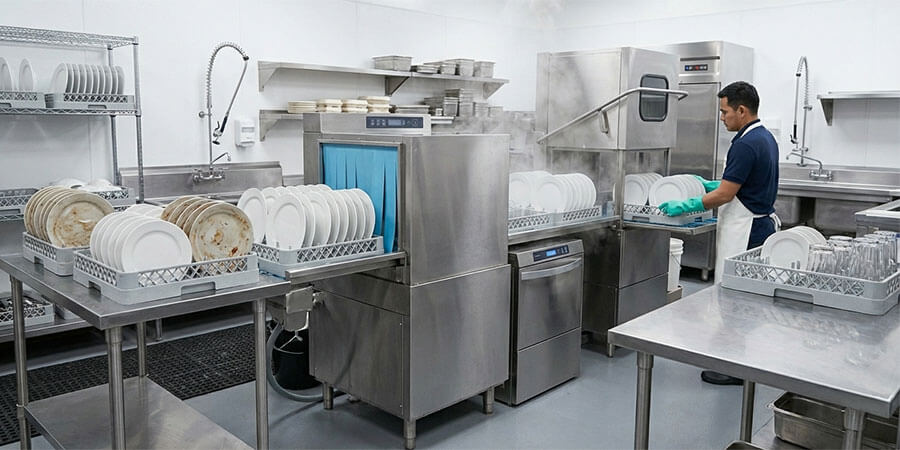
Table of Contents
Choose the right dishwasher type, capacity, and features for your foodservice operation
Commercial dishwashers are essential to any professional kitchen, processing hundreds to thousands of dishes daily while meeting strict health code sanitization standards. Whether you run a small cafe, full-service restaurant, or high-volume institution, choosing the right dishwasher type and capacity directly impacts your labor costs, kitchen efficiency, and compliance. This guide covers the three primary dishwasher categories - undercounter, door-type, and conveyor - helping you match equipment to your volume, budget, and space constraints.
Unlike residential units, commercial dishwashers sanitize dishes, glassware, and cookware at temperatures and speeds impossible for home equipment. Every commercial dishwasher must reach minimum sanitization standards set by the NSF and local health departments, using either high-temperature final rinse (180°F) or chemical sanitizers combined with heat (120-140°F rinse).
The right dishwasher choice affects four critical operational areas:
- Throughput - Can you keep up with peak demand?
- Labor efficiency - Fast cycles reduce hand-washing and labor hours
- Utility costs - Energy and water usage vary significantly by type
- Compliance - Health inspectors verify proper sanitization temperatures
Dishwasher types range from compact undercounter units processing 21-40 racks per hour to massive conveyor systems handling 350+ racks hourly. Understanding capacity requirements, sanitization options, and installation demands prevents costly mistakes and ensures smooth kitchen operations.
Types of Commercial Dishwashers
Undercounter Dishwashers
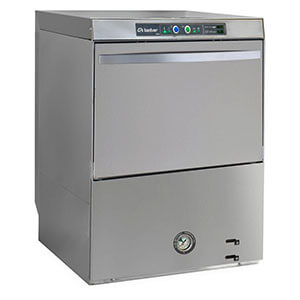
Compact units fitting beneath standard 36-inch counters, ideal for limited space or lower volume operations. These machines slide into existing cabinetry or under prep tables, making them popular for coffee shops, wine bars, and small cafes where every square foot matters. Most undercounter models include built-in booster heaters and drain pumps, providing an all-in-one solution that simplifies installation.
Undercounter dishwashers run shorter cycles (90 seconds to 2 minutes) and process 21-40 racks per hour, sufficient for operations serving 50-150 covers daily. The front-loading design means staff can load and unload without bending, reducing fatigue during busy shifts. While these machines handle standard dishes and glassware efficiently, they lack the capacity for sheet pans or large cookware.
Best For: Small cafes, coffee shops, bars, bistros
Capacity: 21-40 racks per hour
Key Features:
- 24"W × 24"D × 34"H footprint
- Front-loading operation
- 90-second to 2-minute cycles
- Built-in chemical dispensers
Pros:
- Space-efficient
- Lower cost ($3,800-$9,400)
- Simple installation
- 115V or 208V options
Cons:
- Limited peak throughput
- Not for pot/pan washing
- Frequent loading required
Door-Type Dishwashers (Single & Double Rack)
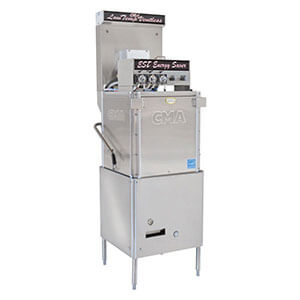
Vertical lift door models with stationary racks, available in single and double-rack capacities. Door-type machines represent the workhorse category for full-service restaurants, processing 25-82 racks per hour depending on configuration. The vertical door design creates a natural workflow where staff load dirty dishes on one side, lower the door to start the cycle, then unload clean dishes from the opposite side.
These machines come in corner configurations for L-shaped dish pits, straight-through models for linear workflows, and front-loading designs for tight spaces. Double-rack models process two racks simultaneously, nearly doubling throughput without increasing footprint. Many operations pair door-type dishwashers with dishtables on both sides to create efficient staging areas for dirty and clean ware.
Best For: Full-service restaurants, hotels, catering, cafeterias
Capacity: 25-82 racks per hour (single: 25-60, double: 60-82)
Configurations:
- Corner - 90-degree dirty-to-clean flow
- Straight-through - Linear workflow
- Front-loading - Same-side loading/unloading
Key Features:
- Stationary rack design
- High-temp and low-temp versions
- Ventless models available
- Pot/pan capable models
Pros:
- Handles moderate to high volume
- Durable heavy-duty construction
- Flexible installation options
- Proven reliability
Cons:
- Larger footprint (26-30"W × 28-32"D)
- Higher electrical needs (208-240V, 30-60A)
- May need ventilation hood
- Higher cost ($5,300-$24,500)
Conveyor Dishwashers
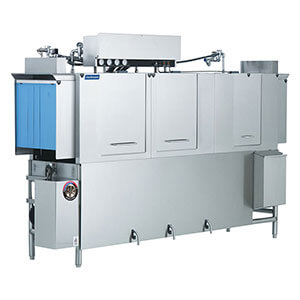
Continuous conveyor systems for ultra-high-volume operations with automatic rack advancement through multiple zones. Conveyor dishwashers eliminate the start-stop cycle of door-type machines, allowing staff to continuously load racks that travel through pre-wash, wash, rinse, and sanitize zones before emerging clean on the other end. This continuous operation makes them essential for institutions serving thousands of meals daily.
These systems require dedicated dish room space (10-20 linear feet) and significant utility infrastructure, including 208-480V electrical service and often steam connections for heating. That footprint has to include the sinks feeding the machine, and our commercial sink sizing guide covers compartment and drainboard dimensions. Despite higher upfront costs ($16,000-$83,000+), conveyor dishwashers reduce labor requirements since one or two employees can keep pace with the machine rather than manually cycling racks. Large facilities often integrate conveyor dishwashers with tray return systems and scrapping stations for maximum efficiency.
Best For: Hospitals, universities, stadiums, large hotels, institutional cafeterias
Capacity: 209-356+ racks per hour
Key Features:
- Multiple tank zones (pre-wash, wash, rinse, sanitize)
- Continuous operation
- Left-to-right or right-to-left flow
- Steam or electric heating
- Automatic advancement
Pros:
- Highest throughput available
- No cycle wait times
- Reduced labor
- Handles heavy soil
Cons:
- Requires 10-20 linear feet
- High electrical demands (60-100A+, 208-480V)
- Substantial cost ($16,000-$83,000+)
- Professional installation required
- Higher operating costs
Commercial Dishwasher Comparison Table
| Type: | Best For: | Capacity (racks/hr): | Price Range: | Space Required: |
| Undercounter | Small cafes, bars, limited space | 21-40 | $3,800-$9,400 | 24"W × 24"D |
| Door-Type (Single Rack) | Full-service restaurants | 25-60 | $5,300-$15,000 | 26-30"W × 28-32"D |
| Door-Type (Double Rack) | Hotels, large catering | 60-82 | $12,000-$24,500 | 30"W × 32-36"D |
| Conveyor | High-volume institutions | 209-356+ | $16,000-$83,000+ | 10-20 linear feet |
Features & Accessories
Sanitization Methods
High-Temperature Sanitization (180°F final rinse):
- Chemical-free sanitization using heat alone
- Requires booster heater ($400-$1,500 if not built-in)
- Higher energy costs but no chemical expense
- Faster drying due to flash evaporation
- Preferred for bars and glassware (no chemical taste/residue)
- Typical power: 208-240V, 30-60A
Low-Temperature Chemical Sanitization (120-140°F rinse):
- Uses chemical sanitizer (chlorine, quaternary ammonium, or iodine)
- Lower electrical requirements (115-208V options)
- Lower energy costs
- Ongoing chemical supply costs ($50-$150/month)
- Slower air-drying required
- Simpler installation
Booster Heaters
- Required for high-temp sanitization if not built into machine
- Electric (6kW-18kW) or steam-powered
- Raises incoming water to 180°F for final rinse
- Standalone units install near dishwasher
- Adds $400-$1,500 to system cost
By Dishwasher Type:
- Undercounter: 68% include built-in boosters (compact all-in-one design)
- Door-type: Approximately 54% include boosters (always verify product specs)
- Conveyor: 93% do NOT include booster heaters (purchased separately)
Conveyor Booster Purchasing: Conveyor dishwashers almost always require a separate booster heater purchase. This separation allows facilities to match booster type to available utilities rather than forcing a one-size-fits-all solution. Large facilities with central hot water systems already at adequate temperature may have different booster needs than smaller operations.
Electric vs. Steam Boosters:
- Electric boosters: Self-contained units, easier installation, higher operating costs, suitable for facilities without steam supply
- Steam boosters: Require existing steam supply, lower operating costs, common in large facilities with central steam systems
- Match booster type to your facility's available utilities for optimal efficiency and cost management
Drain Options
Gravity Drain:
- Simplest and most reliable
- Requires floor drain below machine drain outlet
- No pump to maintain or replace
- Standard on most machines
Drain Pump (also called pump drain):
- Lifts wastewater up to elevated drain lines
- Necessary when floor drain is unavailable or higher than machine outlet
- Adds mechanical complexity and maintenance
- Adds $200-$800 to machine cost
When You Need a Drain Pump
Many operators choose cheaper gravity-drain models only to discover during installation that their plumbing requires a pump. This common mistake results in delays, returns, aftermarket pump purchases, or costly plumber visits. You need a drain pump if:
- Floor drain is at or above the machine's drain outlet level - Gravity cannot move water upward
- Floor drain is located far from the intended machine position - Inadequate slope over distance prevents proper drainage
- Installing in older or historic buildings - Above-floor plumbing systems require pump assistance
- Retrofitting spaces not originally designed for warewashing - Existing plumbing may not accommodate gravity drain requirements
How to Check if You Need a Drain Pump
Before purchasing, measure your installation space:
- Measure the height of your floor drain relative to where the machine's drain outlet will be located
- If the drain is at or above the outlet level, you need a pump
- If the drain is across the room (more than 10-15 feet), you may need a pump for adequate flow
- When in doubt, consult your plumber or equipment supplier
Cost Comparison
- Drain pump adds $200-$800 to machine cost upfront
- Aftermarket pump plus professional installation often costs $500-$1,200
- Relocating a floor drain costs $1,000-$2,500 in plumbing work
- Purchasing the correct model upfront saves time, money, and installation headaches
Ventless Technology
Available on some door-type models, ventless dishwashers use condensation systems to eliminate steam without requiring a hood:
- Built-in steam condensers
- Cool incoming water to condense exhaust steam
- Eliminates costly hood installation ($2,000-$5,000 savings)
- Slightly higher machine cost
- Not available on all models or sizes
Dishwasher Racks & Accessories
- Dish racks - Standard 20" × 20" for plates and bowls; extenders add height, and our rack clearance chart shows which racks fit each machine's door
- Glass racks - Compartmented for stemware and tumblers
- Flatware racks - Cylinder or flat style for utensils
- Peg racks - For cups, mugs, and pitchers
- Sheet pan racks - Open design for large items
- Detergent dispensers - Auto-dosing for chemicals
- Rinse aid dispensers - Reduces spotting and speeds drying
Selecting the Right Commercial Dishwasher
Production & Capacity
Accurate capacity sizing prevents bottlenecks during peak service and avoids overspending on excessive capacity.
Capacity Calculation Formula:
(Peak covers per hour × dishes per cover) ÷ 20 dishes per rack = Minimum racks/hour
Add 20-30% buffer for safety
Example:
- Peak: 100 covers/hour
- Average: 4 dishes per cover (entrée plate, side plate, salad bowl, bread plate)
- Calculation: 100 × 4 = 400 dishes/hour ÷ 20 = 20 racks/hour minimum
- With 25% buffer: 20 × 1.25 = 25 racks/hour recommended
- Solution: Undercounter (30-40 racks/hr) or door-type single rack (25-60 racks/hr)
Capacity Recommendations by Operation:
| Operation Type: | Covers/Hour: | Dishes/Hour: | Recommended Capacity: | Dishwasher Type: |
| Coffee shop, small cafe | 20-40 | 80-160 | 25-30 racks/hr | Undercounter |
| Casual dining restaurant | 50-100 | 200-400 | 30-50 racks/hr | Undercounter or door-type |
| Full-service restaurant | 100-150 | 400-600 | 50-70 racks/hr | Door-type single rack |
| Hotel banquet, large catering | 200-400 | 800-1,600 | 80-150 racks/hr | Door-type double rack |
| University dining hall | 500-1,000 | 2,000-4,000 | 200-350 racks/hr | Conveyor |
Don't forget to account for glassware, cookware, prep dishes, and utensils when calculating total volume.
Space & Utilities
Physical Space:
- Allow 30" front clearance
- Plan workflow: dirty → dishwasher → clean
- Corner models need 90-degree turn space
- Straight-through need access both sides
Electrical:
| Type: | Voltage: | Amperage: |
| Undercounter (low-temp) | 115V | 15-20A |
| Undercounter (high-temp) | 208-240V | 30-40A |
| Door-type (low-temp) | 208-240V | 20-30A |
| Door-type (high-temp) | 208-240V | 40-60A |
| Conveyor | 208-480V | 60-100A+ |
High-temp machines need higher amperage for booster heaters. Budget $500-$2,000 for electrical upgrades if needed.
Plumbing:
- 3/4" water supply line
- 20-25 PSI water pressure
- 120°F hot water minimum
- Floor drain required (not residential-style)
- Floor drain install: $1,000-$2,500
Ventilation:
- High-temp may need condensate hood ($2,000-$5,000)
- Low-temp produces less steam
- Ventless models available (higher upfront cost)
Budget & Total Cost of Ownership
Equipment Purchase Price:
- Undercounter: $3,800-$9,400
- Door-type single rack: $5,300-$15,000
- Door-type double rack: $12,000-$24,500
- Conveyor: $16,000-$83,000+
Installation Costs:
- Electrical work: $500-$2,000
- Plumbing (floor drain): $1,000-$2,500
- Ventilation hood: $2,000-$5,000 (if required)
- Professional installation labor: $500-$1,000
- Total installation: $2,000-$10,500 depending on site conditions
Operating Costs:
- Electricity: $100-$500/month depending on type and usage
- Water and sewer: $50-$200/month
- Detergent: $30-$100/month
- Rinse aid: $10-$30/month
- Sanitizer (low-temp only): $50-$150/month
- Deliming and descaling: $20-$50/month
- Maintenance/service: $200-$500/year
High-temp machines cost more to operate (energy) but save on chemicals. Low-temp machines have lower utility costs but ongoing chemical expenses. Break-even typically favors high-temp for operations running 40+ racks/hour.
Total Cost of Ownership (5-year example for door-type):
- Purchase: $8,000
- Installation: $4,000
- Operating (5 years): $18,000 (utilities, chemicals, maintenance)
- Total: $30,000 over 5 years
Installation & Maintenance
Installation Checklist
- Verify electrical service meets machine requirements (voltage, amperage, dedicated circuit)
- Confirm floor drain location and capacity
- Measure doorways and pathways for delivery access
- Install hot water supply line (3/4" minimum, 140°F preferred)
- Position dishtables on dirty and clean sides
- Level machine (critical for proper drainage)
- Connect water supply, drain, and electrical
- Install booster heater if required (high-temp machines)
- Install ventilation hood if required
- Test all cycles and verify sanitization temperatures
- Train staff on proper operation, loading, and safety
- Schedule NSF or health department inspection if required
Maintenance Schedule
| Frequency: | Tasks: |
| Daily | Clean wash and rinse arms, remove food debris from screens, wipe door gaskets, check detergent/rinse aid levels |
| Weekly | Deep clean spray arms (remove and soak), inspect and clean filters, check drain for blockages, verify water temperature |
| Monthly | Descale wash tank and booster heater, inspect door hinges and latches, check pump seals for leaks, calibrate chemical dispensers |
| Quarterly | Professional service inspection, replace worn gaskets, check electrical connections, test safety interlocks, verify NSF compliance |
| Annually | Replace pump seals and wash arm bearings, full descaling treatment, replace worn racks, inspect electrical components |
Troubleshooting Common Issues
- Dishes not clean - Check spray arm rotation, clean clogged nozzles, verify detergent dispenser working
- Poor drying - Verify rinse temperature (180°F for high-temp), check rinse aid dispenser, ensure proper cycle completion
- Water won't heat - Test booster heater operation, check thermostat settings, inspect heating elements
- Machine won't start - Verify door closed completely, check safety interlocks, test door latch alignment
- Low water pressure - Inspect inlet screens, check supply valve fully open, test for kinked supply lines
- Excessive suds - Wrong detergent type (use low-sudsing commercial formula only), reduce detergent amount
- Steam escaping - Inspect door gasket for damage, verify door alignment, check vent hood operation
Frequently Asked Questions
What type of commercial dishwasher do I need for my restaurant?
Match the type to your volume: undercounter for small cafes (21-40 racks/hr), door-type for full-service restaurants (25-82 racks/hr), and conveyor for high-volume institutions (209-356+ racks/hr). Calculate your peak demand using covers per hour times dishes per cover, divide by 20, and add a 20-30% buffer.
How many racks per hour should my dishwasher handle?
Use this formula: (peak covers/hour × dishes per cover) ÷ 20 = minimum racks/hour needed. For example, 100 covers/hour with 4 dishes each = 400 dishes ÷ 20 = 20 racks minimum. Add 20-30% buffer, so 25-26 racks/hour recommended. An undercounter or small door-type would work for this volume.
Should I buy a high-temp or low-temp dishwasher?
High-temp uses 180°F final rinse for chemical-free sanitization, requires more electrical power (208-240V, 40-60A) and costs more to operate but eliminates chemical expenses. Low-temp uses chemical sanitizers with 120-140°F rinse, has lower electrical needs and energy costs but requires ongoing chemical purchases ($50-$150/month). Choose high-temp for bars, high volume (40+ racks/hr), or if you have adequate electrical service. Choose low-temp for limited electrical capacity, lower volume, or to reduce installation costs.
What electrical service does a commercial dishwasher require?
Undercounter models need 115V (15-20A) for low-temp or 208-240V (30-40A) for high-temp. Door-type machines require 208-240V with 20-30A (low-temp) or 40-60A (high-temp). Conveyor dishwashers demand 208-480V with 60-100A+ on dedicated circuits. All commercial dishwashers need dedicated circuits and GFCI protection. Verify your electrical panel capacity before purchasing.
Do commercial dishwashers need a floor drain?
Yes, all commercial dishwashers require a floor drain. They cannot connect to residential-style drain systems. The drain must be below or level with the machine's drain outlet for gravity drain models. Pump-equipped models can drain upward to elevated drain lines but still require a floor drain connection. Floor drain installation costs $1,000-$2,500 if not already present.
What is a booster heater and do I need one?
A booster heater raises incoming water temperature to 180°F for the final rinse in high-temperature dishwashers. Some machines have built-in booster heaters; others require external units ($400-$1,500). High-temp dishwashers always need a booster heater to meet NSF sanitization standards. Low-temp machines do not need booster heaters as they use chemical sanitizers with lower rinse temperatures (120-140°F).
How much does a commercial dishwasher cost?
Undercounter models range from $3,800-$9,400. Door-type single-rack units cost $5,300-$15,000, while double-rack models run $12,000-$24,500. Conveyor systems range from $16,000 to over $83,000. Add installation costs ($2,000-$10,500) including electrical work, plumbing, and potential ventilation hood. Total project cost typically runs 1.5 to 2 times the machine price.
What is the difference between a corner and straight-through dishwasher?
Corner dishwashers create a 90-degree turn in workflow, with dirty dishes loaded from one side and clean dishes unloaded on the adjacent side. Straight-through models have dirty-side loading and clean-side unloading on opposite ends, maintaining linear workflow. Choose corner models for compact spaces or when dish flow needs to turn 90 degrees. Choose straight-through for linear dish room layouts and when you have adequate linear space.
How long do commercial dishwashers last?
With proper maintenance, commercial dishwashers last 10-15 years. Undercounter models may need replacement in 8-10 years due to higher wear from frequent loading. Door-type and conveyor units often reach 12-15 years with regular service. Lifespan depends heavily on maintenance quality, water hardness, volume of use, and whether deliming is performed regularly.
What maintenance does a commercial dishwasher need?
Daily: clean spray arms, remove debris from screens, wipe gaskets. Weekly: deep clean filters, check drain, verify temperatures. Monthly: descale tank and booster, inspect door seals. Quarterly: professional service, calibrate chemical dispensers. Annually: replace pump seals and worn parts. Neglecting maintenance shortens lifespan and causes health code failures.
Shop Commercial Dishwashers
- Commercial Dishwashers - Full selection of undercounter, door-type, and conveyor models
- Undercounter Dishwashers - Compact units for small cafes, bars, and limited-space operations
- Single & Double Rack Dishwashers - Door-type models for medium to high volume restaurants and hotels
- Conveyor Dishwashers - High-capacity continuous operation for institutions and large facilities
Related Guides
- Commercial Glasswasher Guide - Dedicated glass care equipment for bars and beverage service
- Commercial Sink Sizing Guide - Compartment counts, bowl dimensions and drainboard sizing for code compliance
- 5 Things to Know Before Buying a Dishwasher - Quick decision framework to evaluate your warewashing needs
- Commercial vs Residential Dishwasher Guide - Home installation requirements and considerations
- Cutting Board Color Code Guide - Which board materials can go through the machine, and the color system they carry
Share This!