5 Things to Know Before Buying a Dishwasher
Table of Contents
Quick decision framework to evaluate your warewashing equipment needs
Before investing in commercial warewashing equipment, answer 5 critical questions: Do you need a dishwasher or glasswasher? What capacity matches your volume? Which sanitization method fits your utilities? Do you have the required space and infrastructure? What's your total budget including installation? This quick framework helps you evaluate your needs and avoid costly mistakes.
Why These 5 Questions Matter
Choosing commercial warewashing equipment affects your operation's throughput, labor costs, and food safety compliance. A dishwasher that's too small creates bottlenecks during peak service. One that's too large wastes money on unused capacity and higher utility bills. The wrong sanitization method can double your operating costs or require expensive electrical upgrades.
Commercial dishwashers and glasswashers represent investments ranging from $2,000 to $50,000+, with installation adding another $2,000-$5,000. This purchase will serve your operation for 7-10 years, making it critical to answer these 5 questions before you buy.
1. Dishwasher or Glasswasher: Which Do You Need?
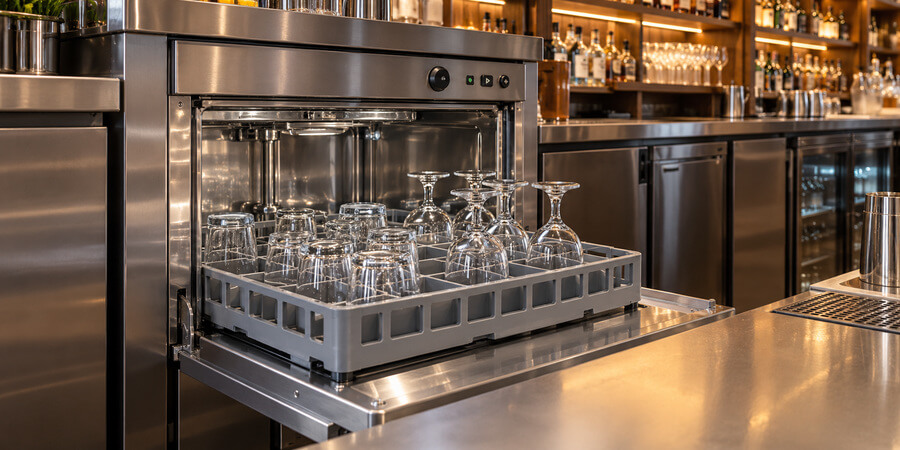
The Question: What type of warewashing equipment matches your operation?
Quick Answer:
- Dishwashers = Plates, utensils, cookware, pots, pans (restaurants, cafeterias, catering)
- Glasswashers = Glassware only (bars, pubs, breweries, wine service)
- Warewashing = Industry term for both categories
Why It Matters:
Glasswashers use lower temperatures, shorter cycles (60-90 seconds), and gentler spray patterns designed specifically for glassware. Using a standard dishwasher for glasses risks damage, leaves spots and film, and doesn't provide the speed bars need during service. Dishwashers operate at higher temperatures with stronger spray for grease removal, making them unsuitable for delicate glassware.
Decision Framework:
- High glassware volume (bars, pubs, breweries) → Dedicated glasswasher required
- Plates, utensils, cookware → Dishwasher
- Both → May need both machines (bar + restaurant operations)
Learn More:
For detailed buying guidance, see our comprehensive guides:
- Commercial Dishwasher Buying Guide - Complete guide to dishwasher types, sizing, and selection
- Commercial Glasswasher Buying Guide - Glass care equipment for bars and beverage service
- Commercial vs Residential Dishwasher Guide - Home installation requirements
2. What Capacity Do You Need?
The Question: How many racks per hour must your machine handle?
Quick Capacity Formula:
(Peak customers/hour × dishes per customer) ÷ 20 dishes per rack = Racks/hour needed
Add 20-30% buffer for peak rushes.
Example Calculation:
100 customers/hour × 4 dishes each = 400 dishes
400 ÷ 20 = 20 racks/hour minimum
20 × 1.25 (25% buffer) = 25 racks/hour recommended
Capacity Quick Reference:
| Operation Type: | Typical Capacity Needed: | Dishwasher Type: |
| Small cafe/bar | 20-30 racks/hr | Undercounter |
| Full-service restaurant | 40-60 racks/hr | Door-type |
| Hotel/catering | 60-150 racks/hr | Door-type or small conveyor |
| High-volume institution | 150-350+ racks/hr | Conveyor |
Common Mistakes to Avoid:
- Forgetting to count glassware, prep dishes, pots, and pans in your calculation
- Not accounting for peak rush periods when all tables turn at once
- Underestimating the buffer needed for special events or equipment downtime
3. High-Temp or Low-Temp Sanitization?
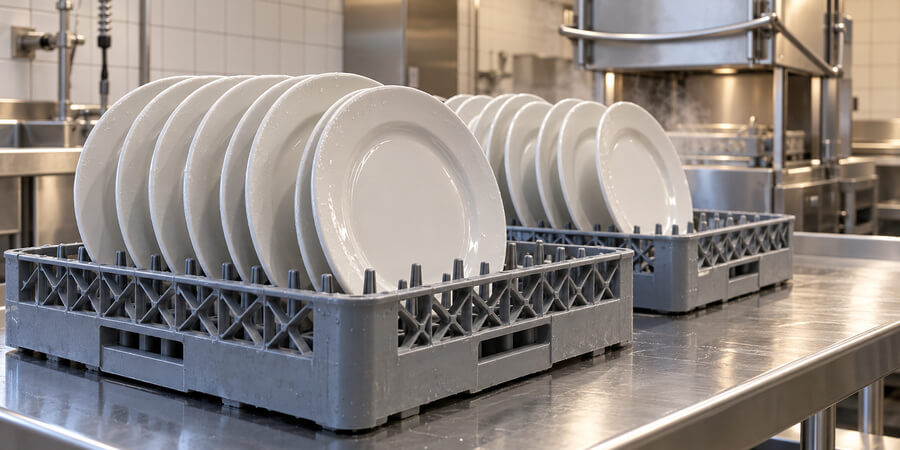
The Question: Which sanitization method fits your operation and utilities?
High-Temperature (180°F rinse):
✅ Pros:
- No chemical costs (detergent only)
- Faster drying (flash-dry from hot rinse)
- Better for bars (no chemical taste on glasses)
❌ Cons:
- Higher energy costs
- Requires booster heater ($400-$1,500)
- Needs 208-240V electrical (may require upgrade)
- More kitchen heat and steam
Low-Temperature (Chemical sanitizer):
✅ Pros:
- Lower energy costs
- Simpler electrical (115-208V options)
- Less kitchen heat
- Easier installation
❌ Cons:
- Ongoing chemical costs ($50-$150/month)
- Slower drying (air-dry required)
- Need more dish inventory for drying time
Quick Decision Guide:
Choose High-Temp if:
- High volume (chemical savings offset energy costs)
- Adequate electrical service (208-240V available)
- Fast turnaround needed
- Bar/brewery (no chemical taste)
Choose Low-Temp if:
- Limited electrical capacity
- Lower volume
- Installation costs are primary concern
- Hot climate (reducing kitchen heat is priority)
4. Do You Have the Required Infrastructure?
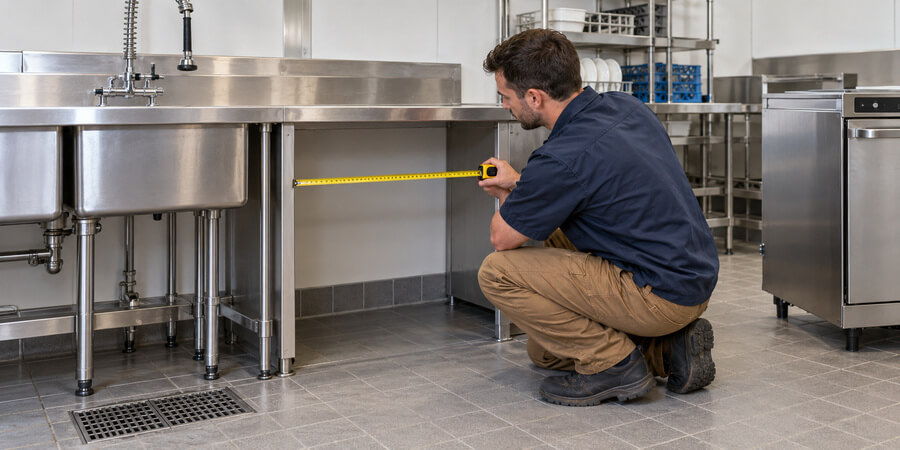
The Question: Can your space support commercial warewashing equipment?
Space Requirements:
| Machine Type: | Footprint: | Door Clearance: |
| Undercounter | 24"W × 24"D | 24-30" front |
| Door-type | 26-30"W × 28-32"D | 30" front |
| Conveyor | 10-20 feet linear | Full access both ends |
Electrical Requirements:
| Type: | Voltage: | Amperage: |
| Low-temp undercounter | 115-120V | 15-20A |
| High-temp undercounter | 208-240V | 30-40A |
| Low-temp door-type | 208-240V | 20-30A |
| High-temp door-type | 208-240V | 40-60A |
| Conveyor | 208-480V | 60-100A+ |
Plumbing Requirements:
- Floor drain (required - commercial units cannot use residential drain connections)
- 3/4" water supply line
- 20-25 PSI water pressure
- Hot water supply at 120°F minimum
Ventilation:
- High-temp may require condensate hood ($2,000-$5,000)
- Low-temp produces less steam (may not need hood)
Red Flags (Add to Budget):
- No floor drain → $1,000-$2,500 installation cost
- Inadequate electrical → $500-$2,000 upgrade
- Need ventilation hood → $2,000-$5,000
5. What's Your Total Budget?
The Question: What's the complete investment including installation and supporting equipment?
Equipment Costs:
| Type: | Price Range: |
| Undercounter dishwasher | $2,000-$5,000 |
| Door-type dishwasher | $4,000-$12,000 |
| Conveyor dishwasher | $20,000-$50,000+ |
| Glasswasher | $2,500-$4,500 |
Installation Costs:
- Electrical work: $500-$2,000
- Plumbing (floor drain): $1,000-$2,500
- Ventilation hood: $2,000-$5,000
- Professional installation: $500-$1,000
Supporting Equipment:
- Booster heater (high-temp): $400-$1,500
- Dish tables (soiled + clean): $600-$1,600
- Pre-rinse station: $200-$500
- Dish racks (6-12 needed): $180-$960
Total Investment Example:
Door-type high-temp dishwasher: $6,000
- + Booster heater: $800
- + Electrical upgrade: $1,200
- + Floor drain installation: $1,500
- + Dish tables (2): $1,000
- + Pre-rinse station: $300
- + Dish racks (8): $400
- + Professional installation: $800
= $12,000 total
Budget Planning Tips:
- Get electrical and plumbing assessments before ordering equipment
- Factor in 20-30% contingency for unexpected infrastructure needs
- Consider financing options (many suppliers offer 0% terms)
- Don't forget ongoing costs (chemicals, maintenance, water, energy)
Frequently Asked Questions
What's the difference between a dishwasher and a glasswasher?
Glasswashers are specialized for glassware with lower temperatures, shorter cycles (60-90 seconds), and gentler spray patterns. Dishwashers handle plates, utensils, and cookware with higher temperatures and stronger spray for grease removal. Bars and pubs typically need dedicated glasswashers for speed and glassware protection.
How do I calculate the capacity I need?
Use this formula: (peak customers per hour × dishes per customer) ÷ 20 dishes per rack = racks/hour needed. Add 20-30% buffer for rushes. Don't forget to include glassware, prep dishes, pots, and pans in your calculation.
Can I use a residential dishwasher in my restaurant?
No. Residential dishwashers lack the capacity, durability, and sanitization capabilities required for commercial use. They violate health codes and void warranties when used commercially. Commercial units reach proper sanitization temperatures or chemical concentrations required by health departments.
Do I need a floor drain for a commercial dishwasher?
Yes. Commercial dishwashers discharge large volumes of hot water quickly and require a floor drain positioned directly beneath or adjacent to the machine. Residential-style drain connections are not rated for commercial temperature and volume. Installing a floor drain costs $1,000-$2,500 if you don't have one.
What's better: high-temp or low-temp?
High-temp costs more upfront (booster heater, electrical) and uses more energy but has no chemical costs and faster drying. Low-temp has lower installation costs but ongoing chemical expenses ($50-$150/month). Choose based on your electrical capacity, volume, and whether you prioritize energy costs or chemical costs.
How much does installation cost beyond the machine price?
Budget $2,000-$5,000 beyond the machine price for electrical work, plumbing, floor drain installation, ventilation, and professional setup. Actual costs depend on your existing infrastructure. Get electrical and plumbing assessments before ordering to avoid surprises.
Next Steps: Making Your Decision
Use this framework to:
- Determine equipment type - Dishwasher vs glasswasher based on what you're washing
- Calculate capacity - Use the formula with your peak customer count
- Choose sanitization - High-temp or low-temp based on utilities and budget
- Verify infrastructure - Confirm space, electrical, plumbing, ventilation
- Budget completely - Include equipment, installation, and supporting items
Ready to buy? Review your answers to all 5 questions, then shop with confidence knowing you've matched equipment to your actual needs.
Need more details? See our comprehensive buying guides:
- Commercial Dishwasher Buying Guide - Detailed type comparisons and specs
- Commercial Glasswasher Buying Guide - Bar-specific guidance
- Commercial vs Residential Dishwasher Guide - Home installation requirements
Shop Commercial Warewashing Equipment
- Commercial Dishwashers - Full selection of dishwashers and glasswashers
- Undercounter Dishwashers - Compact units for cafes and bars (21-40 racks/hr)
- Single & Double Rack Dishwashers - Door-type for medium to high volume (25-82 racks/hr)
- Conveyor Dishwashers - High-volume continuous operation (200-350+ racks/hr)
- Glass Washer Machines - Purpose-built for bars and beverage service (720-2,000 glasses/hr)
Share This!