Dish and Glass Rack Sizing Guide
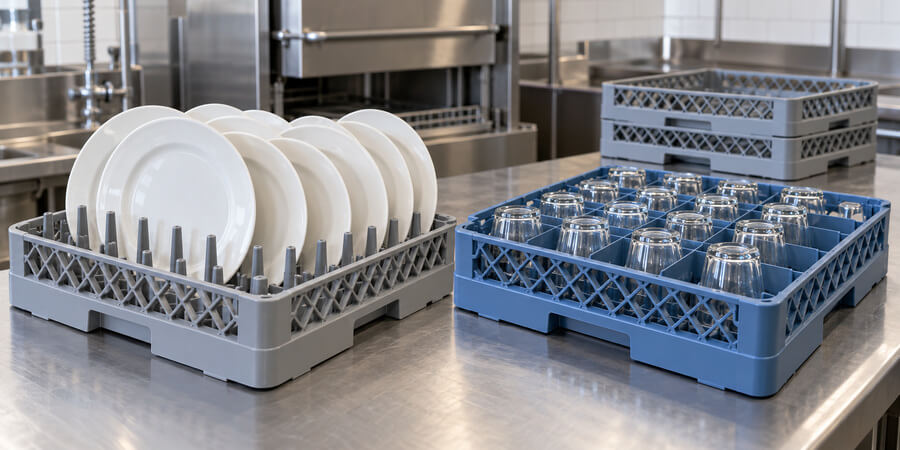
Table of Contents
How to match racks to plates and glasses, choose compartments and extenders, and fit every rack to your dish machine
A standard commercial dish rack is the full-size "20 by 20" rack, which measures about 19-3/4 inches square on the outside, and nearly every commercial dishwasher and most rack-style glasswashers are built to take it. Half-size racks keep the same length at half the width, and a rack gets taller with snap-on extenders rather than a bigger footprint.
Commercial Dish Rack Sizes at a Glance
| Rack or part: | Outside size: | Height: | Where it fits: |
| Full-size rack | 19-3/4 x 19-3/4 in, sold as 20 x 20 | About 4 in as a base rack | Undercounter and door-type dishwashers, most rack-style glasswashers |
| Half-size rack | 19-3/4 x about 9-7/8 in | About 4 in as a base rack | Short runs; two fill one full-size space |
| Extender | Matches the rack footprint | Adds about 1-5/8 in each | Snaps on to raise a rack |
| Compact glasswasher rack | 15-1/2 in square, or 16 in round | 6 to 10 in | Only the glasswashers made for them |
| Rack dolly | About 20-1/2 to 25 in; handle models up to about 27-1/2 in long | Low deck, or about 13 in on raised models | Rolls a stack of full-size racks |
| Underbar rack storage unit | 12 to 48 in wide | Bar height | Holds racks of clean glasses under the bar |
Buy full size unless there is a reason not to. Machines, dollies, covers and underbar units are built around it; half-size racks suit short runs and narrow shelves.
Rack Types and What Each One Holds
| Rack type: | What it holds: | Layout: | Typical use: |
| Open rack (base rack) | Bowls, pitchers, utensils | One open space; about 4-1/4 to 7-1/2 in inside with one to three extenders | Anything without its own rack |
| Peg rack (plate rack) | Plates, bowls, trays on edge | Rows of pegs, such as 9 x 9 or 5 x 9; extended pegs for plates up to 18 in | Dinner service |
| Flatware rack | Loose flatware in one layer | One flat-bottom space | Soaking and washing flatware |
| Flatware holder | Flatware upright in cylinders | Eight compartments | Sorting pieces by type |
| Compartment glass rack | Glasses, upside down | 9 to 49 cells full size; 8 to 17 half size | Every glass the bar washes |
| Cup rack | Coffee cups and mugs | 16 or 20 cells full size; 8 or 10 half size | Cafés and breakfast service |
| Sheet pan and tray rack | Sheet pans and trays | Open end; three full sheet pans | Trays and pans 15 x 20 in or larger |
Plates want pegs. Pegs hold plates on edge so the spray reaches both faces. The FDA Food Code (section 4-603.13) asks for machine-washed items to be racked so they meet unobstructed spray from every cycle and can drain.
Flatware has two routes. A flat rack takes one layer for soaking. Cylinders stand pieces sorted and upright, so the clean side can pick them up by the handles only, as the Food Code asks (section 4-904.11).
Matching Glasses to Compartments
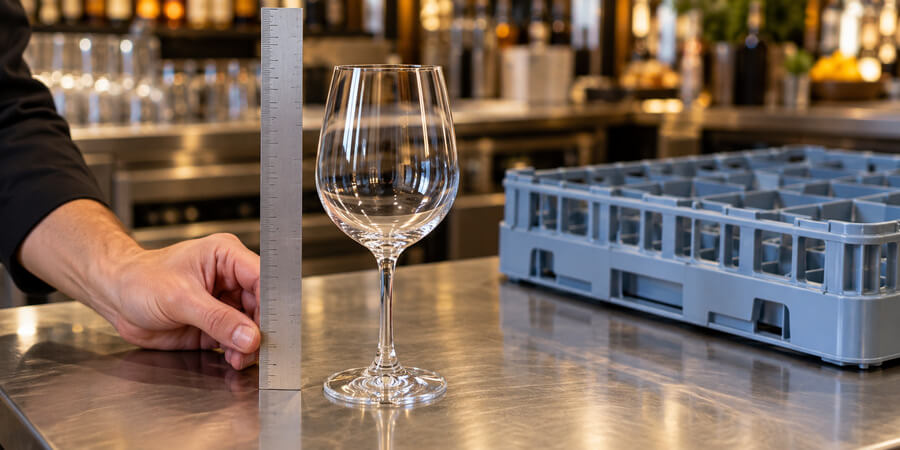
The compartment count sets the widest glass a rack will take. More compartments means narrower cells.
| Compartments: | Widest glass it takes: | Glasses that usually fit: |
| 9 | About 5-7/8 in | Martini and margarita glasses, large mugs |
| 16 | About 4-3/8 in | Wide wine glasses, beer mugs |
| 20 | About 3-7/8 in | Most wine glasses, wide pints and rocks glasses |
| 25 | About 3-7/16 to 3-1/2 in | Rocks, pints, goblets, beverage glasses |
| 30 | About 3-1/8 in | Pilsners, narrow beverage glasses |
| 36 | About 2-7/8 in | Highballs, juice glasses, flutes |
| 49 | About 2-7/16 in | Shot and cordial glasses |
| 8, 10 or 17 (half size) | About 4, 3-7/16 or 2-7/8 in | The same glasses as 16, 25 and 36 |
The next chart is a starting point by glass. Typical sizes are the middle of the range across the glassware we list, so measure your own.
| Glass: | Typical width: | Typical height: | Compartments: | Extenders: |
| Shot | 2 in | 2-3/4 in | 49 | 1 |
| Rocks or whiskey | 3-3/8 in | 3-5/8 in | 25, or 20 for wide styles | 2 |
| Highball | 2-3/4 in | 5-5/8 in | 36, or 30 for wide styles | 3 |
| Beverage or cooler | 3-1/8 to 3-1/2 in | 5-1/2 to 6 in | 25 or 20 | 3 |
| Pint or all-purpose beer | 3-3/8 in | 6-1/2 in | 25, or 20 for wide styles | 3, or 4 if tall |
| Pilsner | 3-1/8 in | 6-3/8 in | 25 | 3, or 4 if tall |
| Beer mug | 4-1/4 in plus handle | 6-1/4 in | 16 or 9 | 3 |
| Wine | 3-3/8 to 3-1/2 in | 8-1/4 to 8-1/2 in | 20, or 16 for wide bowls | 4 or 5 |
| Champagne flute | 2-5/8 in | 8-1/4 in | 36 | 4 or 5 |
| Martini or margarita | 4-1/2 in | 6-1/4 to 6-3/4 in | 9 | 3 |
| Coffee cup or glass mug | 2 to 4 in | Up to 5 in | Cup rack, 16 or 20 | 1 or 2 |
How to measure a glass for a rack:
- Measure straight across the widest point: the rim on a tumbler, the bowl on a wine glass. On a mug that sits inside a cell, include the handle.
- Measure from the table to the rim. Glasses ride upside down, so the full height has to clear the rack.
- Pick the compartment count whose listed maximum glass diameter beats your width with room to spare.
- Pick the extender count whose listed maximum glass height beats your height.
- Load one rack and stack an empty rack on top before ordering the batch.
Leave room, but not too much. A glass pushed into a tight cell chips at the rim; one that swims rattles in the spray. Rack lines differ slightly, so trust the listing's figures. Pour sizes by beer style are in our beer glass sizes chart.
Extenders and Rack Height
An extender is a ring of cells that snaps onto a rack to make it taller. Racks come with one to six already attached, and loose extenders raise racks you already own, as long as the compartment count matches. Stemware extenders suit stemmed glasses, and snap-on ID clips printed with the glass name tell the bar which rack to grab.
| Extenders: | Rack outside height: | Tallest glass it takes: |
| None (cup rack) | About 4 in | About 2-5/8 in |
| 1 | About 5-5/8 in | About 3-5/8 in |
| 2 | About 7-1/4 in | About 5-1/4 in |
| 3 | About 8-7/8 in | About 6-7/8 in |
| 4 | About 10-1/2 in | About 8-1/2 in |
| 5 | About 12-1/8 in | About 10-1/8 in |
| 6 | About 13-3/4 in | About 11-3/4 in |
These are the most common full-size racks we list. Low-profile racks and one other line take a taller glass at each step. Size for the tallest glass of the type, then check the rack still fits the machine.
How Racks Fit Dish Machines and Glasswashers
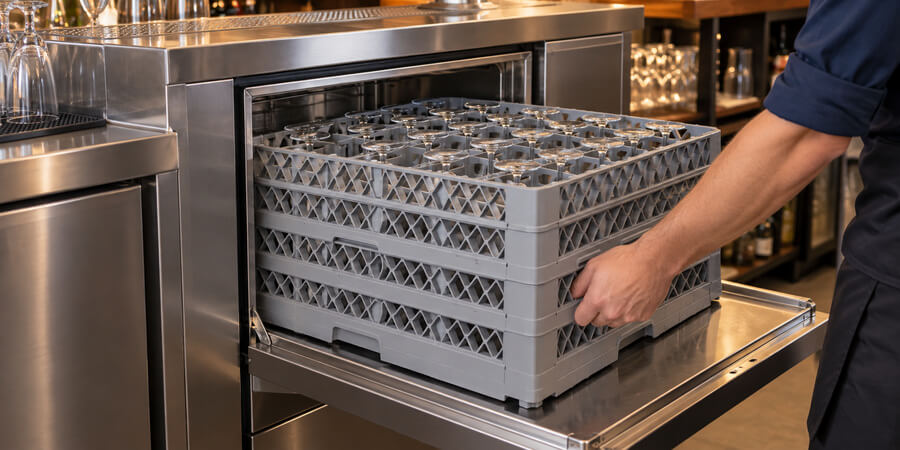
The footprint is standard; the clearance is not. Compare the rack's outside height with the door opening or chamber clearance on the machine's listing.
| Machine: | Rack it takes: | Clearance on our listings: | Tallest rack that clears: |
| Undercounter dishwasher | Full-size 20 x 20; many ship with a peg and a flat rack | About 12 to 16 in | 4 extenders at the low end, 6 at the high end |
| Door-type dishwasher | Full-size 20 x 20 | About 15 to 20-1/2 in; tall models about 27 in | 6 extenders; tall models also take sheet pans |
| Rack-style glasswasher | Full-size on most; some compact models take 15-1/2 in racks | About 11 to 14-1/4 in | 4 extenders at the low end, 6 at the high end |
| Pass-through or carousel glasswasher | Round racks made for the machine, or none | About 10 to 12 in | Square racks do not apply |
The undercounter is where tall racks get caught. The low end of the undercounter dishwasher range will not take a rack built for tall wine glasses, while any door-type dishwasher on our listings takes every standard compartment rack.
Bar machines vary the most. Most rack-style glass washers take standard racks, but the pass-through bar models on our listings come with their own round racks.
How Many Racks a Station Needs
Glass racks: count the glassware. Glasses usually live in their racks from the wash to the bar. For each glass type, divide the number you own by the compartments per rack and round up.
Dish racks: count the flow. Plates go back to a shelf, so peg and open racks are sized by what is moving: one rack loading on the soiled side, one in the machine and one draining on the clean side, for each type washed at once.
Check the machine keeps up. Racks per hour on the machine listing, times compartments per rack, gives glasses per hour. Compare that with your busiest hour.
Worked example, for a bar and dining room with the stock below:
| Item: | Stock: | Rack: | Per rack: | Racks: |
| Pint glasses | 150 | 25 compartments, 3 extenders | 25 | 6 |
| Rocks glasses | 72 | 25 compartments, 2 extenders | 25 | 3 |
| Wine glasses | 48 | 20 compartments, 4 extenders | 20 | 3 |
| Dinner plates, 10 in | Washed in loads | 9 x 9 peg rack | 18, as listed | 3 in the flow |
Round up, never down. A glass with no rack ends up on a towel, and the Food Code rules out cloth drying (section 4-901.11), though air-dried glasses may be polished with a clean, dry cloth.
Storing and Moving Racks
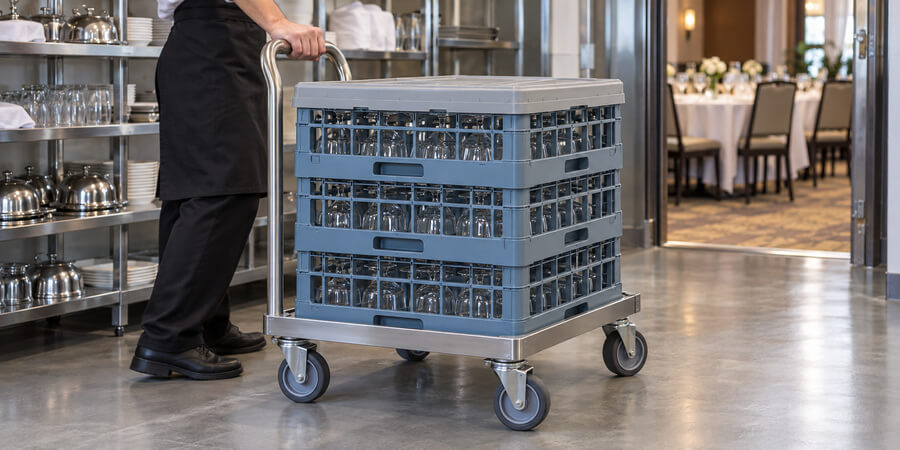
The FDA Food Code sets the storage rule in section 4-903.11: clean equipment and utensils go in a clean, dry place away from splash and dust, at least six inches above the floor, draining so they air-dry, and covered or inverted. Racked glasses already sit inverted, so storage comes down to the floor and the dust.
| Option: | Sizes on our listings: | What it does: |
| Rack dolly | About 20-1/2 to 27-1/2 in; rated 200 to 700 lb where listed; raised decks about 13 in | Rolls a stack of racks to the bar or a banquet |
| Rack cover | Full size | Keeps dust off in place of plastic wrap |
| Underbar rack storage unit | 12 to 48 in wide | Two or three racks on most listings |
| Overhead hanging glass rack | 10 to 48 in long | Hangs stemware by the foot |
| Drying rack cart | 22 to 60 in wide | Air-dries pans and trays that have no rack |
Keep the bottom rack off the floor. A stack set on the tile puts its bottom rack of clean glasses below the six-inch line. Rack dollies move the stack; a raised dolly, a shelf or an underbar glass rack storage unit keeps it clear.
Store and dry what racks don't hold. Overhead hanging glass racks show off stemware at the bar, but the glasses still go through the machine in a compartment rack. Sheet pans and trays drain on edge in a drying rack cart.
Frequently Asked Questions
What size is a commercial dishwasher rack?
The full-size rack, sold as 20 x 20 inches and measuring about 19-3/4 inches square. Half-size racks are the same length and half as wide, and extenders set the height.
How many compartments should a glass rack have?
Measure the widest point of the glass and pick the count whose maximum glass diameter is larger. As a rule, 9 for martini glasses, 16 or 20 for wine, 25 for rocks and pints, 36 for highballs and flutes, 49 for shots.
What is a glass rack extender, and how many do I need?
A ring of compartments that snaps onto a rack and adds about 1-5/8 inches. Choose the count whose listed maximum glass height beats your glass: most pints need three, most wine glasses four or five.
Will standard glass racks fit my glasswasher?
Most rack-style glasswashers take standard 20 x 20 racks if the rack's height clears the door. Pass-through bar models use their own round racks, and some compact models use smaller square racks, so check the machine listing.
What rack do wine glasses go in?
A compartment glass rack, upside down: usually 20 compartments, or 16 for wide bowls, with four or five extenders. Hanging racks store stemware at the bar but do not go through the machine.
Shop Dish and Glass Racks
Racks work as a set built around one footprint. Start with dish and flatware racks for peg, open, flatware and tray racks, then pick glass racks and cup racks by compartment count and extender height for each glass you pour. Many racks sell in multiples, so check the minimum quantity on the listing, and add loose extenders, ID clips and covers as the glassware grows.
Related Guides & Resources
- Commercial Dishwasher Guide - Machine types, capacity and sizing for the racks you run.
- Commercial Glasswasher Guide - Bar glasswashers from rack models to pass-through units.
- Commercial Sink Sizing Guide - Compartment sinks and drainboards for hand washing.
- Sheet Pan Sizes - Pan dimensions to check against a tray rack or a tall machine.
Share This!