Restaurant Tipping Guide for Owners and Operators
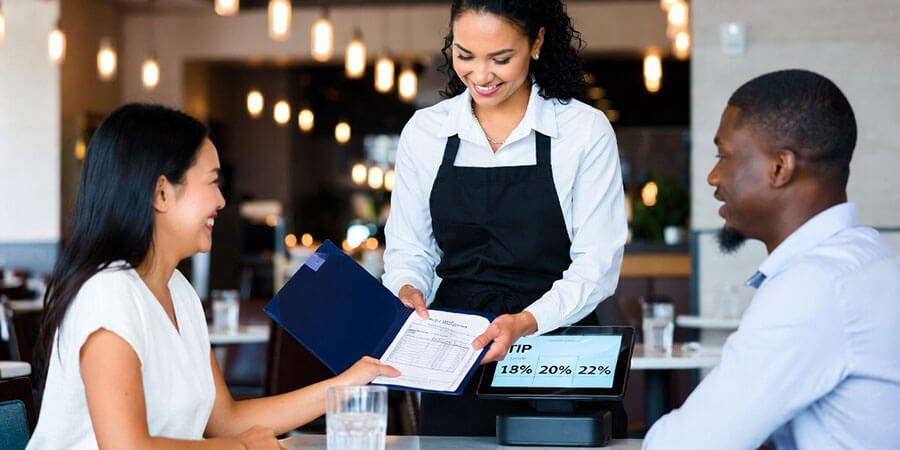
Table of Contents
How modern tipping works, which models fit your operation, and what the law requires you to know as an employer
Tipping has always been a defining feature of the American restaurant industry, but the rules and expectations around it have shifted dramatically in recent years. Post-pandemic dining brought higher default tip percentages, tablet-based prompts at the counter, and growing public debate about who should receive tips and how much is enough. For operators, these changes carry real consequences - from how you structure compensation to how you stay compliant with federal and state labor laws.
Whether you run a full-service dining room or a fast-casual counter, your tipping policy directly affects labor costs, employee retention, and guest satisfaction. This guide breaks down the major tipping models, walks through the legal landscape, and helps you make informed decisions about the approach that fits your operation.
How Tipping Works in Restaurants Today
The traditional 15 to 20 percent tip range held steady for decades, but that baseline has climbed. According to a 2024 Pew Research Center survey, roughly 57 percent of U.S. adults say tipping is expected in more places today than it was five years ago, and the suggested percentages have risen alongside that expectation.
The new standard sits between 18 and 22 percent for full-service dining. Payment platforms now default to suggested tip options that start at 18 percent and often go as high as 25 or 30 percent. Toast's 2024 Restaurant Trends Report found that the average tip at full-service restaurants was approximately 19.4 percent - up from the 18 percent average that held through most of the 2010s.
Several factors drove this shift:
- Pandemic-era generosity - Diners tipped higher during 2020 and 2021 to support struggling restaurant workers, and the habit stuck for many
- Inflation awareness - Guests recognize that food costs and wages have risen, and many adjust their tips accordingly
- Digital prompts - Tablet-based checkout systems present pre-calculated options that anchor higher than what guests might calculate on their own
- Counter-service tipping - Segments that historically did not involve tipping - coffee shops, fast-casual counters, takeout windows - now prompt for tips routinely
For operators, the upward drift in tipping has a silver lining: it offsets some labor cost pressure in a market where attracting and retaining hourly workers remains one of the industry's top challenges. The National Restaurant Association's 2025 State of the Restaurant Industry report identified staffing as the number one concern among operators for the fifth consecutive year.
Tipping Models Explained
Not every restaurant handles tips the same way. The model you choose affects your payroll structure, your employees' take-home pay, and your compliance obligations. Here are the most common approaches.
Traditional Tipping
Servers keep the tips they earn on their individual tables. This is the most familiar model and requires the least administrative overhead. Servers are motivated to provide excellent service because their income is directly tied to guest satisfaction. The downside is income variability - a slow Tuesday and a packed Saturday produce very different paychecks, and back-of-house workers receive none of the tip income.
Tip Pooling
All tips are collected and redistributed among eligible employees based on a set formula, typically by hours worked or by role. Tip pools can be limited to front-of-house staff only (the traditional approach) or expanded to include back-of-house workers like cooks and dishwashers under certain conditions. Pooling reduces individual income swings and can improve teamwork, but some high-performing servers resist sharing their earnings.
Tip Sharing
Similar to pooling but less rigid. Servers voluntarily share a percentage of their tips with support staff - bussers, food runners, bartenders, and hosts. The percentage is usually set by house policy. This is the most common hybrid approach in full-service restaurants.
Service Charge Model
The restaurant adds a mandatory service charge (often 18 to 22 percent) to every check. The charge belongs to the restaurant, not the employee, which gives operators full control over how the money is distributed. Some restaurants use service charges to create more equitable pay between front-of-house and back-of-house roles. It is important to note that service charges are not tips under federal law - they are revenue, and they must be reported and taxed differently.
No-Tipping Model
A small number of restaurants have eliminated tipping entirely, raising menu prices to fund higher base wages for all staff. This model creates pay predictability and eliminates the front-of-house and back-of-house wage gap. However, many operators who tried it during the mid-2010s reverted within a few years, citing customer confusion, difficulty competing on menu price, and challenges retaining experienced servers who earned more under traditional tipping.
| Model: | Operator Control: | Pay Equity: | Server Earning Potential: | Administrative Complexity: |
| Traditional tipping | Low | Low | Highest | Lowest |
| Tip pooling (FOH only) | Medium | Medium | Moderate | Medium |
| Tip pooling (FOH + BOH) | Medium | High | Moderate | Medium-High |
| Tip sharing | Low-Medium | Medium | Moderate-High | Low-Medium |
| Service charge | High | Highest | Set by operator | High |
| No-tipping | Full | Highest | Fixed wage | Medium |
Legal Considerations Every Operator Must Know
Tipping law is one of the most commonly misunderstood areas of restaurant labor compliance. Getting it wrong can result in lawsuits, Department of Labor investigations, and significant back-pay liability.
Federal Tipped Minimum Wage
Under the Fair Labor Standards Act, employers may pay tipped employees a direct cash wage as low as the federal tipped minimum - currently set at the rate established by the FLSA - as long as the employee's tips bring their total hourly earnings up to at least the full federal minimum wage. This is known as the tip credit. If an employee's tips fall short during any pay period, the employer must make up the difference.
State Variations
Many states set their own tipped minimum wage well above the federal floor, and several states - including California, Oregon, Washington, Minnesota, Montana, Nevada, and Alaska - require employers to pay the full state minimum wage before tips. Operators in these states cannot take a tip credit at all. Always check your state's current requirements, as rates change frequently.
What Employers Cannot Do With Tips
Federal law is clear on this point, and the Department of Labor's 2024 final rule on tip regulations reinforced it:
- Managers and supervisors may not keep tips or participate in tip pools under any circumstances
- Owners may not retain any portion of employee tips, even if they perform tipped work alongside staff
- Employers who take a tip credit may only include traditionally tipped employees (servers, bartenders, bussers) in mandatory tip pools
- Employers who do not take a tip credit may include back-of-house employees in tip pools under the 2018 FLSA amendment, but managers and supervisors remain excluded
IRS Reporting Requirements
All tip income is taxable, and both employees and employers have reporting obligations. Employees must report all tips to their employer, and employers must withhold income tax and FICA on reported tips. Establishments where tipping is customary and that employ more than 10 workers must also file annual reports with the IRS. The IRS considers any establishment where tipped employees earned more than a threshold amount in a calendar year to be subject to these requirements.
How Tipping Affects Staffing and Retention
Tipping is not just a payment mechanism - it is a staffing tool. How you handle tips directly shapes your ability to recruit, retain, and motivate workers across every role.
Front-of-house recruiting tends to be easier because tipped positions offer earning potential that often exceeds what operators could afford in straight wages. An experienced server in a busy full-service restaurant can earn significantly more per hour than the posted wage suggests. That earning potential attracts talent and reduces turnover in FOH roles.
Back-of-house retention is a different story. Line cooks, prep cooks, and dishwashers typically earn hourly wages with no tip income. The Bureau of Labor Statistics reports that the median hourly wage for restaurant cooks was roughly half that of what tipped servers effectively earned when tips were factored in. This gap is one of the primary drivers of the chronic BOH staffing shortage the industry has faced since 2020.
Tipping policy can either widen or narrow that gap:
- Traditional tipping maximizes the divide - FOH earns tips, BOH does not
- Tip pooling with BOH inclusion narrows the gap but requires careful legal compliance
- Service charges give operators full control to distribute compensation more evenly
- Higher BOH base wages funded by modest menu price increases can supplement any tipping model
According to the National Restaurant Association's 2025 workforce data, restaurants that implemented some form of tip sharing or pooling with BOH reported lower kitchen turnover rates compared to those using traditional tipping only. Equitable compensation was cited as a top retention driver among hourly BOH workers.
The Tip Pooling Debate
Tip pooling remains one of the most debated topics in restaurant operations. The 2018 amendment to the Fair Labor Standards Act opened the door for expanded pools, but the practical implications are still being worked out across the industry.
Traditional Tip Pool (FOH Only)
Tips are pooled among servers, bartenders, bussers, food runners, and hosts. This is permitted regardless of whether the employer takes a tip credit. It is the most legally straightforward option and faces the least employee pushback because it keeps tips within the service team.
Expanded Tip Pool (Including BOH)
Under the 2018 FLSA amendment, employers who pay the full minimum wage (no tip credit) may include back-of-house employees - cooks, dishwashers, and other non-tipped roles - in mandatory tip pools. This option is not available to employers who take a tip credit. The Department of Labor's 2024 regulations clarified and reinforced these boundaries.
Operator considerations for expanded tip pools:
- You must give up the tip credit entirely, which raises your direct labor cost for FOH workers
- The total labor cost may still decrease if BOH wages can be partially offset by pooled tips
- Top-earning servers may resist the change or leave for restaurants with traditional tipping
- BOH workers generally support pooling because it increases their total compensation
- Clear written policies and transparent distribution formulas are essential to avoid disputes
Digital Tipping and POS Prompts
The rise of tablet-based point-of-sale systems has transformed how tips are collected and how much guests leave. When a guest pays at a counter and the screen swivels to face them with pre-set options of 18, 20, and 25 percent, the dynamics are fundamentally different from leaving cash on a table.
How digital prompts affect tipping behavior:
- Anchoring effect - Pre-calculated options set the starting point. When the lowest option is 18 percent, most guests select that or higher rather than manually entering a lower amount
- Social pressure - The screen is often visible to the employee and other guests, creating pressure to select a generous option
- Expanded tipping occasions - Counter-service, takeout, and grab-and-go locations now prompt for tips in scenarios where tipping was historically uncommon
A 2024 Bankrate survey found that 66 percent of U.S. adults hold a negative view of pre-set tipping prompts, and the term "tipflation" has entered mainstream vocabulary. A 2024 Pew Research study confirmed that most Americans believe tipping culture has gotten out of hand, with many feeling pressured to tip in situations where they previously would not have.
What this means for operators:
- Digital prompts do increase average tip amounts - Toast data shows counter-service tips averaging 16 to 17 percent when prompted versus single digits when unprompted
- However, aggressive prompting can create guest resentment that hurts repeat visits
- Setting reasonable default options - such as 15, 18, and 20 percent for counter service - balances employee earnings with guest comfort
- Transparency matters: guests respond better when they understand where tips go. A brief note like "tips are shared among our team" can reduce friction
Investing in the right tabletop and service essentials and well-designed restaurant furniture also shapes the guest experience that drives tipping - a comfortable, well-appointed dining environment encourages generosity.
Tipping Etiquette by Service Type
One of the most useful references for operators is a clear breakdown of standard tipping expectations across different foodservice formats. This helps you set POS prompt defaults, train staff on expectations, and calibrate your compensation model. Understanding these norms also helps when developing marketing strategies that position your service style to guests.
| Service Type: | Standard Tip Range: | Notes: |
| Full-service restaurant | 18 - 22% | Post-pandemic baseline; 20% is the most common default |
| Fine dining | 20 - 25% | Higher expectations due to elevated service level |
| Counter service / fast-casual | 10 - 18% | Wide range; prompted tips average higher than unprompted |
| Coffee shop / cafe | 10 - 15% | Increasingly common due to tablet prompts |
| Buffet | 10 - 15% | Lower expectations due to self-service element |
| Delivery (third-party apps) | 15 - 20% | Driver tips are separate from restaurant revenue |
| Catering | 15 - 20% | Often included as a service charge on the contract |
| Bar / lounge | 18 - 22% | Per-drink tipping also common for bar-only service |
| Food truck | 10 - 18% | Growing tipping culture, largely driven by digital prompts |
| Takeout / pickup | 0 - 10% | Most variable; many guests tip nothing for pickup orders |
International Tipping Differences
If you are expanding your concept internationally or hosting a significant tourist clientele, understanding global tipping norms helps you set appropriate service expectations. Tipping customs vary dramatically around the world, and what feels normal in the United States can be confusing or even offensive elsewhere.
| Region / Country: | Tipping Norm: | Notes: |
| United States | 18 - 22% expected | Tipping is culturally mandatory in full-service settings |
| Canada | 15 - 20% expected | Similar to the U.S. but slightly lower averages |
| United Kingdom | 10 - 12.5% optional | Service charge often added; extra tip not expected |
| France | Included in price | Service compris (service included) is standard |
| Germany | 5 - 10% common | Round up the bill; large tips are unusual |
| Italy | Not expected | Coperto (cover charge) replaces tipping |
| Japan | Not customary | Tipping can be considered rude |
| China | Not customary | Tipping is uncommon outside international hotels |
| Australia | Not expected | Minimum wages are high; tipping is a bonus, not an obligation |
| Mexico | 10 - 15% expected | Increasingly expected in tourist areas and cities |
| Brazil | 10% often included | Gorjeta is typically added to the bill |
| Middle East (UAE, Qatar) | 10 - 15% appreciated | Service charge often included; extra tip is welcome |
Building a Tipping Policy for Your Restaurant
Creating a clear, documented tipping policy protects your business legally and helps your team understand exactly how compensation works. A strong policy should cover:
- Which model you use - traditional, pooled, shared, or service charge - and why
- Exact distribution formulas if you pool or share tips, including which roles participate and how percentages are calculated
- Compliance language confirming that managers and owners do not participate in tip pools
- POS prompt settings - what default percentages appear on customer-facing screens
- Reporting expectations - reminding staff of their obligation to report all tip income
- Dispute resolution - how employees raise concerns about tip distribution
Put the policy in writing, include it in your employee handbook, and review it with every new hire during onboarding. Update it whenever you change your approach, and keep a signed acknowledgment on file. Proper staff training on your tipping policy prevents misunderstandings and protects you in the event of a dispute.
When it comes to motivating your team beyond tips, strong leadership practices and a culture of staff recognition build loyalty that compensation alone cannot achieve. Understanding how to staff your restaurant properly also ensures you have the right team structure to support whatever tipping model you choose.
For operators looking to integrate tipping policy with broader operational technology, our restaurant technology guide covers POS systems, payment processing, and workforce management tools that support modern compensation structures.
Frequently Asked Questions
Can restaurant owners keep tips left by customers?
No. Under the Fair Labor Standards Act and the Department of Labor's 2024 tip regulations, employers and managers may not retain tips that belong to employees. This applies regardless of whether the owner performs tipped duties alongside staff. Tips belong to the employees who earn them.
Is tip pooling legal in all states?
Federal law permits tip pooling, but state laws add additional requirements and restrictions. Some states limit which employees may participate in a pool, and others prohibit certain pooling arrangements entirely. Always verify your state's specific rules before implementing or modifying a tip pool.
What is the difference between a tip and a service charge?
A tip is a voluntary payment from the guest to the employee. A service charge is a mandatory amount added by the restaurant to the bill. Legally, service charges belong to the restaurant - not the employee - and the restaurant decides how to distribute them. Service charges are treated as revenue for tax purposes, not as tips.
Can back-of-house employees be included in a tip pool?
Yes, but only if the employer pays the full minimum wage and does not take a tip credit. The 2018 FLSA amendment opened this option for employers who forgo the tip credit. Managers and supervisors remain excluded from all tip pools regardless of the wage structure.
How should we set default tip percentages on our POS system?
Match your prompts to the norms for your service type. Full-service restaurants typically set defaults at 18, 20, and 22 percent. Counter-service operations often use 15, 18, and 20 percent. Avoid setting defaults so high that they create guest resentment - the long-term cost of lost repeat business outweighs the short-term gain in tip amounts.
Do employees have to report all their tips?
Yes. Under IRS rules, employees must report all tip income - including cash tips - to their employer. Employers are then responsible for withholding the appropriate taxes. Failure to report tips can result in penalties for both the employee and the employer.
What happens if a tipped employee's tips do not reach minimum wage?
The employer must make up the difference. If an employee's direct cash wage plus tips does not equal at least the full federal (or state, if higher) minimum wage for any pay period, the employer is legally required to pay the shortfall. This is a fundamental requirement of the tip credit system.
Related Resources
- Customer Service Training for Restaurant Staff - Train your team to deliver the service that earns strong tips
- How to Properly Staff Your Restaurant - Build the right team structure for your operation
- 10 Ways to Motivate Your Staff - Boost retention with recognition and leadership strategies
- Restaurant Marketing Guide - Comprehensive marketing strategies for restaurant operators
- Restaurant Technology Guide - POS systems, payment tools, and tech that supports modern tipping
Share This!