Restaurant Customer Service Training
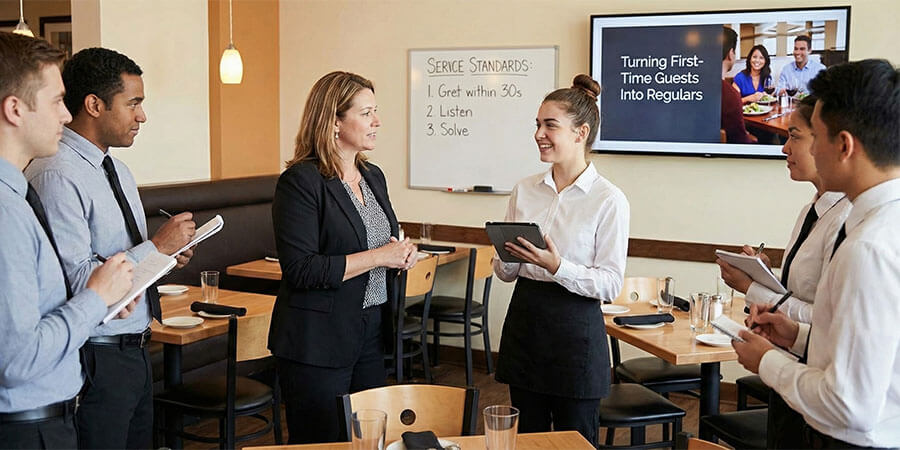
Table of Contents
How to train your restaurant staff to deliver consistent, memorable service that turns first-time guests into regulars
Customer service is the single biggest factor in whether a guest comes back. Research shows that nearly a third of customers will stop visiting a restaurant they love after just one bad experience - and that guests are willing to spend significantly more at places that deliver excellent service. Yet the restaurant industry's turnover rate tops 75%, meaning you are constantly training new people. This post covers how to build a customer service training program that works - from defining your service standards to onboarding, ongoing coaching, and measuring results.
Restaurant customer service training is what separates restaurants that build loyal regulars from those that churn through one-time visitors. The restaurant industry employs 15.9 million people across the United States, according to the National Restaurant Association's 2025 projections - and nearly every one of those roles involves direct or indirect guest contact.
Every guest interaction is a moment that either builds loyalty or erodes it. The food matters, but the experience around the food - the greeting, the attentiveness, the handling of problems, the farewell - is what determines whether someone comes back tomorrow, leaves a five-star review, or tells ten friends to go somewhere else.
Most restaurant owners know this intuitively. The challenge is building a training program that delivers consistent service across every shift, every employee, and every daypart - especially when turnover exceeds 75% and you are constantly onboarding new staff.
Why Customer Service Training Is a Revenue Decision
Training is not an expense. It is one of the highest-return investments a restaurant can make, and the data supports this at every level.
Turnover is the most expensive problem most restaurants face. Industry turnover rates topped 75% in 2025, according to Homebase research. Cornell University studies have found that replacing a single restaurant employee costs thousands in recruitment, onboarding, and lost productivity - and management positions cost significantly more to replace than hourly roles. Every employee you retain through better training and engagement is money that stays in your operation.
Service quality directly impacts spending. An American Express consumer survey found that 70% of consumers are willing to spend more at businesses that provide excellent service - a finding that has been consistently replicated in hospitality research. In a restaurant context, that translates to higher check averages, better tip percentages, and more frequent visits.
Bad experiences drive customers away faster than good experiences bring them in. A widely cited PwC study found that 32% of customers would stop doing business with a brand they love after just one bad experience. In restaurants, where competition is a block away, that number can be even more punishing.
Online reviews amplify everything. A one-star improvement in online ratings has been shown to boost restaurant revenue by 5-9%. Every front-of-house interaction is a potential review - positive or negative. Training your staff to deliver consistently good service is the most direct path to better ratings.
| Service Quality Impact | Data |
| Consumers willing to spend more with excellent service | 70% |
| Customers who leave after one bad experience | 32% |
| Revenue increase from one-star rating improvement | 5-9% |
| Restaurant industry turnover rate (2025) | 75%+ |
| Employees who stay past first month that remain for second | 80% |
| Operators prioritizing basic job skills training (2025) | 61% |
Define Your Service Standards Before You Train
You cannot train what you have not defined. Before building any training program, write down exactly what good service looks like at your restaurant - not in vague terms like "be friendly," but in specific, observable behaviors.
Start with the guest journey. Walk through every touchpoint from the moment a guest enters to the moment they leave. For each touchpoint, define what the staff member should do:
- Greeting - Acknowledge guests within 30 seconds of entering. Make eye contact. Smile. Use a specific welcome phrase if your concept calls for one.
- Seating and first impression - Present menus, explain any specials or changes, and offer water or a beverage within the first two minutes.
- Order taking - Confirm dietary restrictions. Repeat the order back. Note any modifications clearly.
- Check-ins - Return within two minutes of food delivery to confirm satisfaction. Check drinks proactively without being asked.
- Problem resolution - Listen without interrupting. Apologize sincerely. Offer a solution immediately. Escalate to a manager when needed.
- Farewell - Thank guests by name if possible. Invite them to return.
Write these standards down. Print them. Post them where your team sees them daily. A laminated service standards card is more effective than a 40-page manual that sits in a drawer.
Your physical environment supports these standards. The right commercial furniture creates comfort, and the right tabletop presentation sets expectations before a server even speaks. Service is not just behavior - it is also the space and the tools.
Building a Restaurant Training Program That Sticks
Research from the Council of Hotel and Restaurant Trainers found that 61% of restaurant operators prioritized basic job skills training in 2025 - a 25% increase from the prior year. The industry is recognizing that fundamentals matter more than ever.
But many restaurants still compress their training into a day or two of shadowing and then throw new hires onto the floor. Black Box Intelligence data shows that 80% of employees who make it past their first month stay through their second - which means the first 30 days are critical. How you train during that window determines whether you retain or replace.
Week One - Orientation and Observation
The first week should focus on understanding, not performing. New hires should learn your concept, your menu, your service standards, and your culture before they interact with a single guest. Cover:
- Restaurant history and values
- Menu knowledge - ingredients, preparation methods, allergens, popular pairings
- Service standards card review and discussion
- Kitchen and front-of-house workflow walkthrough
- Point-of-sale system basics and order entry practice
- Food safety and sanitation fundamentals
For guidance on how technology supports these operations, see the Restaurant Technology Guide.
Weeks Two and Three - Shadowing and Guided Practice
Pair new employees with your strongest performers - not just whoever happens to be on shift. A dedicated training partner should model the service standards you defined, narrate their decision-making in real time, and gradually transfer responsibility to the new hire.
Start with low-stakes tasks (running food, bussing tables, greeting guests) and progress toward full table management. The new hire should not be fully independent until they have demonstrated competency in every service standard, not just willingness.
Monthly - Ongoing Development
The CHART and Opus Training Hospitality Report found that ongoing training for hourly restaurant employees dropped to just one hour per month in 2025 - a 40-58% decline from the previous year. This is a mistake. The restaurants that sustain service quality invest in regular reinforcement.
Effective ongoing training does not require classrooms or seminars:
- Pre-shift meetings (5-10 minutes) - Review one service standard, share guest feedback, introduce menu changes
- Monthly role-play sessions (30 minutes) - Practice difficult scenarios: complaints, allergy questions, large parties, intoxicated guests
- Peer recognition - Publicly acknowledge staff who deliver exceptional service. Specificity matters: "Sarah handled that allergy concern perfectly" is more effective than "good job everyone"
Essential Customer Service Skills to Train by Role
Not every role requires the same training emphasis. Tailor your program to the responsibilities of each position.
| Skill Area: | Front-of-House Focus: | Back-of-House Focus: |
| Guest communication | Greeting, menu knowledge, upselling, complaint resolution | Allergy protocols, ticket communication with servers |
| Speed and timing | Table turn awareness, drink refill cadence | Ticket time targets, coordinating courses |
| Teamwork | Helping other servers during rushes, communicating wait times | Calling out order status, supporting plating during peaks |
| Product knowledge | Full menu fluency, wine/beverage pairings, daily specials | Preparation methods, ingredient substitutions, portion control |
| Problem solving | Handling complaints, managing guest expectations | Remaking dishes correctly, adapting to 86'd items |
| Cleanliness | Table presentation, restroom checks, dining room appearance | Station sanitation, equipment care, food storage |
For front-of-house, prioritize the skills that directly touch the guest experience. For back-of-house, focus on communication with the service team and consistency of execution. When both sides understand how their work connects, service gets faster and errors drop.
Improving wait staff productivity requires both good training and clear systems. The two are inseparable.
Hire for Service Aptitude, Then Train for Skills
You can teach someone to carry plates and operate a point-of-sale system. You cannot teach someone to genuinely care about other people's experience. When you are staffing your restaurant, prioritize attitude and emotional intelligence over industry experience.
During interviews, ask scenario-based questions:
- "Tell me about a time you dealt with someone who was upset. What did you do?"
- "A guest's order comes out wrong and they are visibly frustrated. Walk me through how you handle it."
- "How do you stay positive during a long, busy shift?"
Listen for specifics, empathy, and ownership. Candidates who blame others, give vague answers, or seem uncomfortable with conflict are warning signs. A new hire with the right disposition and no restaurant experience will outperform a veteran server who does not care.
Measuring Training Effectiveness
If you are not measuring, you are guessing. Track these metrics consistently to understand whether your training program is working.
| Metric: | How to Track: | What It Tells You: |
| Guest satisfaction scores | Comment cards, post-visit surveys, review site ratings | Direct feedback on service quality |
| Online review sentiment | Monitor new reviews weekly for service-related keywords | How your training translates to public perception |
| Employee retention (30/60/90 day) | Track start dates and departure dates by role | Whether your onboarding is strong enough to retain new hires |
| Average ticket size | Point-of-sale reporting by server | Whether staff are effectively suggesting and upselling |
| Complaint frequency | Track complaints per week/month by type | Whether specific service failures are recurring |
| Table turn time | Point-of-sale or reservation system data | Whether service pacing is efficient without feeling rushed |
Small, consistent gains in these metrics compound over time into significant revenue growth. Remember that a one-star improvement in online ratings can boost revenue by 5-9% - and every metric above feeds directly into your ratings. Your marketing efforts will always perform better when the underlying guest experience is strong.
Common Restaurant Training Mistakes to Avoid
- Training only at hire. Service quality erodes without reinforcement. Monthly touchpoints are non-negotiable.
- Relying on shadowing alone. Shadowing teaches habits - good and bad. Pair it with written standards and structured practice.
- Ignoring back-of-house. Kitchen staff who do not understand front-of-house pressures create friction. Cross-training builds empathy.
- No feedback loop. Collecting guest feedback and never sharing it with staff makes the data pointless. Close the loop weekly.
- Treating training as punishment. If training only happens after mistakes, staff will associate it with failure. Make it routine and positive.
- One-size-fits-all approach. A host, a server, a bartender, and a busser all need different training emphasis. Tailor the program.
Frequently Asked Questions
How long does it take to train a new restaurant employee?
Research suggests it takes an average of 19 days to train new restaurant employees to basic competency. However, full productivity typically takes 30 to 90 days depending on the role and the complexity of your operation. Front-of-house positions with extensive menu knowledge requirements generally take longer.
How often should we conduct customer service training?
Daily pre-shift meetings (5-10 minutes) plus monthly focused training sessions (30-60 minutes) is the minimum effective cadence. Annual refresher sessions covering your full service standards should supplement this. The key is consistency - brief, regular reinforcement outperforms infrequent intensive sessions.
What is the biggest mistake restaurants make with service training?
Stopping after onboarding. Most restaurants invest in initial training and then abandon it. Industry data shows ongoing training for hourly employees has dropped to just one hour per month. Restaurants that sustain strong service quality treat training as an ongoing operational priority, not a one-time event.
How do we train for handling difficult customers?
Role-playing is the most effective method. Create realistic scenarios - wrong orders, long waits, dietary restriction failures, intoxicated guests - and practice them monthly. Teach a consistent framework: listen without interrupting, acknowledge the problem, apologize sincerely, offer a specific solution, and follow up. Staff who have rehearsed these scenarios handle them better under pressure.
Should front-of-house and back-of-house train together?
Yes, at least occasionally. Cross-training builds understanding of each team's pressures and reduces friction during service. Having servers spend time in the kitchen and kitchen staff shadow a server shift - even briefly - creates empathy that improves communication and coordination during peak hours.
How do we measure return on investment from training?
Track employee retention rates, online review scores, guest complaint frequency, and average ticket size before and after implementing your training program. Even modest improvements in retention alone can save thousands annually given the cost of replacing restaurant employees. Pair this with improvements in review scores and repeat visit rates for a complete picture.
How does menu knowledge fit into customer service training?
Menu knowledge is one of the most important service skills. Guests expect servers to confidently answer questions about ingredients, preparation methods, allergen information, and pairing suggestions. Regular menu tastings and quizzes keep this knowledge current. For more on designing menus that support great service, see the Restaurant Menu Design Guide.
Related Resources
- Restaurant Marketing Guide - How strong customer service feeds into your broader marketing strategy
- Restaurant Technology Guide - Point-of-sale systems and tools that support service efficiency
- 10 Ways to Motivate Your Staff - Keeping your trained team engaged and motivated
- How to Be an Effective Restaurant Manager - Leadership skills that reinforce your training program
- How to Create Repeat Customers - Turning great service into long-term loyalty
Share This!