Guest Check Guide

Table of Contents
How to match part count, paper type and pad size to your service style and keep every numbered check accounted for
Guest checks are one of the cheapest things a restaurant buys and one of the most handled. Every order starts on one, the kitchen often cooks from a copy of one, and every missing one is a question about money. Choosing them comes down to four decisions: how many copies each order needs, how the copies are made, what size the servers carry, and how the numbers get checked at close.
What a Guest Check Is
A guest check is the numbered, pre-printed form a server writes a table's order on and then turns into that table's bill. One copy tells the kitchen or bar what to make, and the check itself, or a copy of it, is totaled and presented for payment. Most checks carry boxes for the date, table, guest count and server, lined space for items, and a sequence number that ties the order to the payment. Some add a table diagram for seat positions, beverage lines on the back, or a perforated stub the guest keeps as a receipt.
The paper does two jobs at once. On the way in, the check is the kitchen's instructions. On the way out, it is the bill. In the classic three-copy system taught in hospitality training, the top copy goes to the kitchen pass, the second to the cashier who makes out the bill, and the third stays with the server for reference. Smaller rooms run the same idea on two copies: one for the kitchen, one kept for service and billing.
The names overlap, which causes ordering mistakes. A "restaurant check" usually means the bill the guest receives, while a "check pad" is the bound stack a server carries. "Guest check book" gets used for both the booked pad and the folder the bill is presented in. In the kitchen, the copy on the rail is a ticket, a chit or a dupe, short for duplicate.
What Guest Checks Buy the Restaurant
Cash control you can audit. Every check carries a printed number, so every check can be accounted for. A missing number at close is a question with a name attached, because the numbers were issued to someone. That is why auditors reviewing restaurant revenue ask whether every pre-numbered check is accounted for, and why state tax guidance, New York's for one, asks for sequentially numbered checks.
Order accuracy. The order is written once, at the table, and copied to every station that needs it. Nobody rewrites it, and rewriting is where items get dropped. Menu prompts printed on the check nudge the server through the courses, and a table diagram keeps seat positions straight.
Kitchen communication that holds up in a rush. A duplicate on the ticket rail is an order the cooks can read, sequence and mark off. When the bar's pad is a different color from the food pad, nobody has to ask who a ticket belongs to. The paper stays in front of the cook for the life of the order.
A backup when the POS goes down. Terminals fail, internet drops and printers jam, usually on a busy night. POS providers themselves tell restaurants to keep guest check pads and pens on hand for every server and bartender, so service carries on and the orders get keyed in later. A few cases on the shelf is cheap insurance.
Speed at the table and the pass. A server with a pad does not queue at a terminal to start an order, and a torn duplicate reaches the kitchen in one trip. At a counter, the check is the order, the ticket and the bill in one piece of paper. More on keeping a floor moving is in our look at server productivity.
Guest Check Parts Chart: 1-Part to 4-Part
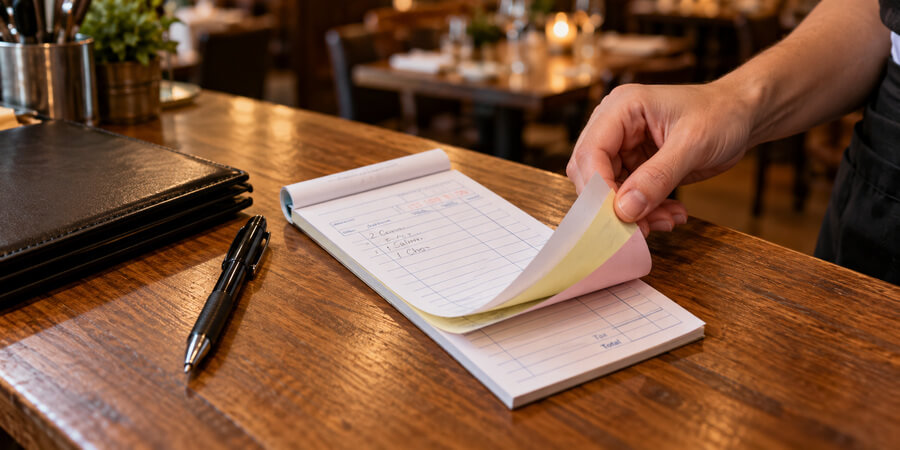
The part count is the number of copies each order produces. Count the places an order has to go, and that is the part count you need.
| Format: | Copies per order: | Where each copy goes: | Best for: |
| 1-part | One sheet, no duplicate | Presented as the bill, or keyed into the POS; the kitchen works from a POS ticket or a separate kitchen check | Counters, cafés and POS-first rooms where the check is handled once |
| 2-part | Original plus one duplicate | One copy to the kitchen or bar; the other stays with the server and becomes the bill | Diners, family restaurants and most table service |
| 3-part | Original plus two duplicates | Kitchen, cashier and server copies; or kitchen, server and a bar, expo or pastry copy | Full-service rooms with a cashier, a bar or a second station |
| 4-part | Original plus three duplicates | Guest, kitchen, bar and management copies; on delivery forms, one copy per hand the order passes through | Delivery and pizza operations, and rooms that audit every order |
More parts do not add control by themselves. Each extra copy earns its place only if someone uses it: a cashier who bills from it, a bar that pours from it, a manager who reconciles it. Most table service is covered by 2-part, which gives the kitchen its ticket and the server its bill. Step up to 3-part when a separate bar or cashier needs its own record. Keep 4-part for delivery and operations that route every order through an office.
Carbon, Carbonless and Single-Sheet Checks
How the duplicate gets made is the second decision, and each type suits a different way of working.
| Type: | How the copy transfers: | Strengths: | Watch-outs: |
| Single sheet, paper | No transfer; one copy only | Light and simple | No duplicate for the kitchen |
| Single sheet, board | No transfer; heavier card stock | Durable when a check is handled many times | Bulkier pad; no duplicate |
| Carbon insert | A loose carbon sheet sits between the top copy and the duplicate | Low-tech and familiar to most crews | The carbon has to be moved to each new set; carbon can mark hands and uniforms |
| Carbon backed | The back of the top copy is coated with carbon | No insert to move between sets | Coated back can smudge; copies only to the sheet beneath |
| Carbonless | Upper sheets carry tiny capsules of colorless dye that break under pen pressure; the sheet beneath is coated to develop the image | Clean hands and clean copies, from 2-part to 4-part | Copies only onto its own coated sheets, never onto plain paper slipped underneath |
Carbonless is the clean choice for table service. The top sheet is coated on the back, middle sheets on both sides, and the last sheet on the front only. Writing pressure breaks the capsules on the back of each sheet, and the dye reacts with the coating on the sheet below to form the copy. Nothing loose, nothing to smear, and the copies stay clean enough to hand a guest.
Carbon and single sheet still have their rooms. Carbon checks are simple and familiar, but with an insert the server has to move the carbon to each fresh set, and a forgotten move means a blank kitchen copy. Carbon-backed checks remove that step by coating the back of the top copy itself. Single sheet suits rooms where the server keys the order into a POS that prints the kitchen ticket, so a duplicate adds nothing. Board single sheets are the durable version for a check that gets picked up and added to all night.
Guest Check Sizes and Pad Formats
Guest checks come in named sizes rather than one standard, so compare the width and height on the listing to your presenters. The bands below are the ones the shop lists.
| Size: | Width x height: | Lines per check: | Best for: |
| Small | 3-1/2 x about 5 to 6 inches | 11 to 13 | Counter orders, kitchen check pads and sales order pads |
| Medium | 3-1/2 x 6-3/4 inches | 8 to 19 | The everyday server pad, with the widest choice of colors and paper |
| Medium wide | 4-1/4 x 7-1/4 to 7-3/4 inches | 8 to 14 | More writing space per line for longer orders and modifiers |
| Large | 4-1/4 x 8-1/4 to 9 inches | 13 to 16 | Large parties and long tickets |
| Large wide | 4-1/4 x 9-3/4 inches | Not listed | The longest check in the range |
| Delivery order form | 10-1/4 x 11 inches | 10 | Phone and delivery orders with customer and fee prompts |
| Format choice: | Options: | What it means for service: |
| Binding | Booked pads or loose checks | Booked pads keep sets in sequence for the server; loose checks ship in bulk |
| Checks per pad | 50 or 100 | 50 keeps a multi-part pad slim; 100 is a single-sheet pad |
| Pack size | 20 to 100 pads per case; loose cases of 2,000 to 3,000 checks | Match the case to how fast the checks go out |
| Numbering | Printed sequence number, repeated on the stub where there is one | The audit trail |
| Receipt stub | Perforated tear-off on some styles | The guest keeps a numbered record; the house keeps the check |
| Color | Green, tan, white, salmon, pink, maroon and purple | Separates food from bar, stations or shifts at a glance |
Medium is the size to start with. It is the everyday server pad, and it comes in 1-part through 3-part across every paper type. Move up to medium wide or large when orders run long or modifiers are written out in full. More lines hold a bigger table on one check, and wider lines are easier to write fast and read on a rail.
Use color on purpose. Beverage checks have long been printed on a different color from food checks so the bar can spot its orders. The same trick separates stations, shifts or dining rooms. Color carries no fixed meaning between restaurants, so it only works once you decide what each one means. Write the scheme down and keep it, so the kitchen learns it.
Choosing by Service Style
The right check follows from how a room takes orders and collects money. Use the chart as a starting point, then adjust for your stations.
| Service style: | Parts: | Paper: | Size and format: | Why it fits: |
| Diner, café or counter | 1-part or 2-part | Board single sheet or carbon | Small or medium booked pad | The check is often the ticket and the bill |
| Full-service restaurant | 2-part, or 3-part with a cashier | Carbonless | Medium or medium wide | Kitchen copy plus a clean bill |
| Bar or lounge | 2-part | Carbonless | Medium pad in a separate color | Drink orders stand apart from food |
| Food truck or window | 2-part | Carbonless | Small or medium pad | One copy to the cook, one kept to call the order |
| Banquet or catering | 2-part or 3-part | Carbonless | Large, or a full order form | Pre-set menus billed to the organizer |
| Delivery, takeout or pizzeria | 3-part or 4-part | Carbonless | Delivery order form | Prompts for name, phone, address, order time, tax, total and delivery fee |
| POS-first room | 1-part, plus a reserve of 2-part pads | Single sheet | Medium | Keyed in at the terminal, with an outage backup |
Counter and mobile service run lean. A diner or café check is often written, cooked from and paid on without ever being copied. On a truck or at a window, space is tight and hands are busy, so a small carbonless pad that tears cleanly beats anything with a loose carbon. Keep a spare pad at the register or the window, because running out mid-rush means taking orders on scrap paper with no number. The rest of a mobile setup is in our food truck equipment checklist.
Delivery and banquets need forms, not pads. A delivery order carries an address, a phone number and a fee, and it passes through the order taker, the kitchen, the driver and the office. Multi-part delivery forms are built for that, with printed prompts so nothing gets left off. Banquet orders are usually set in advance and paid by the organizer, so the check becomes a record of what was served against the agreed menu. Once a delivery leaves the building, the food rides in insulated delivery bags with its copy of the order.
Numbering and Cash Control
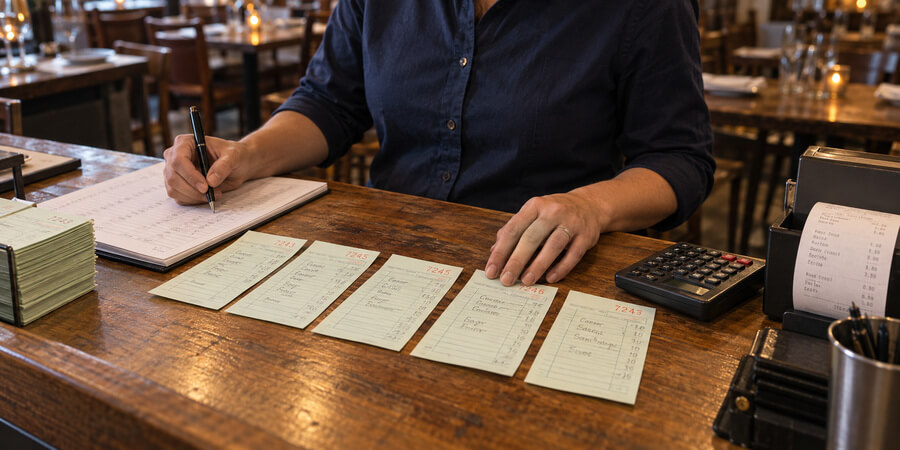
A guest check is a control document first and an order pad second. The printed number turns a stack of paper into an audit trail, and it only works if someone follows it.
| Control step: | What to do: | What a gap means: |
| Issue | Record which number range each server takes at the start of a shift | A check can be traced to the person who wrote it |
| Void | Keep voided and altered checks, signed by a manager, never torn up | A missing number with no voided check needs an answer |
| Match | Compare the kitchen copies against the bills and the POS sales report | A kitchen copy with no matching bill is food that left unpaid |
| Account | At close, confirm every number in the range is used, voided or still in the pad | Unaccounted numbers are the first thing an auditor asks about |
| Keep | File the checks with the day's register tapes and reports | Records you may be asked to produce later |
Issue checks the way you issue cash. In the traditional control system, a cashier or manager issues check pads to servers and records who took which, and the server's number or initial goes on every check. Cancelled or altered checks carry a supervisor's signature and go in the day's envelope, because a torn-up check looks exactly like an unpaid meal. It takes a minute at the start of a shift. It also tells the crew, without a speech, that the numbers are counted.
Reconcile the copies, not just the cash. The kitchen copy says what was made and the bill says what was charged. Laying the two side by side for a shift, or a sample of shifts, puts comps, missed items and walked tables in plain sight. Keep the person who counts the drawer separate from the person who reconciles it. And make sure the day's sales agree with the POS reports.
Keep them as records. Tax rules on restaurant records vary by state, so ask your accountant what yours require. New York's guidance for restaurants is a useful benchmark: it asks for sequentially numbered guest checks and says summary register tapes alone are not enough. It also expects the records to be kept for at least three years.
Guest Checks Alongside a POS
Plan the outage before it happens. POS providers recommend a written backup procedure: guest check pads and pens for every server and bartender on the shift, calculators, and the local tax rate written down where the crew can find it. They also recommend training the plan and putting it in the employee handbook. Once the system is back, key the handwritten orders in so the sales numbers stay complete. Our opening day checklist is a good place to build that drill in from the start.
Keep the reserve where the crew can reach it. A backup box in the office is no help when the printer dies mid-rush. Stage a sealed pack of 2-part pads, pens and a calculator at each host and wait station. Check the box when you check the menus. Replace what gets used the same week.
The Rest of the Order-Taking Kit
Presenters and server books carry the bill back to the table. They come in vinyl, faux leather and wood, with one to three pockets for the check, the card and the receipt. Check the pocket against the check size, because a check longer than the pocket has to be folded. The check presenters and server books range is what most people mean when they search for a guest check book.
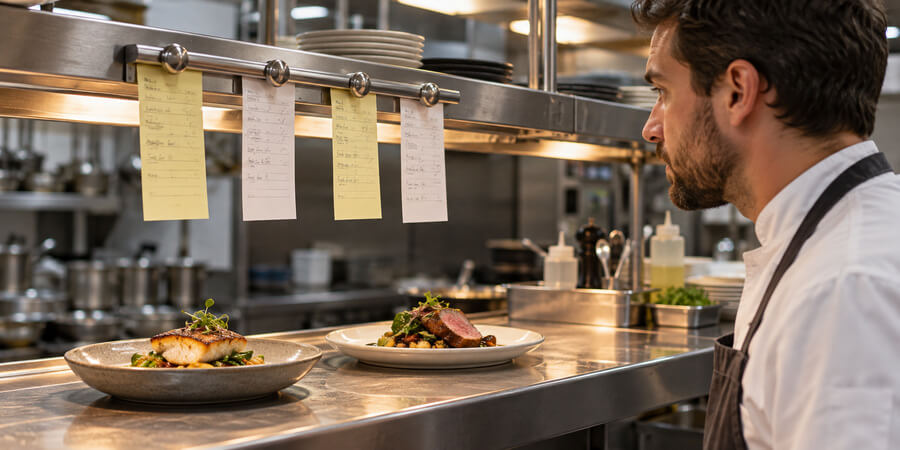
Ticket rails hold the kitchen copies in order. A rail is a strip mounted at the food window that grips the tickets so cooks can read them in sequence. Wall-mount rails come in short lengths for one station and long lengths for a full line, and countertop spindles suit a small pass. For a room that runs single sheet but needs a ticket for a special order, a single-copy kitchen check pad makes the kitchen copy. Rails and spindles sit in the restaurant ticket holders range.
Receipt paper is the guest check's printed cousin. Where a POS prints the bill and the card slip, the register roll does the job a check stub used to do. Rolls come in thermal, traditional and carbonless styles. Match the roll width to the printer before the first shift, from the receipt paper rolls range.
Frequently Asked Questions
What is a guest check?
A guest check is the numbered, pre-printed form a server uses to write down a table's order and turn it into the bill. One copy goes to the kitchen or bar, and the check itself, or a copy, is presented to the guest. The printed number lets management account for every order.
What is the difference between 2-part and 3-part guest checks?
A 2-part check makes one duplicate: one copy for the kitchen, one kept by the server for service and billing. A 3-part check adds a third copy, typically for a cashier, a bar or a second station. Choose 3-part only when a third person actually uses that copy.
Are carbonless guest checks better than carbon?
For most table service, yes. Carbonless checks copy through capsule coatings that break under pen pressure, so there is no loose sheet to move and nothing to smudge. Carbon checks remain a sound choice for diners and counters, especially carbon-backed styles that need no insert.
How many guest checks do I need?
Use your own numbers rather than a rule of thumb. Note the first and last check numbers used over a normal week, including voids, and that is your weekly usage. Multiply by the weeks between orders, add a cushion for busy weeks and a reserve pad for every server and bartender, then convert to cases using the checks per pad and pads per case on the listing.
Do restaurants still use guest checks with a POS system?
Yes, in three ways. Many servers still write orders at the table and key them in, many counters bill straight from paper, and every POS room needs pads as its backup for outages.
Can I get custom guest checks?
The checks in the shop are stock designs with standard layouts, colors and numbering, ready to use out of the case. Custom checks are printed to order by a forms printer: you choose the parts, paper colors, size, layout and starting number, then approve a proof before the print run. They make sense when branding matters more than having checks on hand today.
What is a guest check book?
The phrase is used two ways. Sometimes it means a booked pad of guest checks, and often it means the presenter the bill is carried to the table in. For the pad, look for booked guest check pads; for the folder, look for check presenters and server books.
Why are guest checks numbered?
So every check can be accounted for. Numbers let a manager issue a range to each server, spot a missing check at close, and match kitchen copies to bills and sales reports. Auditors and tax authorities look for sequentially numbered checks for the same reason.
Shop Guest Checks and Check Pads
Four choices get you to the right order. Count the stations each order has to reach, which sets the part count. Pick carbonless for clean table service, carbon or single sheet where they fit the room, and a size that suits your longest usual ticket. Then set up numbering and a reserve for outages, because a guest check only protects the cash if the numbers are followed. Compare parts, paper types, sizes and colors across the guest checks range, and find register rolls and the rest of the front-of-house paper in disposable host and server supplies.
Related Guides & Resources
- Restaurant Menu Design Guide - Layouts and item placement that raise the check average before the pen touches the pad.
- Restaurant Menu Pricing Guide - Set prices that cover costs, so every line on the check earns its margin.
- Restaurant Seating Layout Guide - Plan tables and server sections before deciding how many pads a shift needs.
- Catering Equipment for Off-Premise Events - Equipment and planning for off-premise events, where orders are set in advance.
Share This!