Catering Equipment for Off-Premise Events: What Operators Need to Know
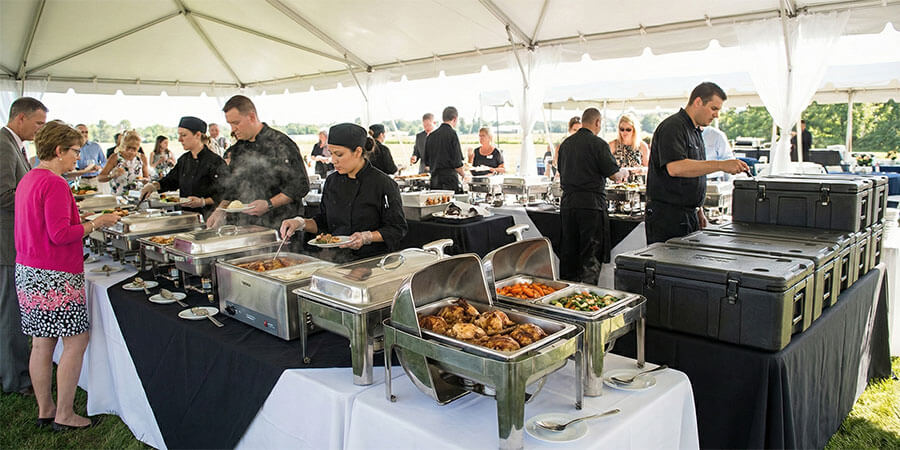
Table of Contents
How to equip your operation for off-premise catering, keep food safe in transit, and turn events into a reliable revenue stream
Off-premise catering requires a different equipment setup than in-house service - hot holding, cold transport, and food safety compliance all work differently when you're away from your kitchen. This post covers the essential equipment categories, FDA food safety requirements for off-premise service, and a practical checklist to help restaurant operators add catering without cutting corners on safety or quality.
Catering is one of the cleaner ways to grow revenue without adding seats. You're using existing kitchen capacity, existing staff skills, and existing food costs - just in a new context. According to IBISWorld, dedicated U.S. catering companies generated nearly 16 billion dollars in annual revenue as of 2025. Technomic estimates catering accounts for roughly 11% of total foodservice industry revenue - a meaningful slice of the market that restaurants with existing kitchen operations are well-positioned to capture.
For restaurant operators who already have the kitchen, the staff, and the food knowledge, the main gap is usually equipment - specifically, the gear that keeps food at safe temperatures from the moment it leaves your kitchen to the moment it hits the buffet line.
This post focuses on that gap. If you're thinking through menu strategy, the catering menu ideas blog covers how to build a catering menu that travels well and scales. Here, we're focused on the physical equipment side: what you need, why you need it, and what the food safety rules actually require.
Why Off-Premise Catering Is Worth the Investment
The growth numbers are hard to ignore. Grand View Research projects workplace and office catering will grow at an 8.8% compound annual growth rate through 2030. The International Caterers Association found in a 2022 survey that 48% of caterers identify corporate events as their largest growth area. That's not a niche - it's a mainstream revenue channel that restaurants with strong kitchen operations are well-positioned to serve.
The appeal from an operator's perspective is straightforward. Catering events are typically pre-ordered, pre-paid, and predictable in volume. There's no walk-in uncertainty, no table turns to manage, and no front-of-house labor overhead at the same scale. The margin profile is different from dine-in, but the predictability often makes up for it.
The catch is that off-premise service introduces food safety risks that don't exist in a controlled kitchen environment. Food travels. Temperatures fluctuate. Service windows stretch. The FDA reports 48 million foodborne illness cases annually in the U.S. - and off-premise catering, when done without proper equipment and protocols, is one of the higher-risk contexts. Getting the equipment right isn't just about quality. It's about liability.
Hot Holding Equipment: Keeping Food Safe and Appetizing
Hot food must be held at 135°F or above throughout service, per the FDA Food Code 2022. That's not a suggestion - it's the threshold below which bacterial growth accelerates rapidly. The challenge in off-premise catering is maintaining that temperature from the time food leaves your kitchen through the end of a service window that might run two to three hours.
Three equipment categories handle this:
Chafing Dishes
Chafing dishes are the workhorse of buffet-style catering. A water pan sits below the food pan, heated by a fuel source (typically canned Sterno or an electric element), and the steam keeps food at serving temperature. They're portable, relatively affordable, and familiar to guests.
The key spec to understand is capacity - full-size food pans (12" x 20") are standard, but half-size and third-size configurations let you offer more variety in the same footprint. For a deeper look at selecting the right setup, the chafing dish buying guide covers fuel types, pan configurations, and what to look for in different event formats.
Browse the full chafing dishes category for options across roll-top, hinged-lid, and rectangular configurations.
Steam Tables and Food Wells
Steam tables are the commercial kitchen version of chafing dishes - more durable, more precise, and better suited for high-volume or recurring catering operations. They use electric heating elements to maintain water temperature in a reservoir, which in turn holds food pans at consistent temperatures.
For operators running frequent corporate catering or large-scale events, a portable steam table is worth the investment over disposable chafing fuel. The steam tables and food wells category includes countertop and drop-in configurations that work for both in-house and off-premise use.
Food Warmers and Holding Cabinets
For transport - not just service - insulated holding cabinets and food warmers bridge the gap between your kitchen and the event venue. These units maintain temperature during transit without requiring a fuel source at the destination. They're particularly useful when you're setting up a buffet line and need food to arrive hot and stay hot while you're arranging the rest of the setup.
The food holding and warming equipment category covers the full range, from countertop warmers to full-size holding cabinets.
Cold Holding and Transport: The Other Half of Food Safety
Cold food must be held at 41°F or below, per the FDA Food Code 2022. This is harder to maintain off-premise than hot holding, because passive cooling degrades faster than active heating. A chafing dish with fresh fuel will hold temperature for hours. An insulated cold pan without ice replenishment will not.
Insulated Carriers and Cold Pans
Cold pans - also called cold food display pans or ice-cooled serving pans - use ice or refrigerant packs to keep food at safe temperatures during service. They're standard for salad bars, cold appetizers, desserts, and any protein that's served chilled.
The practical rule: plan to replenish ice every 60-90 minutes during service, and monitor temperature with a probe thermometer. Don't assume the ice is doing its job - verify it.
Insulated food delivery bags and catering bags are the transport layer - they keep cold food cold during the drive from your kitchen to the venue. Look for bags rated for extended hold times and sized to fit your standard food pan configurations.
Refrigerated Transport
For larger operations or longer transport distances, refrigerated transport - either a refrigerated van or a portable refrigeration unit - is the right solution. This is a significant capital investment, but it eliminates the temperature uncertainty that comes with insulated bags and ice packs.
If you're doing multiple events per week or catering at venues more than 30-45 minutes from your kitchen, the math on refrigerated transport often works in your favor when you factor in food waste and liability risk from temperature failures.
FDA Food Safety Requirements for Off-Premise Catering
The FDA Food Code 2022 sets the standards that most state and local health departments adopt. For off-premise catering, the critical rules are:
The 135/41 Rule. Hot food at 135°F or above. Cold food at 41°F or below. These are the danger zone boundaries. Food held between 41°F and 135°F is in the temperature danger zone, where bacteria multiply rapidly.
The 2-Hour Rule. Perishable food must be refrigerated within 2 hours of cooking. If the ambient temperature exceeds 90°F - common at outdoor summer events - that window drops to 1 hour. This rule applies from the moment food is cooked, not from the moment it's served.
Cooling Protocols. If you're cooking food in advance and transporting it cold to reheat on-site, the cooling process matters. Food must be cooled from 135°F to 70°F within 2 hours, then from 70°F to 41°F within an additional 4 hours. Blast chillers and ice baths are the standard tools for hitting these targets.
Reheating Requirements. Food that's been cooked, cooled, and transported must be reheated to 165°F before being placed in hot holding equipment. You can't put cold food directly into a chafing dish and expect it to reach safe serving temperature - the chafing dish is a holding tool, not a cooking tool.
These aren't bureaucratic details. They're the difference between a successful catering program and a foodborne illness incident that ends it.
Serving and Display Equipment
Beyond temperature control, the physical setup of a catering event affects both the guest experience and your operational efficiency.
Buffet tables and risers create visual interest and make it easier for guests to reach food without crowding. Tiered risers let you display more dishes in a smaller footprint and add a professional look to the setup.
Serving utensils need to be matched to the food - tongs for proteins, ladles for sauces and soups, slotted spoons for vegetables. Plan one utensil per dish, plus spares. Running out of serving utensils mid-event is a small problem that creates a big impression.
Portable bars and beverage stations are worth considering if your catering program includes drinks. A portable bar setup - with an ice bin, speed rail, and drip tray - lets you offer a professional beverage service without a permanent bar structure at the venue.
Sneeze guards and food shields are required by many health departments for buffet-style service. Even where they're not required, they're good practice - they protect food from contamination and signal to guests that you take food safety seriously.
Transport and Logistics Equipment
Getting food from your kitchen to the venue safely is its own operational challenge. The right transport equipment makes the difference between a smooth setup and a chaotic one.
| Equipment Category: | Purpose: | Key Spec/Requirement: | When You Need It: |
| Chafing Dishes | Hot holding during buffet service | Fuel type (Sterno or electric); full/half/third-size pans | Every buffet-style event |
| Steam Tables | Consistent hot holding for high-volume service | Electric; countertop or portable | Recurring or large-scale catering |
| Food Warmers/Holding Cabinets | Maintain temperature during transport and setup | Insulated; no fuel required in transit | Any event requiring transport |
| Insulated Food Carriers | Transport hot food safely from kitchen to venue | Rated hold time; food pan compatibility | Every off-premise event |
| Cold Pans / Ice-Cooled Pans | Cold holding during buffet service | Ice capacity; drain system | Cold appetizers, salads, desserts |
| Insulated Catering Bags | Transport cold food safely | Temperature rating; food pan sizing | Cold food transport |
| Food Pan Carriers | Stack and transport food pans without spilling | Pan capacity; locking lid | Multi-dish transport |
| Serving Utensils | Guest self-service at buffet | One per dish minimum; matched to food type | Every buffet event |
| Sneeze Guards | Food protection and health code compliance | Height and width to cover food pans | Buffet service (often required) |
| Probe Thermometers | Temperature verification throughout service | Calibrated; instant-read | Every event, every food item |
Food pan carriers are the unsung hero of catering logistics. A good carrier holds multiple full-size food pans stacked securely, with a locking lid that prevents spills during transport. They're designed to maintain temperature for a defined hold time - typically 2-4 hours depending on the model and starting temperature.
Food pan carriers are available in configurations ranging from single-pan to six-pan capacity. Match the carrier size to your typical event volume.
Dolly carts and hand trucks are easy to overlook until you're carrying a fully loaded food pan carrier up a flight of stairs. A folding dolly rated for the weight of your loaded carriers is worth having in the van.
Probe thermometers belong in every catering kit. Temperature logs - even informal ones - document that you maintained safe temperatures throughout service. If a food safety question ever arises, that documentation matters.
The full range of catering equipment and supplies covers everything from transport to service to cleanup.
Frequently Asked Questions
What equipment do I need to start catering off-premise events?
The core kit for most operators includes chafing dishes or a portable steam table for hot holding, insulated food pan carriers for transport, cold pans or insulated bags for cold food, serving utensils, and probe thermometers. The exact configuration depends on your menu and event size, but temperature control equipment is non-negotiable. Everything else - risers, sneeze guards, portable bars - adds professionalism but isn't required to start.
What temperature does hot food need to be held at during catering?
The FDA Food Code 2022 requires hot food to be held at 135°F or above throughout service. This applies from the moment food leaves your kitchen through the end of service. Chafing dishes, steam tables, and insulated holding cabinets are the standard tools for maintaining this temperature. Always verify with a probe thermometer - don't assume the equipment is doing its job without checking.
How long can food sit out at a catering event?
Perishable food must be refrigerated within 2 hours of cooking, per the FDA Food Code 2022. At outdoor events where ambient temperature exceeds 90°F, that window drops to 1 hour. During service, food held at proper temperatures (135°F+ for hot, 41°F or below for cold) can remain on the buffet line, but you should still track total time out of temperature control and discard food that's been in the danger zone too long.
Do I need a food handler's permit to cater events?
Requirements vary by state and locality. Most jurisdictions require a catering license or permit separate from your restaurant license, and some require a commissary agreement if you're preparing food in a licensed kitchen and transporting it. Check with your local health department before launching a catering program. Many also require a food safety manager certification (like ServSafe) for the person overseeing catering operations.
What's the difference between chafing dishes and steam tables for catering?
Chafing dishes are portable, fuel-based (Sterno or electric), and well-suited for events where you're setting up at a venue without power access. Steam tables are more durable, electrically powered, and better for high-volume or recurring catering where consistency matters more than portability. Many operators use chafing dishes for off-site events and steam tables for in-house catering setups. The chafing dish buying guide covers the tradeoffs in detail.
How do I keep food cold during transport for catering?
Insulated catering bags and food pan carriers with ice packs are the standard solution for most operators. For longer transport distances or larger volumes, a refrigerated van or portable refrigeration unit provides more reliable temperature control. Whatever method you use, verify temperature with a probe thermometer when you arrive at the venue - don't assume the food is still at 41°F or below without checking.
Can I use my restaurant's existing equipment for catering, or do I need separate gear?
Some equipment crosses over - food pans, serving utensils, and probe thermometers are the same whether you're using them in-house or off-premise. But transport and holding equipment is typically catering-specific. You'll need insulated carriers, chafing dishes or a portable steam table, and cold transport solutions that your in-house kitchen setup doesn't require. Starting with a core catering kit and adding equipment as your volume grows is a reasonable approach.
Related Resources
- Chafing Dish Buying Guide - How to choose the right chafing dish setup for your event format, volume, and fuel preference
- Catering Equipment & Supplies - Full category of catering equipment for transport, holding, and service
- Catering Menu Ideas: How to Build a Catering Menu - Menu strategy for catering programs, including what travels well and how to price for events
- Food Holding & Warming Equipment - Countertop warmers, holding cabinets, and portable units for maintaining safe serving temperatures
- Insulated Food Delivery Bags & Catering Bags - Transport solutions for keeping hot and cold food at safe temperatures during delivery
Share This!