Commercial Bakery Oven Guide
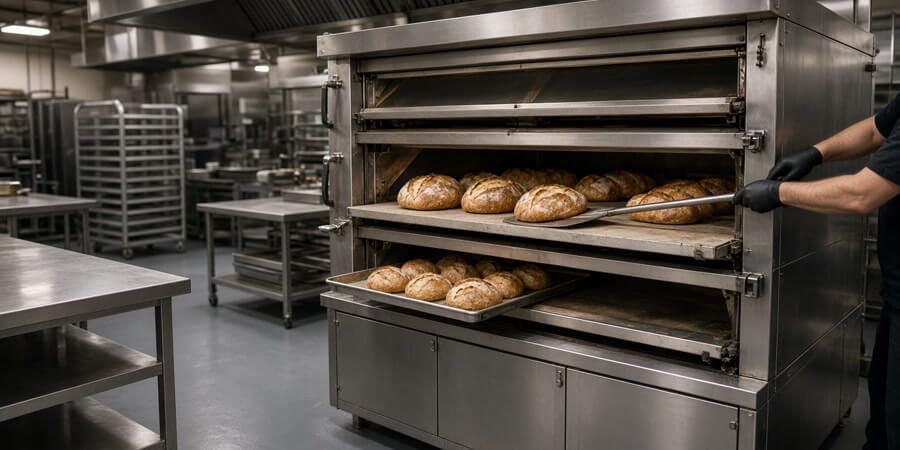
Table of Contents
How deck, convection and oven proofer combo formats differ in heat, capacity, steam and hookup, and how to size one
A commercial bakery oven is a production oven built to bake bread, rolls, pastries and cakes on full size sheet pans, load after load, inside a fixed footprint and on a fixed utility supply. Four formats do that work. Deck ovens bake by radiant heat, with product sitting on a heated deck between heated surfaces. Convection ovens bake with flowing hot air, moved over the pans by a fan. Oven proofer combos put a convection oven over a proofer cabinet in a single footprint. Rack ovens hold product on a wheeled rack that rolls into the chamber. Choosing between them comes down to five decisions: the product mix, because crusty bread and sheet cake want different heat; the capacity needed, counted in sheet pans rather than cubic feet; whether the bake needs steam; whether proofing happens inside the oven or in a separate cabinet; and what the utilities, ventilation and door clearance in the space will actually carry.
Deck, Convection, Rack or Proofer Combo: The Formats Compared
| Format: | How it bakes: | Best for: | Capacity measured in: | Hookup: |
| Deck oven | Radiant heat, product sits directly on a heated deck between heated surfaces | Crusty bread, artisan loaves, product that needs a long shelf life | Pans per deck, times the number of decks | Gas or electric, split about evenly in this category |
| Convection oven | A fan circulates hot air around the pans | Cookies, pastries, sheet goods, volume with less handling | Full or half size pans per cavity, cavities stacked | Majority electric, gas also offered |
| Oven proofer combo | Convection oven above, warm humid proofer cabinet below | One footprint that has to proof and bake | Total full size pans across the compartments | Electric or gas |
| Rack oven | A wheeled rack of pans rolls into the chamber, some units rotate the rack | Production bakeries running continuous output | Racks, and pans per rack | Project scope, specified and installed to site |
Deck ovens are the traditional bakery format and the one most people picture when they think of a bread oven. They are modular: decks stack to use vertical space, and this category runs from a single deck up to two, three, four, six or eight decks in a stack. Because the product bakes on the deck rather than on a rack in moving air, the crust and the base set differently. Browse the bakery deck oven category to see how deck count, pan capacity and fuel combine on real units. If the goal is pizza rather than bread, that is a different bake and a different spec, so start with the pizza deck oven category instead.
Convection ovens are the workhorse of most bakeries and cafes because moving air bakes faster and more evenly across a full cavity of pans. Cavities stack single, double, triple and quadruple high, so a line grows without taking more floor. The types, control levels and feature set on this format have their own workup in the commercial convection oven guide, which covers full size against half size cavities, ventless models, cook and hold, independent rack timers and the rest of the option list. For the units themselves, see the convection oven category.
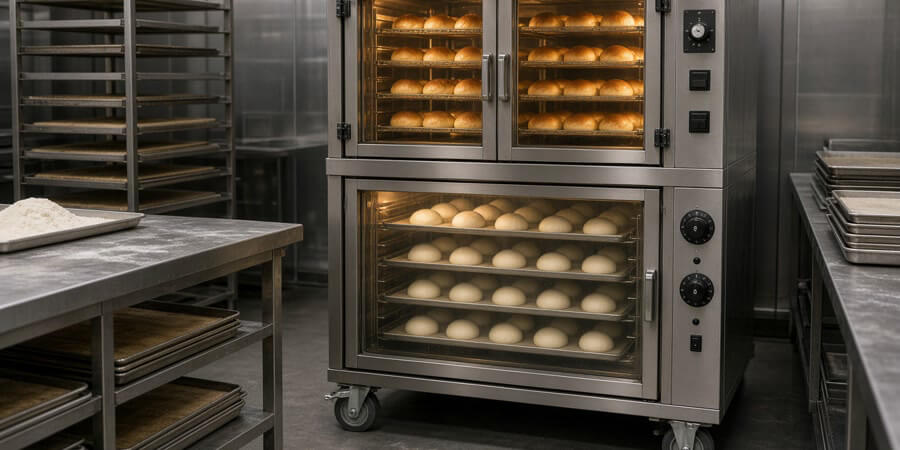
Oven proofer combos answer a specific problem: a bakery that needs both proofing and baking but has one footprint to give. The oven sits on top and a proofer cabinet sits below, in two or three compartments. Total capacity is rated across the whole unit rather than per cavity. The oven proofer combo category is where the "proofer oven" search usually lands, and it suits shops that want the dough to move a few feet from proof to bake.
Rack ovens belong in the comparison because production bakeries run them, but they are a step above the three formats above. A full rack of pans wheels straight into the chamber and, on many designs, rotates while it bakes for even color. They are large, they carry serious utility and ventilation requirements, and they are normally sourced as a project with a site specification rather than picked off a category page.
Deck vs Convection: Which Bakes Your Product Better
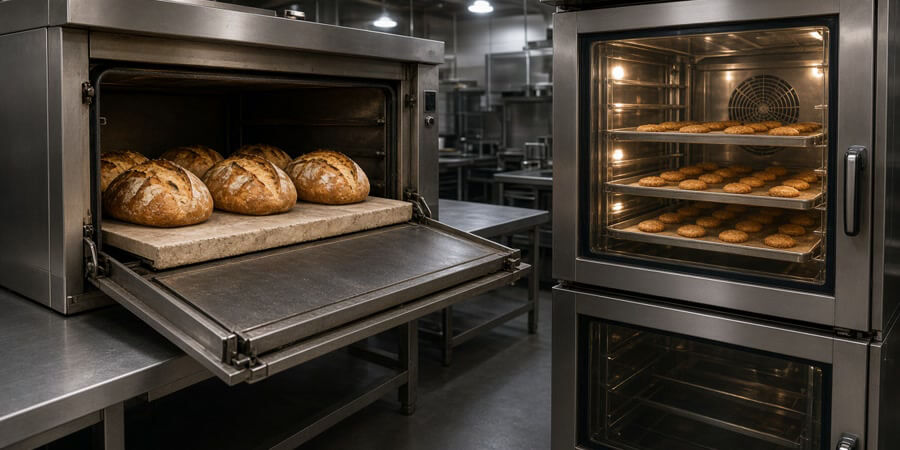
The difference is the heat itself. A deck oven bakes by radiation, with the loaf or the pan resting on a heated deck and heated surfaces above it. Very little air moves, so the bake does not pull moisture out of the product. That is why deck baked bread holds its softness and stays saleable longer, and why the stone or ceramic deck format is the standard for crusty artisan loaves. Contact with a hot deck also drives oven spring, the fast rise in the first part of the bake, and sets a base crust that a pan on a wire rack cannot reproduce.
A convection oven bakes with flowing hot air. The air carries heat to every surface of the product at once, so the bake is faster, the color across a full cavity is more even, and one operator can run more pans with less handling. The trade is moisture: circulating air strips it from the surface and from the crumb, which shortens shelf life on bread and can dry delicate goods. Light items also have to be secured or weighted, since fan driven air can move batter, parchment and thin pastry.
That is why a working bakery often runs both. Bread and rolls go on the decks, where the crust and the keeping quality matter. Cookies, muffins, pastries, sheet cakes and anything racked in volume go through convection, where speed and even color matter. If the plan is to move recipes written for a still air home or conventional oven onto a fan oven, the temperature and time adjustment is covered in the convection vs conventional oven guide rather than here.
Sizing a Bakery Oven by Sheet Pans
Bakery capacity is counted in full size sheet pans, 18 by 26 inches. Half and quarter sizes exist and matter for small ovens and small batches; the sheet pan sizes guide covers every standard size and which ovens take them. Match the pans already in use before matching the oven, and check the pan format on the sheet pan category if the bakery is starting fresh.
Each format states capacity differently. Deck ovens are rated by pans per deck and by the number of decks, so total capacity across the oven runs from a single pan up to sixteen, with common totals at one, two, three, four, six, eight, nine, twelve and sixteen pans. Convection ovens are rated per cavity, from three quarter or half size pans on the smallest units up to twenty eight full size pans on the largest, with five full pans and ten full pans the most common ratings. Oven proofer combos are rated as a total across compartments, at twelve, fifteen, twenty four, thirty or forty six full size pans.
Size by the batch, not by the day. Take the largest single bake that has to come out at one time, divide by the pans the oven holds, and count the loads.
Worked example one: if a morning bake is 40 full sheet pans of pastries and one cavity holds 10 full pans, that batch is four loads through a single cavity, or two loads through a double stack of the same cavity.
Worked example two: if a deck oven is rated 4 pans per deck and has 3 decks, it holds 12 pans at once, so the same 40 pan batch is three full loads plus a fourth part load. Multiply loads by whatever one load actually takes in that oven with that recipe, since cycle time comes from the product and the spec sheet, not from a rule of thumb.
| Capacity band: | Typical operation: |
| 1 to 4 full pans | Cafe, coffee shop, countertop or single deck unit, small batch finishing |
| 5 to 9 full pans | Small bakery or restaurant bake line, one cavity or a two deck stack |
| 10 to 16 full pans | Established retail bakery, a stacked convection pair or a multi deck oven |
| 24 to 30 full pans | Higher volume shop in one footprint, typical combo territory |
| Up to 46 full pans | Largest combo capacity, wholesale or multi location production |
Steam, Proofing and the Artisan Bread Question
Steam is injected into the chamber for a brief interval at the start of the bake, before the air starts circulating. It keeps the surface of the loaf soft long enough for full oven spring, then sets a thin, glossy, crisp crust with better color. Without it, the surface sets early, the loaf lifts less and the crust reads dull and thick. This is the single feature that separates a bread oven from a general purpose oven.
On many deck ovens, steam is plumbed per deck, so each deck can be steamed independently for whatever is baking in it. That per deck arrangement, paired with a stone or ceramic deck, is the classic artisan crusty bread setup. On convection ovens, steam appears as a steam injection feature on the option list alongside cook and hold, independent rack timers, a rotating rack, a broiler and a built in proofer. Steam needs a water supply and often treated water, so confirm the connection and the water quality requirement on the spec sheet before the unit lands.
Proofing is the other half of the bread question. A proofer holds shaped dough at a warm temperature and controlled humidity so it rises predictably instead of at the mercy of the room. There are two ways to get it. A separate cabinet gives flexibility and rolls where it is needed; the holding and proofing cabinet category runs insulated and non insulated, with humidity control on many models, mostly on 120 volt plugs, in widths mostly 24 to 34 inches and heights up to 84 inches, with one to twelve doors. An oven proofer combo builds the proofer into the oven's own footprint, which is the right answer when floor space is the binding constraint. Upstream of both, dough has to be mixed, divided and shaped, which is the job of the dough preparation equipment and of the commercial mixer selection that feeds the whole line.
Utilities, Footprint and Installation
Fuel is the first fork. Deck ovens in this category split about evenly between gas and electric, and gas units are offered in both natural gas and liquid propane. Convection ovens are roughly two thirds electric, with the rest gas in natural and propane. Oven proofer combos come both ways. Confirm which fuel the building actually has, and confirm the gas type, since a natural gas unit is not a propane unit.
Electric ratings decide whether an oven is a plug in or an electrical project. Convection ovens run from 115 and 120 volts on countertop and light duty units up through 208, 240 and 480 volts, single or three phase. Oven proofer combos draw 11,500 to 24,500 watts at 208 or 240 volts, single or three phase, with 120/208 and 120/240 variants; their gas versions are rated at 65,000 or 130,000 BTU per hour in natural or propane. Deck oven gas ratings vary widely by deck count, so check the spec sheet for the BTU load before sizing the gas line. Three phase service is the item most often discovered too late.
Footprint is the second constraint. Deck ovens run 26 to 91 inches wide, in rough bands of 26 to 35, 36 to 55 and 60 to 91 inches, with depths of 28 to 52 inches and heights from 15 inches for countertop units up to 77 inches for stacked floor units. Convection ovens run 14 to 72 inches wide, 19 to 54 inches deep and 12 to 92 inches tall depending on how many cavities are stacked. Oven proofer combos run 32 to 71 inches wide, 37 to 53 inches deep and 71 to 83 inches tall. Measure the doorway and the path, not just the wall.
Ventilation is the third. Gas fired ovens need a hood under most codes, and many electric ovens do too, which is its own dimension, airflow and make up air calculation; the commercial exhaust hood category shows what that involves. Ventless convection models exist for spaces where a hood is impossible, and they are worth checking against local code before assuming they solve the problem. Leave working clearance in front too, enough to load a peel into a deck or slide a full pan into a cavity without turning sideways.
| Requirement: | Deck oven: | Convection oven: | Proofer combo: | What to check: |
| Fuel | Gas or electric, split about evenly | Majority electric, gas offered | Electric or gas | Natural gas versus propane on the model itself |
| Electrical | Varies by deck count and fuel | 115 and 120 V through 208, 240 and 480 V | 11,500 to 24,500 W at 208 or 240 V | Voltage, single versus three phase, breaker size |
| Gas rating | Check the spec sheet | Check the spec sheet | 65,000 or 130,000 BTU per hour | Line size and regulator at the connection point |
| Width | 26 to 91 in | 14 to 72 in | 32 to 71 in | Wall run, doorway and delivery path |
| Depth | 28 to 52 in | 19 to 54 in | 37 to 53 in | Rear clearance and the connection behind the unit |
| Height | 15 to 77 in | 12 to 92 in | 71 to 83 in | Ceiling, hood height and stacking plans |
| Ventilation | Hood in most installs | Hood, or a ventless model | Hood in most installs | Local code before the order goes in |
What Drives the Cost of a Commercial Bakery Oven
Price on this equipment tracks a short list of drivers. Capacity leads: a one pan countertop unit and an eight deck floor oven are the two ends of the same category, and every deck or cavity added moves the number. Fuel and electrical service follow, since three phase and higher voltage units carry different components than a plug in.
Steam is a real cost line, because it adds plumbing, injection hardware and often water treatment, and per deck steam multiplies that across the stack. Stone or ceramic decks cost more than plain decks and are the reason many artisan units sit above general purpose ones. Controls scale the same way, from manual and thermostatic through solid state, digital, computer and touch screen, with programmability and repeatability going up at each step.
Then come the things that are easy to forget at quote time: stacking kits and stands, casters, the pans and racks that make the oven usable, and installation. Installation is the one that surprises people, since running a gas line, bringing in three phase service or adding a hood with make up air can rival the equipment decision in scope. The honest framing is that this category runs from a small countertop unit to a full floor standing production oven, and where a bakery lands on that range is decided by pan capacity, fuel, steam and install, in that order.
Countertop and Small Bakery Ovens
A cafe, a coffee shop or a small retail counter usually does not need a floor oven. The small end of this market is countertop convection ovens starting around 14 inches wide and 12 inches tall, and compact deck ovens starting around 26 inches wide and 15 inches tall. Capacity at that size is measured in three quarter or half size pans up to a handful of full pans, which suits pastry finishing, small batch cookies and par baked product.
The practical advantage is the hookup. Units at 115 and 120 volts plug into an ordinary outlet rather than requiring an electrical project, and ventless convection models can remove the hood question in spaces where a hood cannot be added. Half size pans fit the small cavities and cut waste on short runs.
The usual growth path is a second identical unit stacked on the first, which doubles capacity without taking another square foot of floor. Plan for it by choosing a model that stacks and by leaving the ceiling height for it, rather than replacing the oven a year later.
Cleaning and Care
Deck ovens need crumbs and flour swept off the decks between bakes, since burnt debris carries flavor into the next load and dulls the deck surface. Door gaskets and glass need wiping while warm, before sugar and butter carbonize onto them; a failing gasket shows up as uneven color long before it looks damaged.
On convection ovens, the fan and the interior take the attention. Grease and sugar film on the fan blade and the baffle change how air moves, and that changes the bake. Steam systems need whatever descaling routine the manufacturer specifies, and treated water is the cheapest form of maintenance on a steam unit. Proofer cabinets and combo proofer compartments need their humidity pans emptied, cleaned and refilled, since standing water is where a proofer goes wrong. Follow the intervals in the manual for each of these, not a generic schedule.
Frequently Asked Questions
What ovens do professional bakeries use?
Most run a combination rather than one oven. Deck ovens handle bread and anything that needs radiant heat and a long shelf life, convection ovens handle cookies, pastries and sheet goods in volume, and oven proofer combos cover shops that need proofing and baking in a single footprint. Larger production bakeries add rack ovens, where a wheeled rack of pans rolls into the chamber.
Deck oven or convection oven for a bakery?
Choose by product. Deck ovens bake with radiant heat that does not dry the product, which gives bread better oven spring, a better crust and a longer shelf life. Convection ovens bake faster and more evenly across a full cavity with less handling, which suits cookies, muffins, pastries and sheet cake. A bakery selling both usually ends up with both.
What is a proofer oven?
It is an oven proofer combo: a convection oven mounted over a proofer cabinet in one footprint, sold in two or three compartments. The proofer holds shaped dough at warm temperature and controlled humidity, then the product moves straight up into the oven. Capacity is rated as a total across the unit, at twelve, fifteen, twenty four, thirty or forty six full size sheet pans.
How many sheet pans does a bakery oven hold?
It depends on the format. Deck ovens in this category hold from one to sixteen full 18 by 26 inch pans across the whole oven, depending on pans per deck and deck count. Convection cavities run from three quarter or half size pans up to twenty eight full pans, with five and ten full pans the most common ratings, and combos run twelve to forty six pans in total.
Do bakery ovens need steam?
Only if bread is on the menu. Steam is injected for a brief interval at the start of the bake, before air circulation, and it is what produces full oven spring and a crisp, well colored crust on artisan loaves. Many deck ovens offer steam per deck; convection ovens offer it as a steam injection feature. Cookies, pastries and cakes do not need it.
Gas or electric bakery oven?
Both are available in every format here. Deck ovens split about evenly between gas and electric, convection ovens are roughly two thirds electric, and combos come both ways, with gas models offered in natural gas and liquid propane. The decision is usually made by the building: what fuel is present, whether three phase power exists, and what the hood situation allows.
What size oven for a small bakery or cafe?
Work from the largest single batch. If a morning bake is 12 full sheet pans and one cavity holds 5 full pans, that is three loads through a single cavity or two loads through a double stack. If the same 12 pan batch has to come out at once, a unit rated at twelve total pans covers it in one load. Multiply loads by whatever one cycle takes with that recipe.
Does a bakery oven need a hood?
In most installations yes, and gas fired units almost always do. The hood has its own sizing, airflow and make up air requirements, so it belongs in the plan before the oven is ordered. Ventless convection models exist for spaces where a hood is not possible, but local code decides whether they are acceptable in that room.
How much does a commercial bakery oven cost?
The drivers are pan capacity and deck or cavity count, gas versus electric and whether three phase power is required, steam systems and their plumbing, stone or ceramic decks, the control level from manual through touch screen, and stands or stacking hardware. Installation is the other half: gas line, electrical service and ventilation. The range spans small countertop units to full floor standing production ovens.
Shop Commercial Bakery Ovens
Each format above links to its own category: deck ovens for bread and radiant heat, convection ovens for volume and even color, and oven proofer combos when one footprint has to do both. An oven is only as useful as what feeds it, so match the pans first. Our sheet pan selection covers full, half and quarter sizes, our pan rack selection moves and holds them between proof and bake, and our bakery display selection puts the finished product in front of the customer.
Related Guides & Resources
- Commercial Convection Oven Guide - Types, features and selection for the convection side of the bakery.
- Sheet Pan Sizes - Every standard pan size, which ovens fit it and how pans rack and travel.
- Convection vs Conventional Oven - Temperature and time conversion between the two bake methods.
- Bakery Startup Equipment - What a new bakery really needs first, beyond the oven.
Share This!