Independent vs Chain Restaurants
Table of Contents
Everything operators need to know about ownership models, creative control, and what the failure rate data really says
Choosing how to enter the restaurant industry is one of the biggest decisions a foodservice entrepreneur will make. The independent-versus-chain question shapes every part of the business - from what goes on the menu to how much control you have over daily operations, marketing, and equipment choices. Each path comes with real advantages and real trade-offs, and the right answer depends entirely on your goals, risk tolerance, and vision for the business.
This guide breaks down the core differences between independent restaurants, chain restaurants, and franchise operations. You will find a side-by-side comparison, an honest look at the failure rate statistics that get tossed around online, and practical advice for competing as an independent in a market where brand recognition often feels like an unfair advantage.
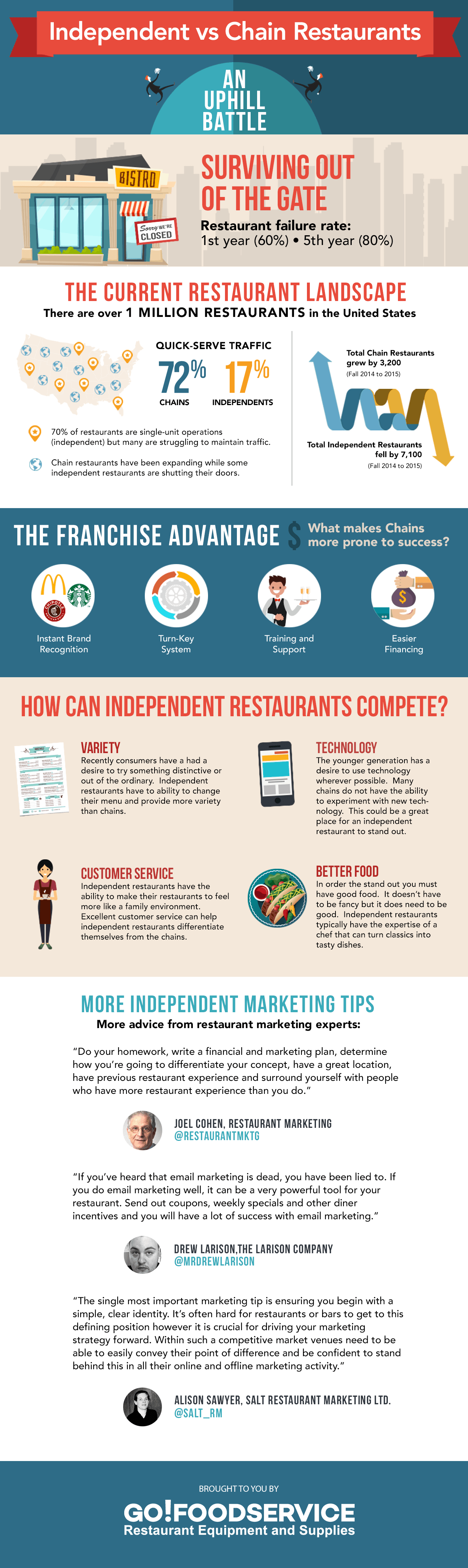
The infographic below highlights the key differences at a glance. Keep reading for a deeper breakdown of each factor and how it affects your decision.
What Is an Independent Restaurant?
An independent restaurant is a standalone operation owned and operated without affiliation to a larger corporate brand or franchise system. The owner makes every decision - concept, menu, pricing, suppliers, staffing, decor, and marketing. There is no corporate office setting guidelines or requiring approval.
Independent restaurants range from single-location neighborhood spots to small multi-unit operations where the same owner runs two or three locations under the same name. The defining characteristic is full autonomy. Nobody above you dictates how the business runs.
According to the National Restaurant Association (NRA), independent restaurants make up roughly 70 percent of all restaurant locations in the United States. They are the backbone of the industry, even though chain brands tend to dominate media coverage and advertising visibility.
What Is a Chain Restaurant?
A chain restaurant is a business that operates multiple locations under the same brand, with centralized management controlling operations, menus, branding, and supplier relationships. Chain restaurants maintain consistency across every location - the menu, the decor, the service style, and even the restaurant equipment are standardized.
Chains can be corporate-owned (every location is owned and operated by the parent company) or a mix of corporate-owned and franchised locations. The key distinction is that the brand, systems, and standards are controlled centrally, not by individual operators.
What Is a Franchise Restaurant?
A franchise is a specific business model where an individual (the franchisee) pays for the right to operate a location under an established brand's name and systems. The franchisee owns the individual business but operates it according to the franchisor's rules, standards, and playbook.
Franchisees typically pay an initial franchise fee plus ongoing royalty fees (usually a percentage of gross revenue) and are required to purchase supplies, equipment, and ingredients from approved vendors. In return, they get access to an established brand, proven operating systems, national marketing campaigns, and corporate training programs.
The key difference between a chain and a franchise: A chain refers to any multi-location brand. A franchise is a specific ownership model within that chain where independent operators buy the right to use the brand. Not all chains franchise - some are entirely corporate-owned.
Side-by-Side Comparison - Independent vs Chain vs Franchise
This table breaks down the major factors that matter most to operators evaluating their options.
| Factor: | Independent Restaurant: | Chain (Corporate-Owned): | Franchise: |
| Ownership | Full ownership and control | Owned by parent corporation | Owned by franchisee under brand license |
| Startup process | Build from scratch - concept, branding, systems | Hired to manage, not own | Follow franchisor's turnkey setup process |
| Creative control | Complete | None - corporate dictates everything | Very limited - must follow brand standards |
| Menu flexibility | Total freedom to create and change | Set by corporate R&D team | Limited to approved menu items |
| Brand recognition | Must build from zero | Established nationally | Established nationally |
| Marketing support | Self-funded and self-managed | Handled by corporate | National campaigns funded by franchisee fees |
| Ongoing fees | None beyond standard business costs | N/A (employee, not owner) | Royalty fees, marketing fees, technology fees |
| Supplier relationships | Choose your own vendors | Corporate-negotiated contracts | Must use approved vendor list |
| Equipment decisions | Full choice - right-size for your concept | Corporate standard equipment | Must use approved equipment |
| Training programs | Develop your own | Corporate training provided | Comprehensive franchisor training |
| Failure risk | Higher perceived risk, but data is nuanced | Low (corporate absorbs losses) | Lower perceived risk, but fees reduce margins |
| Exit strategy | Sell the business or close | Resign your position | Sell franchise rights (subject to approval) |
Advantages of Independent Restaurants
Independent ownership is not the easier path, but for many operators it is the more rewarding one. Here is what independents gain by going it alone.
Complete creative freedom. You choose the concept, the cuisine, the atmosphere, and the guest experience from the ground up. If you want to change the menu tomorrow based on seasonal ingredients or guest feedback, you can - no approval process, no committee, no waiting for corporate to sign off. This agility is one of the strongest competitive advantages independents have. Building a menu that reflects your vision is also closely tied to how you prepare and equip your kitchen.
Local community connection. Independent restaurants become part of the neighborhoods they serve in a way that chains rarely achieve. You can sponsor the local little league team, host community events, source ingredients from nearby farms, and build genuine relationships with regulars. According to a 2024 Technomic study, 65 percent of consumers say they prefer dining at locally owned restaurants when given the choice.
No franchise fees or royalties. Every dollar of revenue stays in the business. There are no ongoing royalty payments, no mandatory marketing fund contributions, and no technology licensing fees eating into your margins. The money you earn goes toward building your business, not funding a corporate parent's national advertising campaign.
Full ownership and equity. When you build an independent restaurant, you are building an asset that belongs entirely to you. The brand equity, the customer relationships, the recipes, and the reputation all belong to the owner. If you decide to sell, you are selling your own creation - not a license that someone else controls.
Ability to adapt quickly. Independents can pivot faster than any chain. When consumer trends shift - whether toward plant-based options, local sourcing, or new dietary preferences - an independent restaurant can adjust the menu, the marketing, and the service model in days rather than months. This flexibility proved critical during recent industry disruptions, when restaurants that adapted their operations quickly fared significantly better than those waiting for corporate directives.
Unique brand identity. In a market crowded with familiar brands offering predictable experiences, a distinctive independent concept stands out. Guests actively seek out unique dining experiences, and the rise of food tourism and social media discovery has made it easier than ever for a standout independent restaurant to attract attention far beyond its immediate neighborhood.
Advantages of Chain and Franchise Restaurants
The franchise and chain model exists for good reasons. For operators who value structure, predictability, and support systems, this path offers genuine advantages.
Established brand recognition. Customers already know the name, the menu, and what to expect. This eliminates the most difficult challenge in the restaurant business - getting people through the door for the first time. A recognized brand reduces the marketing burden on individual operators significantly.
Proven operating systems. Franchises come with detailed playbooks covering every aspect of the operation - staffing procedures, food preparation standards, customer service protocols, and inventory management. These systems have been tested and refined across hundreds or thousands of locations, which reduces the guesswork that independent operators face.
Marketing support and buying power. National advertising campaigns funded by pooled franchisee contributions create visibility that no independent operator could afford alone. The collective buying power of a large chain also means better pricing on supplies, ingredients, and equipment - savings that individual operators cannot replicate through their own vendor negotiations.
Comprehensive training programs. Most franchise systems provide extensive initial training and ongoing support covering operations, management, food safety, and customer service. For first-time restaurant owners, this structured onboarding can be the difference between a rocky launch and a smooth opening.
Supplier relationships and consistency. Chain and franchise operations benefit from established relationships with suppliers, distributors, and service providers. Approved vendor lists ensure consistent quality across locations and simplify the purchasing process for individual operators.
Lower perceived risk. Lenders, landlords, and investors generally view franchise operations as lower risk than independent startups because of the established brand and proven track record. This can make financing easier to secure and lease negotiations smoother.
Challenges Each Model Faces
Neither path is without significant hurdles. Understanding the challenges upfront helps operators prepare rather than be surprised.
Challenges for Independent Restaurants
- Brand awareness from zero. Without an established name, every customer must be earned through marketing, word-of-mouth, and community presence. Effective marketing strategies are essential from day one.
- Limited purchasing power. Independent operators buy in smaller volumes, which often means higher per-unit costs on ingredients, supplies, and equipment compared to what chains negotiate.
- No safety net. When problems arise - equipment failures, staffing shortages, supply chain disruptions - there is no corporate support team to call. The owner handles everything.
- Steeper learning curve. First-time independent owners must build every system from scratch, from accounting and inventory management to hiring and training processes.
Challenges for Chain and Franchise Restaurants
- Rigid operational requirements. Franchisees must follow the franchisor's playbook even when they disagree with specific policies or believe a local adaptation would perform better. Creativity is constrained by brand standards.
- Ongoing fees reduce margins. Royalty payments, marketing fund contributions, and technology fees typically total 8 to 12 percent of gross revenue. This ongoing cost structure means a franchise location needs to generate significantly more revenue than an independent to achieve the same take-home profit.
- Vulnerability to brand reputation. A food safety incident, controversy, or public relations problem at any location in the chain can affect every franchisee. One bad headline can reduce foot traffic across the entire system overnight.
- Limited local adaptation. Chain restaurants struggle to cater to local tastes, seasonal ingredients, or community preferences because menus and operations are standardized nationally.
- Exit restrictions. Selling a franchise is not as simple as selling an independent business. Most franchise agreements require franchisor approval of any buyer, and the brand retains significant control over the transfer process.
The Failure Rate Myth - What the Data Actually Shows
One of the most commonly repeated claims in the restaurant industry is that "60 percent of restaurants fail in their first year" or that "90 percent fail within five years." These numbers are widely cited in articles, business plans, and casual conversation - but they are poorly sourced and significantly overstated.
What the research actually says: A study published in the Cornell Hotel and Restaurant Administration Quarterly (now the Cornell Hospitality Quarterly) found that approximately 26 percent of independent restaurants close during their first year. The Bureau of Labor Statistics (BLS) data on business survival rates shows that restaurants fail at roughly the same rate as other small businesses across industries - about 20 percent in the first year and roughly 50 percent by year five.
The NRA's own research aligns with these findings, suggesting a first-year closure rate in the range of 17 to 25 percent depending on the segment and economic conditions. That is a real risk, but it is a fundamentally different story than the "60 percent" claim.
| Statistic: | Commonly Cited: | Actual Research: |
| First-year failure rate | 60 percent | 17-26 percent (BLS, Cornell, NRA data) |
| Five-year failure rate | 90 percent | Approximately 50 percent (similar to all small businesses) |
| Independent vs chain failure rates | Independents fail far more often | Gap is narrower than assumed - brand recognition helps, but fees and rigidity create their own risks |
| Primary causes of failure | Bad food or bad location | Undercapitalization, poor financial management, and lack of planning (NRA, 2024) |
Why does the myth persist? The inflated failure rate numbers trace back to a handful of studies from the 1990s and early 2000s that had significant methodological issues - including counting ownership transfers and voluntary closures (retirements, relocations) as "failures." When a profitable restaurant closes because the owner retires and sells the liquor license rather than the business, that gets counted as a "closure" in many datasets, inflating the failure rate.
The takeaway for operators: Opening a restaurant - independent or franchise - carries real risk. But that risk is comparable to launching any small business, not the catastrophic odds that the popular narrative suggests. The restaurants that fail most often share common traits: insufficient startup capital, weak financial management, and inadequate planning. The ownership model matters less than the operator's preparation and business fundamentals.
How to Compete as an Independent Restaurant
Independent restaurants can thrive alongside chains by leaning into their natural advantages. The strategies below are where independents consistently outperform larger brands.
Dominate local marketing. While chains spend millions on national campaigns, independents can own their local market through community engagement, local SEO, social media, and partnerships with nearby businesses. A strong presence on local search, Google Business Profile optimization, and consistent engagement with your community creates awareness without a massive budget. The restaurant marketing guide covers these strategies in depth.
Build genuine community relationships. Host local events, partner with schools, participate in farmers markets, and become a recognizable part of the neighborhood fabric. These connections create loyalty that no chain can replicate with a national coupon campaign.
Create a menu that tells a story. Independent restaurants can build menus around a specific philosophy, locally sourced ingredients, family recipes, or cultural traditions. This gives guests a reason to choose your restaurant specifically - not just because it is convenient, but because the experience is unique and cannot be found at the chain across the street.
Leverage technology for efficiency. Modern restaurant technology platforms have leveled the playing field significantly. Independent operators now have access to the same point-of-sale systems, online ordering platforms, inventory management tools, and customer relationship management software that chains use - often at price points accessible to single-location businesses.
Focus on the guest experience. Independent restaurants can deliver a level of personal service and attention that chains structurally cannot. Learning regulars' names, remembering their preferences, accommodating special requests, and making each visit feel personal - these things build loyalty that survives economic downturns, new competition, and changing food trends.
Control your costs with smart equipment choices. One underappreciated advantage of independence is the ability to choose exactly the right equipment for your concept. Franchisees must purchase from approved equipment lists regardless of whether those specifications match their location's actual needs. Independents can right-size their kitchen with food preparation equipment that fits their menu, volume, and space - often at a lower total cost than a franchise's mandated setup.
Equipment Decisions - A Hidden Advantage for Independents
Equipment purchasing is an area where the independent-versus-chain difference has a direct financial impact that many prospective operators overlook.
Franchise equipment requirements are rigid. When you sign a franchise agreement, you typically commit to purchasing or leasing specific equipment from approved vendors at set prices. The franchisor negotiates these deals centrally, and while the pricing may be competitive, the specifications are designed for the brand's standardized menu - not necessarily for your specific location's volume, layout, or market.
Independents choose what fits. An independent operator opening a 40-seat casual concept does not need the same equipment as a 200-seat high-volume operation. Independents can select commercial furniture and kitchen equipment that matches their actual needs, explore multiple vendors for competitive pricing, and upgrade incrementally as the business grows rather than investing in a full buildout dictated by corporate specifications on day one.
Right-sizing saves money and space. A franchise might require a specific combi oven model when your menu only needs a standard convection oven. An independent can make that call based on what the menu actually demands. This flexibility in kitchen design and equipment selection often results in a lower initial buildout cost and a kitchen layout optimized for the specific concept rather than a corporate template.
Frequently Asked Questions
What is the difference between a chain restaurant and a franchise?
A chain restaurant is any brand that operates multiple locations under the same name and standards. A franchise is a specific ownership model within a chain where individual operators (franchisees) pay for the right to use the brand name and operating systems. Not all chains are franchises - some are entirely corporate-owned, meaning the parent company owns and operates every location directly. The distinction matters because franchisees are independent business owners who bear the financial risk of their location, while managers at corporate-owned chains are employees of the parent company.
What is the opposite of a chain restaurant?
An independent restaurant. Independent restaurants are individually owned and operated without any affiliation to a larger corporate brand or franchise system. The owner has complete control over the concept, menu, branding, suppliers, and operations. Roughly 70 percent of restaurant locations in the United States are independents, according to the National Restaurant Association.
Do independent restaurants really fail more often than chains?
The gap is narrower than popular myths suggest. Research from the Bureau of Labor Statistics and the Cornell Hospitality Quarterly shows that independent restaurants have a first-year closure rate of approximately 17 to 26 percent - significantly lower than the commonly cited "60 percent" figure. Chain and franchise restaurants do benefit from brand recognition and proven systems, which can reduce certain risks, but they also face challenges like ongoing royalty fees, rigid operational requirements, and vulnerability to brand-wide reputation issues. The primary predictors of restaurant failure are undercapitalization, weak financial management, and poor planning - regardless of the ownership model.
Is it cheaper to open an independent restaurant or a franchise?
The total cost depends on many variables, but the cost structures differ significantly. Franchises require an initial franchise fee plus ongoing royalty and marketing fund payments - typically 8 to 12 percent of gross revenue. Independents avoid these fees entirely. However, franchises may offer advantages in equipment pricing through bulk purchasing agreements. For the buildout itself, independents often spend less because they can right-size equipment and design choices to their specific concept rather than following a mandated corporate specification. In terms of ongoing costs, an independent keeps every dollar of revenue minus operating expenses, while a franchisee shares revenue with the franchisor indefinitely.
How can an independent restaurant compete with chains on marketing?
By focusing on local visibility rather than trying to match national advertising budgets. Independent restaurants can dominate local search results through Google Business Profile optimization, active social media engagement, community partnerships, and local event sponsorship. These strategies cost a fraction of national campaigns and often deliver stronger returns for single-location businesses because they reach the exact audience most likely to visit. Word-of-mouth and online reviews also carry more weight for independents - a strong reputation in the local community creates organic marketing that chains cannot buy.
What are franchise royalty fees and how do they affect profitability?
Franchise royalty fees are ongoing payments made by the franchisee to the franchisor, typically calculated as a percentage of gross revenue (usually 4 to 8 percent). On top of royalties, most franchises also require contributions to a national marketing fund (1 to 4 percent of revenue) and may charge technology licensing fees. These combined fees can total 8 to 12 percent of gross revenue. The impact on profitability is significant - on a location generating one million in annual revenue, combined fees could represent a substantial portion of what might otherwise be net profit. This is the primary financial trade-off franchisees make in exchange for brand recognition and operational support.
Can I convert an independent restaurant into a franchise or vice versa?
Converting an independent to a franchise is possible but involves significant changes. You would need to apply to a franchise system, pay the franchise fee, and then remodel, re-equip, and rebrand your location to meet the franchisor's specifications. Your existing menu, branding, and supplier relationships would be replaced by the franchise system's standards. Going the other direction - converting a franchise to an independent - requires waiting for your franchise agreement to expire (or negotiating an early termination, which usually involves penalties), then rebranding entirely since you lose the right to use the franchise name, systems, and proprietary recipes.
Related Resources
- Opening a Restaurant - Prepping Day 1 - Step-by-step guide to planning, equipping, and launching a new restaurant
- Restaurant Marketing Guide - Comprehensive strategies for building awareness and driving traffic to your restaurant
- Best Marketing Strategies and Tools for Restaurant Owners - Practical marketing tactics for operators on any budget
- How to Properly Staff Your Restaurant - Hiring, training, and retention strategies for restaurant teams
- Restaurant Technology Guide - Technology platforms and tools that help restaurants operate more efficiently
Share This!