Choosing Cooking Equipment for Poultry Dishes
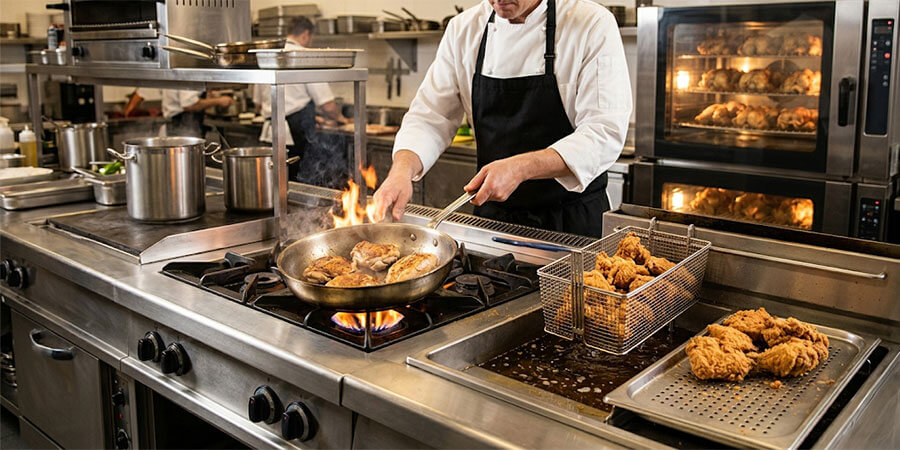
Table of Contents
Match the cooking equipment to the poultry dish so your ovens, pans, grills, and fryers support texture, speed, and food safety more reliably
Poultry is not one cooking problem. Roasted chicken, braised thighs, crispy fried chicken, grilled skewers, and volume-poached or simmered poultry all place different demands on the line. That is why the best cooking equipment for poultry dishes is rarely one universal answer.
The smarter question is which cooking method your menu depends on most often, and what kind of equipment makes that method easier to repeat safely, consistently, and at the right scale. Once you answer that, the equipment decision becomes much clearer.
Start With The Poultry Method, Not The Equipment Catalog
Poultry dishes are easier to plan when you organize them by method rather than by protein alone.
| Poultry Cooking Method: | Equipment Usually Matters Most: |
| Roasting or baking | Ovens and roasting pans |
| Braising or stewing | Braising pans, tilt skillets, rondeaus, steam kettles |
| Grilling or searing | Grills, griddles, charbroilers, saute pans |
| Frying | Fryers, draining and holding support |
| Simmering or poaching | Stockpots, kettles, or similar vessels |
That is the first important distinction. A kitchen that mostly roasts poultry should not be solving the problem the same way as a kitchen built around fried chicken or grilled skewers.
Ovens Usually Sit At The Center Of Poultry Programs
For many restaurants, poultry begins with the oven because roasting, baking, finishing, reheating, and pan-based production all depend on it.
The more useful oven questions are usually:
- Are you roasting in volume or baking to order?
- Does the menu need more even tray production or more specialty roasting?
- Is the poultry program one daypart or several?
- Does the kitchen need one oven to do many jobs, or one oven to do one poultry-heavy job extremely well?
That is why poultry equipment planning often starts with oven fit. The wrong oven does not only affect doneness. It affects volume, holding rhythm, and how easily the kitchen can recover through the shift.
For the broader oven comparison, oven selection still matters because poultry programs often depend on more than one kind of heat behavior across the day.
Pans And Vessels Matter Because Poultry Finishes Differently By Dish
This is one of the places where buyers often drift into generic cookware shopping instead of method-based equipment planning.
If the dish is roasted, the pan and oven combination matters. If the dish is braised, the vessel's depth and heat behavior matter more. If the dish is pan-fried or sauteed, surface area and response matter more.
| Poultry Goal: | Better Vessel Direction: |
| Even roast and pan juices | Roasting pans and oven support |
| Braised texture and liquid control | Braising pan or deeper vessel |
| Pan-seared or sauteed portions | Saute pan or griddle/grill support |
| Fried crispness | Fryer and draining support |
That is why a poultry-equipment conversation can never really be solved by asking “what pot should I buy” in the abstract. The dish decides the vessel.
For the product-side cookware angle, the key is to choose the vessel that matches the method instead of expecting one pan to solve every poultry dish equally well.
Griddles And Grills Matter When Poultry Is A Fast Line Item
If poultry is being grilled, seared, or finished quickly to order, the griddle or grill decision becomes central.
This is where operators need to think about:
- Surface area
- Recovery under repeated loading
- Control zones
- Whether the menu benefits more from flat-contact cooking or open-grate cooking
That is why chicken breasts, cutlets, sandwiches, skewers, and similar line-driven poultry items often push kitchens toward griddle or grill decisions rather than deep vessel decisions.
For that comparison logic, Electric vs Gas Griddles and Commercial Grills & Griddles are the strongest internal resources.
Fryers Matter When The Menu Depends On Crisp Texture And Speed
If poultry is breaded, fried, or served in high-volume fast-turn formats, fryer choice becomes one of the most important equipment decisions on the line.
That matters because fried poultry places heavy demand on:
- Recovery
- Basket or vat size
- Oil management
- Output during rush periods
This is why fried poultry and grilled poultry are not just different recipes. They are different equipment problems.
For the fryer side, Gas Fryers vs Electric Fryers is the best related read.
Batch Poultry Production Usually Rewards Bigger Vessels And Fewer Transfers
For schools, institutions, cafeterias, or banquet operations, poultry is often not only about one order at a time. It is about volume.
That is where equipment like braising pans, tilting skillets, rondeaus, or steam kettles can start to make more sense than a series of smaller pans or a line built only around a la minute finishing.
The value of that kind of equipment is not only capacity. It is also fewer handoffs and more controlled batch movement once the product is cooked.
This is why Tilting Skillet Uses and Benefits fit this topic naturally.
Food Safety Still Decides Whether The Equipment Is Actually Working
No poultry-equipment conversation is complete without temperature control and safe handling.
FDA and USDA guidance both point back to the same operational reality: poultry has to be cooked and handled in a way that reaches safe endpoints, and the most reliable way to confirm doneness is with a food thermometer rather than visual guesswork alone.
That means the right equipment is not only the piece that browns well or looks versatile. It is the piece that helps the kitchen hit its production target while still making it easier to reach safe internal temperatures consistently.
This matters even more in volume or mixed-equipment kitchens, where the real failure is often inconsistency between batches rather than one obvious catastrophic mistake.
It also means the best poultry equipment is often the equipment that helps the kitchen repeat the result, not only the equipment that makes the first batch look good. A great dish once is not the same thing as a reliable poultry program.
For the broader sanitation and temperature side, food safety still has to sit inside the equipment conversation rather than outside of it.
Holding, Resting, And Transfer Equipment Still Affect Poultry Quality
In a lot of kitchens, the equipment decision does not end when the cooking ends. Poultry can lose quality quickly if the kitchen has no clean plan for resting, transferring, or holding it once it leaves the main heat source.
That is why some poultry programs need to think just as carefully about hotel pans, transfer rhythm, brief holding support, and carving or plating flow as they do about the oven or fryer itself. The cooking method still matters most, but the post-cook handling often decides whether the result holds up until it reaches the guest.
The Better Question Is What The Poultry Program Needs Most Often
Some kitchens think they need the “best chicken cooker.” That is usually not the most useful question.
The better question is whether the poultry program needs:
- Consistent roasting
- Fast line finishing
- Crisp fried output
- Large-batch braising
- Simmering and stock-style volume work
That is what makes the equipment choice clearer. Poultry is only the ingredient. The method is what decides the equipment.
Equipment Choice Also Depends On Scale, Not Just Recipe
The same poultry dish can need a different equipment answer depending on scale.
A small restaurant doing occasional roasted chicken has a different need from:
- A cafeteria doing tray after tray of chicken quarters
- A quick-service concept built around fried chicken
- A catering operation producing braised thighs in batch
This is one reason the equipment discussion should always include volume, service style, and how much of the line the poultry program really occupies.
It also helps to think about how the station recovers between waves of production. Poultry menus that spike hard at one daypart often need equipment that can move from fast output to stable holding or transfer with less confusion than a purely recipe-focused plan would suggest.
That is one more reason these decisions should be framed by service pattern and not only by the ingredient itself.
In practical terms, that means a kitchen may cook the same poultry item with different equipment logic depending on whether it is serving thirty portions, three hundred portions, or one steady line of made-to-order plates. Scale changes the answer as much as the recipe does.
Thermometers And Verification Still Belong In The Equipment Conversation
The easiest equipment mistake with poultry is assuming the right oven, fryer, or braising setup automatically guarantees the right result.
It does not.
FDA and USDA guidance both reinforce the same practical point: safe poultry depends on measured internal temperature, not visual guesswork. That makes thermometers and verification habits part of the equipment conversation too, because the best setup is still the one that helps the kitchen reach and confirm safe endpoints consistently.
Frequently Asked Questions
What is the best cooking equipment for poultry dishes?
The best equipment depends on the cooking method. Roasted poultry usually points to oven support, braised poultry to deeper vessels or braising equipment, grilled poultry to grills or griddles, and fried poultry to fryers. The method matters more than the ingredient name alone.
What equipment is best for roasting chicken in a restaurant?
Ovens and roasting support usually matter most, especially when the kitchen needs even cooking, repeatable volume, and a predictable finishing rhythm. The exact oven type still depends on menu, throughput, and how many other jobs the oven is expected to carry.
What is best for fried chicken - a pan or a fryer?
In most commercial kitchens, a fryer is the stronger fit when fried poultry is a real menu category because it supports recovery, batch handling, and repeatable crisp texture more reliably than improvised pan frying.
Can one piece of equipment handle all poultry dishes?
Not usually. Poultry can be roasted, grilled, fried, braised, poached, or simmered, and those methods place different demands on the equipment. Some tools are flexible, but no single station is the best answer for every poultry application.
Why does a food thermometer matter when choosing poultry equipment?
Because the best equipment is still the equipment that helps the kitchen reach safe internal temperatures consistently. Poultry safety depends on measured doneness, not only on appearance or cooking time.
What is the biggest mistake when choosing poultry equipment?
Treating the entire poultry program like one cooking problem. The smarter approach is to choose equipment based on method, volume, and service style instead of assuming all chicken or duck dishes need the same setup.
Related Resources
- Food Safety Guide - Strongest internal food-safety support for poultry handling and temperature control.
- Types of Commercial Ovens - Better oven-selection context for roasted and baked poultry.
- Electric vs Gas Griddles - Useful if poultry service depends on griddle-style cooking.
- Gas Fryers vs Electric Fryers - Strong fryer comparison if fried poultry is central to the concept.
Share This!