Electric vs Gas Griddles
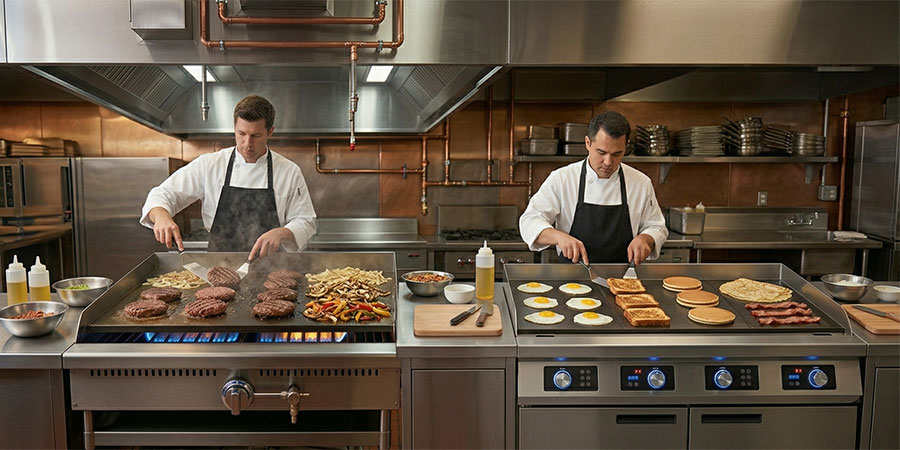
Table of Contents
Compare electric and gas griddles by recovery, control, installation, and line fit so the station works the way your kitchen needs it to
Electric and gas griddles are both common in commercial kitchens, but they do not behave the same way once real service pressure hits the line. The difference is not only fuel. It is also how the unit heats, how quickly it recovers, how precisely it holds a setting, what the building can support, and what kind of menu the station is expected to carry all day.
That is why the better griddle decision usually comes down to fit, not preference. A gas griddle may feel like the natural answer in one kitchen and the wrong installation burden in another. An electric griddle may feel cleaner and easier to control in one operation and too limited in another. The goal is to match the unit to the station's real job.
Start With How The Griddle Will Actually Be Used
The best comparison starts with the line itself.
| Griddle Role: | What Matters Most: |
| Heavy breakfast production | Recovery, even heat, and long service rhythm |
| Burger or sandwich line | Output, browning consistency, and easy workflow |
| Mixed-menu cookline | Flexibility, control zones, and footprint |
| Smaller satellite station | Utility fit, simpler install, and compact operation |
That matters because a griddle doing nonstop breakfast service has different demands from a griddle used for sandwiches and specials during one daypart. The more clearly you define the station, the easier the fuel decision becomes.
For the broader product category, Commercial Grills & Griddles are the strongest direct internal comparison point.
Gas Griddles Usually Appeal For Recovery And Open-Flame Infrastructure
Gas griddles are often chosen in kitchens that already have gas service, hood infrastructure, and a heavy-volume cookline that values rapid recovery under sustained use.
Their appeal is usually operational rather than romantic. In a kitchen that is constantly dropping cold product on the plate, strong recovery can matter a lot because the griddle does not get much rest between orders.
That said, gas still needs to be evaluated through the building. The unit may fit the menu well and still be the wrong answer if the site cannot support the install cleanly or if the broader hood and gas situation adds more complexity than the kitchen can justify.
Electric Griddles Usually Appeal For Control And Simpler Utility Logic
Electric griddles are often attractive when operators want more precise control, more predictable heat behavior, and a setup that can be easier to integrate where gas is less convenient.
That does not mean electric is automatically easier or better. It means the advantages usually show up in different places:
- More controlled temperature behavior
- Cleaner utility planning in some buildings
- Better fit in operations that do not need maximum gas-style recovery
- A station that may feel easier to manage for certain menu types
This is why electric griddles often feel strongest in kitchens that value consistency and controllability as much as raw throughput.
Heat Control And Recovery Are The Real Performance Differences
This is where most kitchens feel the gap.
| Performance Question: | Gas Griddle Tends To Favor: | Electric Griddle Tends To Favor: |
| Faster recovery under heavy continuous loading | Often stronger | Sometimes less so under sustained load |
| Tight, repeatable temperature control | Good | Often stronger |
| Simpler response to load changes | Strong when gas capacity is matched well | Strong when precision matters most |
| Cleaner station feel without combustion at the unit | Less likely | More likely |
That is why the answer is not as simple as “gas is hotter” or “electric is more efficient.” The real question is which performance trait matters more for your station.
For another fuel-type comparison built around commercial cooking equipment, it helps to look at how fuel decisions affect the rest of the line, not only the griddle itself.
Installation And Infrastructure Often Decide The Purchase
Some kitchens decide between gas and electric based on cooking preference. Many decide based on the building.
That means the operator should ask:
- Is gas already available where the griddle needs to go?
- Can the electrical service support the load cleanly?
- What does the hood and ventilation setup require?
- Is this a new build, replacement, or retrofit?
This is one reason the griddle conversation can never be separated from the site conversation. The wrong utility assumption can turn a reasonable griddle plan into a frustrating install project very quickly.
If ventilation or footprint constraints are already a concern, Commercial Cooking Without a Hood and Choosing Equipment for a Small Commercial Kitchen are the best internal companions.
Plate Thickness, Control Zones, And Surface Space Matter Too
Fuel type is only part of griddle performance. The plate itself still shapes the result.
Operators should still think carefully about:
- Plate thickness
- Width and depth
- Number of control zones
- How much of the surface is used continuously at peak
That matters because a badly sized or poorly zoned griddle can disappoint regardless of fuel type. The station has to fit the product mix and the service rhythm, not just the utility preference.
This is also where buyers should look past generic “best griddle” language. A breakfast-heavy line may care deeply about steady control across eggs, proteins, and potatoes at the same time. A lunch-heavy line may care more about recovery and continuous output. The same plate can feel excellent in one situation and underbuilt in another.
| Griddle Build Choice: | Why It Matters: |
| Thicker plate | Helps hold heat under heavier production |
| More zones | Supports different products and temperatures at once |
| More width | Adds capacity, but only if the line can use it efficiently |
| Better fit to menu | Prevents paying for surface you do not actually use |
Maintenance And Cleaning Feel Different On Each Setup
Both fuel types need regular maintenance. The details just differ.
Gas griddles usually bring more combustion-related inspection and cleaning considerations. Electric griddles usually shift the focus more toward element performance, control reliability, and surface behavior over time.
Neither one gets a free pass on cleaning, plate care, and day-to-day reset. If the griddle station is hard to clean or hard to reset, the team will feel it every shift no matter what fuel it uses.
That matters more than some buyers expect because griddles often sit in constant use during busy periods. A unit that is easier to keep stable, easier to reset, and easier to clean usually supports stronger line discipline overall, not only easier maintenance.
For the cleaning side, Commercial Range Cleaning Guide is the strongest related read in the repo.
Utility Cost And Emissions Questions Still Depend On Local Context
One reason fuel comparisons get noisy is that operators want one universal answer on cost and sustainability. In practice, those questions depend on local utility rates, the building's infrastructure, and how the station is actually used day to day.
That is why it is safer to frame electric and gas as different operational tradeoffs rather than to overclaim a winner in every market. Performance metrics and station fit are easier to compare cleanly than universal cost or emissions claims are.
The Better Choice Usually Depends On The Whole Line, Not The Griddle Alone
This is one reason operators get stuck on the question longer than they expect. The griddle's success depends partly on what surrounds it:
- Nearby refrigeration or prep support
- Hood performance
- Staff movement on the line
- What other hot equipment is already competing for utility and ventilation capacity
That is why a gas griddle can be the perfect answer in one kitchen and the wrong answer in another with a nearly identical menu. The larger line context decides more than buyers often expect.
When Gas Usually Makes More Sense
Gas is often the stronger fit when:
- The kitchen already has the right gas and hood infrastructure
- The griddle will carry heavy, repeated volume
- Faster recovery under continuous loading matters more than fine control
- The operation is already built around a gas-heavy hot line
That is not a universal rule. It is just a common pattern.
When Electric Usually Makes More Sense
Electric is often the stronger fit when:
- The site makes electrical installation simpler than gas extension
- The kitchen values precise, repeatable heat control highly
- The station is not being asked to win on gas-style recovery under nonstop heavy load
- Cleaner utility logic and easier integration matter more than maximum combustion-driven output
Again, the point is not that electric is categorically better. The point is that it solves a different kind of fit problem well.
That is why many good griddle decisions end up sounding less dramatic than buyers expect. The strongest answer is usually the one that works better with the kitchen's actual utilities, menu pace, and staffing habits - not the one that wins the loudest argument on paper.
Frequently Asked Questions
Is a gas or electric griddle better for a restaurant?
Neither is universally better. Gas often appeals in high-volume, hood-equipped kitchens that value recovery under sustained load. Electric often appeals in operations that value more precise control or cleaner utility planning. The right answer depends on the menu, the line, and the building.
Do gas griddles recover faster than electric griddles?
In many high-volume situations, gas griddles are often chosen for stronger recovery under repeated loading. But recovery still depends on plate size, plate thickness, input capacity, and how the station is actually being used.
Are electric griddles easier to install?
Sometimes, especially where electrical service is easier to support than extending gas and ventilation infrastructure. But the right answer depends on the building, the unit's electrical load, and the overall kitchen setup.
What matters more - fuel type or plate size?
Both matter, but buyers often underestimate plate size, thickness, and zoning. A poorly sized griddle can disappoint regardless of whether it runs on gas or electric.
Is a griddle the same as a flat top grill?
In restaurant use, those terms are often used very closely because both refer to a flat cooking surface used for items like burgers, breakfast, sandwiches, and other direct-contact cookline work. The more important differences usually show up in build, size, and fuel type rather than in the label alone.
What is the biggest mistake when choosing between gas and electric griddles?
Treating it as a simple fuel preference instead of a line-fit question. Recovery, control, utilities, hood constraints, and station role usually matter more than a general opinion about gas versus electric.
Related Resources
- Commercial Grills & Griddles - Category hub for griddles, grills, and flat-top cooking equipment.
- Gas Fryers vs Electric Fryers - Helpful if you are comparing fuel tradeoffs more broadly across the line.
- Commercial Cooking Without a Hood - Useful when ventilation constraints shape the decision.
- Choosing Equipment for a Small Commercial Kitchen - Stronger compact-line planning if the griddle has to earn a tight footprint.
Share This!