Grease Trap Sizing Guide
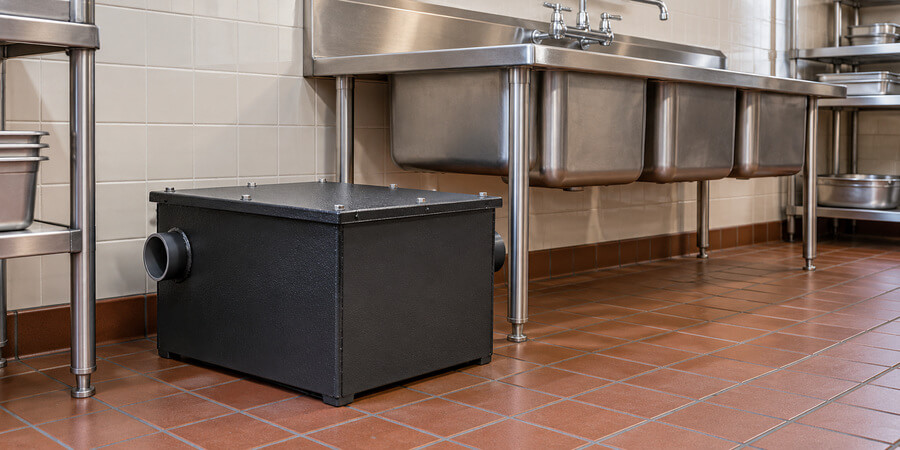
Table of Contents
How to work out the flow your sinks send to a grease trap, pick the rated size and capacity, and place it where it can be cleaned
A grease trap is sized by flow rate: add up the water the sinks that drain into it can release, take 75 percent of it, and divide by the drain time your plumbing code uses, one or two minutes. Pick the next trap rated at or above that many gallons per minute; its grease capacity in pounds runs twice the flow rate on every trap we list.
Grease Trap Sizes by Flow Rate
| Flow rate: | Grease capacity: | Inlet and outlet: | Size on our listings (W x D x H): | Semi-automatic option: |
| 4 to 7 GPM | 8 to 14 lb | 2 in | About 10 to 18 x 10 to 16 x 11 to 18 in | No |
| 10 to 15 GPM | 20 to 30 lb | 2 to 2-1/2 in | About 14 to 22 x 14 to 21 x 12 to 14 in | Yes |
| 20 to 35 GPM | 40 to 70 lb | 3 to 3-1/2 in | About 16 to 30 x 15 to 29 x 13 to 19 in | Yes |
| 50 to 75 GPM | 100 to 150 lb | 3 to 4 in | About 22 to 40 x 22 to 31 x 21 to 24 in | Yes |
| 100 to 250 GPM | 200 to 500 lb | 4 in | About 40 to 52 x 31 to 34 x 33 to 46 in | No |
| 300 to 500 GPM | 600 to 1,000 lb | 6 in | About 76 to 91 x 48 to 60 x 48 to 63 in | No |
The two numbers move together. Every trap on our listings pairs its flow rate with a grease capacity of twice that number in pounds, so a 20 GPM trap holds 40 pounds of grease and a 50 GPM trap holds 100. Size by flow first; the capacity follows.
Small traps sit at the sink, large ones are set on or into the floor. The units up to about 35 GPM fit under or beside a sink or a small bank of fixtures. From about 100 GPM up, the traps on our listings run from a little over three feet to more than seven feet across and serve a whole kitchen's drain line.
How to Size a Grease Trap
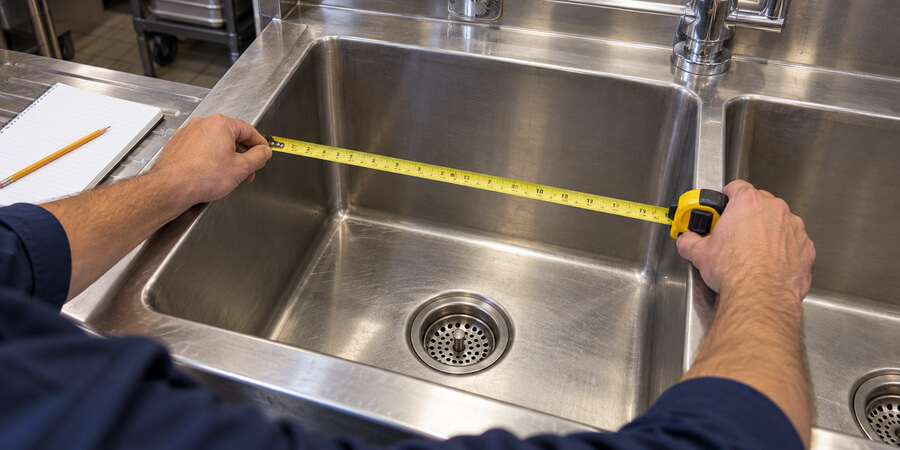
This is the sizing method the Plumbing and Drainage Institute publishes and grease trap makers rate against.
- Measure each sink compartment inside: length, width and depth in inches.
- Multiply the three and divide by 231 to get gallons, then multiply by the number of compartments.
- Take 75 percent of that total. The rest allows for the pots, pans and dishes sitting in the water.
- Divide by the drain time your local code uses, one minute or two, to get gallons per minute.
- Choose the trap rated at or above that figure, and add the flow from any other fixture that drains into the same trap.
Your plumbing code picks the drain time. A one-minute drain doubles the flow, and roughly doubles the trap, compared with two minutes. The plumbing inspector or engineer on the job also decides which fixtures drain through the trap. Many codes limit whether food waste disposers and dishwashers may drain to a grease trap, and the rules differ from place to place, so confirm both before ordering.
| Sink setup (inside bowl size): | Bowls filled to the brim: | Flow at a 1-minute drain, after the 75 percent step: | Trap at 1 minute: | Trap at 2 minutes: |
| 1 compartment, 18 x 18 x 12 in | About 17 gal | About 13 GPM | 15 GPM, 30 lb | 7 GPM, 14 lb |
| 2 compartment, 18 x 18 x 12 in | About 34 gal | About 25 GPM | 35 GPM, 70 lb | 15 GPM, 30 lb |
| 3 compartment, 18 x 18 x 12 in | About 51 gal | About 38 GPM | 50 GPM, 100 lb | 20 GPM, 40 lb |
| 3 compartment, 20 x 20 x 12 in | About 62 gal | About 47 GPM | 50 GPM, 100 lb | 25 GPM, 50 lb |
| 3 compartment, 24 x 24 x 14 in | About 105 gal | About 79 GPM | 100 GPM, 200 lb | 50 GPM, 100 lb |
When the math lands between two ratings, take the higher one. The two-compartment row shows why: about 25.2 GPM sits just over the 25 GPM rating, so the next size up, 35 GPM, is the one that fits. A trap that is too small lets water rush through before the grease can separate.
Measure your own bowls. Bowl widths on our three compartment sinks run from about 10 to 30 inches and depths from 10 to 14, so a chart row is a starting point, not your answer.
Flow Control, Venting and Placement
The flow control fitting is part of the rating. Most traps on our listings include a flow control fitting or plate, which holds incoming water to the trap's rated flow. Install it; a trap rated at 20 GPM is only a 20 GPM trap when the flow is held there.
Venting. Some models ship with a vent fitting and a vented inlet flow control; how the trap and fixtures are vented follows your local plumbing code and is the plumber's call.
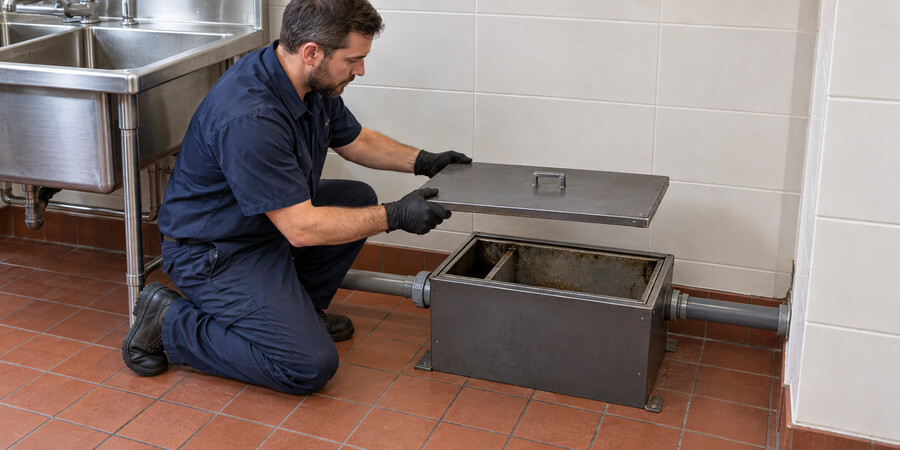
Put it where it can be opened. The FDA Food Code asks that a grease trap, if used, sit where it is easily accessible for cleaning (section 5-402.12). FDA's reason: a trap that cannot be reached and cleaned can harbor pests or lead to a failure of the sewage system.
Floor, recess or under the sink. Some smaller traps on our listings are made to sit on the floor or recessed into it, and the cover has to come off for cleaning, so leave clearance above it. The large units need their covers reachable too.
Standard or Semi-Automatic
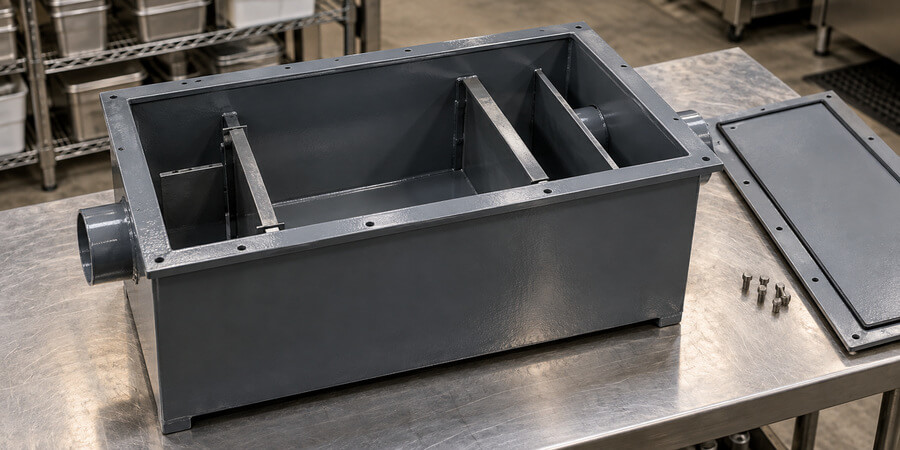
Standard traps are cleaned by opening the cover and removing the collected grease by hand. They come in carbon steel or epoxy-coated steel on our listings, most with a removable baffle and a skid-proof cover.
Semi-automatic traps add a draw-off with a flexible hose and an outlet shut-off valve, so collected grease can be drawn off through the hose. On our listings they run from 10 to 75 GPM, the sizes that sit at or near the sink.
Cleaning sets the real capacity. A trap only holds its rated pounds of grease if it is emptied before it fills. How to do that is in the grease trap cleaning guide listed below.
Frequently Asked Questions
What size grease trap do I need for a 3 compartment sink?
Three 18 x 18 x 12 inch bowls hold about 51 gallons; at the 75 percent factor about 38 gallons drain, which calls for a 50 GPM, 100 pound trap on a one-minute drain or a 20 GPM, 40 pound trap on a two-minute drain. Measure your own bowls and check which drain time your code uses.
How do you calculate grease trap size?
Multiply each compartment's inside length, width and depth in inches, divide by 231 for gallons, multiply by the number of compartments, take 75 percent, and divide by the drain time in minutes. The result is the flow rate in GPM; choose the next trap rated at or above it.
What does GPM mean on a grease trap?
Gallons per minute, the most water the trap is rated to take while still separating grease. On every trap we list, the grease capacity in pounds is twice the GPM rating.
Is a grease trap the same as a grease interceptor?
Our listings use both names for the same units, from 4 GPM traps that sit under a sink to 500 GPM units that serve a whole kitchen. Your local code may use one term for specific sizes, so match its wording on the permit.
Where should a grease trap be installed?
Where it can be opened and cleaned easily, which the FDA Food Code asks for, and where your plumbing code allows for venting and the fixtures it must serve. Some smaller units sit on or recessed into the floor near the sinks they serve.
Shop Grease Traps
Work out the flow first, then pick the rating. Our grease traps and grease interceptors filter by grease capacity from 8 to 1,000 pounds, and each listing gives its flow rate, inlet size and footprint, so you can check the trap fits under the sink or in the floor space before it ships.
Related Guides & Resources
- Grease Trap Cleaning Guide - Step-by-step cleaning and upkeep for the trap you install.
- Commercial Sink Sizing Guide - Bowl sizes and compartment rules for the sinks that feed the trap.
- Commercial Dishwasher Guide - Machine types and capacity for the dish line.
Share This!