Countertop & Nugget Ice Machine Guide
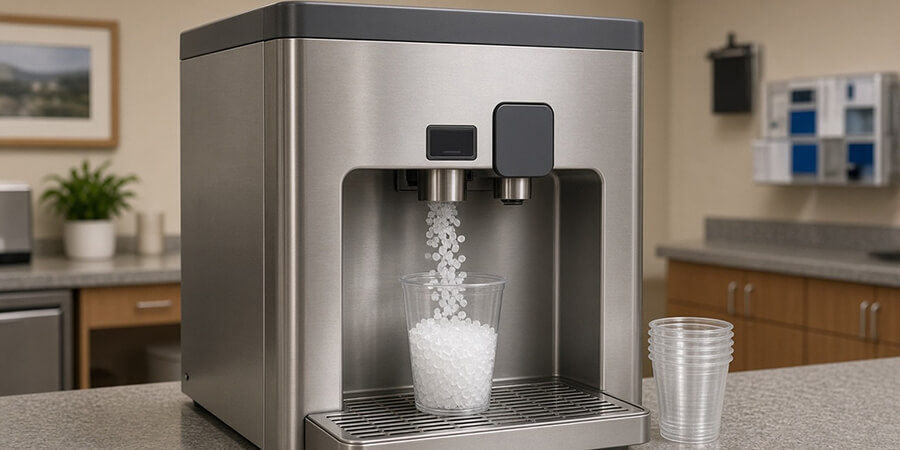
Table of Contents
Countertop dispensers, undercounter nugget machines and modular heads compared, with sizing by application and setup requirements
A countertop ice machine is a self-contained unit that makes ice, stores a small reserve and dispenses it by cup at the counter, and nearly every commercial countertop model makes nugget ice - the soft, chewable style that fountain drinks, healthcare floors and breakrooms run on. Choosing one comes down to five decisions: the format (countertop dispenser, undercounter machine or modular head), the daily production your busiest day needs, how much storage the format gives you, the dispensing method your customers or staff will use, and the utilities the spot can support. This guide works through each with the ranges you will actually find on the market, so a store, a clinic or an office can pick a machine that keeps up without buying more than it needs.
Countertop, Undercounter or Modular: Which Nugget Format Fits
Nugget ice comes out of three machine formats, and the format matters more than the ice, because it decides where the machine lives, how ice gets from the bin to the cup, and how much can wait in reserve.
| Format: | Where it sits: | Daily production: | Ice storage: | Who it serves: | How ice comes out: |
| Countertop ice and water dispenser | On a counter, table or dedicated stand | About 125 to 425 lb per 24 hours | Small, roughly 5 to 50 lb | Convenience stores, quick-service self-serve, offices, healthcare units | Cup-fill by lever, push button or touchless sensor |
| Freestanding floor dispenser | Floor, hallway or alcove | Up to about 425 lb per 24 hours | Larger, roughly 25 to 90 lb | Hotel corridors, cafeterias, high-traffic self-serve | Cup or bucket fill, larger opening |
| Undercounter nugget machine | Beneath a counter or back bar | About 85 to 425 lb per 24 hours | Built-in bin, roughly 20 to 100 lb | Bars, cafes, prep areas, small kitchens | Staff scoop from the bin |
| Modular nugget head | Stacked on a bin or a floor dispenser | Sized separately from its bin; the highest-volume option | Whatever bin or dispenser it sits on | High-volume restaurants, healthcare central supply, large self-serve stations | Depends on the base: scoop bin or dispenser |
Production and storage figures reflect the ranges across the machines in our own catalog, so they describe what is realistically available rather than a single model.
Countertop dispensers are the format most people mean by "countertop ice machine." The ice maker, a small storage hopper and the dispensing chute share one cabinet, most models add chilled water, and the whole unit runs on a standard outlet. Widths run from about 13 inches to the mid-30s, and most are 22 to 24 inches deep, so they fit a beverage station or breakroom counter. The complete range is under ice and water dispensers, where most units dispense both ice and water and a smaller group dispense ice only.
Undercounter nugget machines trade the dispenser for a bigger built-in bin and a scoop. They are the right call where staff, not the public, handle the ice: behind a bar, beside a coffee station, or in a prep area where floor space is scarce. Cabinets run 14 to 29 inches wide, and the ADA-height versions keep the bin reachable from a seated position. Browse them under undercounter nugget ice machines.
Modular nugget heads are for volume. The head makes the ice and drops it into whatever sits beneath it - a scoop bin for the back of house or a floor dispenser for public access - so production and storage are chosen independently. Heads in our catalog are grouped with the other air cooled nugget ice machines, and the bins that carry them are covered in our ice bin sizing guide.
How Much Ice a Countertop or Nugget Machine Needs to Make
Machines are rated in pounds of ice per 24 hours, so sizing starts with a daily demand figure. The consumption standards below are the ones we publish across our ice guides; apply them to your busiest realistic day, not an average one.
| Application: | Planning figure: |
| Fountain drinks, 7 to 12 oz cup | 5 oz of ice per cup |
| Fountain drinks, 12 to 16 oz cup | 8 oz of ice per cup |
| Fountain drinks, 16 to 24 oz cup | 12 oz of ice per cup |
| Restaurant table service | 2 lb per person served |
| Cocktail service | 3 lb per seat |
| Cafeteria or breakroom | 1 lb per person |
| Hospital patient ice | 10 lb per bed |
| Nursing home patient ice | 6 lb per bed |
| Hotel guest ice | 5 lb per room, 7 to 8 lb where guests fill coolers |
| Events and banquets | 2 lb per attendee |
Three worked examples show how the formats sort themselves out:
A convenience store pouring 600 fountain drinks on a Saturday, mostly in 16 oz cups, needs 600 x 8 oz, or 300 lb of ice. A 425 lb countertop dispenser covers it with margin; a 200 lb unit would run dry by mid-afternoon.
An office breakroom serving 80 employees needs about 80 lb a day by the cafeteria figure. The smallest countertop dispensers, in the 125 to 160 lb range, carry that comfortably, which is why they are the standard breakroom machine.
A 40-bed nursing wing needs 40 x 6 lb, or 240 lb a day. A 300 to 340 lb undercounter nugget machine handles it with staff scooping, or a 425 lb countertop dispenser handles it with touchless patient access. The choice is about who dispenses, not about capacity.
Two rules protect the math. First, oversize: production ratings are measured with cool incoming air and cool water, and a warm kitchen or a warm water line cuts real output, so buy above the calculated need rather than at it. Second, remember that the number is per 24 hours - a machine rated at 300 lb makes roughly 12 lb an hour, and a rush that draws 40 lb in an hour is served from storage, not from production. That is the next section.
Production vs Storage: Why Small Bins Work on a Countertop
Countertop dispensers store surprisingly little - many hold only 5 to 20 lb - and that is by design. A cup-fill dispenser hands out a few ounces at a time while the machine replenishes the hopper continuously, so the small reserve rarely matters as long as production keeps pace with the day. The format fails only when demand arrives in bursts bigger than the hopper: a lunch line that fills 60 cups in ten minutes will drain a 7 lb hopper and wait on the machine.
That is the dividing line between a countertop dispenser and a floor dispenser. Floor units hold 25 to 90 lb, absorb bursts, and are the right choice for hotel corridors where guests fill buckets, or for cafeterias with a hard lunch peak. Hotel service is its own case: guest ice buckets take pounds at a time, so the dedicated units under hotel ice machines pair higher production with large storage and a wide bucket opening.
Undercounter machines sit in between. Their built-in bins of 20 to 100 lb are sized for a bar or cafe that scoops steadily through a shift, and the bin doubles as the buffer for a rush. Modular heads escape the tradeoff entirely, because the bin beneath them is chosen separately - the pairing rules are in our ice bin sizing guide, and the bins themselves are under ice bins and dispensers.
Dispensing Methods and Sanitation
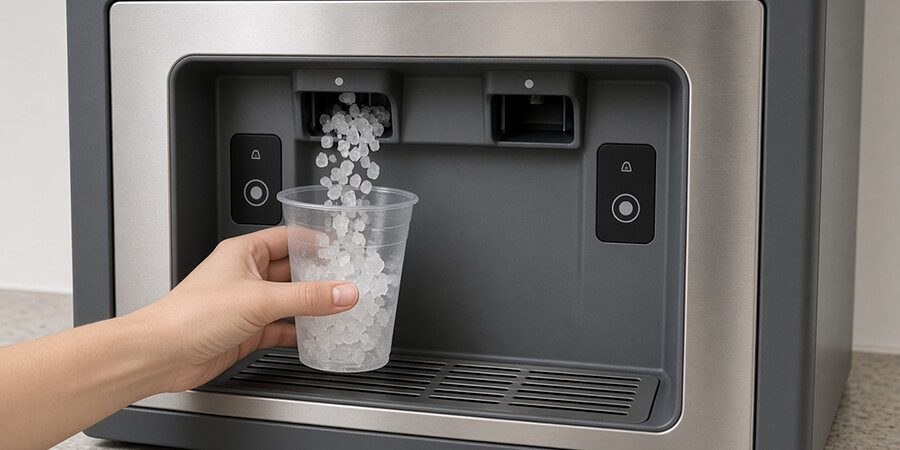
Dispensers exist because of a sanitation problem: any ice that the public can reach with a scoop, a cup or a hand is ice that can be contaminated, and health inspectors treat an open bin in a public area accordingly. A dispenser keeps the stored ice sealed and releases it on demand, which is why countertop and floor dispensers are the standard wherever customers, patients or guests serve themselves.
Three dispensing methods are common. A push lever is the simplest and most durable, activated by pressing the cup against it. A push button gives the same control with one hand free. A touchless infrared sensor detects the cup and dispenses without contact, the preferred option in healthcare and in any operation that wants a no-touch station. Sensor dispensing is the most common method across the countertop machines we offer, with lever units a close second.
Two more choices matter at the counter. Most countertop dispensers pour chilled water as well as ice, so one machine covers a water station; a smaller group dispense ice only for stations that already have water. And ADA-compliant models place the dispensing point and controls within reach from a wheelchair, which matters in healthcare, schools and public buildings.
Utilities, Footprint and Installation
A countertop machine is easy to place, but it is not plug-and-play in the way a coffee maker is. Four utilities decide whether a spot will work.
| Requirement: | Countertop dispenser: | Undercounter nugget machine: | What to check: |
| Electrical | Standard 115 V outlet on most models | 115 V on nearly all models | Dedicated circuit for reliability; larger modular heads may need higher voltage - confirm on the spec sheet |
| Water supply | Cold water line with shutoff | Cold water line with shutoff | Inlet size and pressure per the manual |
| Drain | Required; gravity drain to a floor sink or an optional drain pump | Gravity drain standard, drain pump versions available | A drain within reach, or plan for a pump |
| Ventilation | Air cooled models need clearance to breathe | Air cooled units are front-breathing or side-venting | Clearance per the manual; water cooled for hot or enclosed spots |
| Footprint | Roughly 13 to 34 in wide, 22 to 24 in deep on most | Roughly 14 to 29 in wide, 22 to 28 in deep | Counter depth and weight rating; a matching stand for floor placement |
Cooling deserves a moment. Air cooled machines are the majority and the simplest to install, but they reject heat into the room and need open airflow; a countertop dispenser boxed into a tight cabinet will lose production and shorten its life. Water cooled versions hold output in hot or enclosed spots at the cost of water use, and they are the reason some dispensers and undercounter models are offered in both.
Filtration is not optional on a nugget machine. Nugget and flake makers freeze water on a cylinder and push it out with an auger, and hardness scale on that cylinder cuts production and wears the mechanism. A dedicated cartridge from our ice machine water filters selection protects the machine and the taste of the ice; sizing the cartridge to the machine's flow is covered in our restaurant water filtration guide.
Nugget vs Cube for These Formats
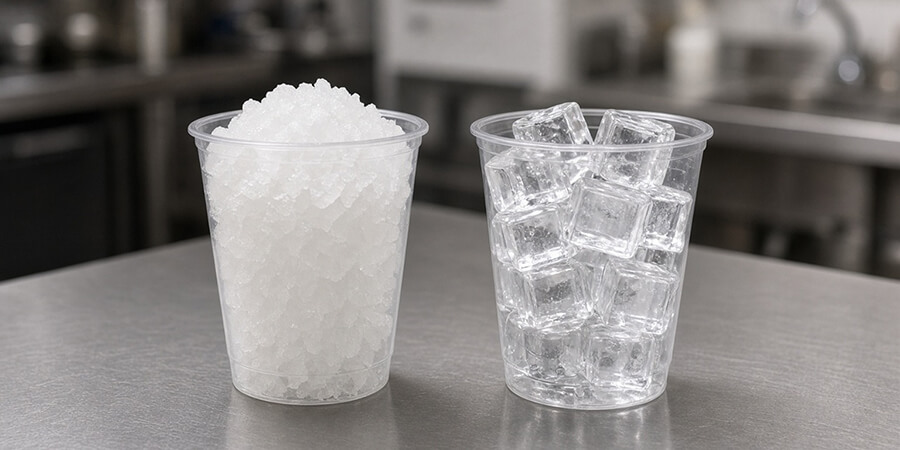
Nugget ice dominates countertop and dispenser formats for practical reasons: it flows cleanly through a dispensing chute, it packs a cup without bridging, it chills fountain drinks fast, and it is soft enough to chew, which is why patients, students and soda drinkers ask for it by name. Some dispensers offer cube ice for operations that prefer it, and undercounter machines come in every ice type. Our guide to which ice type is best for your restaurant covers how each style is made, how fast it melts, and which drinks it suits, so the short version here is: pick nugget for self-serve, fountain and healthcare, and let the ice type guide settle the bar.
Cleaning and Maintenance for Nugget Machines
Nugget machines carry one maintenance difference from cubers: the auger and evaporator cylinder that make the ice are moving parts in constant contact with water, so scale and biofilm affect them sooner. Manufacturers commonly call for a full clean and sanitize at least twice a year, and more often in hard-water areas or in high-use sites like convenience stores and healthcare units. The dispenser side adds its own routine - the chute, drip tray and drain line collect residue and need regular sanitizing - and the touch points on lever and button models are wiped down like any counter surface.
Keep the routine simple: put the cleaning cycle on the same calendar as the filter change, use only the cleaner and sanitizer the manufacturer specifies for the machine's metals, and keep the products on hand from our ice machine sanitation selection so the schedule never slips for lack of supplies. Our commercial ice machine cleaning walkthrough covers the step-by-step process.
Frequently Asked Questions
What is a countertop ice machine?
A self-contained commercial unit that makes ice, holds a small reserve and dispenses it by cup from a counter or stand. Nearly all commercial countertop models produce nugget ice, most also dispense chilled water, and they run on a standard 115 V outlet with a water line and a drain.
Do countertop ice dispensers need a drain?
Yes. The ice maker sheds meltwater and the dispenser has a drip tray, so a gravity drain to a floor sink is standard, with a drain pump option where no drain is within reach. Plan the drain before the counter location.
What size nugget ice machine does a convenience store need?
Multiply cups per busy day by the ice per cup: 5 oz for 7 to 12 oz cups, 8 oz for 12 to 16 oz, 12 oz for 16 to 24 oz. A store pouring 600 sixteen-ounce drinks needs about 300 lb a day, which points to a 425 lb countertop dispenser with margin for hot weather.
Countertop or undercounter - which is right?
Choose by who dispenses. If customers, patients or staff serve themselves in a public area, a countertop or floor dispenser keeps the ice sealed and sanitary. If staff scoop ice behind a bar or in a prep area, an undercounter nugget machine gives a bigger bin in less floor space.
Can a countertop ice dispenser sit on the floor?
Yes, on a matching stand. Manufacturers make enclosed stands that bring a countertop dispenser to serving height and hide the plumbing, which is the usual setup in cafeterias and self-serve beverage stations without counter space.
Do nugget ice machines need special electrical service?
Countertop dispensers and undercounter nugget machines almost all run on a standard 115 V outlet, though a dedicated circuit is good practice. Larger modular heads can require higher voltage, so check the spec sheet before running power.
Are nugget ice makers suited for high-volume restaurant use?
Yes, in the right format. Undercounter nugget machines reach roughly 425 lb a day with built-in bins near 100 lb, and modular nugget heads on a bin scale well beyond that. Countertop dispensers are the wrong tool for back-of-house volume, not because of the ice but because of their small hoppers.
Do nugget machines need water filtration?
More than most ice machines. Scale on the evaporator cylinder slows the auger and reduces output, so a scale-inhibiting filter cartridge sized to the machine is standard practice, and a softener may be warranted in very hard water.
How much ice does a countertop dispenser store?
Usually 5 to 20 lb, with larger countertop models holding up to about 50 lb. That is enough for continuous cup service because the machine refills the hopper as it dispenses; operations with bucket-fill or sharp lunch peaks should look at floor dispensers with 25 to 90 lb of storage.
How often should a nugget ice machine be cleaned?
At least twice a year for a full clean and sanitize, per most manufacturers, and more often in hard-water areas or high-use locations. The dispensing chute, drip tray and drain line need routine sanitizing between full cleanings.
Shop Countertop and Nugget Ice Machines
Every format in this guide maps to a section of our ice catalog: nugget ice and water dispensers for countertop and floor self-serve, undercounter nugget machines for scoop service, modular heads and bins for volume, and the filtration and sanitation supplies that keep them producing.
Related Guides & Resources
- Which Type of Ice Is Best for Your Restaurant - Every ice style compared: how it is made, how fast it melts, and which drinks it suits.
- Commercial Ice Machine Buying Guide - The full sizing method, consumption tables and cooling choices for every machine type.
- Undercounter Ice Machine Guide - Types, cooling systems and selection tips for the scoop-service format.
- What Size Ice Bin Do You Need - Pairing modular heads with bins by production and peak demand.
- Soda Fountain and Beverage Dispenser Guide - The dispenser these machines feed: valve count, cooling method and sizing by service style.
- Restaurant Water Filtration Guide - Station-by-station filtration, including what an ice machine needs and how to size the cartridge.
Share This!