Soda Fountain and Beverage Dispenser Guide
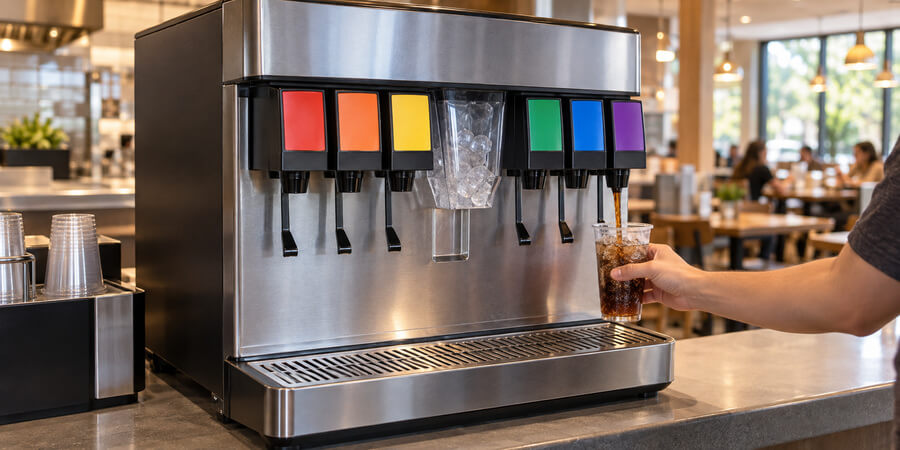
Table of Contents
How to choose a fountain dispenser by system type, valve count, cooling method, ice capacity and water
A soda fountain is not one machine. It is a water line, a gas line, a syrup rack, a cooling method and a row of valves, and four of those five live somewhere other than the counter.
That is what makes the first purchase go wrong. This guide covers how post-mix and pre-mix differ, what each format needs behind the wall, how valves and ice are sized, and what the cleaning schedule actually is.
What a Soda Fountain System Actually Is
A fountain dispenser brings four supplies together at a nozzle: chilled water, carbon dioxide, flavored syrup and, in most units, ice.
The counter is the smallest part of the job. A typical post-mix installation needs the following around the dispenser: a high-pressure regulator, a low-pressure regulator, a gas manifold, a CO2 supply with a restraining chain, beverage tubing, a syrup pump, a syrup rack and a water regulator. Every one sits in the back room or under the counter and is a separate purchase.
Carbonation carries a plumbing rule with it. The FDA Food Code explains that carbon dioxide mixed with water forms carbonic acid, and that if gas backs up into a copper line the acid dissolves the copper, so "the first few customers receiving the drinks are likely to suffer with the symptoms of copper poisoning." The backflow device in front of a carbonator is not optional.
What a Soda Fountain Buys the Kitchen
Margin on the highest margin item on the menu. A post-mix system buys concentrate and makes the drink on site, which is why quick-service operators run one rather than stocking cans. Concentrate plus your own water and gas is why the format exists at all.
Labor taken out of the drink. A self-serve tower lets the guest pour and refill without staff, removing a trip per order when the counter is busiest. Food Code section 4-204.13 requires self-serve equipment to keep the delivery orifice away from manual contact and to prevent contact with the lip contact surface of cups being refilled, which is what makes guest refills lawful.
Speed that matches the fryer. Manufacturer flow settings pour a ten-ounce drink in roughly four to six seconds, which puts a large cup well under fifteen seconds at one valve. Valve count, not machine size, caps a rush.
Consistency the guest can taste. The syrup to water proportion is set with a ratio cup at install and trimmed with a screwdriver at each valve, so once dialed in the drink does not drift. That is a benefit and an obligation at once, because a valve nobody checks is a valve that drifts.
Post-Mix and Pre-Mix: The Two Ways to Build a Fountain
Every fountain is one or the other, and the choice decides what you store, plumb and clean.
Post-mix keeps syrup and water apart until the nozzle. Concentrated syrup arrives in a bag inside a corrugated box, a pump pushes it to the valve, a carbonator makes soda water from your own supply, and the two meet as the drink pours.
Pre-mix arrives already mixed, and the trade is storage against simplicity. Finished carbonated beverage is delivered in sealed tanks and gas pushes it to the valve, with no carbonator, no syrup pump and no water connection to carbonate. Post-mix stores concentrate, so a week of drinks takes a fraction of the floor space, but its pumps, regulators and syrup lines all need setting, checking and sanitizing. Decide which problem you would rather own.
The Dispenser Formats and Where Each One Fits
Four formats cover almost everything sold, separated by where the ice comes from and where the machine sits.
| Format: | Where the ice is: | What it suits: | Typical published dimensions: |
| Countertop ice and beverage | Integral bin inside the cabinet | Quick-service counters, convenience stores, concessions | 22 to 44 inches wide, 30.5 deep, 34 high |
| Drop-in ice and beverage | Integral bin, set into the counter | Self-serve beverage bars, cafeterias, fixed millwork | 30 wide, 23 deep, 35.25 high, cutout 30.25 by 23.25 |
| Countertop mechanically refrigerated | No ice bin; a refrigeration deck holds an ice bath | Bars and back counters with an ice source elsewhere | About 32 inches high; width and depth vary by model |
| Tower with remote cooling | Remote unit under or behind the counter | Long self-serve runs the counter cannot carry | Set by the tower length and the remote cooling unit |
Read the placement filter before the size filter. The catalog splits listings into countertop and drop-in, and the two are not interchangeable once the counter is cut. A drop-in needs an opening cut to a published template, and installation manuals ask for a countertop able to safely support a four hundred pound load.
Depth and height are the dimensions that surprise people. Countertop units commonly run deeper than a standard work counter at every width, and a drop-in sits taller than a countertop unit once it is installed. Under a menu board, height decides whether the lid opens.
Valve Count and Flavor Stations
The valve count is the flavor count, and it is the first decision a buyer makes. Listings filter by valve count in even steps from a pair up to a dozen, and the middle of that range carries most of the catalog.
Count the brands you pour, then add one. Each valve is one flavor permanently, because each has its own syrup line back to its own box, so adding a flavor later means adding a valve, a line and a pump. A menu that looks like four flavors is usually six or eight once the sugar-free versions and the tea are counted.
Some valves pour plain water and some cannot. Many units use adjustable back blocks that let a chosen valve run carbonated or plain water, but some plumb the first few valves for carbonated drinks only. Check before ordering if still water matters.
How the Drink Gets Cold
Three cooling methods show up, and each decides what else you have to buy.
Ice-cooled cold plate units chill the drink with the ice in the bin. Beverage lines run through a metal plate under the ice, so the drink is cold at the nozzle and the same ice fills the cup. It is the cheapest cooling to buy and the most dependent on ice supply, and manufacturers want ice sitting on the cold plate for about an hour before drink ratios are set.
Mechanically refrigerated units carry their own refrigeration deck. These hold a chilled water bath instead of a bin of cube ice, so they pour cold drinks with no ice supply at all. The water bath adds real weight and the refrigeration deck draws several times the current of an ice-cooled machine, so the circuit and the counter both need checking. A remote system instead puts a small tower on the counter and the cooling below.
The Food Code has a rule about tubing in the ice. Section 4-204.16 bars beverage tubing and cold plate cooling devices from contact with stored ice, except for cold plates built integrally with the bin, because condensation runs down tubing into the ice and a bin full of hardware cannot be cleaned.
Bag-in-Box Syrup, Pumps and the Back Room
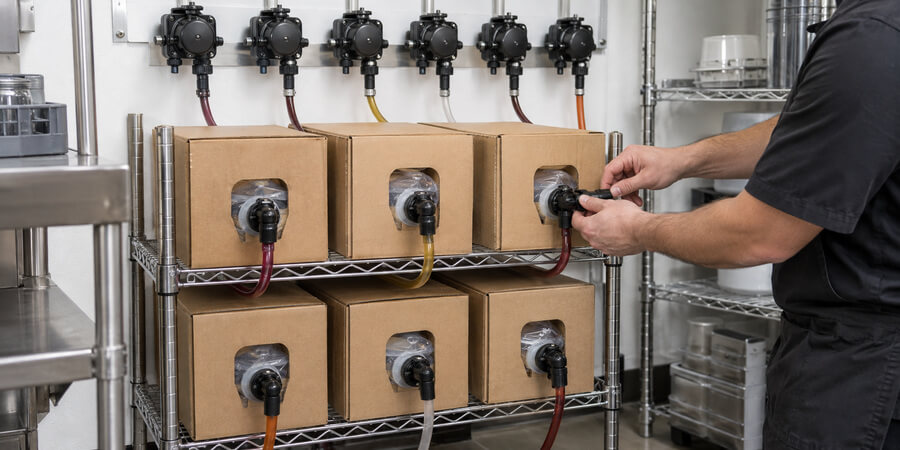
Post-mix syrup arrives as a bag inside a corrugated box, and the boxes sit on a rack with a pump for each flavor. This is where the back room floor space goes.
Every flavor needs its own pump and its own line. Plan one lane per valve and a spare box per flavor, because a bag that runs dry mid rush takes a valve out of service. Installation manuals site the remote carbonator, the syrup pumps, the CO2 tank, the syrup boxes and the water filter together, which is an honest picture of how much room a fountain needs.
Syrup lines are cleaned as a system, not wiped. The manufacturer procedure flushes each line with clean water, lets a cleaning solution stand in it for half an hour, rinses with warm potable water, then lets sanitizer stand for another half hour before product is drawn through until there is no aftertaste. Replacement nozzles, diffusers and pump parts sit in the beverage equipment parts and accessories range, and the concentrates in the beverage syrups and sauces range.
Carbonators, CO2 Supply and Gas Safety
The gas cylinder carries a real safety obligation, and it is the part operators think least about.
Carbon dioxide is an asphyxiant in an enclosed room. Manufacturer manuals carry the warning plainly: prolonged exposure is harmful, high concentrations produce tremors and worse, and a suspected leak means ventilating the area before anyone attempts a repair. Restrain the cylinder too, since a tank chain is a standard post-mix accessory, and run the published leak check by closing the cylinder valve and watching the gauge for five minutes.
Backflow protection is a code requirement with a device named in it. Food Code section 5-203.15 requires, where there is no air gap, a dual check valve with an intermediate vent preceded by a screen of not less than 100 mesh, upstream of the carbonating device and downstream of any copper in the supply line. Section 4-101.14 separately bars copper and alloys such as brass from any fitting between that device and the carbonator.
Cylinders or bulk is a volume question. High volume sites take liquid CO2 in a bulk vessel filled by a supplier; smaller sites swap cylinders.
Water Supply, Filtration and Pressure
A fountain is a plumbing fixture, and its published supply bands are narrower than most kitchens expect.
| Supply: | Published requirement: | Applies to: |
| Water to a carbonator | 25 to 50 psi on a 3/8 inch line | Post-mix units with a carbonator |
| Water to non-carbonated valves | 40 to 70 psi, with a booster if short | Mechanically refrigerated countertop units |
| Water to an ice-cooled drop-in | 20 to 50 psi on a 3/8 inch line | Ice-cooled drop-in units |
| CO2 to a mechanically refrigerated unit | 70 to 80 psi | Mechanically refrigerated units |
| CO2 to an ice-cooled drop-in | 90 to 110 psi | Ice-cooled drop-in units |
| Electrical | 115 volts, 60 Hz, 3 to 15 amps by cooling method | Most countertop and drop-in units |
| Drain | Within 5 feet, insulated, no sags or low points | Every format |
Too much pressure is as much a problem as too little. Manufacturers require anything above the ceiling to be cut back with a regulator, and the boxed caution in the manuals is blunt: failing to limit water pressure will result in improper operation. Where the supply cannot hold the minimum the answer is a booster, so measure flowing pressure at the location before the unit arrives.
Filtration is named in the manual, not sold as an upgrade. Installation manuals instruct the installer to use a filter in the water line to avoid equipment damage and beverage off taste. Scale and chlorine both end up in the glass, so the commercial water filtration systems range belongs in the same order as the dispenser.
Ice Capacity, Ice Type and Drainage
Ice is the consumable that runs out first, and the catalog sizes it in bands.
Storage capacity is the number that decides the rush. Listings group into a low band from around a hundred to under two hundred pounds, a middle band in the middle two hundreds, and a top band running past three hundred toward six hundred. Spec sheets publish a total capacity and a smaller dispensable figure, because a bin never gives back everything it holds.
Cube and nugget are not the same purchase. The ice type filter separates cube from cubelet and nugget, and nugget comes from a different ice machine, so settle the format before the dispenser. Where the ice machine sits away from the counter an ice bin or ice dispenser carries the gap, and sites handing out ice and water as well as soda are better served by a dedicated ice and water dispenser.
Drainage is where installations fail quietly. Manufacturers put the unit within five feet of a drain, insist the line be insulated along its entire length including fittings, and warn against sags where condensation collects. They also warn that hot water collapses the drain tube and that coffee poured in will clog it.
Non-Carbonated Dispensers: Juice, Tea, Bowls and Hot Drinks
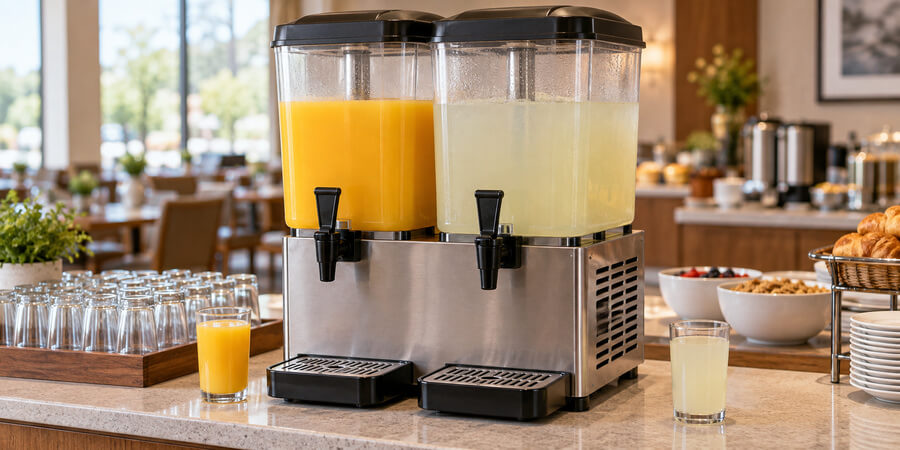
Not every drink needs gas, and the still side of the menu is a different family of equipment.
Refrigerated bowl dispensers are the breakfast and lobby workhorse. A clear bowl sits on a cooling plate, a spray tube circulates the drink so it looks alive, and a valve on the front pours it. Bowls run from about three gallons up to twelve, and the drink should hold between 35°F and 40°F once the thermostat is calibrated. They are filled with finished beverage rather than concentrate, and manufacturers ask for daily cleaning wherever dairy is served. The refrigerated beverage dispensers range covers juice, lemonade and milk service.
Iced tea is brewed and held rather than mixed. Tea comes from urns and dispensers holding brewed product, a different sanitation problem than syrup lines, and the Food Code names iced tea dispensers specifically and requires their food contact surfaces cleaned at least every 24 hours. The iced tea dispensers range covers that end of the counter.
Portable and hot service are separate purchases again. Catering runs on insulated beverage dispensers that hold temperature without a cord, and on uninsulated and ice core dispensers that chill from a central ice chamber without watering the drink down. Coffee and cocoa come from hot beverage dispensers instead.
Sizing by Service Style
Manufacturers do not publish a drinks-per-hour rating for a fountain valve. What they do publish is a pour rate, and what the catalog publishes is valve and ice bands, and the two together size a machine honestly.
| Service style: | What usually sets the size: | Valve range to shop: | Ice band to shop: |
| Quick-service counter | Crew pouring through a lunch rush | Middle of the range | Middle band |
| Self-serve beverage bar | Flavor count and queue length at the tower | Upper half of the range | Middle to top band |
| Convenience store fountain wall | Cup size and ice per cup | Upper half of the range | Top band |
| Bar or back counter | Mixers and still water rather than volume | Lower half of the range | Low band or a refrigerated unit |
| Office, break room and small cafe | Flavors offered, not throughput | Lower half of the range | Low band |
Ice, not syrup, is what runs out. A cup is mostly ice, so choose the ice band against peak hour cup count and size the ice machine behind it to keep the bin fed. An extra valve you never use is cheap; running out of ice at noon is not. The pour is rarely the bottleneck at a published ten ounces in four to six seconds, and on a self-serve run access rather than speed limits the queue.
Cleaning, Nozzle Sanitizing and What the Code Requires
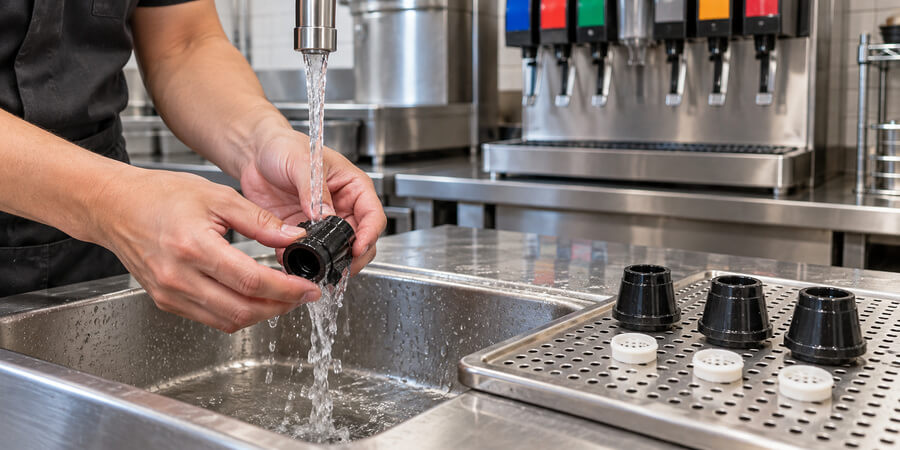
Fountain equipment is cleaned on a schedule published by the manufacturer and backed by the Food Code.
| Task: | Published frequency: | Where it comes from: |
| Remove each nozzle and diffuser, rinse in warm water, no soap | Daily | Manufacturer maintenance schedule |
| Wash the cup rest, clean the drip tray, wipe exterior surfaces | Daily | Manufacturer maintenance schedule |
| Taste each product for off taste; check the water bath level | Weekly | Manufacturer maintenance schedule |
| Brush the condenser air filter clean | Monthly | Manufacturer maintenance schedule |
| Full clean and sanitize of the unit and its syrup circuits | Every six months | Manufacturer maintenance schedule |
| Clean the water bath interior, evaporator and exterior | Yearly | Manufacturer maintenance schedule |
| Ice bins, dispensing nozzles and syrup lines | At the manufacturer's stated frequency | FDA Food Code 4-602.11(E)(4) |
| Iced tea dispensers and self-serve utensils | At least every 24 hours | FDA Food Code 4-602.11(E)(2) |
Soap on a nozzle is a mistake with a published reason. The maintenance schedule says to rinse nozzles and diffusers in warm water and not to use soap or detergent, because detergent causes foaming and an off taste in the finished product. Detergent belongs in the full sanitizing procedure, which ends by drawing finished drink through the valve until there is no aftertaste.
The Code puts the frequency on the manufacturer, then closes the gap. Section 4-602.11(E)(4) requires equipment such as ice bins, beverage dispensing nozzles and beverage and syrup dispensing lines to be cleaned at a frequency specified by the manufacturer, or absent a specification, at a frequency necessary to preclude accumulation of soil or mold. Keep the manual: it is the document an inspector asks for.
Frequently Asked Questions
What is the difference between post-mix and pre-mix?
Post-mix stores concentrated syrup and makes the drink at the nozzle from your own carbonated water, which is what commercial equipment is built around. Pre-mix stores finished, already carbonated beverage in sealed tanks and gas pushes it to the valve.
How many valves do I need?
One per flavor, permanently. Count the brands on your menu, count again including diet variants plus tea or lemonade, then add one. Listings run in even steps from a pair up to a dozen valves, and adding a station later means adding a line and a pump too.
Do I need a separate ice machine?
For most fountain dispensers, yes. Ice-cooled units chill the drink by running the lines through a cold plate under the ice in their own bin, so they need a steady supply feeding it. Mechanically refrigerated units hold a chilled water bath instead.
What water pressure does a soda fountain need?
It depends on the unit and the cooling method, and the band is narrow either way. The table in the water supply section lists the published ranges for carbonators, non-carbonated valves and ice-cooled drop-ins. Above the ceiling needs a regulator, and below the floor needs a booster.
How much is a commercial soda machine?
It depends on four things: valve count, ice storage capacity, countertop against drop-in construction, and whether cooling comes from a cold plate or a refrigeration deck. The back room hardware, meaning the regulators, pumps, rack and carbonator, adds to the total again.
Can I put a commercial soda machine in my home?
It is a plumbing and gas installation rather than an appliance. It needs a dedicated water line inside a narrow pressure band, a drain within five feet, a dedicated circuit, a restrained CO2 cylinder in a ventilated space, and room for syrup boxes.
How often do fountain nozzles have to be cleaned?
Daily, in practice. The published maintenance schedule has nozzles and diffusers removed and rinsed in warm water every day with no soap, and the Food Code requires nozzles and syrup lines cleaned at the manufacturer's stated frequency.
Do I need a backflow preventer for a carbonator?
Yes, unless an air gap is provided. Food Code section 5-203.15 calls for a dual check valve with an intermediate vent, preceded by a screen of not less than 100 mesh, upstream of the carbonating device and downstream of any copper in the supply line.
Shop Soda Fountain and Beverage Dispensers
Settle five things and the order writes itself. Decide post-mix or pre-mix, because that decides the back room. Count your flavors including the diet variants and buy the valve count above that number. Choose the cooling method against whether you have ice to spare. Measure counter depth, height clearance and the distance to the drain before anything ships. Then check water pressure against the published band, and compare what fits in the fountain drink machines and soda dispensers range or across the wider beverage dispensers selection.
Related Guides & Resources
- Commercial Ice Machine Guide - Machine types, production rates and cooling, for sizing the ice supply that feeds the bin.
- Which Ice Cube Shapes Are Best for Your Restaurant - Cube against nugget, for deciding the ice format before you choose the dispenser.
- What Size Ice Bin Do You Need? - Storage capacity against demand, for the gap between what the machine makes and what the counter uses.
- Restaurant Water Filtration Guide - Filtration for ice, coffee and steam equipment, and for the water line the manual asks you to filter.
Share This!