What Size Ice Bin Do You Need?
Table of Contents
Match bin storage to your real demand pattern - not just your ice machine's production number
The standard advice for sizing an ice bin is simple: choose a bin that holds at least your ice machine's 24-hour production. A 500 lb/day machine gets a 500 lb bin or larger. That baseline rule works - but if you look at what experienced operators actually order, machine and bin sizes mismatch constantly, and usually on purpose. This guide covers the baseline rule, why the published ratios disagree, how to size from your real demand pattern instead, and when an odd pairing is exactly the right call.
Why the published sizing rules disagree
Search for bin sizing advice and you will find rules that flatly contradict each other. Some sources say the bin should hold 60 to 100% of daily production. Others say 80 to 100%. Some say only 10 to 20% more than production. Bartenders will tell you to get the biggest bin that fits. They are not all wrong - they are describing different demand patterns.
A steady lunch-and-dinner restaurant, a Friday-spike sports bar, and a weekend-only event hall all draw ice completely differently, and the right bin for one is wrong for the others. The production number on the machine tells you how fast ice is made. It says nothing about when your ice gets used - and that timing is what actually sizes the bin.
Start with the baseline, then adjust for your pattern
The safe starting point is the 1:1 rule: bin capacity equal to or greater than the machine's 24-hour production. The logic is overnight recovery - the machine refills overnight what service used during the day, so a full bin greets the opening shift.
From there, adjust based on how your demand actually arrives:
| Demand pattern: | Typical pairing: | Why it works: |
| Steady all-day use (casual restaurant, cafeteria) | Bin roughly equal to daily production | Draw and production stay in balance; overnight refill resets the day |
| Sharp evening or weekend peaks (bars, sports venues) | Bin larger than daily production | The bin banks ice through slow hours so the rush draws from storage, not from real-time production |
| Weekend or event-only use (banquet halls, event centers, some churches) | Small machine head on a much larger bin | The machine has all week to fill the bin, so a modest head can stockpile for one big day |
| Space-constrained sites with steady draw | Bin somewhat smaller than production | Constant use keeps the bin from ever filling; floor space matters more than reserve |
That third row is the mismatch that surprises people most, and it is well documented: a venue that pours 500 lbs of ice every Saturday but almost nothing midweek can run a 200 lb/day head over a 700 lb bin, because the bin has days to fill between events. On paper the pairing looks wrong. In practice it is the cheapest correct answer - a smaller head costs far less to buy and run than a machine sized to produce Saturday's ice in one day.
Rated capacity is not usable capacity
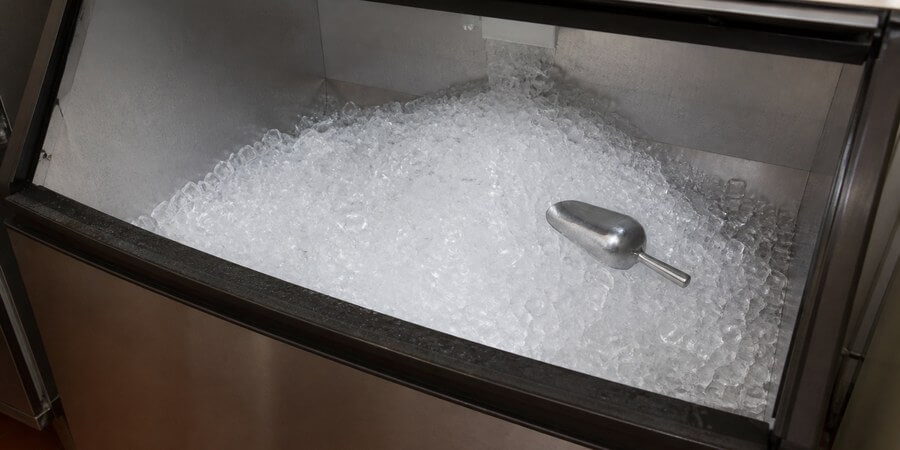
Here is the nuance most sizing advice skips: an ice bin shuts off production before it is actually full. Ice falls into the bin and forms a mound, and when the peak of that mound reaches the bin's level switch, the machine stops - even though open space remains around the mound. Industry service providers note that in practice a bin holds roughly 80% of its rated capacity before the switch trips, so a 700 lb bin realistically holds about 560 to 600 lbs of ready ice.
| Rated bin capacity: | Realistic ready ice (~80%): |
| 400 lbs | ~320 lbs |
| 700 lbs | ~560 lbs |
| 1,000 lbs | ~800 lbs |
If your peak-day math says you need 550 lbs on hand, a 700 lb bin is the honest match - not a 550. Build the margin into the bin choice, not into your hopes.
Ice type changes the math
Storage bins are insulated, not refrigerated. The ice inside slowly melts and drains, which means your effective reserve depends partly on which ice you make. Denser, slower-melting shapes hold up better in storage; softer and wetter ice types melt down faster, so the same bin holds fewer usable pounds by the end of a long day. Melt behavior differs by cube shape - our ice cube shapes guide compares crescent, square cube, nugget, and flake ice - and nugget or flake operations should lean toward the larger bin when in doubt.
Two other demand items operators consistently undercount: ice that never touches a drink, and ice that leaves the building. Wait stations, food prep, cold displays, and beer troughs all draw from the same bin as the soda station. If ice goes out the door to catering jobs, mobile ice bins typically move 100 to 200 lbs at a time - demand your bin has to cover in one scoop-out, not across a whole day.
Can a bin be too big?
Yes - and not just because of floor space and budget. In a badly oversized bin, the ice at the bottom sits unused, slowly melts, and refreezes as fresh ice lands on top of it, fusing into solid blocks that staff have to chip apart. Old ice sitting in storage is also a sanitation concern, because ice is food.
The fix is honest sizing plus rotation: size the bin to your realistic peak with the 80% rule margin, and if you deliberately oversize for events, plan to draw the bin down regularly rather than letting a deep reserve sit for weeks. For event stockpiling beyond the bin, the walk-in freezer trick works well: bag and store excess during slow days, then pull the reserve during peaks - our ice machine buying guide covers this strategy alongside machine sizing itself.
Bars and mobile setups size differently

Underbar bins are their own question. The bar ice bins and chests that sit in the well hold roughly 14 to 278 lbs and should be sized to your busiest shift, so bartenders are not sprinting to the main bin mid-rush. The main storage bin then acts as the reservoir that refills the wells.
Catering and banquet operations usually run the big-bin-small-head pattern plus mobile bins for transport to the floor. High-volume bagging operations pair the machine with ice baggers instead of scooping from storage.
Fit comes before capacity
Whatever capacity you land on, the machine has to physically sit on the bin. Bin widths commonly run 22", 30", and 48", and the machine must match the bin opening or be paired with a top kit (converter kit) to close the gap - an uncovered gap is a contamination risk and a health-code problem. Capacity planning picks the bin size; the compatibility check picks the exact bin. Browse commercial ice bins by capacity and width, and commercial ice machines if you are sizing both halves of the system at once.
Frequently Asked Questions
What size ice bin do I need for a 500 lb per day ice machine?
Start at 500 lbs of bin capacity as the baseline, then adjust for your pattern. Steady all-day use: around 500 lbs works. Sharp evening peaks: step up toward 700 lbs so the bin banks ice through slow hours. Remember bins realistically hold about 80% of rated capacity, so a 500 lb bin means roughly 400 lbs of ready ice.
How much ice does a bin actually hold?
About 80% of the rated capacity in practice. Ice mounds under the drop point, and when the mound reaches the bin's level switch, production stops even though space remains around the pile. A 700 lb bin typically holds 560 to 600 lbs of ready ice.
Can an ice bin be too big?
Yes. Beyond wasted floor space and cost, ice at the bottom of an oversized bin melts and refreezes under fresh ice, fusing into blocks. If you oversize deliberately for events, draw the bin down regularly instead of letting deep reserve ice sit.
Do ice bins keep ice frozen?
No - bins are insulated, not refrigerated. The insulation slows melting dramatically, and meltwater exits through a drain, but stored ice does slowly shrink. That is why effective capacity depends on ice type and how long ice sits before use.
Why would anyone put a small ice machine on a huge bin?
Because the bin fills over time. A venue that needs 500 lbs every Saturday but little midweek can run a 200 lb/day head over a 700 lb bin - the machine spends the week stockpiling. It is often the most cost-effective setup for event halls, banquet spaces, and weekend-heavy operations.
What if my ice machine is narrower than my bin?
Use a top kit (also called a converter kit) to close the gap between the machine and the bin opening. An uncovered gap invites contamination and health-code trouble. Always verify machine and bin dimensions before buying either half.
How should I size ice storage for catering events?
Work backward from the event: pounds of ice per guest for drinks plus display and food-holding ice, moved in mobile bins that carry roughly 100 to 200 lbs each. Many caterers stockpile ahead using the walk-in freezer method rather than buying a bigger machine for occasional peaks.
Does the type of ice change what bin size I need?
Somewhat. Softer, wetter ice like nugget and flake melts down faster in storage than dense cubes, so the same bin yields fewer usable pounds late in the day. If you run nugget or flake and your sizing math lands between two bins, take the larger one.
Related Resources
- Commercial Ice Machine Guide - Machine types, production sizing, and the full selection process
- Soda Fountain and Beverage Dispenser Guide - Ice capacity, drainage and valve count for the station that draws hardest on the bin
- Which Ice Cube Shapes Are Best for Your Restaurant - Melt rates and applications for crescent, cube, nugget, and flake ice
- How Long Do Commercial Ice Machines Last? - Lifespan by maintenance level and the repair-or-replace math
- Ice Machine Maintenance Checklist - The cleaning routine and log that protect ice quality in storage
Share This!