How Long Do Commercial Ice Machines Last?
Table of Contents
How to tell whether the next repair bill is worth paying - and when the smarter money goes to a new machine
Ice is the one product a foodservice operation sells every single day, and the machine that makes it rarely fails at a convenient time. The honest answer to how long a commercial ice machine lasts: with regular cleaning and good water, plan on 8 to 12 years. Neglected machines often fail in 4 to 6 years, while well-maintained units in clean, cool environments can run past 12. Where your machine lands in that range - and whether the next repair bill is worth paying - comes down to a handful of factors you can actually check. This post breaks lifespan down by maintenance level, covers what quietly shortens a machine's life, lists the six signs that point to replacement instead of repair, and walks through the repair-or-replace math operators actually use.
Why published lifespan numbers disagree
Look around the industry and you will find lifespan claims anywhere from 4 to 10+ years, which sounds contradictory until you notice what each source is describing. Dealers who see heavily used, rarely cleaned machines quote the low end. Manufacturers describing properly serviced units quote the high end. Both are right about the machines they see.
The real variable is not the calendar. It is water quality, ambient heat, and whether cleaning actually happens on schedule. Two identical machines can be five years apart in effective age.
Commercial ice machine lifespan by maintenance level
| Maintenance level: | Typical lifespan: | What it looks like in practice: |
| Neglected | 4 - 6 years | No water filtration, deep cleaning only when ice quality forces it, condenser rarely cleaned, hot or greasy install location |
| Maintained | 8 - 12 years | Filtration in place with cartridges changed on schedule, deep clean and sanitize every 3 to 6 months, condenser checked monthly |
| Well-kept | 12+ years | All of the above, plus good ventilation and clearances, soft or filtered water from day one, annual professional service |
Water is the biggest single factor. Scale buildup from hard water strains the compressor and evaporator continuously, which is why filtration alone typically adds 2 to 4 years of service life - and why most manufacturers require it to keep warranty coverage intact. If your machine runs unfiltered, adding a commercial water filtration system is the cheapest lifespan extension available. The Water Filter Buying Guide covers how to match a system to your water conditions.
What quietly shortens an ice machine's life
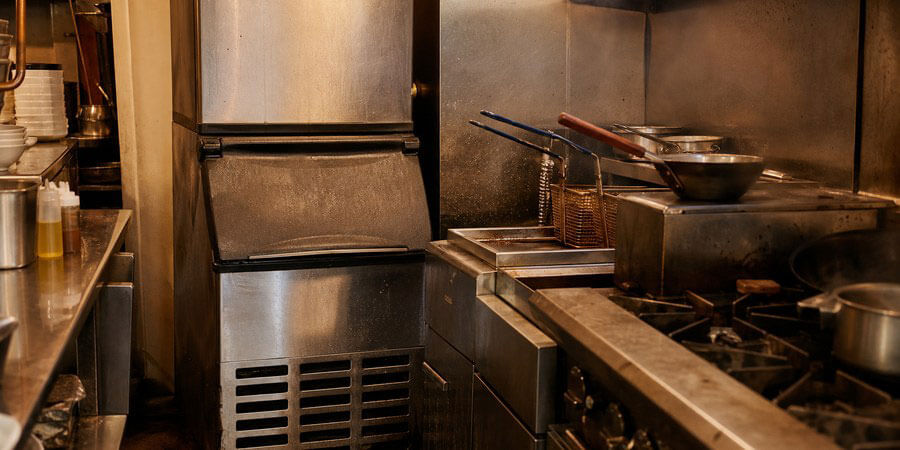
Most machines do not die of old age. They die of working conditions. Four factors do most of the damage, and every one of them is controllable.
Hard water and scale. Minerals coat the evaporator and water system, so the machine runs longer cycles to freeze the same amount of ice. Longer cycles mean more compressor hours per pound of ice, every day, for years. Scale is the closest thing an ice machine has to a chronic illness.
Heat around the machine. Ice machines are rated to produce at normal room temperatures, and a unit squeezed next to a fryer bank or into an unventilated closet works measurably harder for every batch. Hot air in means the refrigeration system never gets an easy shift. If relocating the machine is impossible, keeping clearances open and the condenser clean is the next best thing.
Grease and dust in the air. Kitchen air carries grease vapor that coats condenser coils and acts like a blanket on the one component that needs to shed heat. A condenser check belongs on the same monthly rhythm as your other equipment checks.
Skipped small maintenance. A filter cartridge that should have been changed two months ago, a deep clean pushed to next quarter, a scoop of scale nobody descaled - none of these kill a machine this week. All of them shave months off the far end.
Six signs it is time to replace, not repair
Any one of these alone is not automatically fatal. Two or more together usually mean you are paying to keep a machine alive rather than paying to keep making ice.
- Evaporator plate damage: Pitting, flaking, or plating separation on the evaporator is one of the most expensive failures an ice machine can have, and on an older unit the repair often approaches the cost of a new machine.
- Repeat service calls: A widely used industry rule of thumb is that more than two breakdowns in a single year means the machine is telling you something. Each fix buys less time than the last.
- A repair quote over half the replacement cost: Another common operator rule: when a single repair exceeds roughly 50% of the price of a comparable new unit, replacement usually wins - especially past year seven.
- Falling ice production: If output has dropped noticeably even after a full deep clean, fresh filter, and clean condenser, the refrigeration system itself is wearing out. Production loss that cleaning cannot recover does not come back.
- Rust or corrosion on the frame or food zone: Structural corrosion is a sanitation problem, not just a cosmetic one. Ice is food, and inspectors treat the machine as food-contact equipment.
- Compressor or refrigerant system failure on an older unit: On a machine past its eighth year, a major sealed-system failure is almost always the end. The money belongs in the next machine.
The repair-or-replace math
The decision gets much easier when you put three numbers side by side: the repair quote, the machine's age, and the cost of a comparable new unit. Current replacement costs run roughly:
| Machine class: | Typical production: | Typical price range: |
| Undercounter | 50 - 100 lb/day | $1,500 - $2,000 |
| Mid-size modular | 300 - 600 lb/day | $3,000 - $6,000 |
| High-capacity | 1,000+ lb/day | $8,000 - $15,000+ |
Two worked examples show how the math plays out. A $900 sealed-system quote on an eight-year-old undercounter machine that cost $1,800 new is 50% of replacement on a unit near the end of its typical range - replace it. A $300 water valve on a three-year-old modular machine is a routine fix on a unit with most of its life left - repair it without a second thought.
The hidden costs of keeping an old machine
The repair quote is the visible number. An aging machine carries several costs that never appear on it.
Downtime. A bar or restaurant without ice is buying bagged ice at retail markup while paying for the service call - and sending staff to fetch it during service. If a machine has made downtime a recurring event, that hidden cost belongs in the replacement column.
Compounding service frequency. Service calls on an old machine rarely get further apart. Three visits last year is a better predictor of next year than any spec sheet.
Energy creep. A scaled evaporator and a tired compressor run longer cycles to make the same ice, and that shows up on the utility bill month after month. New machines also benefit from more efficient designs than units built a decade ago.
Inspection risk. Rust, standing water, and surfaces that no longer come fully clean are exactly what health inspectors look at, because ice is food. A machine that keeps you nervous before inspections is charging you rent in stress.
What a technician will check before you decide
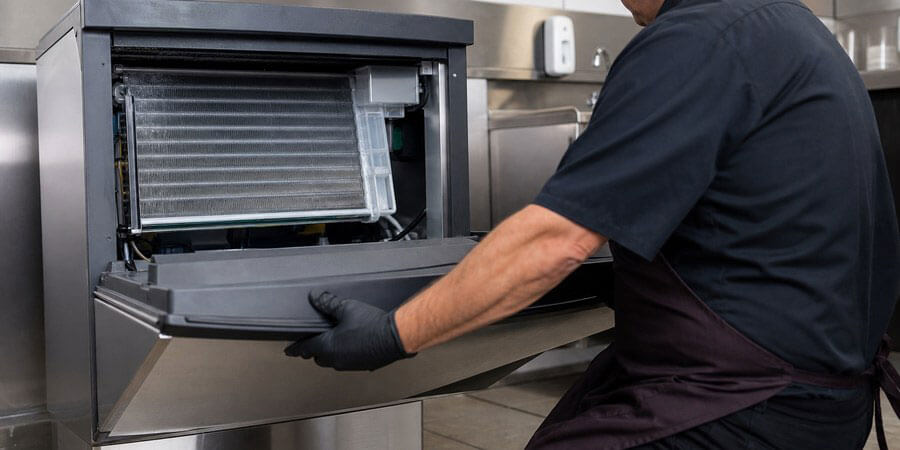
If you are on the fence, a proper diagnosis is worth far more than a guess. A qualified technician will typically evaluate the evaporator surface condition, compressor health, water system and inlet components, and the controls - and then tell you which side of the repair-or-replace line the machine sits on. Ask for the finding in writing with a quote. That single document turns the 50% rule from a guess into arithmetic, and it protects you from replacing a machine that needed a $200 valve - or from sinking $2,000 into one that will need a compressor by spring.
When repair is still the right call
Replacement is not always the answer, and a machine should never be scrapped over a problem that cleaning solves. Repair usually makes sense when the machine is under five years old, when the fix is minor and clearly diagnosed, when the problem is a first occurrence rather than a pattern, or when the unit is still under warranty.
Many production problems - low output, cloudy ice, off tastes - are caused by scale, dirty filters, or a fouled condenser, and a proper deep clean with the right food equipment cleaners and descalers restores them completely. Our Ice Machine Maintenance Checklist covers the full cleaning routine, schedule, and log - and following it is precisely how a borderline machine earns a few more good years.
This decision framework is not unique to ice. For the same repair-or-replace thinking applied across the whole kitchen, see When to Replace Restaurant Kitchen Equipment.
Planning the replacement
The worst time to choose an ice machine is the day the old one dies, with the bar open and the bin empty. If your machine is past year eight or showing two or more of the signs above, start scoping the replacement now, while it still runs.
Two planning notes worth stealing from operators who have been through this. First, size the new machine to your peak demand plus a buffer, not your average day - an undersized machine runs constantly, which is exactly the working condition that shortened the last machine's life. Second, larger operations often replace one big unit with two smaller machines placed where the ice is actually used, which adds redundancy: the next failure costs you capacity, not your entire ice supply.
Sizing, ice types, cooling styles, and the full selection process are covered in the Commercial Ice Machine Guide, and you can compare current models across commercial ice machines, including undercounter units for smaller operations. Replacing a machine on your schedule instead of its schedule also means you can plan installation, water and drain connections, and filtration properly - which is exactly how the next machine earns the long end of the lifespan range.
Frequently Asked Questions
How long do commercial ice machines last?
With proper maintenance, commercial ice machines typically last 8 to 12 years. Neglected machines may fail in 4 to 6 years, while well-maintained units with good water quality can exceed 12 years.
Is it worth repairing a 10-year-old commercial ice machine?
Usually not, unless the fix is genuinely minor. At 10 years the machine is past its typical service life, and a major repair buys expensive time on borrowed equipment. Put the money toward the replacement.
Does water filtration really extend an ice machine's life?
Yes. Filtration typically extends machine lifespan by 2 to 4 years by preventing the scale buildup that strains the compressor and evaporator. Most manufacturers also require filtration to maintain warranty coverage.
How many service calls per year is too many?
The common industry rule of thumb is that more than two breakdowns in a year points toward replacement. Track your service history - a machine that needed three visits last year will rarely need fewer this year.
Do air-cooled or water-cooled ice machines last longer?
Neither type wins automatically - the installation environment decides. Air-cooled machines suffer in hot, greasy, or cramped spaces because they depend on the surrounding air to shed heat. Water-cooled machines sidestep hot-kitchen stress but depend on water quality and use more water. A well-placed, well-maintained machine of either type outlasts a poorly placed one of the other.
Which ice machine problems are usually NOT worth panicking over?
Low production, cloudy ice, and off tastes are most often scale or cleaning problems, not equipment failures. A full deep clean, a fresh water filter cartridge, and a clean condenser resolve them in most cases. Panic is for evaporator damage and sealed-system failures. For the symptom-by-symptom checks, see our commercial ice machine troubleshooting post.
How much does it cost to replace a commercial ice machine?
Roughly $1,500 to $2,000 for small undercounter units, $3,000 to $6,000 for mid-size modular machines, and $8,000 to $15,000 or more for high-capacity units, plus an ice bin for modular machines.
Related Resources
- Commercial Ice Machine Guide - Ice machine types, sizing, and selection criteria
- Ice Machine Maintenance Checklist - The cleaning routine, schedule, and log that earn the long end of the lifespan range
- When to Replace Restaurant Kitchen Equipment - The same repair-or-replace framework applied across the whole kitchen
- Water Filter Buying Guide - Filtration basics that affect scale and ice quality
Share This!