Commercial Ice Machine Troubleshooting
Table of Contents
Diagnose a commercial ice machine symptom by symptom - the fixes you can do yourself and the moment to call for service
An ice machine that stops making ice rarely announces why. Here is the good news hiding inside that bad day: most "broken" commercial ice machines are not broken at all - they are dirty, hot, starved for water, or overdue for a filter change, and the fix costs an hour of attention instead of a service call. This guide works through the common problems symptom by symptom: no ice, less ice, ice that will not drop, cloudy cubes, off tastes, leaks, and freeze-ups. For each one you get the likely causes in order, the checks an operator can safely make, and the point where a technician genuinely earns the fee. Two rules before any of it: ice is food, so anything that touches the ice zone gets food-safe treatment - and the machine gets switched off before you reach inside it.
How an ice machine makes ice - and why it matters for diagnosis
Nearly every commercial cuber runs the same two-beat rhythm. In the freeze cycle, water flows over a refrigerated evaporator plate and builds into a sheet of cubes. In the harvest cycle, the plate warms briefly so the finished sheet releases and drops into the bin, and the machine starts over.
That rhythm is the diagnostic key, because almost every symptom lives in one half of it. Slow production, thin cubes, and hollow cubes are freeze-cycle problems - something is wrong with the water or the machine's ability to shed heat. Ice that forms perfectly but will not let go is a harvest-cycle problem. Knowing which half you are looking at cuts the suspect list in half before you touch a panel.
The first four checks - power, water, filter, heat
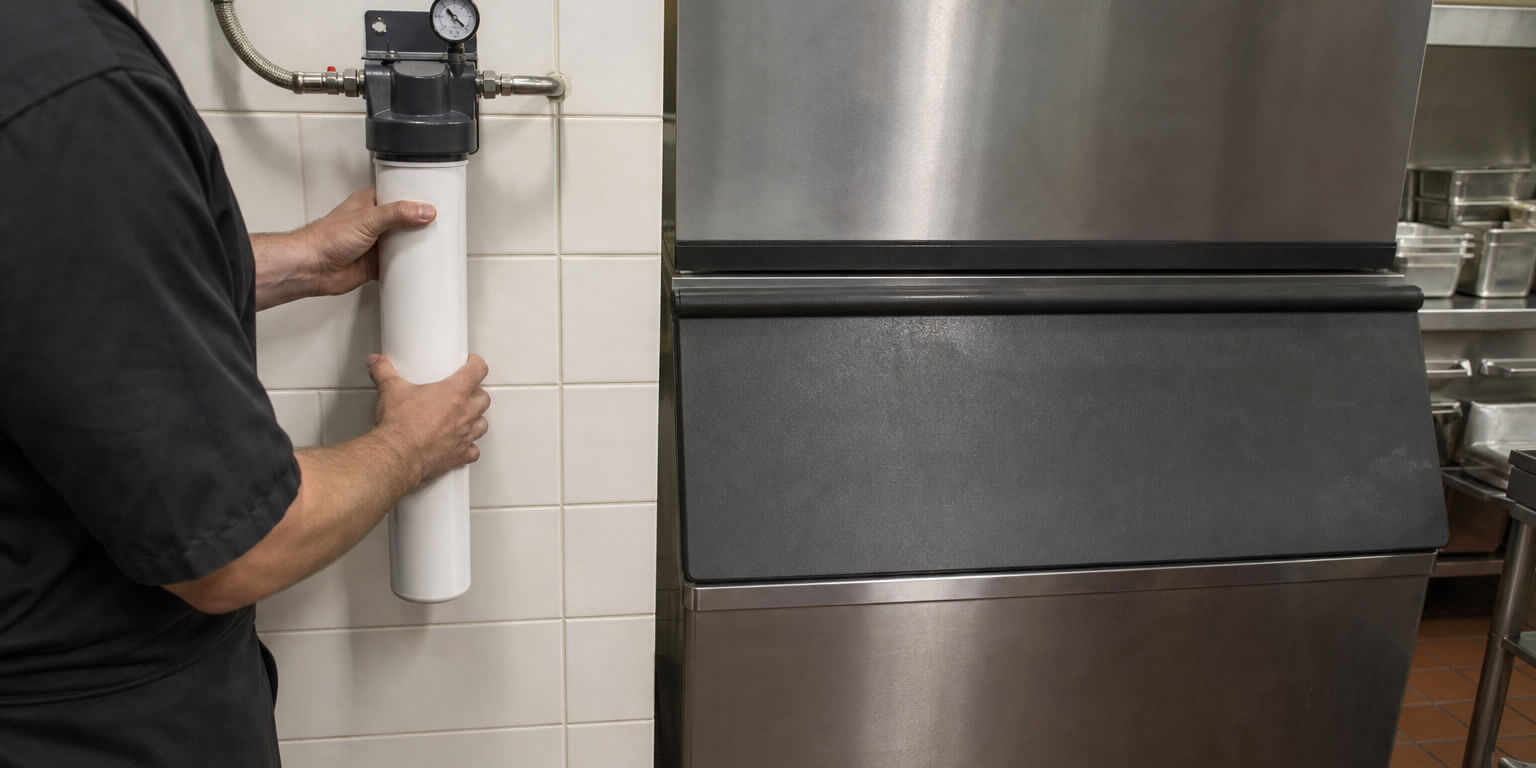
Whatever the symptom, run these four checks first. Between them they explain the majority of ice machine complaints, and all four are operator-safe.
Power. Confirm the machine is plugged in, its switch is on, and the circuit breaker has not tripped. A single power cycle - off, a few minutes' wait, on again - clears an occasional control fault. If the problem returns after a reset, the reset was masking the cause, not fixing it, so resist the urge to keep flipping the switch.
Water. The supply valve must be fully open and the line free of kinks. Most machines also need at least about 20 PSI of water pressure to fill properly - below that, cubes come out thin or hollow before production stops entirely.
Filter. A water filter cartridge past roughly six months of service is a prime suspect for nearly everything: low output, small cubes, off tastes. If you cannot remember when it was last changed, that is the answer.
Heat and airflow. An air-cooled machine must shed every BTU it pulls out of the water. A condenser coil coated in kitchen grease and dust, vents crowded against a wall (most manufacturers want about 6 inches of clearance), or a machine parked next to the fry line all force longer freeze cycles. Machines are typically rated to produce at roughly 50-100°F ambient conditions - check the spec plate for your model's exact range, and remember that a machine near the top of it is working twice as hard for the same ice.
The symptom chart
| Symptom: | Most Likely Causes, In Order: | Fix It Yourself or Call For Service: |
| No ice at all | Power, water supply, bin sensor reading full, safety shutdown | Yourself first |
| Less ice than it used to make | Dirty condenser, scale buildup, old filter, hot room | Yourself first |
| Ice forms but will not drop | Scale on the evaporator, stuck water curtain or bin switch, crusted thickness probe | Yourself first - service if it repeats |
| Cloudy, hollow, or small cubes | Low water pressure, low water level, heavy mineral content | Yourself |
| Bad taste or smell | Old filter cartridge, stale ice, bin needing a sanitize, source water | Yourself |
| Leaking water | Drain line, unlevel machine, stuck inlet valve, loose fitting | Yourself first |
| Frozen into a solid block | Failed harvest that snowballed, scale, thickness probe | Thaw yourself - service if it repeats |
| Grinding or squealing noise | Pump or fan bearings wearing out, scale in the pump | Service |
The seven problems, symptom by symptom
Commercial ice machine not making ice
Start with power and water, then check what the machine believes about its bin. A stuck bin switch or an ice-blocked sensor can convince a working machine the bin is full, and it will wait politely forever. Clear any ice bridging the sensor area and make sure the curtain or paddle swings freely. Many machines also lock out after several failed cycles as a safety measure - one power cycle clears the lockout, but a lockout that returns is the machine reporting a real fault for a technician to read.
Less ice than it used to make
The slow fade is almost always heat or scale. A blanketed condenser makes every freeze cycle longer; mineral scale on the evaporator does the same from the water side; a tired filter cartridge throttles the water flow that becomes ice in the first place. Clean the condenser, run a full cleaning cycle, put in a fresh cartridge, and give the machine a day. Production loss that survives all three fixes is the refrigeration system itself wearing down - a different conversation, covered below.
Ice forms but will not drop
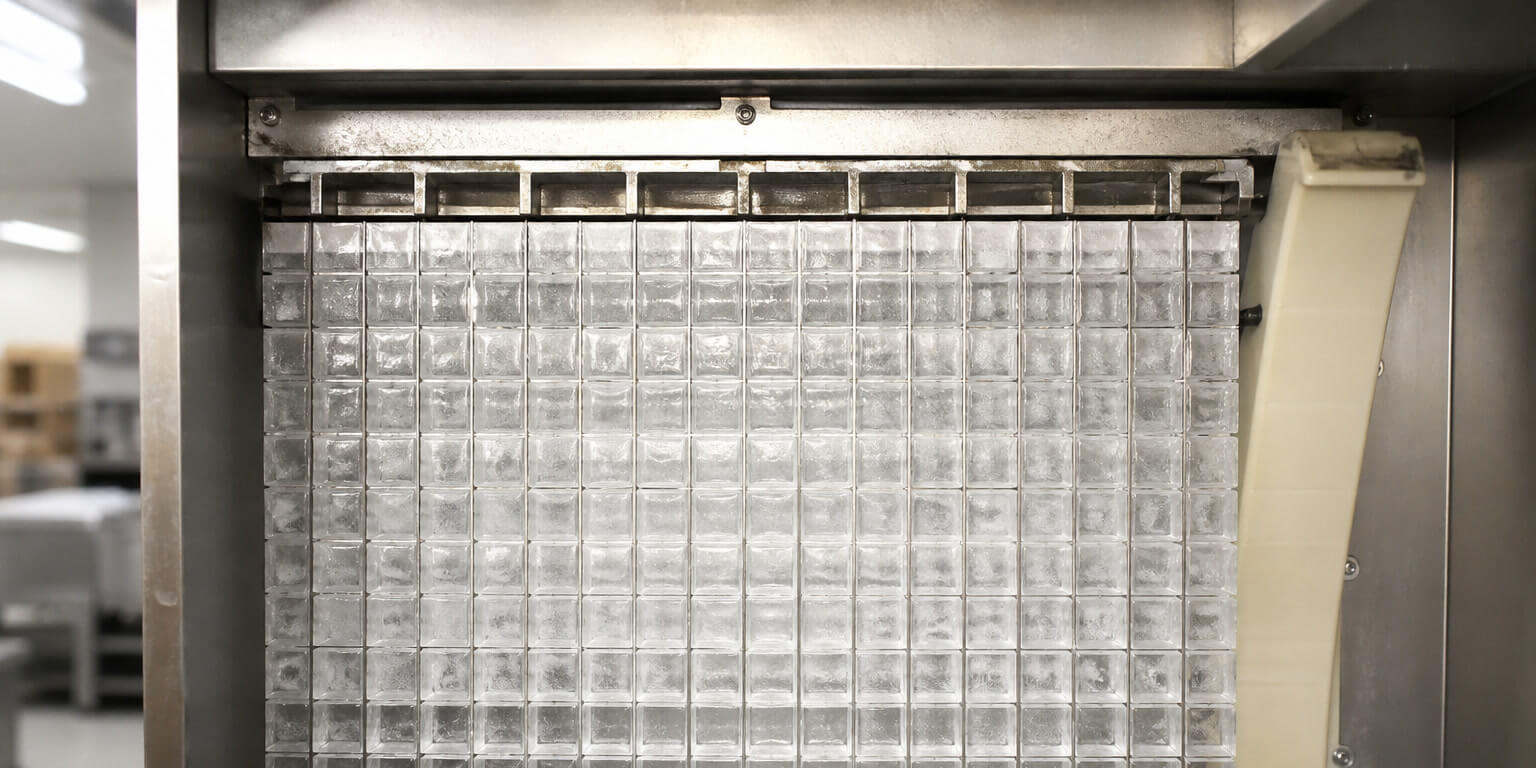
This is the classic harvest failure. Scale is the usual culprit: a mineral-crusted evaporator grips the ice sheet instead of releasing it. Run a complete cleaning cycle with a nickel-safe ice machine cleaner - commercial evaporators are commonly nickel-plated, and a generic descaler can strip the plating and total the most expensive component in the machine. Our ice machine cleaning and sanitation supplies are the ice-safe versions of both cleaner and sanitizer. While the panel is off, check that the water curtain swings freely and wipe the mineral crust off the ice thickness probe - the factory setting for an ice bridge is typically only about 1/8 inch, and a crusted probe misreads it. If harvests keep failing after a genuine deep clean, the hot gas valve that warms the plate is a suspect, and that one belongs to a technician.
Cloudy, hollow, or small cubes
Commercial cube ice should be hard and clear; cloudy or fragile ice means the water is wrong. Check pressure first - below about 20 PSI, the machine cannot fill its pattern and cubes come out hollow. Then look at the water itself: heavily mineral-laden water freezes cloudy and scales the machine while it does it. If your source water is hard, proper filtration pays for itself twice, in ice quality now and machine lifespan later - our commercial water filtration systems cover the standard cartridge setups ice machines use.
Ice that tastes or smells bad
Four causes, in the order worth checking: a filter cartridge past its service life, stale ice that has absorbed odors (ice is porous and takes on whatever the air around it carries), a storage bin overdue for a sanitize, and the source water itself. The fix ritual is the same regardless: dump the old ice, sanitize the bin, change the cartridge, and let the machine build a fresh batch. If taste problems persist through all of that, the water coming into the building is the remaining suspect, and the water filter buying guide covers matching a filtration setup to what your water actually contains.
Leaking water
Find where the water is coming from before assuming the worst. A clogged or kinked drain line backs water out of the machine; a machine that is not sitting level overflows its trough and mis-harvests; a supply fitting works loose; an inlet valve stuck open runs water continuously - which also shows up as the machine running constantly without finishing ice. All four are visible with the panels off and the machine powered down. What should never be a DIY job is anything on the sealed refrigeration side: if you suspect a refrigerant leak (oily residue, hissing, production collapse with a clean machine), stop and book service.
Freeze-ups and strange noises
A freeze-up usually starts with one failed harvest: the stranded sheet catches the next batch, and the evaporator disappears into a block. Switch the machine off and let it thaw completely - never chip ice off the evaporator with anything hard, because a gouged plate is the most expensive self-inflicted wound an ice machine can suffer. If the machine freezes up again after a full thaw and cleaning, the harvest system needs professional eyes. On noise: a new rattle is often a loose panel or scale circulating through the pump, but grinding or squealing is bearing wear in the pump or fan motor - schedule service before it finishes the job.
When to stop troubleshooting and call for service
The line is simple: operators handle water, cleaning, filters, and airflow; technicians handle the sealed system, valves, boards, and anything that needs gauges. Compressor problems, refrigerant work, hot gas valve replacement, and repeated control lockouts all sit on the technician's side of it.
There is also a second, bigger question hiding behind a service call on an older machine: whether to fix it at all. The industry rules of thumb we use - more than two breakdowns in a year points to replacement, and a repair quote over half the price of a comparable new unit usually loses to it - are covered with the full decision math in our post on how long commercial ice machines last. If the answer comes up "replace," the commercial ice machine guide walks through sizing and selection, and you can compare current commercial ice machines by type and capacity.
The prevention routine that keeps you off this page
Almost everything above traces back to four controllable things: water quality, cleanliness, airflow, and filter changes. That is why the boring routine works - a deep clean and sanitize every 3 to 6 months, a condenser check monthly, cartridges changed on schedule, and a log entry each time so the schedule actually holds. The complete routine, schedule, and printable log live in our ice machine maintenance checklist. A machine that gets that routine rarely gives you a reason to search for this article.
Frequently Asked Questions
What are the most common problems with commercial ice machines?
Not making ice, making less ice than before, ice that will not drop from the evaporator, cloudy or hollow cubes, bad-tasting ice, water leaks, and freeze-ups. Nearly all of them trace back to four root causes: power, water supply, mineral scale, or heat around the machine.
How do I reset a commercial ice maker?
Switch the machine off (or unplug it), wait a few minutes, and switch it back on - that clears control lockouts and occasional board faults. A reset that has to be repeated is a symptom, not a fix: the machine is shutting down for a reason a technician should diagnose.
Why is my ice machine running but not making ice?
Check the water path first: supply valve open, line unkinked, filter fresh, and water actually reaching the machine. An inlet valve stuck open, a bin sensor reading full, or heavy scale interrupting the freeze cycle are the next suspects. If water and cleaning check out, the refrigeration side needs professional service.
Why is my ice machine making less ice than it used to?
Heat and scale, in some combination: a dirty condenser, a hot install spot, mineral buildup on the evaporator, or an old filter cartridge throttling water flow. Clean all of it and recheck output over a full day - production loss that cleaning cannot recover means the machine itself is wearing out.
What is a nickel-safe ice machine cleaner?
A scale remover formulated to be safe on nickel-plated evaporators, which most commercial ice machines use. Generic descalers can attack the plating and ruin the evaporator - the most expensive part of the machine - so cleaners used in the ice zone should be labeled nickel-safe and food-contact appropriate.
Why does the ice taste or smell bad?
The usual causes in order: a filter cartridge past its service life, old ice that has absorbed odors from the air around it, a bin that needs sanitizing, or the source water itself. Dump the ice, sanitize the bin, change the cartridge, and taste the next fresh batch.
How often should a commercial ice machine be cleaned?
Deep clean and sanitize every 3 to 6 months at minimum - more often in bakeries, breweries, or anywhere airborne yeast and grease run high. Check the condenser monthly and change filter cartridges on their service schedule, usually about every six months.
When should I stop repairing an ice machine and replace it?
The common operator rules: more than two breakdowns in a year, a single repair quote over roughly half the cost of a comparable new machine, or major evaporator or sealed-system failure on a unit past its eighth year. Any of those means the money usually belongs in the next machine, not the old one.
Related Resources
- Ice Machine Maintenance Checklist - The cleaning routine, schedule, and log that prevent most of the problems above
- How Long Do Commercial Ice Machines Last? - Lifespan by maintenance level and the repair-or-replace math
- Commercial Ice Machine Guide - Types, sizing, and selection when the answer is a new machine
- Commercial Refrigerator Troubleshooting - The same symptom-first approach applied to reach-in refrigeration
Share This!