Restaurant Water Filtration Guide
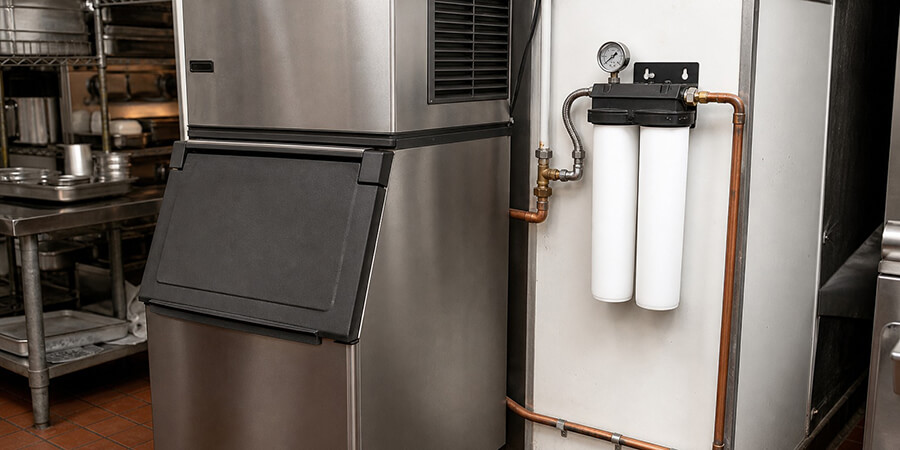
Table of Contents
What each station needs filtered - ice, coffee, fountain, steam - plus micron ratings, sizing and change schedules
Most water problems in a restaurant trace back to one decision: running every machine on the same unfiltered line. The ice machine, the coffee brewer, the fountain tower, and the combi oven each face a different threat from the same city water - scale in one, chlorine taste in another - so each station needs its own match, not one filter for the whole building. This guide works through restaurant water filtration station by station: what unfiltered water does to each machine, which filtration type stops it, the micron ratings and flow rates that matter when you size a system, and the replacement schedule that keeps everything protected.
Start With Your Water, Not the Filter
Filtration choices only make sense once you know what is actually in your water, and finding out is free. Every municipal utility publishes an annual water quality report (called a Consumer Confidence Report) that lists hardness, disinfectant type, and sediment levels for your address. Two findings in that report drive almost every decision that follows.
The first is hardness. Hard water carries dissolved calcium and magnesium, and every machine that heats or freezes water turns those minerals into scale - the chalky buildup that coats ice machine evaporator plates, coffee boiler elements, and steamer tanks. Scale is the single biggest equipment killer on this list, and it is invisible until performance drops.
The second is the disinfectant your city uses. Chlorine is the common one, and standard activated carbon removes 95-99% of it along with the taste and odor it causes. A growing number of cities use chloramine instead - a chlorine-ammonia compound that is more stable in the pipes and much harder to remove. Chloramine passes through standard carbon at normal flow rates; it takes catalytic carbon and more contact time. If your report says chloramine and your filters say carbon, that is why the soda still tastes like a swimming pool. Well water changes the picture again: it skips city disinfection entirely but raises sediment, iron, and cyst questions that municipal water rarely does, so test before you buy anything.
Read the Symptoms Before You Shop
Water problems announce themselves long before a service call - usually somewhere a manager has already noticed and blamed on something else. If any of these look familiar, the water is telling you which section of this guide you need.
| Symptom: | Likely Cause: | The Fix: |
| Cloudy, soft, or fast-melting ice | Sediment and dissolved minerals freezing into the cube | Sediment + carbon + scale-inhibitor cartridge at the ice machine |
| White crust inside the steamer or combi | Hardness scale baking out of boiling water | Scale inhibition or treated feed water, per the manufacturer |
| Soda or coffee tastes like chemicals | Chlorine or chloramine surviving to the glass | Carbon at the station - catalytic carbon if your city uses chloramine |
| Spots and film on "clean" dishes | Dissolved hardness drying onto the surface | Softening or scale control, not finer filtration |
| Slow ice harvest, weak fountain flow | A spent or undersized cartridge choking the line | Replace the cartridge; move up a flow rating if it keeps happening |
Two of those five are hardness problems, two are disinfectant problems, and one is a maintenance problem - which is the whole point: no single filter fixes all five, and the rest of this guide is about matching each one to its cure.
What Each Station Needs: The Filtration Table
Here is the whole guide in one table - each water-fed station, what unfiltered water does to it, and what its filter has to do about it.
| Station: | What Unfiltered Water Does: | What The Filter Must Do: | Typical Spec: |
| Ice Machines | Scale on the evaporator, cloudy ice, off-taste | Sediment + carbon + scale inhibitor | 1-5 micron, high flow |
| Coffee, Espresso & Tea | Scale on heating elements, flat or bitter taste | Carbon + scale inhibition | 1-5 micron |
| Fountain & Cold Beverage | Chlorine taste, cloudiness, syrup flavor distortion | Fine sediment + carbon | 0.5-1 micron, often cyst-rated |
| Steamers & Combi Ovens | Scale in the boiler, mineral spotting on food contact surfaces | Scale inhibition; RO in very hard water | Per manufacturer requirement |
| Dishwashers | Spotting, filming, scale in the booster heater | Scale control / softening more than filtration | Softener or scale-inhibitor feed |
| Drinking & Culinary Water | Taste and odor complaints | Carbon | 1-5 micron |
Ice machines are the highest-stakes station: they run continuously, scale attacks the evaporator plate directly, and ice quality is something customers can see and taste. A dedicated cartridge combining sediment filtration, carbon, and a scale inhibitor is the standard setup, and it pays for itself in service calls avoided - our ice machine buying guide pegs proper filtration at 2-4 extra years of machine life. Systems matched to ice production are grouped under ice machine water filters.
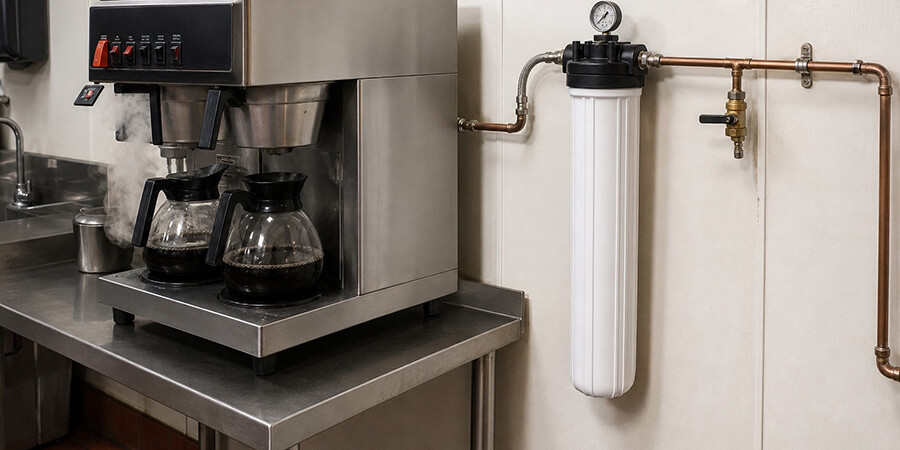
Coffee, espresso, and tea equipment lives or dies by taste and by its heating elements. Carbon handles the taste side; scale inhibition protects the boiler and group heads, where mineral buildup changes brew temperature and ruins consistency. Cartridges built for brewers are collected under hot beverage water filters. For choosing the brewer itself, see the commercial coffee maker guide.
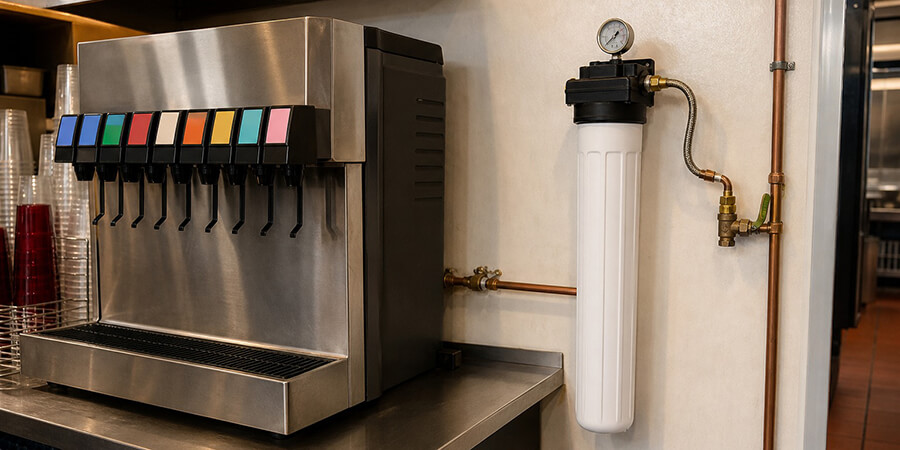
Fountain and cold beverage equipment is where chlorine taste shows up most, because there is no brewing or roasting to hide it - the water IS the product, mixed one-to-five with syrup. This station uses the finest filtration of the group, typically 0.5-1 micron with cyst-rated cartridges common. The matching systems live under cold beverage water filters, and our soda fountain and beverage dispenser guide covers the equipment those filters protect.
Steamers and combi ovens concentrate minerals faster than any other station because they boil water all day - whatever is dissolved in the feed line ends up baked onto the tank. Scale inhibition is the minimum; in very hard water areas, manufacturers commonly require treated or reverse osmosis water to keep warranties intact, so check your manual before choosing. Boiler-rated systems are grouped under steam equipment water filters.
Dishwashers are the odd station out: their problem is almost entirely mineral, not taste, so the fix is water softening or scale-inhibitor feed rather than fine filtration. If your racks come out spotted and filmed, treat hardness first.
Micron Ratings, Explained Once
A filter's micron rating is the particle size it stops - smaller number, finer filter. The working ladder for foodservice:
| Rating: | What It Handles: | Where It Belongs: |
| 5 micron | General sediment, rust, visible particles | First-stage and general use |
| 1-5 micron | Drinking water polish, taste-critical stations | Coffee, ice, culinary water |
| 1 micron or less | Parasitic cysts (Cryptosporidium, Giardia) when certified to NSF/ANSI 53 | Beverage stations, well or surface water |
| 0.2 micron | Bacteria, with proper certification | Specialized applications |
Finer is not automatically better: the finer the filter, the faster it loads up and the more flow restriction it adds, which is why a 0.5 micron beverage cartridge on a high-draw ice machine is a mismatch in both directions. Match the rating to the station, not to the biggest number on the box.
The Treatment Toolbox: Match the Technology to the Problem
Every product in the filtration aisle is built from a short list of technologies, and each one solves exactly one kind of problem. Knowing which is which turns a confusing wall of cartridges into a simple matching exercise.
| Technology: | What It Does: | Where It Earns Its Keep: | Its Limits: |
| Sediment filtration | Strains out particles, rust and grit | First stage at every station | No effect on taste or dissolved minerals |
| Activated carbon | Removes 95-99% of chlorine plus taste and odor | Every consumption station | Standard carbon barely touches chloramine |
| Catalytic carbon | Breaks down chloramine | Cities that disinfect with chloramine | Needs contact time - size it generously |
| Scale inhibitor | Keeps hardness minerals from crystallizing into scale | Ice, coffee and steam equipment | Controls minerals rather than removing them |
| Water softening | Removes hardness by ion exchange | Dishwashers and very hard water | Overkill for taste problems; adds sodium |
| Reverse osmosis | Strips nearly all dissolved solids | Very hard water, steam and combi feeds | Slower flow, produces waste water, can over-purify |
| UV purification | Neutralizes bacteria and microorganisms | Well water and safety-critical feeds | No effect on particles, minerals or taste |
Most stations get a stack, not a single technology - sediment first, then carbon, then scale inhibition is the classic three-stage cartridge that ice and coffee filtration is built around. Our Water Filter Guide walks through each technology in depth, including the commercial and residential system formats each comes in.
One counterintuitive warning before you reach for the strongest option: over-filtering is a real mistake. Reverse osmosis strips water nearly bare, and espresso machines in particular are built to brew with some mineral content - it carries flavor, and many machines sense water level through its conductivity. Steam boilers fed straight RO water can corrode faster, not slower. That is why RO systems in coffee and steam service typically run through a blend valve that mixes a controlled amount of unfiltered water back in. Cleanest possible is not the goal; the manufacturer's specified water is.
Sizing: Flow Rate, Capacity, and Connections
Three numbers size every system, and all three are printed on the cartridge or spec sheet.
Flow rate, in gallons per minute, has to meet or exceed what the equipment draws at peak. An undersized filter throttles the machine behind it - slow ice harvests and sputtering fountain valves are classic symptoms of a filter chosen by price instead of flow.
Rated capacity, in total gallons, is how much water the cartridge can treat before its media is spent. Divide by your realistic daily usage and you have its honest lifespan in months - which is worth doing before buying, because a cartridge that "lasts six months" at low volume may last eight weeks under a busy fountain.
Connections and format decide what physically fits: inlet size, drop-in cartridge versus quick-change head, and whether one station needs a single cartridge or a multi-cartridge manifold. The trade has names for the two basic layouts - a point-of-entry system treats all water where it enters the building, while point-of-use filtration is a dedicated cartridge at one machine. High-volume operations usually run both: a point-of-entry stage (or a manifold feeding several stations) knocks down sediment and chlorine for everything, with a point-of-use polishing cartridge at taste-critical equipment - a layout that filters everything once and the beverage line twice. The full commercial range, spanning single cartridges to multi-station systems, is at commercial water filters and systems, and the wider water filter systems and cartridges selection includes residential formats for office and break-room use.
Replacement Schedules: The Part Everyone Skips
A spent filter is worse than no filter - flow drops, pressure falls, and an exhausted carbon bed can shed what it caught. Commercial cartridges typically last 6 months or 10,000-20,000 gallons, whichever comes first, and the gallons usually come first in a busy operation.
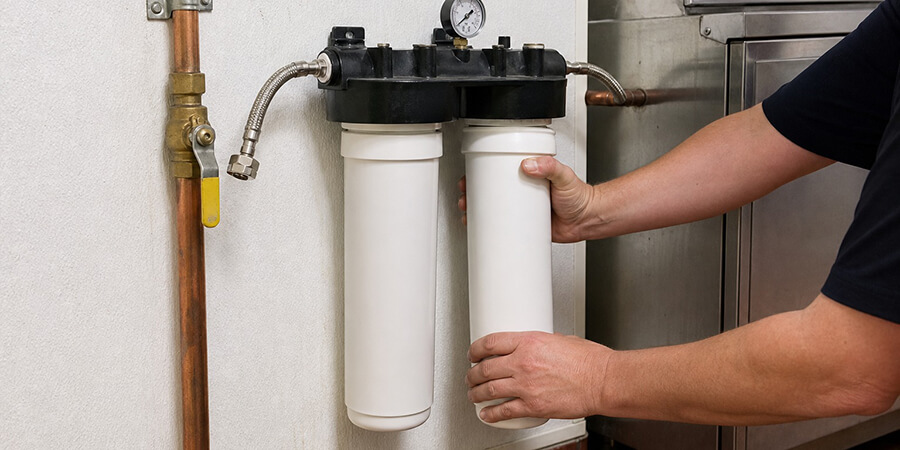
Build the schedule around signals, not memory. Falling flow at the station, a return of chlorine taste, or a pressure-gauge drop across the filter head all say the cartridge is done regardless of the calendar. Write the install date on every cartridge with a marker when it goes in, put the swap on the same preventive-maintenance calendar as ice machine cleaning, and keep one spare per station format on the shelf so a spent filter never waits on a delivery.
Common mistakes worth avoiding on the way:
- One filter for the whole building - a single undersized cartridge feeding every station protects nothing well and dies fast.
- Carbon-only in a chloramine city - standard carbon barely touches chloramine; check the water report first.
- Residential cartridges on commercial equipment - lower flow ratings and capacities mean they clog early and leave equipment unprotected at peak draw.
- Ignoring the dishwasher - filtration will not fix spotting; hardness treatment will.
- Running past capacity - the filter still looks fine from the outside long after the media inside is spent.
Frequently Asked Questions
Does my restaurant actually need water filtration?
If any equipment freezes, heats, or serves water - ice, coffee, fountain, steam - yes. The question is not whether to filter but what each station needs; unprotected scale buildup and disinfectant taste are both progressive, and both show up as service calls and customer complaints before anyone thinks to blame the water.
Can one filtration system cover my whole restaurant?
A properly sized central system can handle sediment and chlorine for the building, but taste-critical stations - fountain and coffee especially - usually still deserve their own polishing cartridge, and steam equipment may need scale treatment the central system does not provide. Filter everything once, and the sensitive stations twice.
What is the difference between chlorine and chloramine, and why does it matter?
Both are municipal disinfectants. Standard carbon removes 95-99% of chlorine, but chloramine is far more stable and needs catalytic carbon with longer contact time. Your city's annual water report says which one you have - and it decides which cartridge type actually works.
What micron rating do I need?
For general use: 5 microns. For drinking water and taste-critical stations: 1-5 microns. For cyst removal: 1 micron or less with NSF/ANSI 53 certification. For bacteria: 0.2 microns with proper certification. Finer always trades away flow and capacity, so match the rating to the station.
How often should I replace cartridges?
Commercial cartridges typically last 6 months or 10,000-20,000 gallons, whichever comes first. High-volume stations hit the gallon limit early, so date every cartridge at install and treat falling flow or returning off-taste as a replace-now signal regardless of the calendar.
Does filtration replace water softening?
No - they solve different problems. Filtration removes particles, taste, and odor; softening and scale inhibitors deal with dissolved hardness minerals. Scale-heavy stations like steamers and dishwashers need hardness treatment, and no sediment or carbon cartridge substitutes for it.
Do I need special filtration on well water?
Usually more than city water, not less. Wells skip municipal disinfection and can carry heavier sediment, iron, and cyst risk, so testing comes first and cyst-rated filtration (1 micron or less, NSF/ANSI 53) is commonly warranted at consumption stations.
Can I use residential filters on commercial equipment?
Not recommended. Commercial cartridges are built for higher flow rates and larger capacities; residential formats clog sooner and leave equipment unprotected exactly when it is busiest.
How do I know a cartridge is spent before the schedule says so?
Three signals: flow at the station drops, chlorine taste or odor returns, or the pressure reading across the filter head falls off. Any one of them means the media is exhausted - swap it, then check whether your usage means the schedule itself needs shortening.
Can my staff install and maintain filtration, or do I need a professional?
Split the job. The initial plumbing - tapping the line, mounting heads and manifolds, setting a blend valve - is worth doing professionally so warranties and codes stay clean. Routine cartridge changes on quick-change heads are designed to be staff work: twist out, twist in, log the date. Keep the two separate and filtration stops depending on anyone's memory.
Shop Restaurant Water Filtration
Every station covered in this guide maps to a section of our filtration catalog. Start from the full water and oil filtration department to see both sides of the program - the water systems covered here and the fryer oil filtration that protects the other liquid your kitchen depends on.
Related Guides & Resources
- Water Filter Guide - The product-side companion: filtration technologies, commercial vs residential formats, and installation.
- Commercial Ice Machine Buying Guide - Sizing, types, and the full ownership picture for the station filtration protects most.
- Ice Machine Maintenance Checklist - The cleaning and upkeep routine that filter changes belong inside.
- Commercial Coffee Grinder Guide - The other input to coffee extraction once the water is handled
- Commercial Combi Oven Guide - The steam equipment with the narrowest water specification and a warranty that depends on it
- Soda Fountain and Beverage Dispenser Guide - The fountain station in full: carbonation, valves, water pressure and the filtration it depends on.
Share This!