Commercial Combi Oven Guide
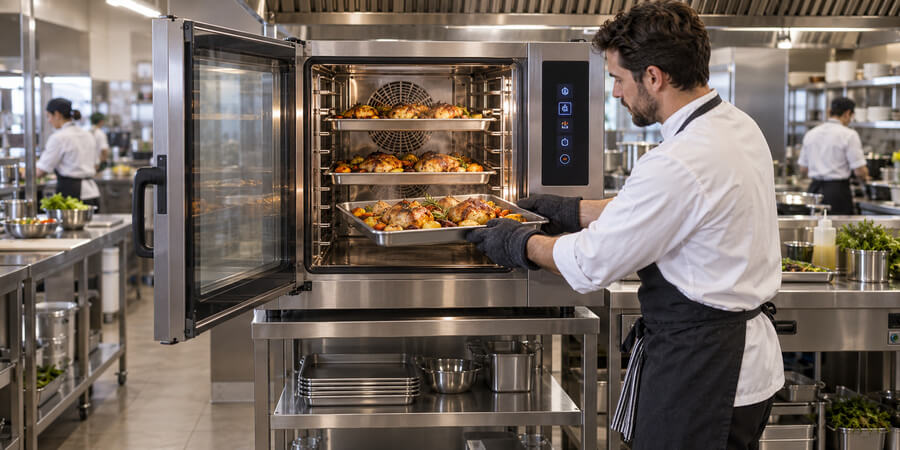
Table of Contents
How to choose a combi oven by cooking mode, steam generation, pan capacity and the utilities behind it
A combi oven is the only cooking cabinet that changes what kind of heat it makes. It runs dry air like a convection oven, it makes steam like a steamer, and it runs both together.
It is also the machine researched last and installed first, arriving with a water line, a drain and a circuit no other oven on the line asked for. This guide covers what a combi does, how the modes are used, how steam is made, how capacity is counted and what the site must provide.
What a Combi Oven Actually Is
A combi oven is a sealed chamber with a fan, a heat source and a steam source, holding pans on runners. Fan plus heat gives it convection. The steam source gives it a steamer. Running both at once gives it the third mode the name comes from.
It is sold as a consolidation machine. One manufacturer states that combi ovens "do the work of a convection oven, kettle, steamer, fryer, smoker and more." That is a claim about capability, not a promise that one cabinet carries every station at peak.
What it genuinely displaces is narrower. A combi absorbs the pressureless steamer outright, takes the batch roasting and baking that would sit in a commercial convection oven, and takes over reheating and low-temperature holding. It rarely displaces a fryer or a griddle, because those are surface-contact jobs.
Answer the steamer question first. If the menu needs steam and nothing else, a dedicated unit from the commercial steamers selection is simpler to plumb. A combi earns its keep when one cabinet must bake, roast and steam in one service.
Holding is a mode, not a second appliance. A combi can finish a cook and drop into a holding cycle, which is why some kitchens buy one cabinet instead of an oven plus a holding and proofing cabinet. Whether that works depends on whether the oven is free to hold, which at peak it usually is not.
What a Combi Oven Buys the Kitchen
Where a figure exists below it is a manufacturer's own; where there is none, the reasoning is operational and said to be.
Labor and space consolidation. One manufacturer describes the cabinet as "combining multiple cooking functions into a single appliance." That means one footprint, one hood decision, one cleaning routine and one set of controls to train on.
Yield and moisture retention. Steam and combination modes cook in a moist atmosphere, so product loses less water than in dry convection. No source fetched here publishes a yield figure, so none is printed - but the mechanism is why banquet kitchens roast in combination mode.
Consistency through programs. Combi listings are overwhelmingly touchscreen-controlled, and programmable models form a large share of the range. A program turns a cook into a repeatable instruction, which matters most where the crew turns over and the menu does not.
Cook and hold in one cabinet. A manufacturer's function list for a gas model runs "baking, steaming, roasting, grilling, air-fry, rethermalization, proofing, finishing, poaching, stewing, low temp, defrosting, cook & hold and more." Overnight roasting followed by a hold moves work into the night.
Cleaning built in rather than bought in. Automatic cleaning is the most common feature across the catalog's combi listings, and one manufacturer publishes "auto delime ability." A cabinet that delimes itself keeps its steam performance.
The Three Modes and When Each Is Used
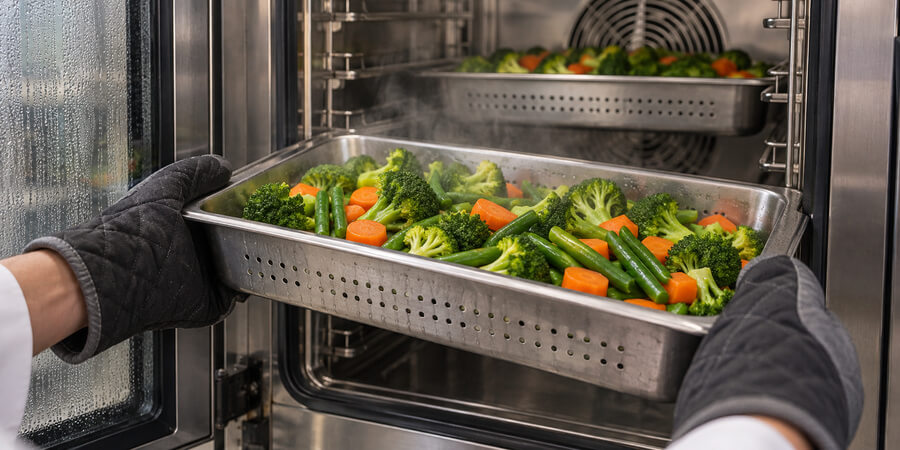
The modes are less settings on a dial than three machines sharing a chamber. Convection is dry heat with air movement, and it is the browning and finishing mode that competes with the oven the kitchen already owns. Steam is moist heat at low pressure, with no browning at all, and it is what replaces a standalone steamer. Combination runs both together, so dry heat browns the surface while steam keeps the interior from drying.
| Mode: | What the chamber is doing: | Typical work: | What it replaces on the line: |
| Convection | Fan-driven dry heat, no steam | Baking, roasting, browning, finishing, air frying | A convection oven for batch work |
| Steam | Moist heat, no browning | Vegetables, seafood, eggs, rice, rethermalization, poaching | A pressureless steamer |
| Combination | Dry heat and steam together | Roasting proteins, baking, stewing, high-volume batch cooking | Convection oven plus steamer working in sequence |
| Low temperature and cook and hold cycles | Gentle heat with controlled moisture | Overnight roasting, proofing, defrosting, holding after the cook | Some of the work of a heated holding cabinet |
The fourth row is a cycle, not a fourth kind of heat, built from the same three modes under program control. Where holding is the main job rather than the tail of a cook, a dedicated cook and hold oven does it without occupying the kitchen's most flexible cabinet.
Boiler and Boilerless Steam Generation
Every combi must make steam somehow, and there are two ways. The catalog carries both in roughly an even split, so neither has won.
Boilerless, also called injection. One manufacturer describes a "boilerless design, which generates steam by spraying water on a heated surface and then circulating it with fans." There is no separate vessel of standing water, so there is less to descale and less to service.
Boiler, also called a steam generator. A separate vessel heats water and feeds steam into the chamber, giving a ready reserve that matters when the door opens constantly. The cost is a second water-bearing vessel to maintain, and one manufacturer puts the obligation bluntly: "boiler maintenance as well as the use of good quality feed water are the responsibility of the owner/user."
Choose on service pattern, not menu. A kitchen opening the door repeatedly through a steady service benefits from a reserve; one running scheduled batches gains more from having less to maintain. Both types need feed water within specification, so boilerless does not mean water-indifferent.
Sizing by Pan Capacity
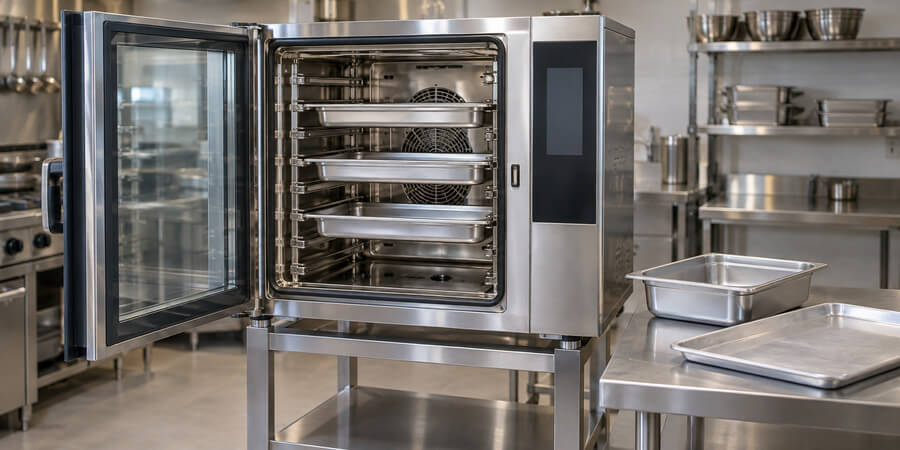
Combi ovens are sold by how many pans they hold, and the same cabinet is usually rated twice: once in full-size food pans, which kitchens call hotel pans, and once in sheet pans.
Read the two ratings as one cabinet. A manufacturer's ten-level gas model publishes its capacity as ten full sheet pans, or as ten steam pans on the same runners. Check the rating against the hotel pans the kitchen already stocks.
The half-size cabinet is the one people get wrong. A six-level countertop model is published as holding six half sheet pans on those same runners. If the kitchen's inventory comes from the sheet pans range in full size, a half-size cabinet means buying pans too.
The table maps the pan counts the catalog clusters on. The size class column reads the catalog's own format language and is not a published specification; confirm it against the model drawing.
| Pan capacity: | Pan ratings published at this capacity: | Size class and where it sits: | Power types listed: |
| 4 to 5 pans | Full size food pans, half and quarter size sheet pans, two-thirds size food pans | Half size, countertop | Electric only in the listings scanned |
| 6 to 8 pans | Full size food pans, full and half size sheet pans | Half or full size, countertop or on a stand | Electric or gas |
| 10 to 14 pans | Full size food pans, full and half size sheet pans, two-thirds size food pans at ten | Full size, floor standing or stacked | Electric or gas |
| 20 pans | Full size food pans, full and half size sheet pans | Full size, floor standing or roll-in | Electric or gas |
| 24 to 40 pans | Full size food pans, half size sheet pans at thirty-two | Roll-in, or two cabinets stacked | Electric or gas |
No source fetched here states a covers-per-service or meals-per-service rule for combi ovens, so none is printed. Anyone quoting one is estimating. Size from pans instead: count the pans a single service needs in the oven at once, add the pans that must be reheated, and buy the next capacity up. Above twenty pans the listings thin out into roll-in and stacked builds, which is the practical ceiling for one cabinet.
Countertop, Floor and Roll-In
Format follows capacity, and it decides the install.
Countertop cabinets sit on a counter or a stand. They are the small-pan-count end of the range. One manufacturer's six-level countertop model nearly doubles in overall height once its stand is under it, so the stand belongs in the floor plan from the start.
Floor-standing cabinets are the bulk of the range. They stand on legs or a base and are loaded pan by pan. The catalog's combi width bands run from under thirty inches to just under fifty, so a floor model is not automatically a wide one.
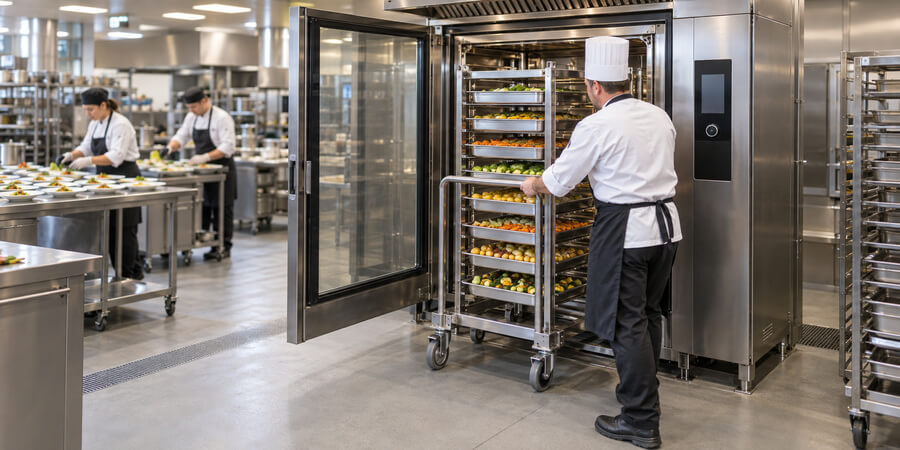
Roll-in cabinets take a rack rather than pans. A loaded rack is wheeled in whole, which is the only way twenty or forty pans change over inside a banquet turnaround. The floor in front must then be flat, clear and wide enough to turn a rack.
Stacking is the other way to get capacity. Two cabinets on one footprint give two independent chambers, so two menus run at once. Compare the whole range in the commercial ovens selection before assuming a combi is the right shape of oven at all.
Gas and Electric and the Utilities Behind Them
This is the section that catches kitchens out, because a combi needs services no other oven on the line needs.
Electric is the larger part of the catalog and gas the minority. Every gas listing is offered in both natural gas and propane, so fuel type is a configuration rather than a separate model.
Gas models still need electricity. Two manufacturer model pages publish a gas combi's electrical supply as a single-phase cord-and-plug connection on the low voltage band. The burner heats; the controls, fan and wash system run on that cord.
Phase and amperage are what the catalog cannot tell you. No phase filter and no amperage filter exists on the combi listings, and the voltage filter implies neither. Read the model's data plate.
| Utility: | Electric models: | Gas models: |
| Voltage options published | 120, 208, 208/240, 240, 440 and 480 volts | 120 volts for controls, published as "120/60/1" on two model pages |
| Phase | Not published as a filter; read the data plate | Not published as a filter; read the data plate |
| Amperage | Not published as a filter; read the data plate | "4.4 amp max load at 120v" on two model pages |
| Connected load | 6.9 kW to 72.3 kW across the listings | Not applicable |
| Gas input | Not applicable | 37,500 BTU to 320,446 BTU across the listings |
| Gas connection | Not applicable | Three-quarter inch NPT female |
| Water supply | Filtered and unfiltered cold water line, three-quarter inch male NSHT fitting | Filtered and unfiltered cold water line, three-quarter inch male NSHT fitting |
| Water pressure | 50 to 60 psi recommended on two model pages | 50 to 60 psi recommended on two model pages |
| Drain | One and a half inch diameter, tempered below 140°F | One and a half inch diameter, tempered below 140°F |
| Hood | Ventless models are listed; every ventless listing scanned was electric | No ventless listing appeared among the gas models scanned |
The water connection is often two connections. Both manufacturer model pages fetched here call for a "filtered and unfiltered cold water line," because the filtered supply feeds the chamber while the unfiltered supply tempers the drain. Specifying one and not the other is a common install failure.
The drain runs hot and must be tempered. The same pages specify drain tempering below 140°F through the cold unfiltered connection, which is a plumbing requirement rather than a preference.
Clearances are small but not zero. One manufacturer publishes side clearances of well under two inches for a countertop model, with a back clearance of zero.
Water Quality, Filtration and Descaling
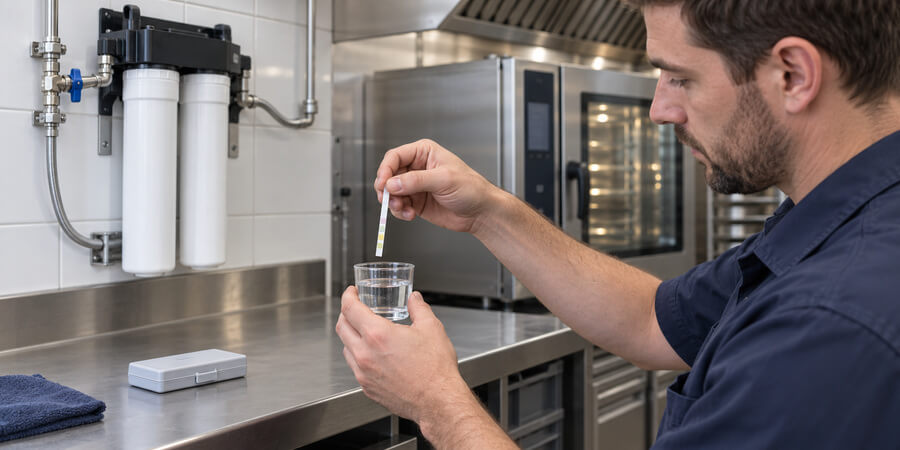
A combi is a steam machine, and steam machines are destroyed by their water supply. This decides how long the oven lasts.
Manufacturers publish a specification, and it is narrow. One publishes a single required set for combi feed water:
- Total dissolved solids: 40 to 125 parts per million.
- Hardness: 35 to 180 parts per million.
- Silica: less than 13 parts per million.
- Chlorides: less than 25 parts per million.
- Chlorine: less than 0.2 parts per million.
- Chloramine: less than 0.2 parts per million.
- pH: 7.0 to 8.5.
A second manufacturer uses different units, so its figures stay separate. It recommends that hardness "do not exceed 3 grains," with a pH window between seven and eight.
Scale is the slow failure. Limescale is "the chalky white residue found at the bottom of pots, pans and inside steamers," and it builds wherever water is boiled off. It insulates the heating surface, so the oven works harder for less steam.
Chlorides are the fast failure, and filtration does not fix them. The same manufacturer warns that the compound "becomes very corrosive when it's heated above 140 degrees" and "cannot be removed through basic filtration or softening processes." That is why the published chloride limit is worth testing for specifically.
Warranty is the part that costs money. One manufacturer states that where the supply "does not meet the specified water supply standards, warranty service calls may not be covered or warranties may be voided altogether." Test the water before the oven is ordered, then match a cartridge from the water filtration range to what the test found.
Descaling is scheduled work, not a repair. One manufacturer's three steps are to "test your water," "install an appropriate water treatment system" and "maintain equipment with proper cleaning, deliming and preventative maintenance." A cabinet with an automatic cycle still needs it run.
Cleaning, Programs and Accessories
Automatic cleaning is close to standard on combis. One manufacturer describes a wash system "with water recirculation using non-proprietary liquid detergent." Non-proprietary matters commercially: the cabinet is not locked to one brand of chemical.
The chemical is still a consumable. Detergent and descaler are ordered separately and run out, so build them into the same order cycle from the equipment cleaners and descalers range.
Racks, runners and probes are model-specific. Whatever the cabinet takes, it takes exactly, which is why the combi oven parts and accessories range is worth reading before the first service.
Hoods, Ventless Models and Clearance
Most combis expect ventilation. A cabinet producing steam and roasting fumes is normally installed under extraction, and the hood type is a code question for the local authority. Start from the commercial kitchen hoods range once the model and its clearances are known.
Ventless combis are a real minority of the catalog. One manufacturer describes a model with "a condensation hood," enabling installation without external ventilation. Every ventless combi listing scanned here was electric, so a site with no ductwork should not assume gas comes in that configuration.
Who Needs a Combi Oven
Schools and healthcare. Fixed menus, fixed service times and a great deal of rethermalization, so programs and steam mode carry most of the work.
Hotels and banquet kitchens. The clearest case for roll-in capacity, because racks are loaded away from the oven and wheeled in whole.
Bakeries. Steam during bake is the reason to look at a combi, though a deck oven still wins on hearth products.
Quick service and small-format kitchens. Usually the countertop end, often ventless, replacing two appliances because there is no room for two.
Commissaries and central production. Cook and hold overnight, with the capacity ceiling reached by stacking.
Who should not buy one. A kitchen that needs steam only, one whose water is out of specification and untreated, and one with no drain within reach of the intended position.
Frequently Asked Questions
What is a combi oven?
It is a cooking cabinet that runs dry convection heat, low-pressure steam, or both at once. One manufacturer describes the type as doing the work of a convection oven, kettle, steamer, fryer and smoker in one appliance. All three modes share a chamber and a pan rack.
What does a combi oven replace in a kitchen?
It absorbs a pressureless steamer, takes the batch roasting and baking a convection oven was doing, and takes over reheating and low-temperature holding. It rarely replaces a fryer or a griddle, because those are surface-contact jobs. Manufacturers claim a wider list; treat that as capability, not a staffing plan.
What is the difference between a combi oven and a convection oven?
A convection oven makes dry heat with a fan and nothing else. A combi adds a steam source and runs steam alone or with dry heat. That difference is also why a combi needs a water line and a drain, and why on dry baking alone the convection oven is the simpler machine.
What is the difference between a boiler and a boilerless combi oven?
A boilerless model sprays water onto a heated surface and circulates what flashes off, so there is no standing vessel of hot water to maintain. A boiler model heats a separate vessel and holds a steam reserve, recovering faster when the door opens often. The catalog carries both in roughly an even split.
What size combi oven do I need?
Size by pans, because no source here publishes a covers-per-service rule and inventing one would mislead. Count the pans a single service needs in the oven at once, add the pans that must be reheated, then buy the next capacity up.
Does a combi oven use hotel pans or sheet pans?
Both, and the same cabinet is usually rated twice. One manufacturer publishes a ten-level model as holding ten full sheet pans, or ten steam pans on the same runners. Check the rating against the pans your kitchen owns, because a half-size cabinet takes half-size sheet pans.
Does a combi oven need a water line and a drain?
Yes, and often two water connections. Manufacturer model pages call for a filtered and an unfiltered cold water line, the filtered supply feeding the chamber and the unfiltered tempering the drain. The published drain must be tempered below 140°F, which is a plumbing requirement.
What water quality does a combi oven need?
Narrower than most supplies deliver untreated. Manufacturers publish limits for total dissolved solids, hardness, silica, chlorides, chlorine, chloramine and pH, and state that water outside specification can void the warranty. Chlorides matter most: they corrode when heated and basic filtration does not remove them.
Does a combi oven need a hood?
Usually yes, and the hood type is decided by local code rather than by the oven. Ventless models exist as a real minority of the range, one manufacturer describing a model with a condensation hood that installs without external ventilation. Every ventless listing scanned here was electric.
Can a combi oven hold food after it finishes cooking?
Yes. A manufacturer's published function list for a gas model includes low temperature operation and a cook and hold function alongside the cooking modes, making overnight roasting and a morning hold practical. Where holding is the main job, a dedicated cabinet does it without tying up the oven.
Shop Commercial Combi Ovens
Settle five things and the specification writes itself. Fix the pan capacity first, counting pans rather than covers, because capacity drives format, footprint and utilities. Decide boiler or boilerless on service pattern, not on menu. Pick electric or gas on what the building can supply, and confirm phase and amperage from the data plate. Test the water before ordering, because the published specification is narrow and the warranty depends on it. Then settle the hood question with the local authority, and compare what fits in the commercial combi ovens range.
Related Guides & Resources
- Commercial Convection Oven Guide - Dry-heat oven types, features and sizing, for deciding whether steam is needed at all.
- Commercial Steamer Guide - Convection, pressure and microwave steamers compared, for kitchens that need steam only.
- Cooking Without a Hood - What ventless installation actually allows, and the equipment that qualifies.
- Restaurant Water Filtration Guide - Matching treatment to a water test for ice, coffee and steam equipment.
Share This!