Commercial Coffee Maker Guide
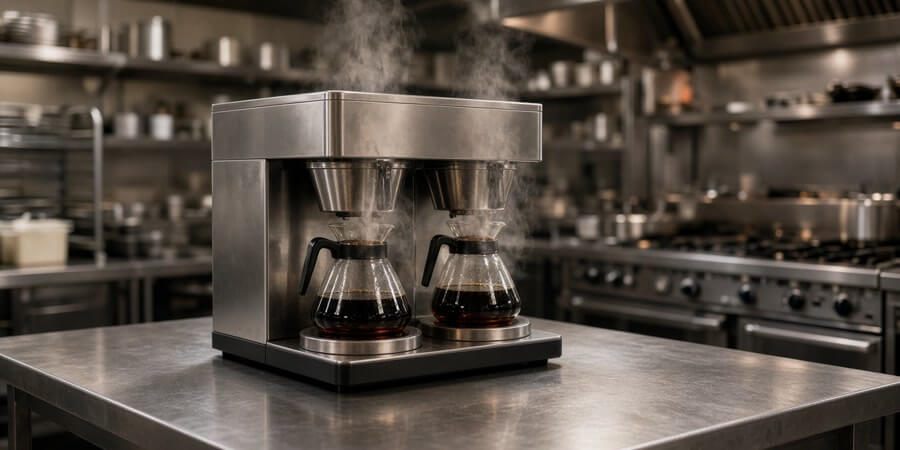
Table of Contents
A practical comparison of automatic, pourover, airpot, satellite and urn brewers, covering output, holding and hookup
A commercial coffee maker is a brewer built for continuous service, sized to keep a dining room, a breakfast buffet or a breakroom supplied all day rather than make a single household pot. Picking one comes down to five decisions. First, the format, which sets how the coffee is brewed and what it lands in. Second, the water hookup: a plumbed cold water line that fills the tank automatically, or hand-poured water into the top. Third, the output you need at your busiest hour, not your average hour. Fourth, how the coffee is held after brewing, whether that is a glass decanter on a warmer, an airpot, a sealed thermal server, a satellite shuttle or a banquet urn. Fifth, the utilities the machine needs, meaning voltage, circuit, counter depth and water treatment. Get those five right and the rest is preference. Espresso is a separate machine class with its own plumbing, training and workflow, so if a latte and cappuccino program is the goal, start with the commercial espresso machine guide instead.
Types of Commercial Coffee Makers
| Format: | Where it fits: | How coffee is held: | Hookup: |
| Pourover decanter brewer | Offices, breakrooms, small dining rooms, sites with no plumbing | Glass decanter on a heated warmer plate | Hand-filled, standard 120 V plug |
| Automatic decanter brewer with warmers | Diners, cafes and dining rooms with steady all-day pours | One to six decanters held on warmer plates | Plumbed cold water line |
| Airpot brewer | Buffets, convenience counters, self-serve stations | Insulated pump airpot, carried anywhere | Plumbed or hand-filled versions exist |
| Thermal server brewer | Restaurants and hotels wanting sealed, unheated holding | Insulated server or shuttle, no burner | Mostly plumbed |
| Satellite (shuttle) brewer | Multi-station service, remote coffee stands | Shuttle brewed at the machine, moved to a stand or warmer | Plumbed, with stands and warmers sold separately |
| High volume urn | Banquets, conferences, catering, large events | Batch held inside the urn body | Fill and hold, mostly 220 V |
| Liquid coffee dispenser | Very high traffic self-serve and convenience programs | Dispensed to order from concentrate | Electrical, heated or ambient |
| Bean-to-cup brewer | Lobbies, hotels, offices wanting fresh grind per cup | Brewed straight into the cup | Plumbed or reservoir depending on model |
| Single-cup and pod brewer | Low volume points of service, guest areas, private offices | Brewed straight into the cup | Plug-in, often reservoir fed |
Automatic brewers are the volume core of the category. Most are built around sealed thermal servers rather than decanters and warmers, they split between single and double brewers, and bean-to-cup, single-cup and pod machines form a small on-demand fringe. Pourover machines are the simpler set, carrying one, two or three warmers. Airpot brewers come in both automatic and pourover versions and are mostly single-head, which fits what an airpot program is for: brewing ahead and carrying coffee to where guests are.
Satellite equipment is its own ecosystem rather than a single machine. Brewers, shuttles, stands and warmers are listed separately, so a satellite setup is normally assembled from a brewer plus enough shuttles to keep one filling while another is out on the floor. For batch events, high volume urns come in 3, 6, 12 and 20 gallon capacities, which is the classic banquet answer: brew once, hold a large volume, serve a crowd in a short window.
At the far end of throughput sit liquid coffee dispensers, rated from 69 up to 293 cups per hour and offered heated or ambient. These dispense from concentrate rather than brewing a batch, which is why the top rating clears anything else in the category.
Automatic vs Pourover: The Water Line Decision
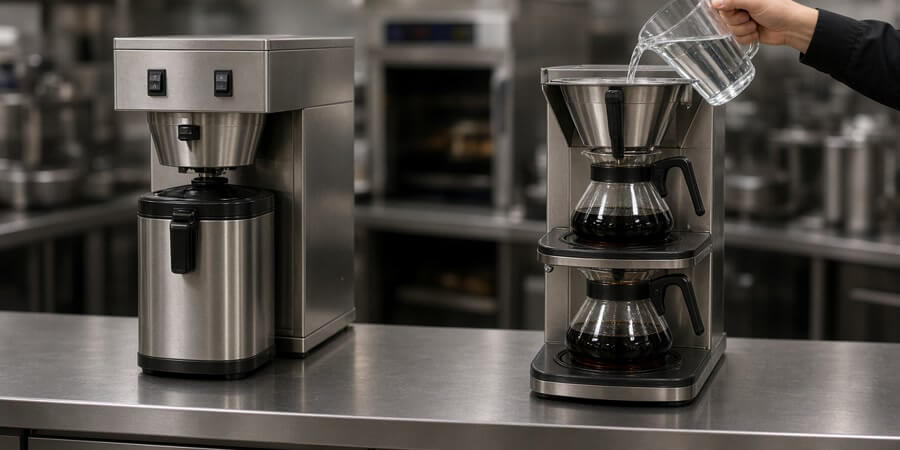
The single question that eliminates the most models is whether you can run a cold water line to the machine. An automatic brewer fills its own tank from that line, keeps water hot, and brews on a button press without anyone measuring or carrying anything. That is what people are describing when they search for an autofill or auto fill coffee maker, and it is the right choice anywhere coffee runs all day, because the staff step is reduced to swapping the grounds and the server.
A pourover brewer needs no plumbing and no special wiring. It runs on a standard 120 V plug, you pour cold water into the top, and brewing starts immediately. That is why pourover units are so common in offices and breakrooms, in leased spaces where cutting into plumbing is not an option, and at temporary or seasonal stations. The trade is labor and pacing: someone has to be present with a pitcher of water for every batch, so a pourover machine is a poor fit for a rush that outruns the person filling it.
Two middle paths are worth knowing. Some manufacturers build convertible brewer series that run both ways, brewing automatically where a line exists and accepting a hand pour where it does not, which is the safest choice for a site whose plumbing plans are not settled. Separately, "pourover backup" appears as a feature on some automatic machines: the machine normally fills itself, but it can still brew from a hand pour if the water supply is interrupted.
Portability follows the same logic. A hand-filled unit can be moved to a catering site, a patio or a second floor with nothing but an outlet. A plumbed unit is effectively fixed once installed. Both formats brew into the same vessels, so choosing pourover does not lock you out of airpots, thermal servers or decanters - the holding decision stays independent of the hookup decision.
How Much Coffee You Need to Brew
Output is published two ways in this category, and mixing them up is the most common sizing mistake. Some machines are rated in gallons per hour, from about 4 up to 36, with a separate class rated at 1.5 gallons per batch. Others are rated in cups per hour, from about 60 up to 280. This catalog's cups-per-hour ratings work out to roughly 8-ounce cups, since 4 gallons per hour lands around 60 to 67 cups per hour on the same machines.
The second structural choice is single versus double. A single brewer runs one brew head; a double runs two, so a second batch can start before the first is finished or carried away. Doubles are the standard answer when the constraint is not water heating capacity but the human cycle of swapping servers during a rush.
Size to the peak hour, not the day. Count the people you expect to serve in your busiest single hour, assume one cup each unless you know otherwise, and match that to a rating with margin. If 90 people each take one cup in the first hour of a breakfast shift, you need a brewer rated near 90 cups per hour, which points at the 82 to 102 band, plus a second server held in reserve so the machine is never the bottleneck. A 40-person breakroom where everyone pours one cup between eight and nine means 40 cups in that hour, comfortably inside a machine rated around 60 cups per hour. A 200-seat banquet where every seat is served one cup inside a 30-minute dessert window is a demand rate of 400 cups per hour during that window, which is a holding problem more than a brewing problem: brew ahead into urn or shuttle capacity and serve from held coffee.
| Output band: | What it serves: |
| 1.5 gallons per batch class | Batch-at-a-time service, small breakrooms, single-server setups |
| 4 to 4.5 gallons per hour | The workhorse band for cafes, small dining rooms and offices |
| 60 to 67 cups per hour | The same workhorse band expressed in cups, roughly a cup per minute |
| 82 to 102 cups per hour | Busy breakfast service and mid-size dining rooms |
| 127 to 163 cups per hour | High-turn diners, hotel breakfast, steady catering |
| 238 to 280 cups per hour | Conference floors, concourses and large self-serve programs |
| 12 to 36 gallons per hour | The gallon-rated high-volume tier, usually feeding multiple stations |
| Urn capacities of 3, 6, 12 and 20 gallons | Banquets and events served from held batches |
| Dispensers rated 69 to 293 cups per hour | Continuous self-serve where a brew cycle cannot keep up |
Holding Coffee: Decanters, Airpots, Thermal Servers and Satellites
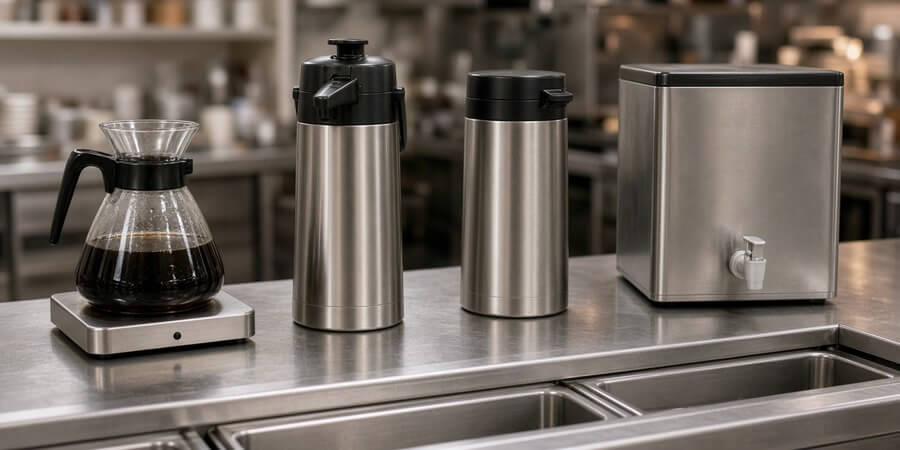
Brewing is the easy half. How coffee is held after brewing decides what the guest actually tastes. A glass decanter on a warmer plate is the least expensive and most visible option, and the reason warmer counts appear on spec sheets: decanter machines carry anywhere from one to six warmers, while most automatic brewers carry none because they are built around sealed servers instead. The weakness of a warmer plate is constant applied heat, which degrades flavor the longer a pot sits.
Coffee airpots solve that by holding coffee in an insulated body with a hand pump, in 2.2 L, 2.5 L, 3 L and 3.8 L sizes. They need no power once filled, so an airpot goes on a buffet table, a meeting room credenza or a catering cart. Thermal servers and carafes work on the same principle in a serving shape, sealed and unheated, which is why thermal server brewers dominate the automatic side of the catalog.
Satellite shuttles scale that idea. The brewer stays in the back, the shuttle carries a full batch to a remote station, and a stand or a shuttle warmer holds it there for service. Shuttles outnumber brewers in the listings for a reason: the normal pattern is more than one shuttle per machine so the brewer never sits idle waiting for a vessel to come back. Urns are the opposite pattern, holding one large batch in the same body that heated it, which suits banquets where everything is served at once.
Utilities and Installation
Electrical is the first gate. Pourover machines run on a standard 120 V plug with no special wiring, which is the whole reason they exist. Automatic machines span a much wider range: many run on 120 V, a large share on 120/208-240 V or 208-240 V, and the largest equipment on 220, 240, 380-400 or 440-480 V. Airpot brewers mostly run on 120 V with 208-240 and 220 V options, and satellite equipment splits between 120 V and 220 V with dual-voltage variants between. Anything above a plug-in 120 V unit needs an electrician and, in practice, a dedicated circuit so the brewer is not sharing a line with a toaster or a microwave.
Water comes second. An automatic brewer needs a cold water line with an accessible shutoff valve, positioned so the machine can be pulled for service without breaking the connection. Measure counter depth, counter height and overhead clearance before ordering, especially for urns, which run 24 to 38 inches wide, 28 to 38 inches tall and 19 to 22 inches deep.
Water quality is the quietly decisive utility. Coffee is almost entirely water, so untreated supply shows up two ways: scale building on heating elements and in the tank, which slows heating and shortens the machine's life, and taste, which reads as flat, dull or harshly bitter depending on what the water carries. The usual treatment pairs carbon filtration for taste and odor with scale inhibition for the equipment, sized to the machine's flow. The restaurant water filtration guide covers cartridge selection, station-by-station needs and change intervals in detail.
| Requirement: | Pourover: | Automatic: | What to check: |
| Power | Standard 120 V plug | 120 V through 440-480 V depending on size | Voltage, phase and whether a dedicated circuit exists |
| Water supply | None, filled by hand | Cold water line required | Line routing and an accessible shutoff valve |
| Water treatment | Recommended | Strongly recommended | Filter type, capacity and change schedule |
| Counter footprint | Compact | Varies widely by output | Width, depth, height and overhead clearance |
| Servicing access | Move the unit | Pull forward without disconnecting | Clearance behind and beside the machine |
| Relocation | Easy, outlet only | Fixed once plumbed | Whether the site plan may change |
Office, Breakroom and Self-Serve Coffee
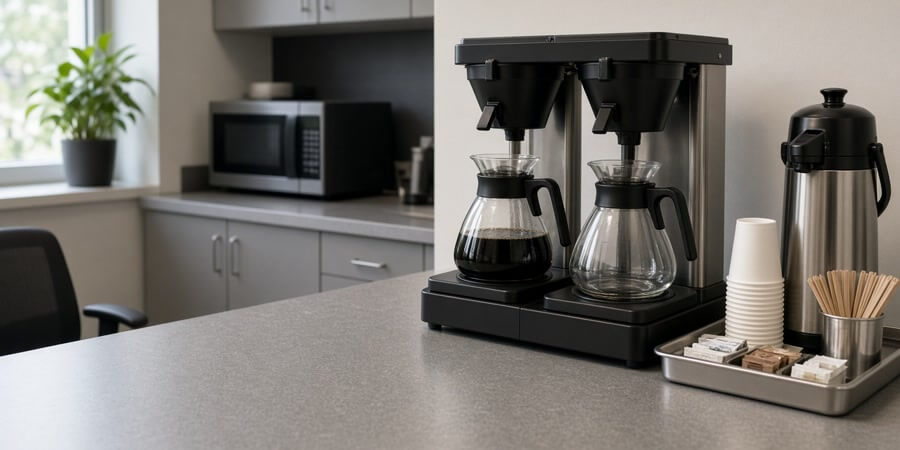
Workplace coffee is its own buying pattern, and it usually starts with an automatic office machine on a plumbed line so nobody is assigned to fill a pitcher. Where plumbing is out of reach, a pourover unit with one to three warmers does the same job with a person in the loop, and a convertible series covers a space that may be replumbed later.
Self-serve stations change the priorities. Anything guests or employees touch unsupervised should be simple, spill tolerant and hard to leave in a bad state, which is why airpot stations are popular: coffee is sealed, portioned by pump, and a station can be set up away from the machine entirely. Bean-to-cup units suit lobbies and hospitality areas because each cup is ground and brewed on demand, so a slow afternoon does not produce a pot nobody drinks. Single-cup and pod brewers cover the same low-volume need with less machine and less cleaning. For very high traffic self-serve, a liquid dispenser carries the load without a brew cycle to wait on.
Two convenience features are worth asking about by name. Auto shut-off protects an empty warmer plate and an unattended machine after hours, and programmable timers let a machine be hot and ready before the first person arrives. Neither is universal, so confirm both on the spec sheet rather than assuming. Touch screen controls, powder hoppers for cocoa and specialty drinks, and splash-rated (IP44) construction also appear on machines in this category, and a built-in grinder is an option for sites that want whole bean freshness without a second countertop appliance.
Grinders, Filters and Accessories
If the brewer is not grinding for itself, grind size and freshness are the biggest quality levers you control. The coffee grinders here run from small single-hopper units up to heavy dual-hopper bulk grinders in two width bands, so hopper size and counter width are the two specs to reconcile. The commercial coffee grinder guide works through burr types, hopper sizing and retention in full.
Filters are format specific, not interchangeable. Our disposable coffee filters selection breaks out as decanter filters, gourmet filters, iced coffee filters, tea filters and urn filters, and using the wrong shape is a reliable way to get overflow or weak coffee.
Serving vessels are the other consumable-adjacent decision. Our coffee carafes and decanters selection runs from 12 to 20 ounce servers up to 61 to 68 ounce pots, in glass, plastic, polycarbonate, polypropylene and stainless steel, in brew-through and server styles, and as carafes, decanters or vacuum bottles. Glass is visible and inexpensive; stainless and vacuum bodies hold heat without a burner. Standalone coffee pot warmers, offered with one, two or three plates, let a station hold decanters away from the brewer.
Iced coffee is a separate program with its own hardware. Cold brew and iced coffee dispensers span 9 to 23 inches wide with up to 4 taps, so a single unit can hold more than one batch or more than one flavor. Browse the cold brew and iced coffee dispensers selection alongside the hot side if summer volume matters to the operation.
Cleaning and Daily Care
Daily care is short and non-negotiable. Rinse the brew basket after every batch so old grounds and oils do not carry into the next pot, and wash decanters, airpots and thermal servers daily rather than topping them up.
Clean the sprayhead on a regular schedule so water still distributes evenly across the bed; a partly blocked sprayhead channels water and produces weak, uneven extraction. Descale on the interval the manufacturer's manual specifies for your water hardness, and change water filter cartridges on schedule rather than waiting for taste to fall off, because by then scale is already forming.
Frequently Asked Questions
What is a commercial coffee maker?
It is a brewer built for continuous, high-volume service rather than occasional home use, designed to brew into decanters, airpots, thermal servers, shuttles or urns. Commercial units are rated in cups or gallons per hour, are often plumbed to a cold water line, and are built for daily cleaning and long service life. The category also covers urns, liquid dispensers, bean-to-cup and single-cup machines used in foodservice and workplace settings.
Do commercial coffee makers need a water line?
Automatic models do, because they fill their own tank from a cold water supply and keep it hot. Pourover models do not; they need no plumbing and no special wiring, and run from a standard 120 V plug with water poured in the top. Some convertible series brew both ways, so plumbing is a preference rather than a hard requirement in most sites.
What is the difference between an airpot brewer and a thermal server brewer?
Both hold coffee without a heated plate, but the vessel differs. An airpot is an insulated container with a hand pump, sized at 2.2 L, 2.5 L, 3 L and 3.8 L, which suits self-serve and portable stations. A thermal server is a sealed serving vessel intended to be poured, which suits table service and staff-poured refills.
How many cups per hour do I need for a restaurant?
Size to your busiest hour rather than your daily total. If you expect 90 guests each taking one cup during the peak breakfast hour, look at a rating near 90 cups per hour, which falls in the 82 to 102 band, and add a spare server so the machine keeps brewing. Ratings in this category run from about 60 cups per hour up to 280, with gallon-rated machines above that.
What is a satellite coffee brewer?
A satellite brewer brews into a portable shuttle that is carried to a remote serving station and held there on a stand or a warmer. It lets one back-of-house machine supply several service points without running plumbing to each one. Shuttles usually outnumber brewers in a working setup, since one is being served from while another is being filled.
Can I use a commercial coffee maker without plumbing?
Yes. Pourover brewers are made for exactly that situation and are common in offices, breakrooms and low-volume settings, with one to three warmers depending on the model. Convertible series brew either way, and some automatic machines list a pourover backup feature so they can still brew if the water supply is off.
What size coffee maker do I need for an office of 50 people?
Work the arithmetic on your own assumptions. If all 50 people take one cup during a single morning hour, that is 50 cups in that hour, which a machine rated around 60 cups per hour covers with margin. If half of them take a second cup later in the morning, that is another 25 cups spread across a slower stretch, which the same machine handles between rushes.
Why does my coffee taste flat or bitter?
The three usual causes are water, scale and holding. Untreated water carries minerals and chlorine that dull or sharpen flavor, scale on heating elements changes brew temperature, and coffee left on a heated warmer plate degrades the longer it sits. Filter the incoming water, descale per the manual, and move to a sealed thermal server or airpot if pots regularly sit for long stretches.
What is a bean-to-cup machine?
It grinds whole beans and brews a single serving on demand, so nothing sits in a pot waiting for a taker. That makes it a good fit for lobbies, hotels and offices with steady but light traffic where freshness matters more than throughput. It is a small part of the automatic category, sitting alongside single-cup and pod brewers at the low-volume end.
Shop Commercial Coffee Makers
Start with our automatic commercial coffee machines selection if a cold water line is available, or our commercial pourover coffee machines selection for plug-in, hand-filled brewing. For multi-station and event service, our satellite coffee brewers, servers and warmers selection covers brewers, shuttles, stands and warmers together.
Related Guides & Resources
- Commercial Espresso Machine Guide - Machine types, group counts and installation for espresso programs.
- Commercial Coffee Grinder Guide - How to size and set the grinder that decides what the brewer can extract
- Restaurant Water Filtration Guide - Station-by-station filtration, including what coffee and tea equipment needs.
- 38 Ways to Make a Perfect Coffee - Every coffee drink explained, from drip to specialty pours.
Share This!