Commercial Smoker Guide
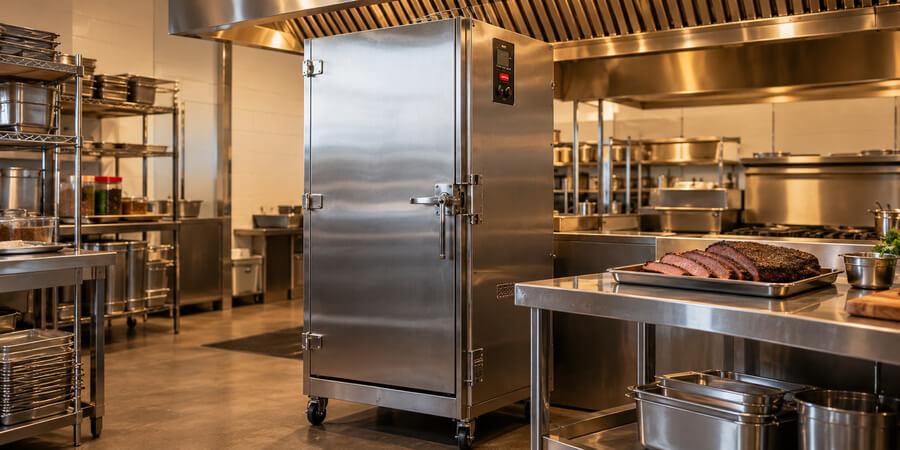
Table of Contents
Which commercial smoker fits your menu and your kitchen, how much meat each size holds, and what it takes to run one indoors
A commercial smoker comes down to three decisions: how it makes heat and smoke, how many pounds of meat it has to hold on your busiest day, and where it can legally stand. Wood pellet smokers burn pellets for both heat and smoke and run the hottest, up to 400°F. Electric cook-and-hold smokers heat with an element while wood chunks smolder in a box, and with the optional meat probe they drop into a holding cycle when the meat is done. Countertop cold smokers add smoke flavor without cooking the food at all. Every hot smoker makes smoke, so settle the hood or vent before you settle on a spot in the kitchen.
Smoker Types at a Glance
| Smoker type: | Where the heat and smoke come from: | Hot or cold: | Temperature range: | Power: | Best for: |
| Wood pellet smoker oven | Wood pellets supply both; a convection fan moves the heat | Hot | 160°F to 400°F | 120 V | Barbecue menus that want wood-fired flavor, from ribs to whole chickens |
| Wood pellet rotisserie smoker | Wood pellets, with racks that rotate through the cabinet | Hot | 160°F to 400°F | 120 V | High-volume barbecue, catering and commissaries |
| Electric cook-and-hold smoker | An electric element heats; wood chunks smolder in a separate box | Hot; cold with an add-on kit | 130°F to 275°F | 120 V on the smallest, 208/240 V on larger | Low and slow cooks that switch themselves to holding |
| Electric smoker oven with humidity control | Electric heat, with separate controls for smoke, humidity and heat | Hot | Up to 350°F | 208 V or 240 V, single or three phase | One cabinet that smokes, bakes, slow cooks and holds |
| Countertop cold smoker | A low-wattage element smolders fine sawdust; the smoke cools before it reaches the food | Cold | Not stated | 120 V | Smoke flavor on fish, cheese and vegetables without cooking them |
| Towable propane smoker | A propane burner under a smoker trough, on a trailer | Hot | 225°F to 350°F | Propane | Outdoor events, festivals and off-site catering |
Temperatures and power are as stated on the smokers on our site. On our commercial smoker ovens category, the Type filter sorts these into Smoker Ovens, Rotisserie Smokers and Cold Smokers, and the Power filter into Electric and Wood Burning. The towable smoker sits with the towable outdoor grills.
Types of Commercial Smokers
Wood Pellet Smoker Ovens
A pellet smoker is a wood-fired smoker with a thermostat. Pellets feed from a hopper into a firepot, an igniter lights them, and an offset firebox with a convection fan moves heat and smoke through an insulated stainless cabinet. Because the wood is the only fuel, every degree of heat comes with wood smoke. The hoppers hold 35 to 80 pounds of pellets, depending on size.
The digital controllers store several programs and run a cook in stages, so a brisket can smoke at one temperature and finish at another without anyone touching a dial. With the optional meat probe, the oven switches itself to hold once the meat reaches the temperature you set.
Watch for: these smokers must be installed under a commercial hood with fire suppression, according to their product pages. Plan the hood first.
Wood Pellet Rotisserie Smokers
A rotisserie smoker hangs its racks on a wheel that turns through the cabinet, so every rack passes through the hot and cool spots instead of sitting in one. The makers say the rotation gives more even cooking. These units preheat in about 10 to 15 minutes and recover in about 15 after the door opens. The racks lift out for power washing, and a foot pedal opens the self-closing door, which helps when both hands are full.
These are the largest smokers we sell, built for a barbecue restaurant, a caterer or a commissary that smokes several hundred pounds at a time. They roll into place on casters, and matching trailers turn the same cabinet into a mobile unit for events. Indoors they still need a flue, a vent or a commercial hood with fire suppression.
Electric Cook-and-Hold Smokers
An electric cook-and-hold smoker heats with an electric element while wood chunks smolder in a slide-out wood box, so the wood is there for flavor, not heat. The element runs only when the door is fully closed, and the cabinet has no drying drafts of air, which is why these smokers are known for moist results.
The temperature range runs lower than a pellet smoker's, topping out at 275°F, which suits low and slow cooking. Once the meat hits its target, the probe (sold separately) switches the oven to hold, and these units are rated to run around the clock. That is the appeal for a small kitchen: load the smoker at close and come back to meat holding at temperature. An optional cold smoke kit turns the same cabinet into a cold smoker for salmon, cheese and nuts.
Watch for: these units need additional ventilation if used indoors. A powered smoke hood that mounts on top of the cabinet is offered for each size.
Electric Smoker Ovens with Humidity Control
This cabinet is a full kitchen oven that also smokes. Separate controls set the smoke, the humidity and the heat, and it can bake dry, bake with moisture, slow cook and hold, with a 24-hour timer. It takes full-size sheet pans on wire racks, or twice as many half sheets, so it fits a kitchen that already plans its batches in pans.
The product pages for these ovens do not address ventilation or whether moist baking needs a water line. Any appliance that makes smoke still falls under the hood rules below, so ask both questions against the spec sheet before you plan on an open wall.
Countertop Cold Smokers
A cold smoker smolders fine sawdust with a low-wattage element, and the smoke cools before it reaches the food. Nothing cooks. The work surface is a stainless tray that sits on a counter, in a standard or long version or a two-tier model for more capacity, with a timer and a cover. The makers suggest fish, meat, vegetables, poultry and cheese.
Cold smoking is flavor only, so raw food goes in raw and comes out raw. The food safety section covers what that means for your menu.
Towable Propane Smokers
For events, a towable smoker puts a propane burner under a smoker trough on a trailer with a hitch. The one we sell has a cooking surface about 5 feet by 2 feet, comes with a rib rack and a propane cylinder, and holds its heat in the range a barbecue cook works in. It is built for outdoor work. Our outdoor kitchen equipment guide covers the rest of an outdoor cook line.
What a Smoker Adds to a Restaurant Kitchen
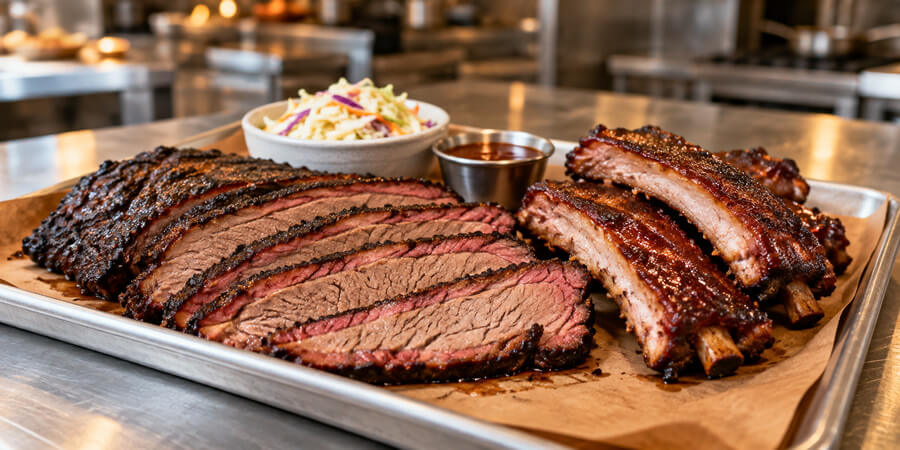
Tough cuts become signature dishes. Brisket, pork shoulder and ribs are tough cuts that need long, low heat to turn tender. A smoker is built to hold that heat for hours, which is hard to do in a standard oven alongside the rest of service.
The cook runs without a cook. With a probe in the meat, cook-and-hold and pellet models switch themselves to holding when the meat is done. Nobody has to be standing there when a brisket finishes in the middle of the night.
Every batch follows the same program. Saved programs run the same stages, temperatures and times each time, so the ribs on Saturday match the ribs on Tuesday, whoever loaded them.
Smoke flavor without tending a fire. Pellets feed themselves from a hopper, and electric models smolder a box of wood for flavor while the element holds the temperature. No one splits logs or watches a firebox.
More than meat. A cold smoker or a cold smoke kit adds smoked cheese, nuts and fish to the menu, and an electric smoker oven with humidity control bakes and holds as well.
Pellet vs Electric Smoker: Which Fits Your Kitchen
Flavor and bark. A pellet smoker burns wood for all of its heat, so the smoke is constant and the cabinet gets hot enough to crisp chicken skin. An electric cook-and-hold smoker runs cooler and makes its smoke from a box of wood, which suits slow cooking and holding better than high-heat finishing.
Moisture. Electric cook-and-hold smokers keep the air still and the element off whenever the door opens, which helps meat stay moist through long cooks. Pellet smokers move air with a fan, which builds more crust.
Power. Every pellet smoker we sell, rotisseries included, runs on a 120 V circuit. Electric smokers need 208/240 V in most sizes; only the smallest cook-and-hold cabinet runs on 120 V. The space and power table below has the details.
Ventilation. Both need it. The pellet models call for a commercial hood with fire suppression, and the electric models call for additional ventilation indoors. Pellet smokers also count as solid fuel cooking under the fire code, covered in the hood section below.
Fuel. Pellet smokers burn pellets from a hopper. Electric models use small-cut wood chunks in the wood box. Either way you are buying wood by the bag or the box, so keep it on the supply order.
The short version: choose pellet for a barbecue-forward menu that wants the most smoke and higher heat; choose electric cook-and-hold for overnight cooks, holding and a smaller footprint.
How Much Meat a Commercial Smoker Holds
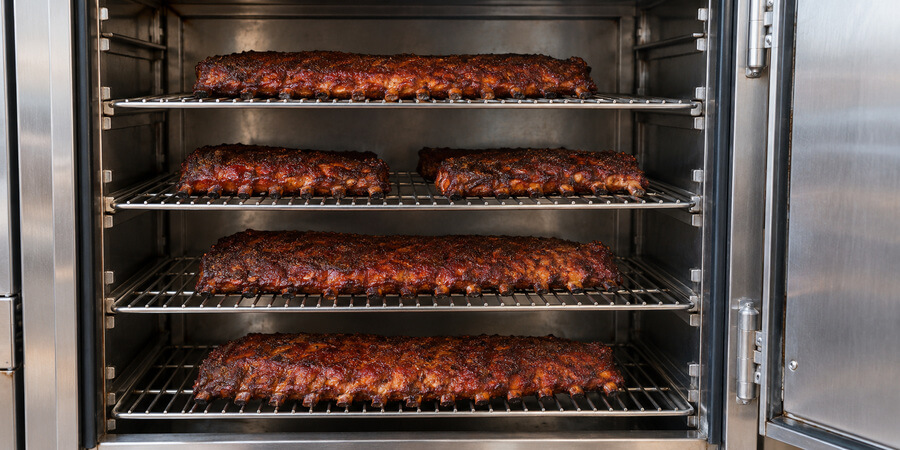
Smokers are rated in pounds of raw meat per load. These are the makers' figures, by cabinet class.
| Smoker:: | Racks: | Cooking area: | Pork butt: | Brisket: | Ribs: | Whole chickens: |
| Electric cook-and-hold, half size | 5 | 1,620 sq in | 120 lb | 100 lb | 50 lb | 20 |
| Electric cook-and-hold, 3/4 size | 6 | 3,456 sq in | 240 lb | 200 lb | 100 lb | 40 |
| Electric cook-and-hold, full size | 28 | 9,072 sq in | 550 lb | 500 lb | 270 lb | 100 |
| Wood pellet smoker oven, 3/4 size | 5 | 1,955 sq in | 150 lb | 120 lb | 90 lb | 30 |
| Wood pellet smoker oven, full size | 8 | 3,128 sq in | 250 lb | 240 lb | 180 lb | 60 |
| Wood pellet rotisserie, smallest | 15 rotisserie | 5,400 sq in | 350 lb | 300 lb | 100 lb | 45 |
| Wood pellet rotisserie, mid size | 15 rotisserie | 7,350 sq in | 500 lb | 450 lb | 150 lb | 70 |
| Wood pellet rotisserie, largest | 15 rotisserie | 10,800 sq in | 750 lb | 700 lb | 300 lb | 110 |
Electric smoker ovens with humidity control are rated in pans instead: 6 or 13 full-size sheet pans, or 12 or 26 half-size pans.
Size to the busiest day's raw weight. Smoked meat loses a good share of its weight as it cooks, so start from the portions you sell on your biggest day, work back to raw pounds, and pick the cabinet that holds that in one load.
Count loads, not just pounds. Brisket and pork shoulder cook for most of a day, so a cabinet often gets one big load of them. Ribs and chicken finish faster and can turn more than once. If the menu leans on the long cooks, buy for capacity; if it leans on ribs and chicken, a smaller cabinet that turns twice can do the job.
Check the rack against the cut. Racks run from squares about 18 inches across to rotisserie racks 60 inches long but under a foot deep. A whole brisket or a full slab of ribs has to lie flat on the rack, which is why the rotisserie units hold fewer pounds of ribs than their size suggests.
Space, Power and Delivery
| Smoker type: | Width: | Depth: | Height: | Weight: | Electrical: |
| Wood pellet smoker oven | 46.5 in | 35 in | 61 to 76 in | 560 to 675 lb | 120 V, single phase |
| Wood pellet rotisserie | 49.5 to 84 in | 85.5 to 89 in | 77 to 79 in | 1,475 to 2,100 lb | 120 V, single phase |
| Electric cook-and-hold | 20.5 to 48 in | 26 to 40.5 in | 52 to 71 in | 245 to 750 lb | 120 V, 1,500 W on the half size; 208/240 V, 3,050 W to 6,000 W on larger |
| Electric smoker oven with humidity control | 27.4 in | 36.25 in | 48.9 to 78 in | 400 to 600 lb | 208 V or 240 V, single or three phase |
| Countertop cold smoker | 16 in | 28 to 40 in | 8 to 12 in | 40 to 45 lb | 120 V, 4 amps |
| Towable propane smoker | 45 in | 121 in long | 51 in | 830 lb | Propane |
Get the amps and the plug from the spec sheet. The electric cook-and-hold smokers give their wattage, but the pellet smokers and the humidity-control ovens give only voltage and phase, and none of the product pages names a plug type or the clearance to walls and combustibles. Each smoker's page links a spec sheet; hand it to your electrician and hood installer before the smoker ships.
Measure the delivery path. Even the narrowest rotisserie smoker is wider than most single doors, and the heaviest weighs more than a ton. Measure every door, hallway and elevator between the truck and the kitchen, and confirm the floor can carry the weight.
Leave room to work. The door has to swing fully open and the racks have to slide out. Measure the space with the door open, not just the cabinet.
Hoods, Ventilation and Running a Smoker Indoors
The code starting point. The International Mechanical Code, which most states and cities adopt, requires a Type I hood where cooking appliances produce grease or smoke. Smokers produce both, and our cooking without a hood guide lists smoker ovens among the equipment that typically needs a Type I hood. Shop commercial kitchen ventilation hoods when you get to that step.
What the makers say. The wood pellet smoker ovens must be installed under a commercial hood with fire suppression. The rotisserie smokers need a flue, a vent or a commercial hood with fire suppression. The electric cook-and-hold smokers need additional ventilation if used indoors. None of the smokers on our site is described as ventless.
Vent add-ons help, but they do not replace the hood decision. Each electric cook-and-hold smoker has a matching smoke hood that mounts on top of the cabinet and pushes its smoke through a 4-inch outlet, to vent outside or under a commercial hood. It does not catch all of the smoke that escapes while you unload. Rotisserie smokers take a flue collector with a 6-inch outlet. Both are powered by a blower of their own, so each needs an outlet, and both are offered on the smoker's own product page rather than in the accessories category. A smoke evacuator for pellet smokers opens louvers when the doors open, and it still needs an updraft fan and additional ventilation to get the smoke out of the building.
Pellet smokers are solid fuel cooking. They burn wood and nothing else, so they fall under the solid fuel chapter of NFPA 96, the fire standard most jurisdictions use for kitchen exhaust. That chapter calls for spark arresters and keeps solid fuel exhaust separate from every other exhaust system, so a pellet smoker may need its own hood and duct rather than a spot under the fryer hood. Electric smokers that smolder a little wood for flavor are the gray area, and your fire marshal makes that call.
Who signs off. The building department, the fire marshal and the health department each have a say. Bring the model's spec sheet to your hood installer and to all three before you order. Outdoors is not automatically exempt either; some areas require a hood even for outdoor cooking.
Food Safety Rules for Smoked Food
The FDA Food Code does not treat smoked meat differently from any other cooked food. The same temperatures apply, and the same thermometer checks prove them.
Cook to the code minimum, then keep going for tenderness. Whole cuts of pork and beef have to reach 145°F for 15 seconds, or follow the code's time and temperature table for whole roasts; sausage and other ground meat need 155°F for 17 seconds, and poultry 165°F (section 3-401.11). Barbecue goes well past those numbers for tenderness, but the code number is the floor your inspector checks.
Hold at 135°F or above. Hot food has to stay at 135°F or higher (section 3-501.16). The code allows 130°F for whole roasts cooked under its roast table, which is why the electric cook-and-hold smokers can be set as low as 130°F. 135°F is right for everything, so use it unless your health department has signed off on the roast exception, and confirm the meat itself with a thermometer.
Cool fast, in pieces. Cooked food has to cool from 135°F to 70°F within 2 hours and to 41°F within 6 hours total (section 3-501.14). A whole brisket or pork shoulder cools slowly, so slice or pull it into shallow pans, or use a blast chiller.
Reheat to 165°F. Smoked meat that was cooked, cooled and reheated for hot holding has to reach 165°F within 2 hours (section 3-403.11).
Smoking to preserve needs a variance. Smoking food as a way to preserve it, rather than for flavor, requires a variance from your regulatory authority before you start, and usually a HACCP plan (section 3-502.11). Talk to your health department before you cold smoke raw fish or meat for service, since cold smoking does not cook it.
Check with a thermometer, not the probe alone. The oven's probe tells the oven when to hold; a calibrated food thermometer is what proves the temperature. Our food thermometer guide covers calibration and probe placement, and the heated holding equipment guide covers holding cabinets for service.
Wood, Pellets and Smoker Accessories
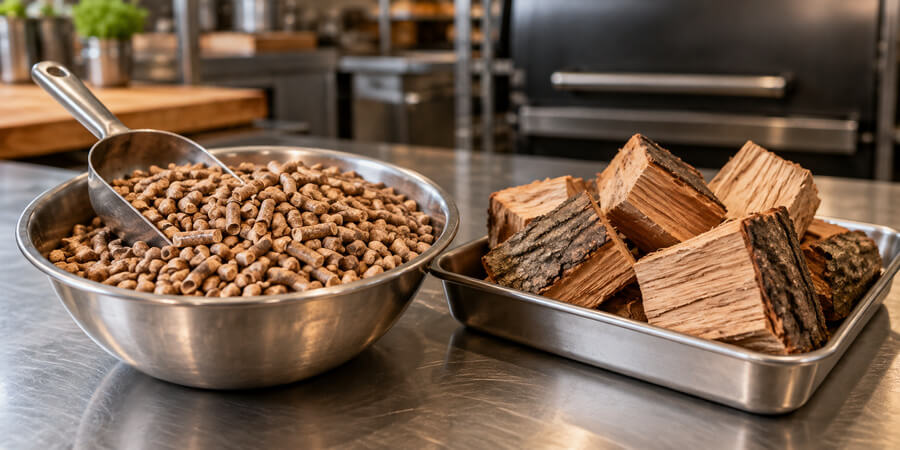
Use the fuel your smoker is built for. Pellet smokers burn pellets from the hopper. Electric cook-and-hold smokers take small-cut wood chunks in the wood box. Cold smokers burn fine sawdust, which comes with the unit and is not sold on our wood page. They are not interchangeable.
Pick the wood for the flavor. Our wood for smoking includes pellets, small-cut chunks and chips in hickory, mesquite, apple, cherry, oak and fruitwood. Oak reads neutral, apple and cherry run sweet, and hickory and mesquite run bold. Many kitchens keep one everyday wood and one for specials.
What comes in the box. Pellet smokers ship with a starter supply of pellets and a drip pan, and electric cook-and-hold smokers ship with wood, a drip pan, a wood box and a spare heating element. Racks are included with every cabinet.
Accessories worth knowing about. The smoker oven accessories on our site include:
- A meat probe that switches the smoker to hold when the meat reaches temperature
- Cold smoke kits for electric cook-and-hold smokers
- Rib racks, jerky rods and seafood grill racks sized to each cabinet
- A smoke enhancer box that sits over the firepot of a pellet smoker for a deeper smoke flavor
- A stainless pig pan, front shelves, and trailers for the rotisserie smokers
- A smoke evacuator for pellet smokers
Installing and Caring for a Commercial Smoker
Before the Smoker Arrives
- Pull the spec sheet for amperage, plug type, clearances and the vent connection
- Get the hood or vent plan approved by the building department, fire marshal and health department
- Have the electrician install the circuit to the spec sheet's voltage and phase
- Measure doors, hallways and elevators against the cabinet's narrowest dimension
- Confirm the floor is level and can carry the weight, and plan where the casters lock
- Calibrate the food thermometers the cooks will use to check the meat
Daily and Weekly Care
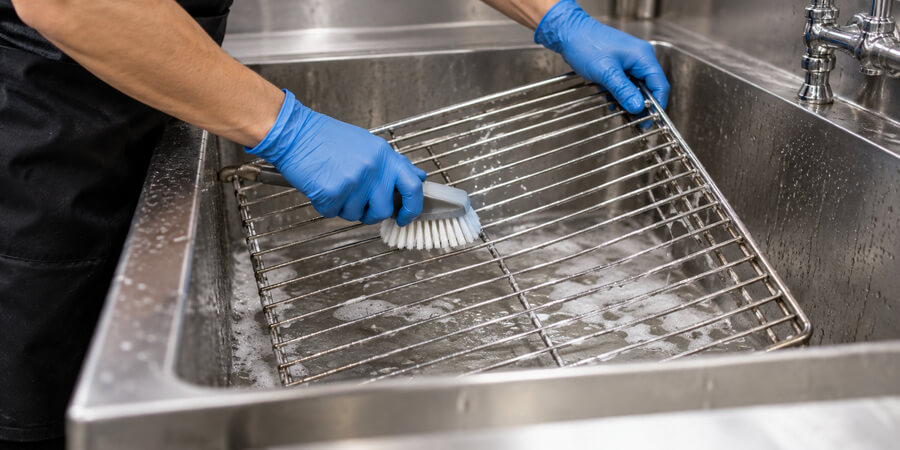
Empty the drip pan and wood box after every cook. Grease and ash left in the cabinet bake on during the next cook and add a burnt taste.
Wash the racks like any food-contact surface. The rotisserie racks lift out and can be power washed. Wash, rinse and sanitize every rack between uses.
Keep pellets and wood dry. Pellets that take on moisture swell and crumble, which can jam the feed.
Keep the hood on schedule. Smoke carries grease into the hood filters and duct. NFPA 96 puts exhaust systems that serve solid fuel cooking on a monthly inspection schedule, the most frequent in the standard, so a pellet smoker raises the bar for hood cleaning.
Frequently Asked Questions
Do commercial smokers need a hood?
Usually, yes. The International Mechanical Code requires a Type I hood where cooking appliances produce grease or smoke, and smokers produce both. The pellet smokers we sell must go under a commercial hood with fire suppression, and the electric ones need additional ventilation indoors. None is sold as ventless, and your building department and fire marshal make the final call.
Is a pellet smoker or an electric smoker better for a restaurant?
A pellet smoker burns wood for all of its heat, runs hotter and gives the most smoke flavor, so it suits barbecue-forward menus. An electric cook-and-hold smoker runs cooler, keeps meat moist and switches to holding on its own, so it suits overnight cooks and smaller kitchens.
What size smoker does a restaurant need?
Start from the most smoked meat you sell on your busiest day, work back to raw pounds, and choose a cabinet that holds it in one load. Capacities run from about 120 pounds of pork butt in a half size electric smoker to 750 pounds in the largest rotisserie, and ribs take more rack space per pound than butts or brisket.
What is a cook-and-hold smoker?
A smoker that cooks low and slow, then switches itself to a holding temperature when the meat is done. An optional meat probe triggers the switch, so the meat waits at temperature until service.
What is the difference between a smoker oven and a cold smoker?
A smoker oven cooks the food while it smokes it. A cold smoker cools the smoke before it reaches the food, so it adds flavor without cooking. Cold smoked fish or meat is still raw.
What is a rotisserie smoker?
A smoker whose racks turn on a wheel through the cabinet, so every rack passes through the same heat for more even cooking. They are the largest smokers we sell, rated for several hundred pounds a load, and trailers are made for them.
What power does a commercial smoker need?
Pellet smokers run on 120 V. Electric smokers need 208/240 V in most sizes, and some humidity-control ovens come in three phase. Get the amperage and plug type from the spec sheet before the electrician wires the circuit.
What temperature should smoked meat be held at?
At 135°F or above under the FDA Food Code. The code allows 130°F for whole roasts cooked under its roast table, but 135°F is safe for everything, so set the hold there unless your health department has approved the lower number.
Do I need health department approval to smoke food?
Smoking for flavor is ordinary cooking. Smoking as a way to preserve food requires a variance from your regulatory authority under the Food Code, usually with a HACCP plan. Ask your health department before you cold smoke raw fish or meat.
What certifications should a commercial smoker have?
Look for a sanitation listing such as NSF; the Food Code accepts equipment certified for sanitation by an ANSI-accredited program (section 4-205.10). The pellet and electric cook-and-hold smokers we sell are NSF and UL listed, and the humidity-control ovens are NSF and ETL listed.
What warranty comes with a commercial smoker?
It varies by type. The pellet and electric cook-and-hold smokers we sell carry two years on parts and 90 days on labor, the humidity-control ovens two years on parts and one year on labor, and the countertop cold smokers one year on parts and labor.
What wood should I use in a commercial smoker?
The one your smoker is built to burn: pellets in a pellet smoker, small-cut chunks in an electric smoker's wood box, fine sawdust in a cold smoker. For flavor, oak is neutral, apple and cherry are sweet, and hickory and mesquite are bold.
Shop Commercial Smokers
- Commercial Smoker Ovens - wood pellet, rotisserie, electric cook-and-hold and countertop cold smokers, filtered by type and power
- Smoker Oven Accessories - meat probes, cold smoke kits, rib racks, jerky rods and smoke evacuators
- Wood for Smoking - wood pellets, chunks and chips in hickory, mesquite, apple, cherry and oak
- Commercial Kitchen Ventilation Hoods - the hood a smoker goes under indoors
Related Guides & Resources
- Commercial Cooking Equipment Guide - the full cook line, from ranges and fryers to ovens
- Commercial Cooking Without a Hood - which equipment needs a Type I hood and which can go without
- Commercial Heated Holding Equipment Guide - cabinets and warmers that keep smoked meat at temperature for service
- Food Thermometer Guide - calibration, probe placement and the cooking temperatures to hit
- Commercial Outdoor Kitchen Equipment Guide - grills, smokers and the rest of an outdoor cook line
- Food Safety Guide - the wider rules for cooking, holding and cooling
Share This!