Food Thermometer Guide
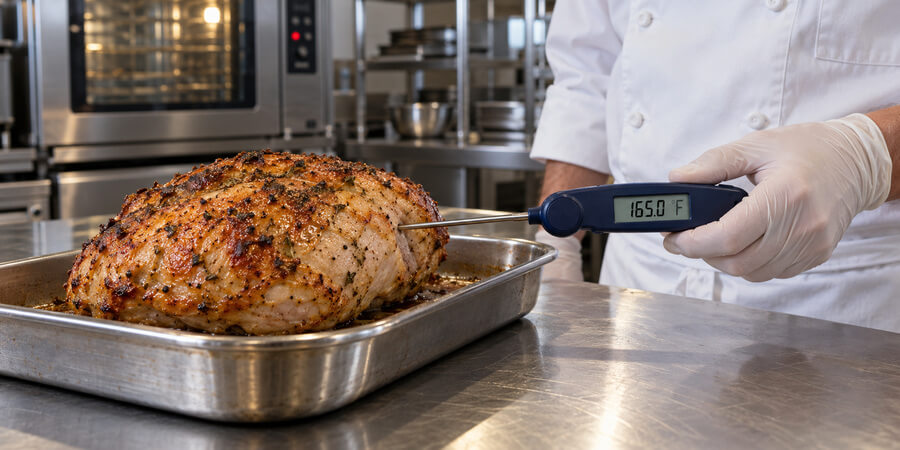
Table of Contents
Which thermometer suits each job in a commercial kitchen, how to calibrate it, and where to put the probe for a true reading
A food thermometer in a commercial kitchen has to be accurate to within 2°F, calibrated as often as its maker requires, and fitted with a thin probe for thin foods such as burger patties and fish fillets. Those are FDA Food Code rules, not suggestions. The fastest way to check one is the ice water test: a thermometer held in a stirred glass of ice and water should read 32°F. This guide covers the thermometer types, how to calibrate each, where to put the probe, and the temperatures it has to confirm.
Food Thermometer Types Chart
| Thermometer: | How fast it reads: | How deep it goes in: | Best for: | Can it be calibrated? |
| Digital thermocouple | 2 to 6 seconds | 1/4 in or deeper | Any food, thick or thin; the fastest reading | Yes, on most |
| Digital thermistor pocket | About 4 to 10 seconds | At least 1/2 in | Line checks, thin foods with a thin tip | Many can; some are sealed and sold as not needing it |
| Dial instant-read pocket | 15 to 20 seconds | 2 to 2-1/2 in | Roasts, soups, casseroles, cold holding checks | Most on our listings, with a nut and a tool on the sheath |
| Oven-safe dial (meat or roast) | 1 to 2 minutes | 2 to 2-1/2 in | Roasts left in the oven | Some |
| Probe with cable and base unit | Continuous | At least 1/2 in | Roasts and large cuts in the oven | Some; the USDA notes oven cord models cannot be |
| Deep fry and candy | Continuous | Clipped into the oil or syrup | Fryer oil, candy, chocolate | Many, per the listing |
| Refrigerator and freezer | Air temperature, continuous | Hangs or stands in the unit | Walk-ins, reach-ins, freezers | Check the listing |
| Oven, grill and hot holding | Air or surface, continuous | Hangs, stands or sits on the surface | Checking an oven, a griddle or a holding cabinet | Check the listing |
| Infrared (non-contact) | Instant | Does not go in; reads the surface | Griddle and pan surfaces, quick screening | Check the listing |
| Dishwasher (plate surface) | One cycle | Rides through on a rack | Confirming a hot water machine sanitizes | Check the listing |
Reading speeds and depths follow the USDA's food thermometer factsheet; the digital speeds match what the listings on our site state for their own models.
A probe thermometer is the one the Food Code requires. Every kitchen has to keep food thermometers on hand and within reach (section 4-302.12). Where the menu has thin foods, one of them needs a small-diameter probe built for thin masses. Infrared thermometers read only the surface, so they cannot confirm a cooking or holding temperature.
What the Food Code Requires of a Food Thermometer
The FDA Food Code sets the rules for the thermometer itself in Chapter 4.
Accurate to 2°F. A food thermometer scaled only in Fahrenheit must be accurate to plus or minus 2°F in the range it is used for; one scaled in Celsius, or in both, to plus or minus 1°C (section 4-203.11). Thermometers that measure air or water, such as the one in a walk-in, get a looser plus or minus 3°F (section 4-203.12).
Readable in 2-degree steps. Food thermometers, and the water thermometers on dish machines, must show a scale, printout or digital readout in steps no bigger than 2°F (section 4-204.112).
A thin probe for thin food. A thermometer with a small-diameter probe designed for thin masses has to be on hand to check thin foods such as meat patties and fish fillets (section 4-302.12). The code's own explanation defines thin as under 1/2 inch, says a bimetal dial thermometer with a bayonet stem cannot read it accurately, and points to a probe 1.5 millimeters across or less on a thermocouple-type thermometer (Annex 3).
No bare glass. A food thermometer may not have a glass stem or sensor unless the glass is encased in a shatterproof coating, as on candy thermometers (section 4-201.12).
Calibrated as the maker says. Food thermometers must be calibrated according to the manufacturer's instructions as often as needed to keep them accurate (section 4-502.11). The code sets no fixed schedule; the maker's instructions and your own checks do.
One in every holding unit. Cold and hot holding equipment for foods that need temperature control must have a built-in or permanently attached thermometer that is easy to read, placed in the warmest part of a refrigerated unit and the coolest part of a hot one (section 4-204.112). Steam tables, bain-maries, heat lamps, cold plates, salad bars and insulated transport containers are exempt from the built-in rule, which is why a probe check is the only way to know what the food in them is doing.
A way to prove the dish machine sanitizes. A manual dish sink needs a thermometer for the wash and sanitizing water. A hot water dish machine needs an irreversible registering temperature indicator that proves dishes reach a surface temperature of 160°F (sections 4-302.13 and 4-703.11).
How to Calibrate a Food Thermometer
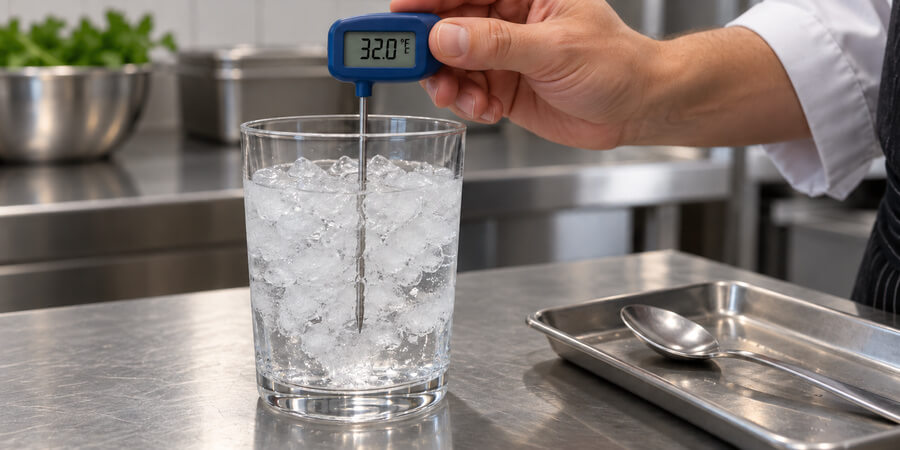
Calibration is checking a thermometer against a temperature you know and adjusting it if it is off. The USDA's food thermometer factsheet gives two methods: ice water, which it calls best for most thermometers, and boiling water, for higher temperatures.
The ice water method (ice point)
- Fill a large glass with ice cubes, add clean drinking water, and stir well.
- Put the thermometer stem at least 2 inches into the mixture, touching neither the sides nor the bottom of the glass.
- Wait at least 30 seconds, and read the thermometer without taking it out of the water.
- It should read 32°F. If it does, it is calibrated.
- If it does not, adjust it as the maker's instructions say: turn the calibration nut under the dial with the tool or wrench, or use the calibration button on a digital model, until it reads 32°F with the stem still in the ice water.
The boiling water method (boiling point)
- Bring a pot of clean water to a full boil.
- Put the stem at least 2 inches into the boiling water, touching neither the sides nor the bottom of the pot.
- Wait at least 30 seconds and let the reading settle.
- At sea level it should read 212°F. Water boils at a lower temperature at altitude, usually at least 2°F lower and as much as 5°F lower, so check the local boiling point with your health department or extension office before adjusting.
- Adjust as the maker's instructions say. If the thermometer cannot be adjusted and reads outside its stated accuracy, replace it.
Use ice water for most checks. The ice point does not change with altitude, and it sits close to the cold holding temperatures a kitchen checks most. Boiling water is the better check for a fry or candy thermometer that works well above 200°F.
Know which thermometers cannot be adjusted. Many dial pocket thermometers on our listings come with a recalibration tool built into the sheath, and many digital models offer field or one-button calibration. Some digital models are sold as accurate for life with no field adjustment; check those in ice water anyway, and replace one that reads outside its stated accuracy. The USDA notes that oven cord thermometers and thermometer forks cannot be calibrated.
When to check. The code leaves the schedule to the maker, so most kitchens set their own. A good routine is at the start of every shift, after a thermometer is dropped, after it has been used at an extreme temperature, and whenever a reading looks wrong. Log the checks; an inspector asking how you know your thermometers are accurate is asking to see that log.
Where to Put the Probe
A thermometer is only as accurate as where the tip sits. The USDA's placement rules:
Thickest part, away from bone, fat and gristle. A probe resting against bone or sitting in fat or gristle is not reading the meat. For steaks, chops and roasts, go into the center of the thickest part.
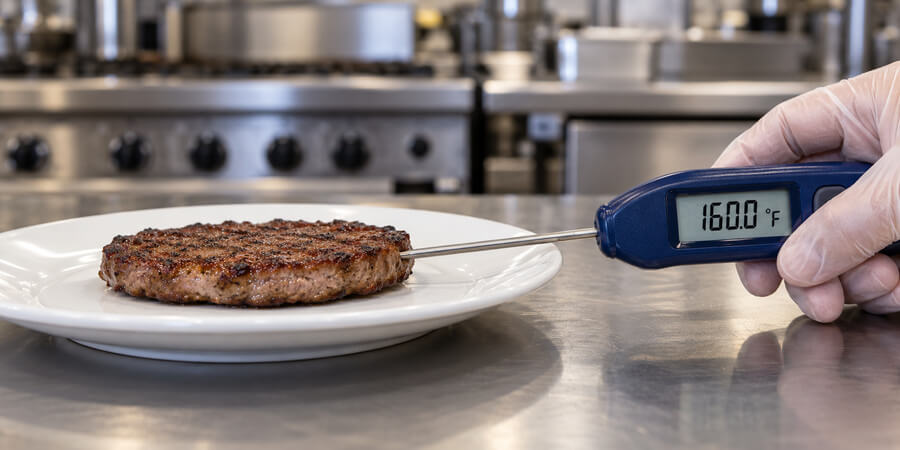
Thin foods go in from the side. For a burger patty, sausage, thin chicken breast or fish fillet, push the probe in through the side until the tip reaches the center. Take the food off the heat onto a clean spatula or plate first so hands stay clear of the grill.
Whole poultry gets three checks. The innermost part of the thigh, the innermost part of the wing, and the thickest part of the breast, all away from the bone. Stuffing is checked at its center.
Large or irregular foods get several checks. A roast, a casserole or an egg dish can be done in one spot and under in another, so check the center and a few other places.
Know where the sensor is. A digital probe reads at the tip. A dial thermometer averages along its stem, from the tip up about 2 to 3 inches, and the stem often carries a small dimple marking the top of the sensing area. The USDA says a dial thermometer has to go 2 to 3 inches into the food, which is why a dial cannot read a thin patty unless it goes in sideways, and why the code wants a thin probe for thin food.
Check every batch, not every tenth. Pieces cook at different rates depending on size and where they sit on the grill or in the oven. The USDA says to check each piece, so a pan of chicken breasts gets a probe in every breast.
Temperatures Your Thermometer Has to Confirm
These are the Food Code minimums for a restaurant or food service kitchen (sections 3-401.11, 3-401.12 and 3-403.11). All parts of the food have to reach the temperature and hold it for the time shown.
| Food: | Minimum internal temperature: | Hold time: |
| Fish; whole cuts of beef, pork and lamb; eggs cooked to order for immediate service | 145°F | 15 seconds |
| Ground, chopped, tenderized or injected meat; ground fish; eggs cooked for hot holding | 155°F | 17 seconds (or 145°F for 3 minutes, 150°F for 1 minute, 158°F instantly) |
| Poultry; stuffed meat, fish, pasta or poultry; stuffing containing meat, fish or poultry | 165°F | Instant |
| Whole meat roasts: beef, corned beef, lamb, pork and ham | 130°F to 145°F | From 112 minutes at 130°F down to 4 minutes at 145°F |
| Raw animal food cooked in a microwave | 165°F | Stand covered 2 minutes after cooking |
| Fruits and vegetables cooked for hot holding | 135°F | None |
| Leftovers reheated for hot holding | 165°F | 15 seconds, within 2 hours |
| Commercially packaged ready-to-eat food reheated for hot holding | 135°F | None |
Restaurant temperatures differ from consumer charts. The USDA's chart for home cooks says 160°F for ground meat and 145°F with a 3-minute rest for whole cuts. The Food Code sets its own time and temperature pairs for food service, and it is the one your inspector enforces, so train from the code.
Holding and cooling are separate checks. Once cooked, hot food is held at 135°F or above and cold food at 41°F or below. Cooked food has to cool from 135°F to 70°F within 2 hours and to 41°F within a total of 6 hours. Our restaurant food temperature requirements article covers holding in full, and the blast chiller guide covers the cooling logs.
Choosing a Thermometer for Each Job
| Job: | Thermometer: | What to look for on the listing: |
| Cooking checks on the line | Digital thermocouple or thermistor pocket | A 1.5 mm thin tip, a reading in under 6 seconds, plus or minus 2°F or better |
| Thin foods: patties, fillets, thin breasts | Digital with a 1.5 mm tip | The tip size in the listing; a dial will not do |
| Cold holding checks in the walk-in and prep line | Digital pocket or dial pocket | A range that goes below 32°F, plus or minus 2°F |
| Roasts in the oven | Oven-safe dial or a probe with a heat-resistant cable | An oven-safe rating or a cable rated for the oven temperature |
| Walk-ins, reach-ins and freezers | Refrigerator and freezer thermometer | A range from below 0°F to above 41°F; plus or minus 2°F if the dial offers it |
| Hot holding cabinets and steam wells | Hot holding dial for the cabinet, probe for the food | A 100°F to 175°F dial range; plus or minus 3°F |
| Fryer oil and candy | Deep fry or candy thermometer with a pan clip | A range to 400°F or higher and a long stem or paddle |
| Milk frothing and beverages | Beverage and frothing thermometer | A 0°F to 220°F range and a clip for the pitcher |
| Oven and griddle calibration | Oven thermometer, grill surface thermometer or infrared | Treat these as rough checks; several are rated to plus or minus 25°F |
| Hot water dish machines | Dishwasher plate-surface thermometer or irreversible indicator | Rides through a cycle and records the maximum surface temperature |
Digital for the line, dial for backup. The digital pocket thermometers on our listings read in 2 to 8 seconds, mostly cover about minus 40°F to 392°F or 450°F, a few to 572°F, and many add a hold button that freezes the reading after the probe comes out. A dial pocket thermometer reads more slowly but needs no battery, and a spare in the office drawer covers a dead battery during a rush.
Read the accuracy line. The digital pocket thermometers on our listings that state an accuracy give plus or minus 1°F or 2°F, and the standard dial pocket thermometers plus or minus 2°F, all within the code's limit. Fry and candy dials state plus or minus 5°F, and oven and grill thermometers plus or minus 25°F, which is fine for checking an oven or oil but not for confirming a food temperature.
Waterproof models survive the dish sink. Several digital models on our listings carry an IPX6 or IPX7 waterproof rating, and a few dial models are rated safe for commercial dishwashers. The USDA notes that most thermometers should not be immersed, so check the rating before washing one under water.
Antimicrobial housings help, but do not replace cleaning. Many pocket thermometers on our listings have antimicrobial plastic cases or sheaths. The probe itself still has to be cleaned and sanitized.
Cleaning, Sanitizing and Storing Thermometers
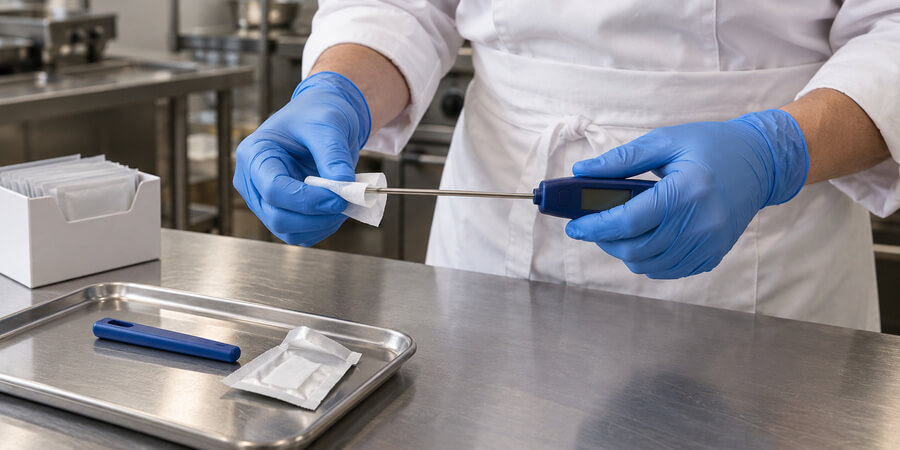
Clean and sanitize the probe between foods. A probe that goes from raw chicken into potato salad carries whatever was on the chicken. A probe touches food like any utensil, and the Food Code requires utensils to be cleaned when a cook moves from raw to ready-to-eat food and between different raw animal foods (section 4-602.11). Wash with hot, soapy water or as the maker says, then sanitize.
Probe wipes make it quick on the line. The thermometer probe wipes on our listings are individually wrapped and saturated with 70 percent isopropyl alcohol, sold 100 or 200 to a box, for wiping the stem between temperature checks. Keep a box at each station where temperatures are taken.
Store the probe in its sheath. Probes are sharp and bend easily, and a bent probe reads wrong. Most pocket thermometers on our listings come with a sheath that clips to a pocket or doubles as a handle extension.
Do not leave a pocket thermometer in the oven. Only thermometers made to stay in food while it cooks, such as oven-safe dials and probe-and-cable models, can go in. A pocket thermometer's plastic face or case can melt.
Replace what fails the ice test. A thermometer that cannot be adjusted and reads outside its stated accuracy, has a cracked lens, or has a bent stem goes in the bin.
How Many Thermometers a Kitchen Needs
One probe thermometer for each person who checks temperatures, plus a spare. Every cook who finishes proteins should have one in a pocket. Sharing one thermometer across a line means checks get skipped when it is busy.
One air thermometer in every refrigerator, freezer and hot holding unit. The code wants a built-in or permanently attached one in the warmest spot of each cold unit. Where a unit's built-in display is hard to read or suspect, a hanging dial thermometer confirms it.
One thin-tip thermometer anywhere thin foods are cooked. The grill and the fish station need a 1.5 mm tip.
One way to check the dish machine. A plate-surface thermometer or irreversible temperature labels for a hot water machine; a thermometer for the sanitizing sink.
A log for all of it. Calibration checks, cooking temperatures and holding temperatures all go on paper or a screen. Kitchen timers sit next to the log for the hold times and the cooling clock.
Frequently Asked Questions
How do you calibrate a food thermometer?
Fill a glass with ice, add water and stir. Put the stem at least 2 inches in without touching the glass, wait 30 seconds, and read it in the water. It should read 32°F. If it does not, turn the calibration nut under the dial, or use the calibration button on a digital model, until it does.
What should a thermometer read in ice water?
32°F, or 0°C. The ice and water have to be well mixed and the stem at least 2 inches in without touching the sides or bottom of the glass.
What should a thermometer read in boiling water?
212°F at sea level. At altitude water boils lower, usually by at least 2°F and by as much as 5°F, so check your local boiling point before adjusting.
How often should a food thermometer be calibrated?
The Food Code requires calibration according to the manufacturer's instructions as often as needed to keep it accurate. Most kitchens check at the start of each shift, after a drop, after use at an extreme temperature, and whenever a reading looks wrong, and log each check.
How accurate does a food thermometer need to be?
Within plus or minus 2°F for a thermometer scaled in Fahrenheit, or plus or minus 1°C for one scaled in Celsius or both. Air and water thermometers, such as a walk-in's, must be within plus or minus 3°F.
What are the main types of food thermometers?
Digital thermocouples and thermistors, dial (bimetal) thermometers in instant-read and oven-safe versions, probe-and-cable thermometers that stay in the food, and single-purpose thermometers for fryers, refrigerators, ovens and dish machines. The chart at the top compares their speed, depth and uses.
Can you use an infrared thermometer to check food temperatures?
Not to confirm a cooking or holding temperature. An infrared thermometer reads only the surface, and the Food Code's inspection guidance calls it inappropriate for internal cooking temperatures. It is useful for griddle and pan surfaces and quick screening.
What thermometer is required for thin foods like burgers?
One with a small-diameter probe designed for thin masses (section 4-302.12). The code's guidance describes a probe 1.5 millimeters across or less, which is the thin tip on many digital pocket thermometers. A dial thermometer's sensor runs 2 to 3 inches up the stem and cannot read a thin patty accurately.
Where do you put a thermometer in chicken?
In the thickest part, away from the bone. For a whole bird, check three places: the innermost thigh, the innermost wing and the thickest part of the breast. Poultry is done at 165°F under the Food Code.
How far should a thermometer go into food?
It depends on the type. The USDA says a digital thermocouple needs about 1/4 inch, a thermistor at least 1/2 inch, and a dial thermometer 2 to 2-1/2 inches, because its sensor runs up the stem. Always aim the tip for the center of the thickest part.
Can a food thermometer go in the dishwasher?
Only if the listing says so. Some dial and waterproof digital models are rated for commercial dishwashers; most thermometers should be washed by hand without being immersed. Probe wipes clean the stem between checks.
What is the difference between a thermocouple and a thermistor?
Both are digital. A thermocouple reads fastest, in 2 to 5 seconds, from a sensor right at the tip, and works in thick and thin foods. A thermistor takes about 10 seconds and needs about 1/2 inch of depth, though thermistors with a 1.5 mm tip read thin foods well.
Shop Food Thermometers
Start with a digital pocket thermometer with a thin tip for every cook, a refrigerator thermometer for every cold unit, and a box of probe wipes at every station. Our commercial food thermometers cover pocket, thermocouple, oven, fryer, refrigerator and dish machine models, probe wipes keep the stems clean between checks, and kitchen timers keep the hold times honest.
Related Guides & Resources
- Food Safety Guide - Receiving, holding, cooling and the program your thermometers support.
- Commercial Blast Chiller Guide - Cooling food through the two-stage rule, and logging it.
- Food Date Labeling Guide - The 7-day rule for food that has passed its temperature checks.
- Commercial Fryer Guide - Fryer types and oil management, where a fry thermometer earns its keep.
Share This!