Food Date Labeling Guide
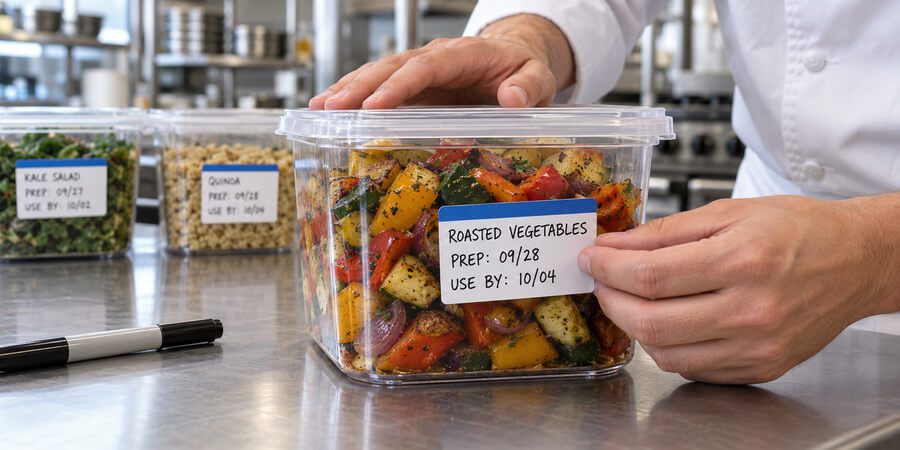
Table of Contents
How to date mark ready-to-eat food under the 7-day rule, read day dot colors, and pick the right label for the job
Ready-to-eat food that needs time and temperature control for safety, kept refrigerated and held longer than 24 hours, must be marked with the day it has to be used or thrown away, and it gets seven days at 41°F or colder, counting the day it was made as day 1. Day-of-the-week labels are a common way to do it: one colored sticker per container tells anyone on the line how old the food is.
The 7-Day Date Marking Chart
| Made or opened on (day 1): | Use or discard by the end of (day 7): | Color for the day made: | Color for the discard day: |
| Monday | Sunday | Blue | Black |
| Tuesday | Monday | Yellow | Blue |
| Wednesday | Tuesday | Red | Yellow |
| Thursday | Wednesday | Brown | Red |
| Friday | Thursday | Green | Brown |
| Saturday | Friday | Orange | Green |
| Sunday | Saturday | Black | Orange |
The Food Code sets the days, not the colors. Both label makers on our listings use this same set of day colors. The Food Code does not assign colors; it allows calendar dates, days of the week, color-coded marks or any other effective method, as long as you can explain your system to the inspector (section 3-501.17).
Pick one way to read the label, and train everyone on it. The code allows marking either the day the food was made or opened, with a procedure to discard it by day 7, or the day it must be used. A kitchen that mixes the two throws out good food or keeps old food, so choose one and post it.
The Date Marking Rule, Section by Section
The FDA Food Code sets out date marking in sections 3-501.17 and 3-501.18.
Food made in-house. Refrigerated, ready-to-eat food that needs time and temperature control, prepared and held more than 24 hours, is marked with the day or date by which it must be eaten, sold or discarded: seven days at 41°F or less, with the day of preparation as day 1.
Opened packages. The same rule applies to refrigerated, ready-to-eat food from a processing plant once the original container is opened and the food is held more than 24 hours, with the opening day as day 1. The date you mark may not run past the manufacturer's use-by date when that date is based on food safety.
Combined food keeps the oldest date. When a dated ingredient goes into a new batch, the batch keeps the date of the earliest-prepared ingredient.
Freezing pauses the clock. Time the food spends frozen does not count toward the seven days.
Unmarked means discard. Food that the rule covers has to be thrown away when it has passed seven days, sits in a container with no date or day, or carries a mark that runs past seven days (section 3-501.18).
Some opened foods are exempt. Certain commercially made foods do not need a mark after opening, including hard and semi-soft cheeses, cultured dairy such as yogurt and sour cream, deli salads from a processing plant, preserved fish, and shelf-stable dry sausages and cured hams. Check the full list in the code before you rely on it.
Time Labels for Food Held Without Temperature Control
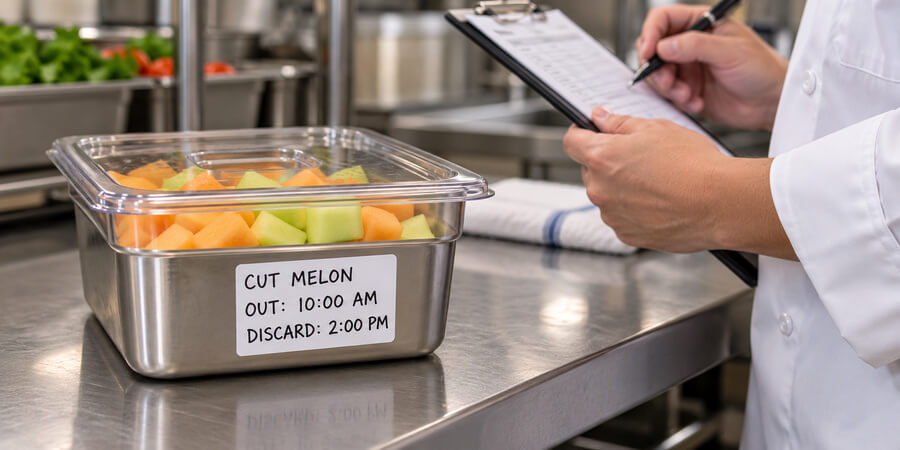
Some kitchens hold food outside the refrigerator or hot-holding unit on purpose, on a buffet or a busy prep station, and use time instead of temperature as the safety control. The Food Code allows it only with written procedures prepared in advance, including how the food was cooled beforehand, and kept on hand for the inspector (section 3-501.19), and never for raw eggs in a kitchen serving a highly susceptible population, such as a hospital or nursing home. The label changes from a day to a clock time.
The four-hour limit. Food starts at 41°F or colder, or 135°F or hotter, and is marked with the time four hours after it left temperature control. By that time it has to be cooked and served, served, or thrown away. Cut fruit and vegetables, and food from a sealed can or jar, may start at 70°F or colder instead.
The six-hour limit. This one is for cold food only. It starts at 41°F or colder, must stay at 70°F or below with the warmest part of the food checked during the hold, and is marked with both the time it came out and the time six hours later. Food that goes above 70°F, or reaches the six-hour mark, is thrown away.
No time, no food. Under either limit, food in an unmarked container, or marked past its limit, is discarded. A write-on rotation label carries a clock time as easily as a date.
Setting Up a Labeling System in Five Steps
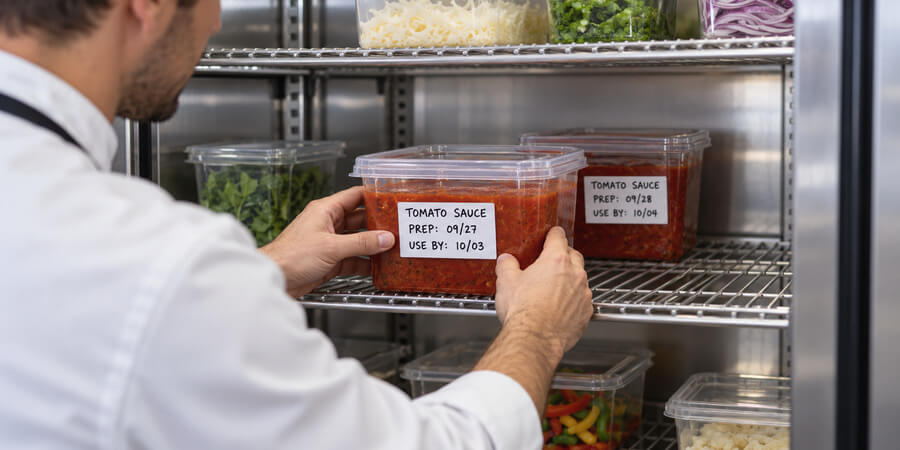
- Decide what the label marks, the day food was made or opened or the day it must go, and write it down, since the code expects you to explain your system to the inspector on request.
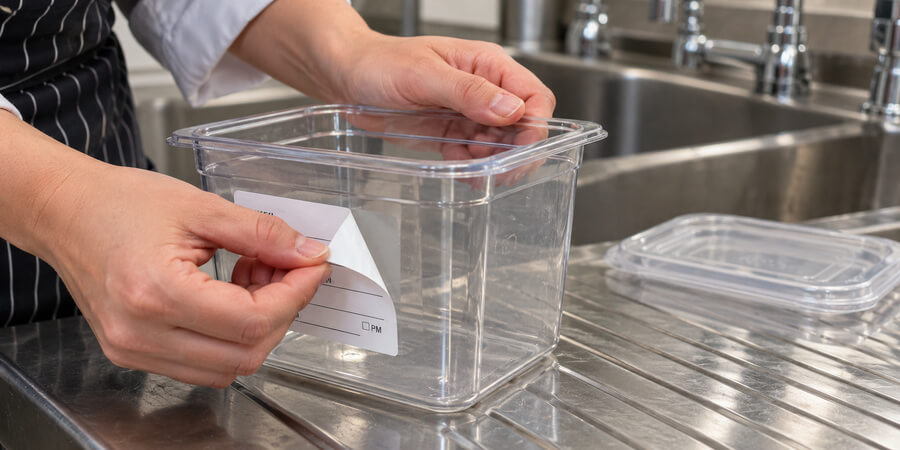
- Choose the adhesive by how containers get cleaned: dissolvable for containers that go straight to the dish machine, removable for containers peeled before washing, permanent for wrap, foil and throwaway containers.
- Stock each station with a roll for every day of the week and a roll of write-on rotation labels, in a dispenser where food is portioned and stored.
- Label food the moment it goes into a container, and before it goes into the freezer, adding the item and use-by day wherever similar batches share a shelf.
- Walk the shelves before prep starts every day, discard anything past day 7 or with no label, and move the oldest food to the front.
Choosing a Label: Dissolvable, Removable, Permanent or Reusable
| Label type: | How it comes off: | Best for: | On our listings: |
| Dissolvable | Dissolves in water, leaving no residue | Containers that go straight into the dish machine or sink | 1 in squares, plus 2 x 2, 3 x 2 and 4 x 2 in rotation labels; 125 to 1,000 per roll |
| Removable | Peels off by hand before washing, leaving no residue | Reused containers washed by hand or machine | 3/4 in rounds, 1 in squares and octagons, 2 and 3 in rounds, and 2 x 1 to 4 x 2 in rotation labels; 500 to 2,000 per roll |
| Permanent | Strong adhesive that stays put | Plastic wrap, foil and throwaway containers | 3/4 in rounds and 1 in squares; 1,000 to 2,000 per roll |
| Reusable or wash-resistant | Removed before or after washing without residue | Containers that go through the washer with the label on | 3 x 2 in rotation labels |
Dissolvable labels save scrubbing. The dissolvable labels on our listings dissolve completely in water, and one line states it works in water of any temperature in 30 seconds, so nobody picks at old adhesive on the dish line.
Match the label to the cold. Labels rated for the freezer stay put well below zero once they are on, but each line has a minimum application temperature, 10°F on the removable line and 21°F on the dissolvable line, so label food before it goes into the freezer, not after.
Day labels or full rotation labels. Small day-of-the-week dots mark the day only. Larger rotation labels on our listings come preprinted for the item, prep date and use-by day, or as shelf-life, use-by, use-first and plain product labels, and the day-colored labels in the larger size carry item, date and use-by lines as well, which helps when several batches of the same sauce sit on one shelf. A day-only sticker cannot tell this Monday's batch from last Monday's, so either walk the shelves and discard before the day's prep starts or use a label that carries the date.
Keep the rolls at the station. Dispenser kits hold a full roll of each day in one case, and label roll dispensers hang on the wall or sit on the counter by the prep table so the right color is in reach while the food is still on the board.
Frequently Asked Questions
How long can prepped food be kept in the refrigerator?
Under the FDA Food Code, refrigerated ready-to-eat food made in-house can be kept up to seven days at 41°F or colder, counting the day it was made as day 1, as long as it is marked. Food made on a Monday is used or discarded by the end of Sunday.
What are day dot labels?
Small colored stickers printed with a day of the week, stuck on a container to show when food was made or when it must be used. The day labels on our listings are trilingual, printing the day in three languages.
What color is each day on food labels?
Both label makers on our listings use Monday blue, Tuesday yellow, Wednesday red, Thursday brown, Friday green, Saturday orange and Sunday black. The Food Code does not set colors, so confirm the scheme printed on your own labels.
Should the label show the day food was made or the day it expires?
Either one is allowed, as long as the kitchen has a procedure to discard food by day 7 and can explain the system to an inspector. Pick one method and train every shift on it.
Do opened store-bought foods need a date label?
Yes, if they are refrigerated, ready-to-eat, need time and temperature control for safety, and are kept more than 24 hours after opening; the opening day is day 1. Some items, such as hard cheeses, yogurt and sour cream, are exempt.
Does food used within 24 hours need a date label?
The date marking rule applies to covered food held more than 24 hours, so food used within 24 hours of being made or opened is not required to carry one. Labeling everything anyway keeps the system simple, so nobody has to guess which containers count.
Does freezing reset the date?
No. Freezing pauses the clock: time spent frozen does not count toward the seven days, but the days before freezing still do, and the count picks up again once the food thaws.
What date goes on food made from several ingredients?
The date of the oldest dated ingredient. A batch made with a sauce prepared two days earlier carries that sauce's date, not the day the batch was assembled.
Are day dot labels required by law?
Date marking is required for covered food; day dots are not. The Food Code lets a kitchen use calendar dates, days of the week, color-coded marks or another effective method, as long as the system can be explained to the inspector.
What does day 1 mean in date marking?
The day the food is made, or the day a commercial package is opened, counts as day 1. That is why food made on a Monday has to be used or discarded by the end of Sunday, not the following Monday.
Shop Food Date Labels
Start with the day-of-the-week set in the adhesive that matches how your containers are cleaned, then add rotation labels where cooks need to write the item and use-by date. The full range of day of the week and food rotation labels filters by adhesive, day, shape and label type, and the food storage containers they go on sit alongside.
Related Guides & Resources
- Food Safety Guide - Cold holding, cooling and the wider program date marking belongs to.
- Cutting Board Color Code Guide - The other color system on the prep line.
- Disposable Glove Guide - Which glove to wear while handling ready-to-eat food.
Share This!