Commercial Restroom Supplies Guide
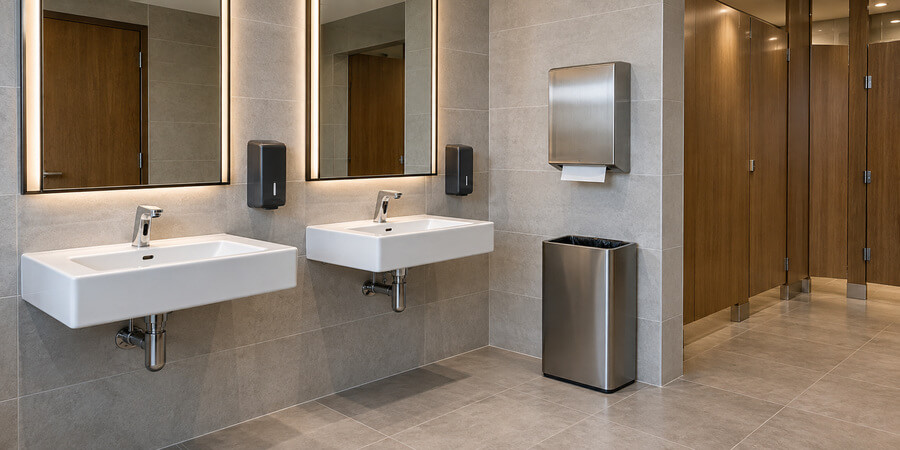
Table of Contents
Dispensers, hand drying, soap, odor control, waste and mounting heights, the six decisions behind a restroom order
A commercial restroom is hardware and consumables that have to match each other. The hardware goes on the wall once and stays for years; the consumables arrive by the case forever after, and the wrong pairing means a case of refills nothing will accept. Six decisions settle almost every restroom order. Hand drying comes first, because towels and electric dryers lead to different supply chains entirely. Then dispenser format, meaning which towel fold and which soap refill the hardware physically takes. Then soap and sanitizer, where the refill format matters more than the fragrance. Then odor control, which is what guests judge a restroom on, and waste, because a restroom with nowhere to put a towel becomes a plumbing problem. Last, mounting heights and accessibility, which is federal design law rather than preference. Toilet paper itself is covered in the commercial toilet paper guide, so this guide takes the rest of the room.
Hand Drying: Paper Towels or Electric Dryers
Hand drying changes the shape of the whole operation. A towel restroom needs storage, restocking labor, a waste receptacle and a recurring case order; a dryer restroom needs an electrician once and almost nothing after. Both are accepted practice: the Centers for Disease Control and Prevention tells people to dry their hands "using a clean towel or an air dryer," and takes no position between them.
| Drying option: | Sourced band: | Hardware it needs: | Restocking character: | Where it fits: |
| Hardwound roll towel | Roll lengths 300 to 1,150 feet | Roll dispenser, lever or hands free | Longest interval of any towel format | High-traffic public restrooms |
| Center pull towel | Drawn from the roll center, a sheet at a time | Center pull dispenser | Long interval, controlled use | Rooms where waste control matters |
| Multifold (M-fold) | The largest folded group stocked | Folded-towel dispenser | Frequent, very fast to reload | Offices, moderate traffic, tight walls |
| C-fold | Wider sheet than multifold | Dispenser sized for C-fold | Frequent | Guest-facing rooms wanting a larger sheet |
| Z-fold and single fold | The smallest folded groups stocked | Dispenser matched to the fold | Frequent | Niche and legacy dispenser fits |
| Electric dryer, heated | Voltages 115v through 240v, including dual voltage | A dedicated circuit and wall backing | None; wipe the housing | Rooms eliminating towel waste |
| High-speed unheated dryer | One manufacturer states an 8 second dry time for its model | A dedicated circuit; the higher draw | None | Busy rooms where throughput is the point |
Sheet size is the quiet variable behind the folded formats. Towel widths run from 6.75 inches at the narrow end up to 14.8 inches, and that spread is why a case bought on price alone can arrive and refuse to load. Both 1-ply and 2-ply are stocked, in brown and white. Every format has to be ordered against the hardware, which is why commercial paper towels and the dispensers that take them are two separate decisions.
Electric drying trades a consumable for a fixture. Electric hand dryers come in two families, hands-under units where the user holds hands beneath the airflow and hands-in units where the hands go into a chamber, in heated and unheated high-speed styles. Stainless steel is the usual housing wherever vandalism is a real risk. One honest limitation: dry time is a manufacturer claim tied to a specific model rather than a property of dryers in general.
Dispenser Formats: What the Hardware Actually Takes
Fit is mechanical, and it is where most restroom supply money gets wasted. A dispenser is built for one family of refill, and the label on the case rarely says whether it will load.
Towel dispensers split three ways: roll, folded and center pull. Within the folded group the styles run C-fold, multifold, single fold and their relatives, and a dispenser built for one fold will not reliably take another. Activation is the second axis, from a lever the user turns through to hands free units that sense the hand. Mounting is the third, and wall mounted is the norm, with countertop and recessed options for casework and for tight corridors. Choosing among paper towel dispensers is three questions, not one.
Tissue dispensers follow the same pattern. Capacity runs from single roll up to quad roll, locking is common, and combination units exist that build a seat cover dispenser or a napkin receptacle into the tissue cabinet, which matters when wall space is short. Anyone specifying toilet paper dispensers and holders should settle the roll class first and the finish second, because hardware outlives refills by years.
Hand Soap and Sanitizer: Bulk, Cartridge, Foam and Liquid
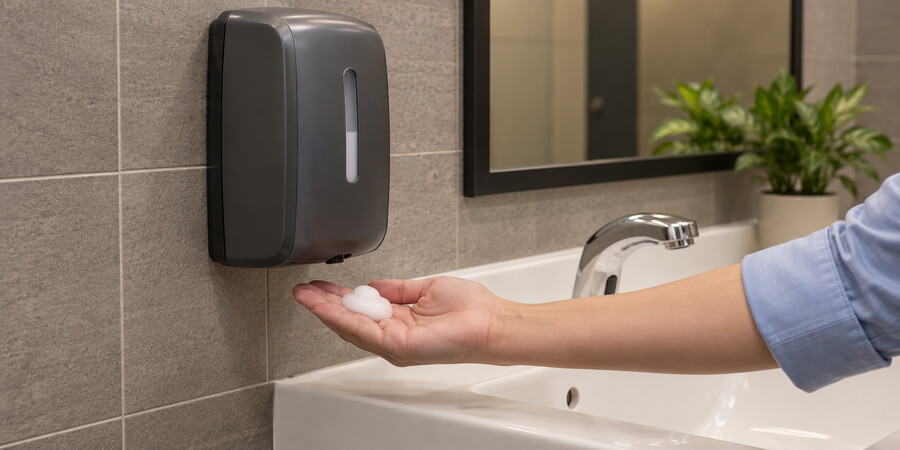
Soap is where the refill format matters more than anything printed on the label. Bulk soap arrives in gallon jugs and is poured into a refillable reservoir: cheapest per wash, easiest to top up, and most exposed to contamination and overfilling. Sealed cartridges drop in as a closed unit, which removes the mess and ties the site to that dispenser's cartridge, and bag-in-box sits between them. Cartridge refills run from roughly 800 milliliters up through the low-liter sizes while bulk comes by the gallon, so the two are not interchangeable on a shelf or in a budget.
Foaming and liquid are both well represented, and the choice is operational rather than cosmetic. Foam dispenses a pre-aerated dose, so less product goes per wash and it rinses faster; liquid gives a heavier lather and is the default where guests expect a traditional feel. A restroom that runs out of soap by mid-afternoon is usually running liquid at a generous dose, and switching that room to foam is cheaper than switching the dispenser.
Activation runs manual, lever, push button and automatic, and touchless removes the most-touched surface at the sink. Sanitizer belongs next to the soap decision rather than instead of it: the Centers for Disease Control and Prevention is explicit that washing with soap and water "is the best way to get rid of germs in most situations," and that an alcohol-based sanitizer should be used when soap and water are not readily available, at a minimum of 60% alcohol. One order can cover hand soaps and sanitizers for the sink and the doorway alike.
| Restroom traffic: | Hand drying: | Soap refill format: | Waste receptacle: | Restocking character: |
| Low, a small office or single-fixture room | Folded towels, or a heated dryer | Cartridge refills at the smaller sizes | Roughly 3 to 16 gallons | Weekly walk, one person |
| Moderate, a dining room or guest-facing room | Folded towels, or roll towel for fewer changeovers | Cartridge, foaming, touchless | Roughly 20 to 32 gallons | Checked each shift, restocked daily |
| High, quick service or a public restroom | Roll towel at the long end, or a high-speed dryer | Bulk gallon refills, locking reservoir | Roughly 35 to 44 gallons | Checked hourly at peak |
| Very high, a school, stadium or transit facility | High-speed dryers, or a second roll dispenser | Bulk gallon refills, foaming | Upper band, plus a second receptacle | Continuous during events |
Seat Covers, Napkin Receptacles and Stall Hardware
Seat covers are a guest-confidence item rather than a hygiene requirement, and guests notice a public restroom that lacks them. The dispenser is a flat wall cabinet with stocked faces from about 15.75 inches wide up to roughly 17.25 inches, so a stall wall already carrying a tissue dispenser and a grab bar needs checking before a third cabinet is committed. Specification starts from the wall, which is where toilet seat cover dispensers belong in the plan.
Sanitary napkin receptacles are expected in every restroom serving women, with a covered unit in each stall, and the consumable is a waxed paper liner rather than a plastic bag. The 2026 FDA Food Code goes further: every toilet room needs a covered receptacle, not only rooms serving women (section 5-501.17). Stocked units are wall-mount, in stainless steel and plastic, so treat feminine hygiene dispensers and receptacles as a fixture decision with a short list.
Grab bars compete for the same stall wall as every dispenser. Stocked lengths run from 18 inches up to 42 inches in stainless steel, and those lengths map onto the accessibility requirements below. Specifying restroom fixtures and grab bars is the first physical decision in an accessible stall and the constraint every dispenser works around.
Odor Control: Screens, Mats and Air Fresheners
Odor is what a guest remembers, and almost all of it comes from two places: the urinal and the floor around it. Urinal screens sit in the bowl and do two jobs, catching debris so the drain stays clear and dispersing the stream so it does not splash back. Modern screens carry the fragrance that used to come from a separate block, which is why screens are now the dominant format. What a urinal cake is for is masking odor and freshening the fixture between cleanings; it is a deodorizing consumable, not a cleaner. Both sit together in urinal screens and cakes, and a screen is the better default in almost every commercial setting.
The floor is the other half. Splash reaches the floor in front of every urinal no matter what is in the bowl, and grout absorbs it. Stocked urinal mats run roughly 17 to 18.5 inches across the front, and commode mats are the wider version for the base of a toilet. Adding urinal and toilet mats is the cheapest fix for a restroom that smells clean at the fixture and wrong at the door.
Air fresheners are the third layer, and the distinction that matters is between masking and neutralizing. Deodorizers work on the source; air fresheners add scent. The stocked formats are metered refills for programmable dispensers, total-release aerosols for treating a whole room at once, jelled deodorants, and liquid concentrates for dilution into a cleaning routine. Metered refills are the format built for continuous restroom use. Scent should stay conservative in a foodservice building, so treat air fresheners and deodorizers as a format decision before a fragrance one.
Waste Receptacles: The Cheapest Plumbing Insurance There Is
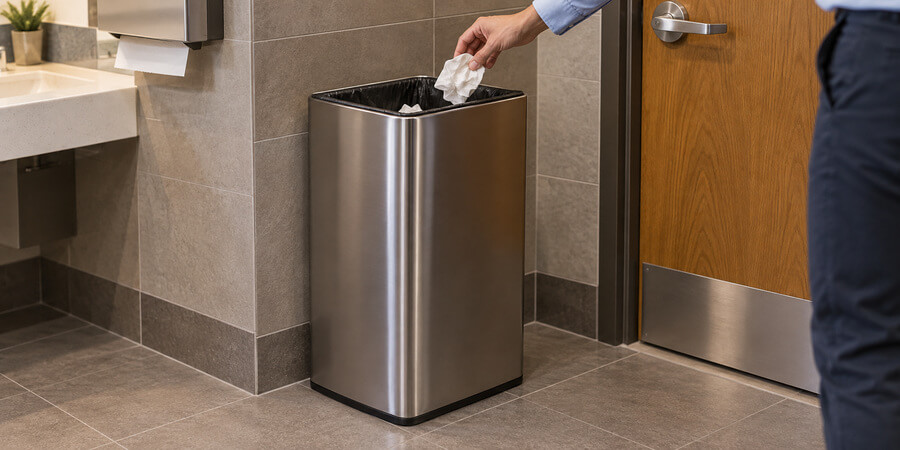
Many restroom clogs involve something that was never meant to be flushed, and the usual reason is that there was nowhere obvious to put it. A receptacle inside the stall, one by the door and one at the sink is not over-provisioning; it is the plumbing budget.
Capacity comes first. The stocked range runs from small wastebaskets up to the largest band in the traffic table above, and the middle of that range is the restroom workhorse. Slim rectangular cans fit the wall between a stall and a sink where a round can will not, and a swing door lid earns its keep here, hiding the contents and slowing odor without a touch. Size trash cans and recycling bins to the towel format, because a roll towel restroom generates far more volume per user than a folded towel one and a dryer restroom generates almost none.
Liners should be ordered against the can rather than a number in a memo, and a liner size chart by can size gives the flat width and length to match. Gauge is what people get wrong: a thin liner is fine for paper waste and tears on anything with an edge, and a torn liner in a public restroom is a floor-cleaning job.
Mounting Heights and Accessibility
This is the one part of a restroom order governed by federal design law rather than preference. The 2010 ADA Standards for Accessible Design set where things go, and the Americans with Disabilities Act requirements apply to the dispenser as installed, not to the product as sold. Almost every figure below is a range, leaving room to plan a wall and none to guess.
The rule that catches people most often is the toilet paper dispenser, which has a horizontal position measured from the front of the water closet, a vertical range for its outlet, and a prohibition on sitting behind a grab bar. That last clause turns a compliant dispenser into a non-compliant installation: the bar goes up first, and the dispenser has to find a legal position around it.
| Element: | Requirement: | ADA section: |
| Toilet paper dispenser, horizontal | Centerline 7 inches minimum to 9 inches maximum in front of the water closet | 604.7 |
| Toilet paper dispenser, outlet height | 15 inches minimum to 48 inches maximum above the floor, not behind grab bars | 604.7 |
| Operable parts, unobstructed forward reach | 15 inches minimum to 48 inches maximum above the floor | 308.2.1 |
| Operable parts, unobstructed side reach | 15 inches minimum to 48 inches maximum, at 10 inches maximum depth | 308.3.1 |
| Obstructed forward reach | 44 inches maximum where reach depth over an obstruction exceeds 20 inches | 308.2 |
| Obstructed side reach | 46 inches maximum where obstruction depth exceeds 10 inches, to 24 inches maximum depth | 308.3 |
| Operating force | No more than 5 pounds of force, and no tight grasping, pinching or twisting of the wrist | 309.4 |
| Wall-mounted objects in circulation paths | Protrude no more than 4 inches where the leading edge is above 27 inches and below 80 inches | 307.2 |
| Vertical clearance | 80 inches minimum headroom along circulation paths, 78 inches minimum at doorways | 307.4 |
| Side wall grab bar | 42 inches long minimum, 12 inches maximum from the rear wall, extending 54 inches minimum from it | 604.5.1 |
| Rear wall grab bar | 36 inches long minimum, 12 inches minimum one side of the water closet centerline and 24 inches the other | 604.5.2 |
| Grab bar height | 33 inches minimum to 36 inches maximum, to the top of the gripping surface | 609.4 |
| Mirror, bottom edge of reflecting surface | 40 inches maximum over a lavatory or counter, 35 inches maximum elsewhere | 603.3 |
| Lavatory rim or counter surface | 34 inches maximum above the floor | 606.3 |
Two of those lines govern hardware nobody thinks of as accessible equipment. The protruding-objects rule covers every surface-mounted cabinet in a corridor or in front of a sink run, so a deep towel dispenser at chest height on a circulation path can fail even though it is perfectly usable. The operating-force rule quietly rules out any dispenser needing a firm two-handed pull, worth testing with one hand before a hundred go on a wall.
Soap dispensers, towel dispensers and hand dryers are all operable parts, so the unobstructed reach range applies to all three, and the obstructed lines apply where one sits behind a counter. Plan in this order: grab bar, then tissue dispenser, then everything else.
Consumables Math: Dispensers per Fixture and Refill Sizing
Start from fixtures rather than square footage, because fixtures generate demand. A workable default is one tissue dispenser per stall, one soap dispenser per lavatory, one towel dispenser or dryer per two lavatories in a small room and one per lavatory where queues form, a covered receptacle inside each stall serving women and at least one in every toilet room, and a large receptacle at the exit door. That last one matters in a towel restroom, because the exit is where the towel is discarded and a receptacle anywhere else will be ignored. Apart from the covered receptacle, none of these ratios comes from a code; required fixture counts come from the plumbing code and the designer.
Refill sizing is arithmetic on measured usage. Count users rather than hours: a restroom serving a dining room turns over with covers, one serving an office with headcount. Work out daily consumption of one item, divide the case into it for a reorder interval, then repeat per consumable and the restocking round assembles itself. Roll towel is the easiest to model because the catalog states the length; soap is harder because the dose per wash varies with the dispenser.
Two rules keep this from staying theoretical. Order against the busiest realistic week rather than the average one, then measure one real week of restocking and substitute that number for every assumption above.
The Restroom Checklist: Daily, Weekly and Monthly
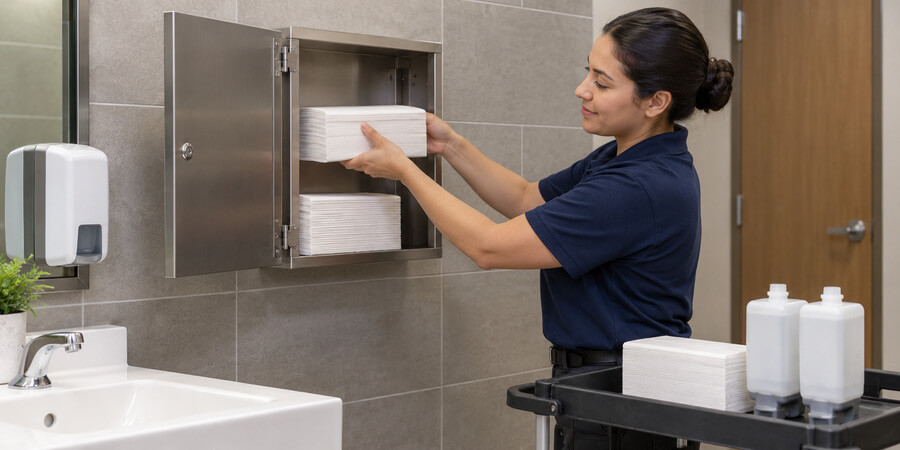
A restroom fails on the round that did not happen, not on the product that was bought. The routine below is a framework to adapt, not a standard.
Every shift or peak check. Look at the four things that run out: tissue, towels or dryer function, soap, and receptacle capacity. Clear the floor and confirm the sink area is dry, because standing water is the fastest signal a guest reads as neglect.
Daily. Clean and disinfect the fixtures, flush handles, door handles, dispenser fronts and taps. Empty and reline every receptacle. Refill each dispenser to full rather than to adequate, so the next check is a look and not a job.
Weekly. Clean the floor properly, including behind the toilet and under the urinal where splash collects. Descale if the building has hard water, replace mats, and wipe the walls behind the dispensers.
Monthly. Check hardware rather than supplies: dispenser locks, dryer housings and sensors, loose mountings, grab bar fixings, receptacle lids. Confirm the dispenser inventory still matches the refills being ordered, which is where format drift gets caught before a pallet of the wrong fold arrives.
Frequently Asked Questions
What are urinal cakes for?
A urinal cake is a deodorizing block that sits in the urinal to mask odor and freshen the fixture between cleaning rounds. It is a consumable rather than a cleaner. Most commercial restrooms now use a screen instead, because a screen carries fragrance while also catching debris and cutting splash.
Should a restroom use urinal screens or urinal cakes?
Screens are the better default in almost every commercial setting. A screen disperses the stream so less reaches the floor, catches debris that would otherwise reach the drain, and carries fragrance the way a cake does. Cakes remain useful where a fixture cannot take a screen, but screens are the dominant format in the current selection.
How high should a toilet paper dispenser be mounted?
Under the 2010 ADA Standards for Accessible Design, the dispenser outlet must be between 15 inches and 48 inches above the finish floor, and the dispenser must not sit behind a grab bar. Its centerline also has to fall in a narrow window in front of the water closet; both figures are in the accessibility table above.
How high should soap and paper towel dispensers be mounted?
Soap dispensers, towel dispensers and hand dryers are all operable parts, so the accessible reach range applies: nothing lower than 15 inches or higher than 48 inches above the floor on an unobstructed approach. Mounting one over a counter counts as an obstructed reach and the allowance drops.
Are hand dryers better than paper towels for a restaurant?
The Centers for Disease Control and Prevention accepts a clean towel or an air dryer without ranking them, so the decision is operational. Dryers remove a recurring case order, restocking labor and most waste volume, but need a circuit. Many operators run dryers in staff restrooms and towels out front.
What is the difference between C-fold, multifold and Z-fold towels?
They are different fold patterns with different sheet sizes, and each needs a dispenser built for it. Multifold is the largest folded group in the selection, C-fold uses a wider sheet, and Z-fold and single fold are the smallest. Because towel widths span a wide band, a case bought on price alone can refuse to load.
Which soap refill format is best, bulk or cartridge?
Bulk gallon refills poured into a reservoir cost the least per wash and suit high-traffic restrooms with a reliable cleaning routine. Sealed cartridges arrive closed, which removes contamination risk and spillage and makes refilling a ten-second job. The deciding question is usually who does the refilling.
How many dispensers does a commercial restroom need?
As a planning default, one tissue dispenser per stall, one soap dispenser per lavatory, one towel dispenser or dryer per lavatory where queues form, a covered receptacle in each stall serving women and at least one in every toilet room, and a large waste receptacle at the exit door. Required fixture counts for a building come from the plumbing code and the designer.
Shop Commercial Restroom Supplies
Settle hand drying first, match each dispenser to the refill format it will actually run, then size the waste receptacles to the drying decision. Confirm every mounting height against the accessibility table before anything is fixed to a wall, and keep the room's hardware and consumables together in restroom supplies so the order matches the wall rather than last quarter's invoice.
Related Guides & Resources
- Commercial Toilet Paper Guide - Roll formats, ply, dispenser fit and case math for restroom tissue.
- Commercial Sink Sizing Guide - Hand sink placement, mop sinks and the Food Code rules behind them
- Commercial Toilet Paper Dispensers: Types and Selection - Dispenser types, capacity, placement and tamper resistance for busy restrooms.
- How to Choose a Commercial Soap Dispenser - Matching soap dispensers to traffic, refills and maintenance.
- Your Complete Restaurant Kitchen Cleaning Checklist - Daily, weekly and monthly cleaning routines for the whole building, restrooms included.
Share This!