Trash Can and Liner Sizing Guide
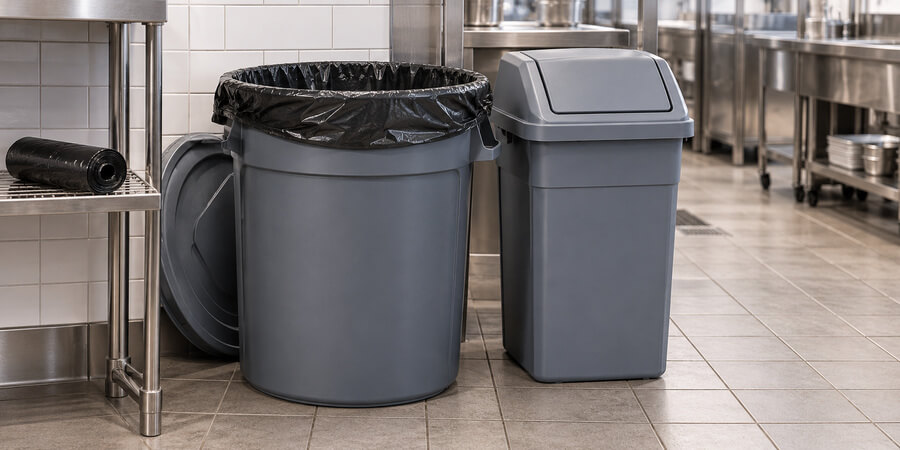
Table of Contents
How to match trash bags to every can, read mil and micron thickness, and pick the right can and lid for each station
A trash can liner fits by its flat width and length, not by the gallon number on the box: the width should be about half the distance around the inside of the rim, and the length the can's depth plus half its base plus 3 to 4 inches to fold over. Liners for the common 32 and 33 gallon cans, for example, are 33 inches wide on our listings; the chart below carries every label's flat size and thickness.
Trash Can Liner Size Chart
| Liner label: | Flat size on our listings (width x length): | Thickness on our listings: |
| 4 to 7 gallon | 17 x 17 in | 0.35 mil |
| 10 gallon | 24 x 23 or 24 x 24 in; also 20 x 21 and 22 x 25 | 0.35 to 0.4 mil, or 6 microns |
| 13 gallon | 23 x 29 in; about 24-1/2 x 27-1/2 in with a drawstring | 0.6 to 0.8 mil |
| 16 gallon | 24 x 32 or 24 x 33 in | 0.35 to 0.7 mil, or 6 to 8 microns |
| 23 gallon, for slim cans | 29 x 44 in | 0.95 mil |
| 30 gallon | 30 x 36 or 30 x 37 in; also 26 x 43 | 0.6 to 0.95 mil, or 10 microns |
| 32 to 33 gallon | 33 x 38 to 33 x 40 in; 33 x 44 for heavy-duty round 32 gallon cans | 0.5 to 1.6 mil, or 14 to 16 microns |
| 38 to 39 gallon | 30 x 46 or 35 x 43 in | 0.75 to 1 mil |
| 44 to 45 gallon | 37 x 50 in for heavy-duty round 44 gallon cans; 40 x 46 to 40 x 48 for 45 gallon | 0.6 to 1.6 mil, or 10 to 19 microns |
| 55 to 60 gallon | 38 x 58 or 38 x 60 in (60 gallon); 41 x 54 or 36 x 58 (55 gallon); 43 x 47 or 42-1/2 x 48 (56 gallon) | 0.6 to 2 mil, or 11 to 19 microns |
The gallon label is not a size standard. The 10 gallon liners on our listings alone run from 20 x 21 to 24 x 24 inches. Match the width first: a bag too narrow will not reach around the rim, and one far too wide bunches and slips. Then check the length leaves enough to fold over the rim.
How to Measure a Can for a Liner
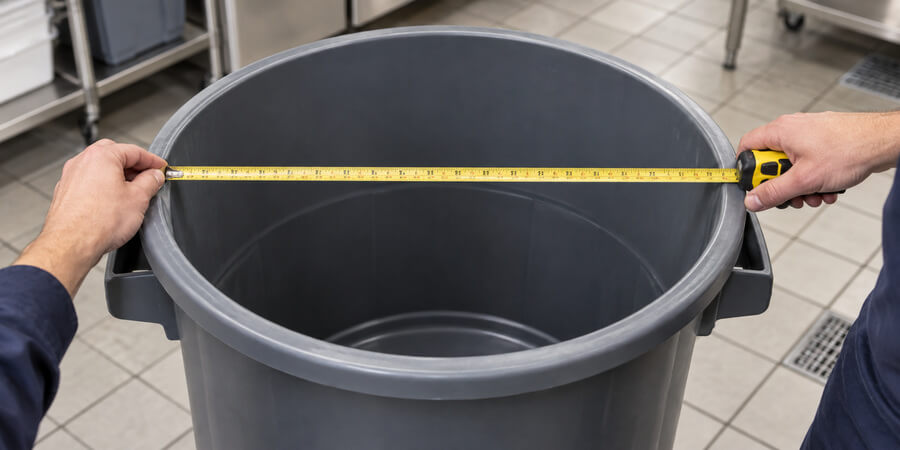
- Measure across the inside of the rim. For a round can, multiply that by 3.14 to get the distance around; for a square or rectangular can, add up all four sides.
- Halve that number. That is the flat width you need, and if it falls between two sizes, take the wider bag.
- Measure the depth from the rim to the floor of the can, then add half the width of the base and 3 to 4 inches to fold over the rim. That is the flat length.
- Match both numbers to the chart, and treat the gallon label as a tiebreaker.
A worked example. A round can that measures 20 inches across the inside of the rim and 27 inches deep, with a base about 20 inches across: 20 x 3.14 is 62.8 inches around, so about 31-1/2 inches of flat width, and 27 + 10 + 4 gives 41 inches of length. A 33 x 44 inch liner covers it with room to fold over; a 33 x 40 would come up an inch short on the fold.
Measure the can, not the listing. Can listings give outside dimensions, which take in the rim lip and the handles. The heavy-duty round 32 gallon cans on our listings measure 22 inches across on the outside, and the liners made for them are 33 inches wide.
Commercial Trash Can Sizes by Shape
Commercial trash can sizes on our listings run from 3-1/2 gallon wastebaskets to 44 gallon round cans. The shape decides where a can fits and which liner it takes.
| Can shape: | Capacity on our listings: | Size on our listings: | Where it works: |
| Wastebasket | 3-1/2 to 10-1/4 gallon | About 11 x 8 to 16 x 12 in, 12 to 20 in tall | Hand sinks, desks, host stands, restroom stalls |
| Slim | 16 and 23 gallon | About 20 to 22 x 11 in, 25 to 30 in tall | Between stations and along walls, where an 11 inch depth keeps the aisle clear |
| Round | 10 to 44 gallon | About 15-1/2 to 24 in across, 16-1/2 to 31-1/2 in tall | Prep lines, the dish room and the back door; most listings are heavy-duty |
| Square | 23 and 35 gallon | About 15-1/2 and 19-1/2 in square, 27-1/2 to 31 in tall | Front of house and restrooms, with swing or soft-close lids |
| Enclosure | 25 to 36 gallon | Wood cabinets with tray tops or tray holders | Dining rooms and self-bus stations; holds a rigid liner |
Every area needs its own can. The FDA Food Code asks for a receptacle in each area where trash is made or thrown away, a waste receptacle at every handwashing sink or group of sinks that uses paper towels, and a covered receptacle in every toilet room (sections 5-501.16 and 5-501.17). In a restroom, a lidded wastebasket or a feminine hygiene receptacle meets that last rule.
Round cans do the heavy work. They take a lift-off lid and roll on trash can dollies sized to the base, so a full can goes out the back door without lifting.
Slim and square cans pair up for recycling. Both come as matching recycling containers with bottle and can or paper lids, so one station can split trash from recycling in the same footprint.
Lids and What the Food Code Asks
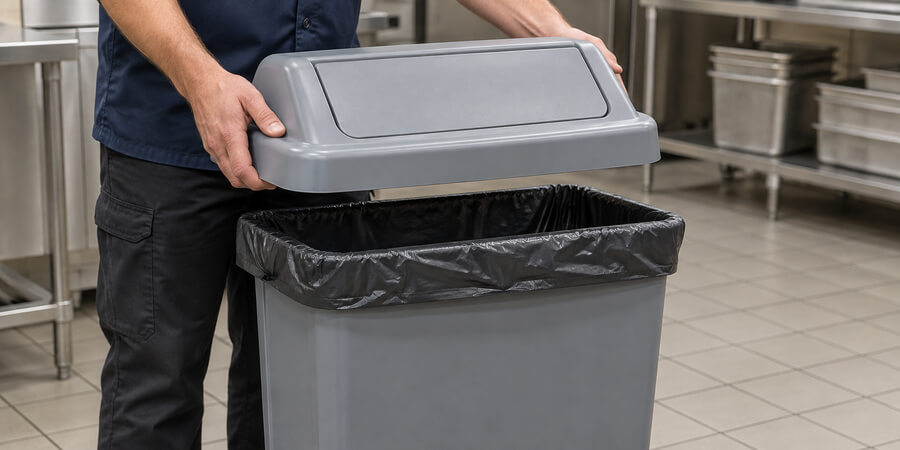
Section 5-501.113 of the Food Code asks for trash receptacles to be covered inside whenever they hold food waste and are not in continuous use, and once they are full; outside, they need tight-fitting lids or doors. Plastic bags may line receptacles inside, or inside closed outside receptacles, but bags of food waste may not sit outside on their own (sections 5-501.13 and 5-501.112).
Buy the lid made for the can. Lid listings name the can or the capacity they fit. Round cans take flat, lift-off, open-hole and funnel-top lids; slim and square cans take swing-door, soft-close and swivel lids, plus recycling lids with bottle and can or paper slots.
A lid does not change the liner. A swing or soft-close lid sits on the rim, so size the bag to the can underneath and fold the overhang down before the lid goes on.
Liner Thickness: Mil, Microns and Load
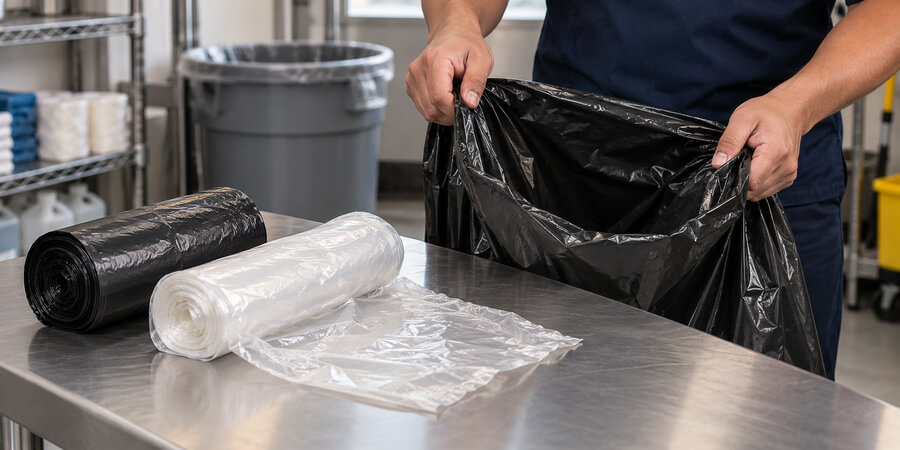
Low density liners are measured in mil, a thousandth of an inch; high density liners are measured in microns. One mil is 25.4 microns, so a 19 micron high density liner is about 0.75 mil thick.
The two films do not compare by thickness alone. Among the same maker's red 33 gallon liners, a 17 micron high density bag, about 0.67 mil, is rated for 80 pounds, and a 1.2 mil low density bag for 70.
| Low density thickness: | Load rating on our listings: | Liner sizes at that thickness: |
| 0.35 mil | 15 lb | 7 to 16 gallon |
| 0.65 mil | 50 lb | 32 gallon |
| 0.7 to 0.75 mil | 55 lb | 16 to 56 gallon |
| 0.8 mil | 60 lb | 30 gallon |
| 0.95 mil | 65 lb | 23 to 56 gallon |
| 1.1 mil | 70 lb | 44 gallon |
| 1.3 mil | 75 lb | 56 gallon |
Rate the bag to its heaviest trip. A 0.35 mil liner rated for 15 pounds suits paper towels and office trash, not a prep line. Low density is the film our listings pitch for heavy loads and sharp or abrasive trash. Where a listing gives no rating, compare thickness only within the same film type.
Colors, Seals and Specialty Liners
Color. Black liners hide what is inside, the selling point their listings give. Clear liners show the contents, and the listings pitch see-through bags for recycling. White and gray are also listed.
Seals and rolls. Most liners on our listings have a star-seal bottom, which the listings say spreads the weight and resists leaks. Many come on coreless or perforated rolls; tall kitchen bags also come with a drawstring.
Compostable liners. The compostable liners and bags on our listings are made from a blend of PBAT and corn starch, carry a 12 month expected shelf life, and should be stored away from heat, direct sunlight and moisture. Buy them in the quantity you will use within the year, and confirm your hauler or compost program accepts them.
Red liners. Red liners printed with the biohazard symbol are listed for hospitals, doctors' offices, dental clinics and nursing homes. Kitchen and dining room trash goes in standard liners.
Rigid liners. A rigid liner is a hard plastic inner can, about 18 inches square and 26 to 29 inches tall on our listings, that sits inside a wood trash can enclosure. The bag goes in the rigid liner, so measure the rigid liner, not the cabinet.
Frequently Asked Questions
What size trash bag fits a 32 gallon can?
A 33 inch wide liner, 38 to 44 inches long. Liners labeled 32 or 33 gallon on our listings run from 33 x 38 to 33 x 40 inches, and the 33 x 44 is made for heavy-duty round 32 gallon cans and leaves more to fold over.
How do you measure a trash can for a liner?
Halve the distance around the inside of the rim for the width. For the length, add the can's depth, half the width of its base and 3 to 4 inches of overhang. Match both numbers to a size chart rather than trusting the gallon label.
What size liner fits a 55 gallon drum?
Look for liners about 36 to 41 inches wide and 54 to 58 inches long. On our listings those are labeled 55 or 60 gallon: 38 x 58, 41 x 54 and 36 x 58 inches.
What does mil mean on trash bags?
A mil is a thousandth of an inch, the thickness unit for low density liners; high density liners are measured in microns, and one mil equals 25.4 microns. Thickness only compares within one film type, so check the load rating when the listing gives one.
Do restaurant trash cans need lids?
Under the FDA Food Code, cans holding food waste must be covered when they are not in continuous use and once they are full, and outside containers need tight-fitting lids. Cans in constant use during service can stay open until they are full.
Shop Trash Cans and Liners
The slim 23 gallon can takes the 29 x 44 liner, and the heavy-duty round 32 and 44 gallon cans take the 33 x 44 and the 37 x 50; every other can gets measured. Choose from commercial trash cans and recycling bins by the spot each one fills, lids included, and restock trash bags and can liners by flat size and thickness, 100 to 1,000 bags a case on our listings.
Related Guides & Resources
- Commercial Restroom Supplies Guide - Dispensers, receptacles and mounting heights for the restroom.
- Food Safety Guide - Procedures and equipment standards across the kitchen.
- Eco-Friendly Food Packaging Guide - Compostable and recyclable materials for disposables.
Share This!