Commercial Toilet Paper Guide
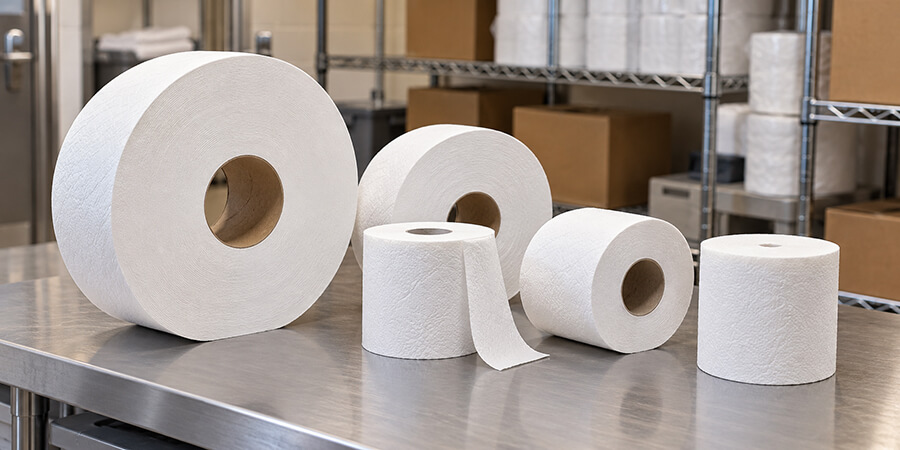
Table of Contents
Roll formats, ply, dispenser fit, case quantities and plumbing, the five decisions behind every restroom tissue order
Commercial toilet paper is bulk restroom tissue built around a dispenser rather than around a shopping cart: rolls are longer, cases are larger, and the roll has to physically fit the holder already on the wall. Five decisions settle almost every order. First, roll format - standard, mini jumbo, jumbo, coreless or center pull - because format decides how often someone walks into the restroom to reload. Second, ply, which trades softness against sheet count at the same roll size. Third, dispenser fit, meaning roll diameter, core diameter and capacity, since a roll that does not fit is a roll that cannot be used. Fourth, case math, the plain arithmetic of sheets per roll times rolls per case against a restocking routine. Fifth, plumbing, because older drain lines, low-flow fixtures and grease-heavy restaurant waste systems all reward tissue that breaks up quickly. Work through those five in order and the brand question mostly answers itself.
Roll Formats: Standard, Mini Jumbo, Jumbo, Coreless and Center Pull
| Format: | Sourced roll size: | Dispenser it needs: | Where it fits: | Changeover frequency: |
| Standard 2-ply | 500 sheets, 3.75 in x 4 in sheet, 156.25 ft, 4.40 in diameter | Standard roll holder, single through quad capacity | Guest rooms, offices, small restrooms | Most frequent; short rolls empty fastest |
| Standard 1-ply large core | 1,232 sheets, 4 in x 3.75 in sheet, 410.67 ft, 5 in diameter | Standard roll holder sized for a larger diameter | Busy standard-roll restrooms | Much less often than a 500 sheet roll |
| High-capacity 2-ply plugged core | 1,000 sheets, 3.75 in sheet length, 312.50 ft, 3.77 in width, 5.40 in diameter | Matching high-capacity standard holder | Traffic that outruns ordinary standard rolls | Roughly half as often as a 500 sheet roll |
| Mini jumbo (jumbo junior) | 751 ft, 7.40 in diameter, 2.30 in core inner diameter, 2-ply | Mini jumbo dispenser, smaller core spindle | Tight stalls where a full jumbo will not fit | Infrequent |
| Jumbo, 9 inch class | 1,000 ft, 3.40 in width, 8.80 in diameter, 3.30 in core inner diameter, 2-ply | 9 inch jumbo dispenser, larger core spindle | High-traffic public restrooms | Rare compared with standard rolls |
| Coreless | Wound with no tube; a manufacturer states 333.3 ft against 156.3 ft for a conventional 2-ply roll | Coreless-specific dispenser | Sites cutting waste and storage | Less often than conventional standard rolls |
| Center pull | Sheet or foot counted, drawn from the roll center | Center pull dispenser | Single-sheet-at-a-time control | Depends on roll length ordered |
Standard rolls are the largest group in our commercial toilet paper selection, followed by jumbo, then coreless, then center pull. The standard roll is the familiar shape, and it now comes in far more than the familiar size: alongside the conventional 500 sheet 2-ply roll at 4.40 inches across, there are large-core and high-capacity versions at 5 and 5.40 inches that hold considerably more paper in a roll a normal holder can still take, provided the holder was built for that diameter.
Jumbo rolls solve the reloading problem outright. The sourced 9 inch class roll carries 1,000 feet of 2-ply on an 8.80 inch diameter with a 3.30 inch core opening, so one roll replaces many standard rolls and a stall can go a long stretch untouched. Larger jumbo rolls exist above this class for the busiest facilities. Mini jumbo, also sold as jumbo junior, is the same idea scaled down: 751 feet, a 7.40 inch diameter and a 2.30 inch core, which matters because the narrower core will not sit on a full-size jumbo spindle. Mini jumbo is what to specify when the stall or the existing cabinet cannot swallow a nine-inch roll.
Coreless rolls are wound without a cardboard tube, so the whole roll is paper. A manufacturer states one coreless roll at 333.3 feet against 156.3 feet for a conventional 2-ply roll, roughly twice the length, and claims half the storage space of regular rolls, less packaging, and no core or wrap to throw away. Recycled 1-ply coreless rolls run as high as 3,000 sheets. Coreless requires its own dispenser class, which is the usual reason a site does not switch. Center pull rolls dispense from the middle of the roll one sheet at a time, which suits restrooms where controlled use matters more than speed. Whichever format is chosen, it has to be matched against our toilet paper dispensers and holders before the first case is ordered.
1-Ply vs 2-Ply: Sheets, Softness and Cost per Sheet
Ply is the softness-versus-quantity trade, and the catalog numbers make the trade concrete. The sourced 1-ply large-core roll holds 1,232 sheets at a 5 inch diameter. The sourced high-capacity 2-ply roll holds 1,000 sheets at a slightly larger 5.40 inch diameter. Put those side by side and 1-ply carries roughly twice the sheets of 2-ply at a like roll size, because half the paper thickness means twice as many sheets wind onto the same spool before the roll fills its dispenser.
That is the entire cost-per-sheet argument. If a case of 1-ply holds close to twice the sheets of a comparable case of 2-ply, and a user takes the same number of pulls, the 1-ply case covers roughly twice as many pulls. In practice some users compensate by taking more sheets of 1-ply, which narrows the gap, so the honest way to run the comparison is to divide case cost by sheets per case for the specific rolls under consideration and then watch the actual reorder interval for a month.
Two-ply belongs where guests notice paper. Sheet counts on 2-ply rolls in the catalog run from 400 sheets on short conventional rolls up through 1,000 and beyond on high-capacity rolls, and 2-ply is the dominant ply across the selection because most operators want the softer feel in customer-facing restrooms. One-ply belongs where volume and cost per use dominate: schools, stadiums, warehouses, high-traffic public restrooms and any facility where the paper is consumed faster than anyone can restock it. Recycled content is available as an option in either direction and is common on coreless 1-ply, which is worth knowing if a sustainability policy is part of the specification.
Dispenser Fit: Roll Type, Core and Capacity
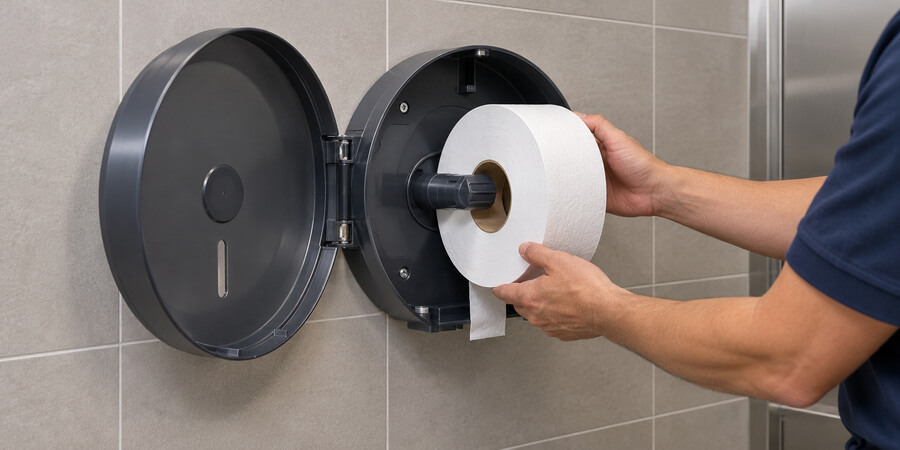
Fit is mechanical, and it comes down to six things: the roll type the dispenser is built for, the core inner diameter it spindles, the maximum roll diameter it will close over, how many rolls it holds, whether it locks, and how it mounts. Dispensers in the catalog split roughly evenly between jumbo and standard roll types, with capacities from single roll up to quad and double roll the largest group. Locking is a common feature, and mounting options cover surface, wall and recessed installations in plastic, stainless steel, steel, chrome and aluminum. Numbers make the fit question unambiguous: a 9 inch jumbo roll at 8.80 inches diameter with a 3.30 inch core will not go into a mini jumbo cabinet built for a 7.40 inch roll on a 2.30 inch core, and a coreless roll has no core at all. For the full breakdown of dispenser styles and how to place them, see the guide to commercial toilet paper dispenser types.
That leads to the question operators most often ask too late: what if there is a plan to move to higher-capacity rolls later? The dispenser class decides the roll, not the other way around, so buy the dispenser for the roll that will actually be run. A site expecting to graduate from standard rolls to jumbo should install jumbo dispensers now and run jumbo, rather than installing standard holders and discovering later that every restroom needs new hardware. Where the future is genuinely uncertain, the safer choice is a multi-roll standard dispenser, which buys reloading headroom without changing the roll format.
Case Math: How Much to Order and How Often to Restock
The arithmetic is simple: sheets per roll times rolls per case equals sheets per case, and sheets per case divided by the sheets used per day equals days of supply. Everything else is an assumption to be checked against actual restocking logs.
Worked on stated assumptions: if a restroom goes through one 500 sheet standard roll a day, a 48 roll case lasts 48 days. Swap to the sourced 1-ply large-core roll at 1,232 sheets in a 48 roll case and that case holds 59,136 sheets; at the same 500 sheets a day, it covers about 118 days. On the jumbo side, the sourced 9 inch system ships 12 rolls of 1,000 feet per case, so one case is 12,000 feet; if a stall consumes 100 feet a day, that case runs 120 days. Mini jumbo ships 12 rolls of 751 feet, or 9,012 feet per case, on the same basis about 90 days. These are illustrations of the method, not claims about consumption. Measure a week of real usage and put that number in place of the assumption.
Storage is the other half of the order. Coreless rolls remove the cardboard tube entirely, and manufacturers claim half the storage space of regular rolls along with less packaging and no core or wrap to discard. Case counts in the catalog run from 4 rolls up to 96, so the same monthly volume can arrive as a few large cases or many small ones - worth deciding before a delivery arrives that the stockroom cannot hold.
| Format: | Sheets or feet per roll: | Rolls per case: | Restocking character: |
| Standard 2-ply | 400 to 1,000+ sheets (500 sheets sourced) | Catalog range 4 to 96; 48 sourced | Frequent checks, quick swaps |
| Standard 1-ply large core | 1,232 sheets sourced; up to 3,000 sheets on recycled coreless 1-ply | 48 sourced | Long intervals for a standard holder |
| High-capacity 2-ply | 1,000 sheets sourced | 36 sourced | Fewer changeovers than conventional 2-ply |
| Mini jumbo | 751 ft sourced | 12 sourced | Occasional, small storage footprint |
| Jumbo, 9 inch class | 1,000 ft sourced | 12 sourced | Rare changeovers, bulky cases |
| Coreless | 333.3 ft per manufacturer comparison | Catalog range 4 to 96 | Fewer changeovers, less packaging waste |
| Center pull | Catalog roll lengths 500 to 2,000 ft | Catalog range 4 to 96 | Set by roll length ordered |
Plumbing, Septic and Low-Flow Toilets
Rapid breakup is the property that keeps drains clear, and it is worth being precise about its status. "Septic safe" and "rapid dissolving" are manufacturer product claims, not certifications against a governing standard. The only specification written for industrial and institutional toilet tissue was withdrawn in 2000 and never replaced, so there is no active standard a roll can be measured against. Read those phrases as what the manufacturer says about its own paper, and treat the manufacturer's own documentation as the source.
That said, the physical logic behind the claims is sound. Thinner paper has less material to separate, so 1-ply generally breaks down faster in water than 2-ply, and facilities with older drain lines, narrow laterals, root intrusion or long horizontal runs tend to see fewer problems on thinner tissue. Restaurant waste systems add their own complication: lines carrying grease build up interior coating over time, which narrows the effective pipe and makes anything slow to disperse more likely to catch. Low-flow fixtures move less water per flush, which gives paper less help getting down the line, and this is the most common reason a restroom that worked fine for years starts backing up after a fixture upgrade.
Practically, a septic system or a known-fragile drain argues for 1-ply, or for a 2-ply the manufacturer specifically documents as rapid breakup. It also argues for making seat covers, wipes and paper towels clearly distinct from tissue and giving them their own bins, since many restroom clogs involve something that was never meant to be flushed at all. Everything the restroom stocks can be sourced together from our restroom supplies selection.
Choosing by Setting: Restaurant, Office, Hotel and Public Restroom
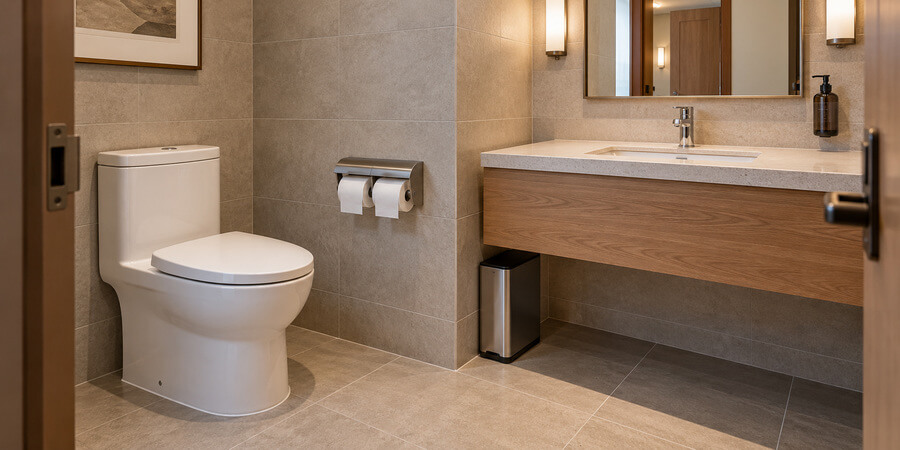
There is no single best commercial toilet paper, and rankings of branded products skip the only two variables that decide the answer: format and ply for the setting.
An upscale dining room should run 2-ply, in a standard roll on a multi-roll holder or an enclosed mini jumbo cabinet. The restroom is part of the guest experience, traffic is moderate, and the softer sheet is the point. Multi-roll capacity prevents the worst-case scenario, which is a guest finding an empty holder mid-service.
A quick service restaurant is a different problem. Traffic is heavy, restrooms are often public-access, and staff attention is scarce during a rush. Jumbo rolls, 2-ply where guest comfort still matters and 1-ply where volume dominates, in a locking dispenser, cut reloading to a rare event and cut theft with it. Mini jumbo is the fallback where a stall cannot take a nine-inch roll.
Office breakroom restrooms serve a known, small population, so 2-ply standard rolls on a double roll holder are usually right. High-capacity standard rolls are the upgrade when a facilities routine only reaches the restrooms weekly. Hotels split cleanly: guest rooms want 2-ply standard rolls, often individually wrapped, presented on a simple holder, while lobby and public restrooms should be treated like any high-traffic public space and run jumbo or high-capacity rolls in locking dispensers. Schools, stadiums, transit facilities and other public restrooms are where 1-ply, coreless or jumbo formats earn their keep: maximum sheets per roll, minimum changeovers, locking hardware, and tissue that clears older plumbing without incident. When ply is a close call in a public setting, the sourced comparison is the deciding fact - 1-ply carries roughly twice the sheets of 2-ply at a like roll size.
The Rest of the Restroom
Hand drying is the next largest paper line, and our commercial paper towels selection covers roll towels along with M-fold, C-fold, Z-fold, single fold and center pull styles in 1-ply and 2-ply, with roll lengths from 300 to 1,150 feet and 800 feet the most common length, in brown and white. Towel format is a dispenser decision exactly as tissue is, so match the style to the hardware in our paper towel dispensers selection before ordering a pallet of folds that will not load. Hand soap is the third consumable to standardize, and our hand soap and sanitizer selection pairs with the walkthrough on how to choose a soap dispenser. Seat covers reassure guests in public restrooms and need their own wall-mounted holder, stocked in our toilet seat cover dispensers and accessories. Urinal and toilet mats control odor and splash on the floor, which is the part of the restroom guests judge fastest, and they live in our urinal and toilet mats selection. Finally, giving towels, covers and wipes an obvious destination is the cheapest clog prevention there is, so size the receptacles from our trash cans and recycling bins and keep liners and wipers flowing from our janitorial disposables selection.
Frequently Asked Questions
What is commercial toilet paper?
Commercial toilet paper is bulk restroom tissue made for dispensers in businesses and institutions rather than for household holders. It comes in standard, jumbo, mini jumbo, coreless and center pull formats, in 1-ply and 2-ply, with sheet counts and roll lengths well above retail rolls. It is sold by the case, with case quantities in this catalog ranging from 4 rolls up to 96.
What is the best commercial toilet paper?
The best choice is defined by format and ply for the setting, not by a brand name. Guest-facing restrooms in dining rooms and hotel rooms do best on 2-ply standard rolls; high-traffic public restrooms do best on jumbo or high-capacity rolls, in 1-ply where volume and cost per use dominate. Match that format to the dispenser class already installed, and to the plumbing the building has.
Are jumbo rolls better than standard rolls?
Jumbo rolls hold far more paper and cut changeovers to a rare event, which is why they dominate high-traffic public restrooms. The sourced 9 inch jumbo roll carries 1,000 feet of 2-ply, compared with 156.25 feet on a conventional 500 sheet standard roll. The trade is that jumbo needs its own dispenser and a stall wide enough for an 8.80 inch roll, so smaller or guest-facing restrooms often run standard or mini jumbo instead.
What is coreless toilet paper?
Coreless rolls are wound without a cardboard tube, so the entire roll is usable paper and there is no core to throw away. A manufacturer states one coreless roll at 333.3 feet against 156.3 feet for a conventional 2-ply roll, about twice the length, and claims half the storage space of regular rolls with less packaging. Coreless requires a coreless-specific dispenser, so it is a hardware decision as much as a paper one.
Should a restaurant use 1-ply or 2-ply?
Dining rooms that guests use should generally run 2-ply, since the restroom is part of the guest impression and traffic is manageable. Quick service, stadium-style and staff-only restrooms are better served by 1-ply, which carries roughly twice the sheets of 2-ply at a like roll size and breaks down faster in older drain lines. Many operators run 2-ply out front and 1-ply in back-of-house restrooms.
Is commercial toilet paper septic safe?
"Septic safe" and "rapid breakup" are manufacturer product claims, not certifications against a governing standard. The only specification for industrial and institutional toilet tissue was withdrawn in 2000 with no replacement, so there is nothing active to certify against. For a septic system or fragile plumbing, read the specific manufacturer's documentation and lean toward thinner 1-ply, which has less material to separate in water.
What size roll fits my dispenser?
Toilet paper holders are not interchangeable, so check three measurements: the roll type the dispenser accepts, the maximum roll diameter it closes over, and the core inner diameter it spindles. A 9 inch jumbo roll measures 8.80 inches in diameter on a 3.30 inch core, while mini jumbo measures 7.40 inches on a 2.30 inch core, and the two will not swap. Coreless rolls have no core at all and need a coreless dispenser.
How many rolls come in a case?
Case quantities in this catalog run from 4 rolls up to 96, with the count tied to roll size. The sourced conventional 2-ply standard roll and the 1-ply large-core roll both ship 48 rolls per case, the high-capacity 2-ply roll ships 36, and both the 9 inch jumbo and mini jumbo systems ship 12 rolls per case. Bigger rolls mean fewer rolls per case and a larger box.
How often should restrooms be restocked?
Work it as arithmetic on measured usage: sheets per roll times rolls per case gives sheets per case, and that divided by daily use gives days of supply. On a stated assumption of one 500 sheet roll a day, a 48 roll case lasts 48 days; on the same assumption, a 48 roll case of 1,232 sheet 1-ply rolls holds 59,136 sheets and covers about 118 days. Track one real week of consumption and substitute that figure for the assumption.
Shop Commercial Toilet Paper
Compare roll formats, ply and case quantities across our commercial toilet paper selection, then confirm the hardware in our toilet paper dispensers and holders so the roll and the dispenser class match before the first case ships.
Related Guides & Resources
- Commercial Toilet Paper Dispensers: Types and Selection - Dispenser types, capacity, placement and tamper resistance for busy restrooms.
- How to Choose a Commercial Soap Dispenser - Matching soap dispensers to traffic, refills and maintenance.
- Your Complete Restaurant Kitchen Cleaning Checklist - Daily, weekly and monthly cleaning routines, restrooms included.
Share This!