How to Choose a Hand Soap Dispenser for Your Business
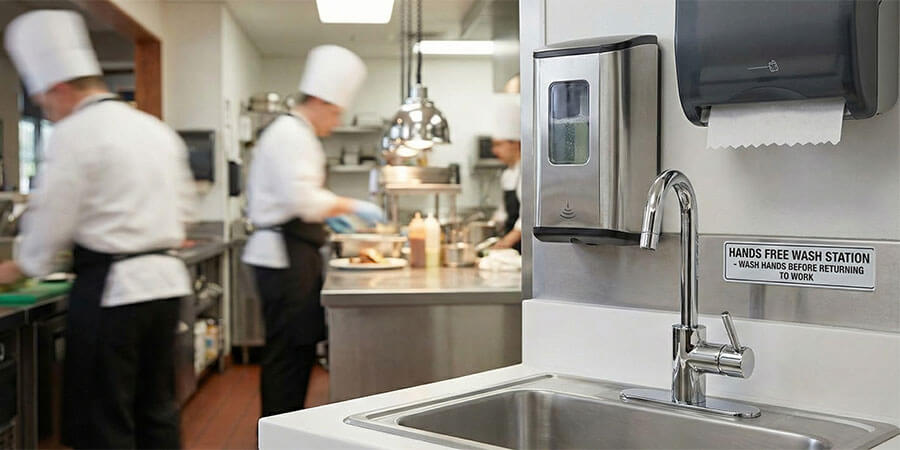
Table of Contents
A practical breakdown of dispenser types, soap compatibility, and compliance for commercial kitchens
Choosing the right commercial soap dispenser affects hygiene compliance, operating costs, and maintenance workload. This guide compares automatic vs. manual dispensers, foam vs. liquid soap, and mounting options so you can match the right setup to your traffic level and health code requirements.
Handwashing is one of the most effective ways to prevent foodborne illness - yet CDC research shows food workers only wash their hands about one in three times when they should (CDC, 2024). The dispenser you install directly influences whether your team follows through. A poorly placed, constantly empty, or hard-to-use soap dispenser creates friction that discourages compliance.
Beyond hygiene, the wrong dispenser costs you in soap waste, maintenance labor, and refill frequency. The right one pays for itself by controlling how much soap gets dispensed, reducing mess, and keeping your handwashing stations stocked longer between refills.
Here is what to consider when choosing a commercial soap dispenser for your restaurant, commercial kitchen, or food service operation.
Types of Soap Dispensers
Commercial soap dispensers fall into two main categories based on how they operate - manual or automatic. Each has clear advantages depending on your environment.
Manual (Push-Button) Dispensers
Manual dispensers require the user to press a pump or lever to release soap. They are simple, reliable, and require no power source.
Best for: Lower-traffic areas, back-of-house stations, and operations where simplicity matters most. Manual dispensers have fewer parts that can fail and are straightforward to maintain.
Trade-offs: Every user touches the pump mechanism, which creates a potential cross-contamination point. Users also control how much soap they take - which often means they take too much.
Automatic (Touchless) Dispensers
Automatic soap dispensers use an infrared sensor to detect hands and release a pre-measured amount of soap. Most activate in under a second.
Best for: High-traffic restrooms, food preparation areas, and any location where maximum hygiene matters. Touchless operation eliminates one contact point in the handwashing process, and controlled dispensing reduces waste significantly.
Trade-offs: Automatic dispensers require batteries or an AC power connection. Battery-powered units in high-traffic locations may need new batteries every one to three months. Sensors can also malfunction if soap residue builds up on the detection window.
Comparison at a Glance
| Feature: | Manual (Push-Button): | Automatic (Touchless): |
| Contact required | Yes | No |
| Power source | None | Batteries or AC |
| Soap waste control | User-controlled | Pre-measured dose |
| Maintenance complexity | Low | Moderate |
| Cross-contamination risk | Higher | Lower |
| Best environment | Low-traffic, back-of-house | High-traffic, food prep |
For commercial hand soap and sanitizer options, both manual and automatic setups work - the decision comes down to traffic volume and hygiene priorities.
Foam vs. Liquid Soap - Which Works Better?
The type of soap your dispenser uses affects cost, hygiene, and how often you refill.
Liquid soap is the traditional choice for commercial kitchens. It lathers with water and is widely perceived as more effective for removing heavy soiling - grease, food residue, and grime common in food prep environments. Peer-reviewed research also suggests that liquid soap may be more effective at reducing bacteria on hands compared to foam formulations (American Journal of Infection Control, 2017).
Foam soap mixes liquid concentrate with air before dispensing, creating a pre-lathered foam. The primary advantage is efficiency - foam dispensers typically use about half the soap per activation compared to liquid, which directly cuts supply costs and extends the time between refills. Foam also rinses faster and creates less mess around the sink.
The practical answer: For food preparation areas and commercial kitchens where hand contamination risk is highest, liquid soap is the safer default. For customer-facing restrooms and lower-risk handwashing stations, foam soap offers meaningful cost savings.
You can browse liquid soap options and foaming soap options to compare what fits your operation.
Mounting Options and Placement
Where and how you mount your dispenser matters for accessibility, compliance, and daily usability.
Wall-mounted dispensers are the most common choice for commercial restrooms and dedicated handwashing stations. They save counter space and are easy to position at the correct height for ADA compliance. Standard mounting height is 38 to 48 inches above the floor, with ADA guidelines requiring operable parts no higher than 48 inches.
Countertop or deck-mounted dispensers install through the counter surface near the sink. These work well for integrated employee handwashing stations and food prep areas where you want the soap right at the point of use. They are also harder to tamper with since the reservoir sits below the counter.
Freestanding dispensers sit on the counter surface with no installation required. These are best for temporary setups or supplemental stations - not as a primary solution in high-traffic commercial environments.
Placement tips for restaurants:
- Position at least one hand sink with soap dispenser per food preparation and cooking area
- Make sure the dispenser is visible from where workers stand - CDC research found workers wash hands more often when a hand sink is within their line of sight (CDC, 2024)
- Keep dispensers away from food preparation surfaces to avoid contamination from drips
Soap Compatibility - Getting It Right
Using the wrong soap in your dispenser is one of the most common causes of clogs, leaks, and premature failure. Two specifications matter most.
Viscosity refers to how thick the soap is. Most commercial dispensers are designed for soap between 100 and 2,500 centipoise. Soap that is too thin runs through too fast and feels diluted. Soap that is too thick clogs valves, congeals inside the pump, and causes inconsistent dispensing. Foam dispensers require a much thinner formulation - typically under 100 centipoise - because the dispenser adds air to create lather.
pH level should fall between 6.5 and 8.5 for most commercial dispensers. Soap that is too acidic corrodes metal components and degrades rubber seals. Soap that is too alkaline causes plastic and rubber parts to swell and deteriorate. Low-cost soaps sometimes fall outside this range, which leads to premature valve failure.
| Dispenser Type: | Compatible Soap: | Not Compatible: |
| Foam dispenser | Foaming formula (under 100 cP) | Regular liquid soap, gel soap |
| Liquid dispenser | Liquid soap (100 - 2,500 cP) | Foaming formula |
| Automatic (sensor) | Per manufacturer specs | Soaps exceeding viscosity limits |
Bottom line: Always check the manufacturer's soap specifications before buying refills. Using the wrong type voids warranties and creates maintenance headaches.
Bulk-Fill vs. Sealed Cartridge Systems
How your dispenser gets refilled has a direct impact on hygiene - especially in food service.
Bulk-fill dispensers have an open reservoir that you pour soap into from a larger container. They cost less per ounce of soap and give you flexibility to choose different soap formulations. However, every time you open the reservoir, you expose the soap to air and potential bacterial contamination. Health inspectors in some jurisdictions flag open-reservoir systems as a hygiene concern.
Sealed cartridge systems use pre-filled, factory-sealed cartridges that snap into the dispenser. The soap is never exposed to air until it is dispensed. Cartridge changes take seconds and require no cleaning between refills.
For food service environments, sealed cartridge systems are the stronger choice. They eliminate the contamination risk inherent in bulk-fill designs and reduce maintenance labor. The higher per-ounce soap cost is offset by reduced cleaning time and better hygiene compliance.
Health Code and Compliance Basics
The FDA Food Code requires every food service establishment to have handwashing sinks equipped with soap dispensers and water at a minimum of 100 degrees Fahrenheit (FDA Food Code, 2022). These sinks must be dedicated to handwashing only - not used for food preparation or dishwashing.
Key compliance points:
- A general guideline is one hand sink per five employees and at least one per food preparation area
- Hand sinks must be accessible and unobstructed at all times
- Soap dispensers must be kept stocked - an empty dispenser is a health code violation
- Single-use towels or an air dryer must be available alongside the soap dispenser
ADA requirements apply to public-facing restrooms. Dispenser controls must be operable with one hand, without tight grasping or twisting, and with no more than five pounds of force. Automatic dispensers inherently meet these operation requirements, though they still must be mounted within ADA reach ranges.
For a broader look at keeping your restroom supplies stocked and compliant, maintaining a regular inventory check prevents gaps that lead to violations.
Maintenance and Troubleshooting
Even the best dispenser needs routine attention. Here is a practical maintenance schedule for commercial environments.
Daily: Wipe the dispenser exterior and nozzle area. Check soap level and refill if below 25 percent. Clean any drips around the sink. For automatic dispensers, wipe the sensor window with a soft damp cloth.
Weekly: Inspect for leaks, test pump or sensor operation, and clean the dispenser body thoroughly.
Monthly: Check battery level on automatic units. Clean the nozzle and spout to prevent soap buildup. Inspect mounting hardware for looseness.
Common issues and fixes:
- Clogging - Usually caused by soap that is too thick or the wrong type. Flush the valve with warm water and switch to the correct viscosity soap
- Sensor not activating - Clean the sensor window. If the problem persists, replace batteries or check the power connection
- Leaking or dripping - Check pump seals and do not overfill the reservoir. Tighten all connections and replace worn components
- Inconsistent dispensing - Often caused by low batteries in automatic units or air pockets in the soap reservoir
Pairing your soap dispensers with the right paper towel dispensers creates a complete handwashing station that keeps inspections clean and employees compliant.
Frequently Asked Questions
Are automatic soap dispensers more sanitary than manual ones?
Yes. Automatic dispensers eliminate the need to touch a pump mechanism, which removes one potential cross-contamination point in the handwashing process. This matters most in food preparation areas where CDC data shows contamination from food worker hands contributes to a significant portion of foodborne illness outbreaks (CDC MMWR, 2025).
What types of soap work best in automatic dispensers?
It depends on the dispenser model. Most automatic dispensers are designed for either liquid or foam soap - not both. Always check the manufacturer's viscosity specifications. Liquid dispensers typically require soap between 100 and 2,500 centipoise, while foam dispensers need a thinner formulation under 100 centipoise.
How do I choose the right automatic soap dispenser size?
Calculate based on traffic. A standard 1,000 ml dispenser with foam soap at roughly 1 ml per use serves about 200 handwashes before refilling - roughly five days for a station used 40 times daily. For high-traffic locations, choose 1,100 ml or larger capacity units to reduce refill frequency.
How often should commercial soap dispensers be refilled?
Frequency depends on capacity, soap type, and daily traffic. Foam soap dispensers last roughly twice as long per fill as liquid soap dispensers because foam uses about half the soap per activation. In a busy restaurant, plan to check dispensers at least once daily and refill as needed.
Can I use regular liquid soap in a foam dispenser?
No. Foam dispensers require a specially formulated foaming soap that is much thinner than standard liquid soap. Using regular liquid soap will clog the foaming mechanism, cause inconsistent dispensing, and can damage the pump.
What is the best soap dispenser for a commercial kitchen?
For commercial kitchens, an automatic dispenser with a sealed cartridge system using liquid soap provides the best combination of hygiene, compliance, and reliability. Automatic operation reduces cross-contamination risk, sealed cartridges prevent bacterial contamination during refills, and liquid soap is more effective for removing food-related soiling.
Do health codes require a specific type of soap dispenser?
The FDA Food Code requires handwashing sinks to have soap available but does not mandate a specific dispenser type. However, many local health departments prefer or recommend touchless dispensers in food preparation areas. Sealed cartridge systems also receive favorable consideration during inspections because they eliminate contamination risks associated with bulk-fill units.
Related Resources
- Commercial Toilet Paper Guide - Specify the tissue and dispenser fit for the same restroom station.
- Commercial Restroom Supplies Guide - The full restroom checklist around your handwashing station.
- Hand Soap, Lotion, and Sanitizers - Browse commercial soap and sanitizer options for your operation
- Restroom Supplies - Complete restroom supply catalog including dispensers and accessories
- Janitorial Supplies - Full range of cleaning and sanitation products for commercial kitchens
- Commercial Paper Towel Dispensers - Pair with your soap dispensers for a complete handwashing station
- Foaming Soap Options - Browse foaming soap formulations for commercial dispensers
Share This!