Commercial Food Steamers
Steam vegetables, seafood, and rice to order with convection, pressure, and microwave steamers!
Brand
Depth
Type
Wattage
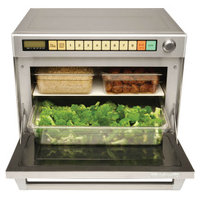
Heavy Duty Commercial Steamer Microwave Oven, 208/240V, 3.2 kW, Sonic Steamer
$5,192.00 /ea
Free Shipping
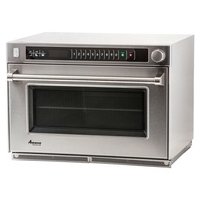
Heavy Duty Commercial Steamer Microwave Oven, 208/240V, 2.2 kW
$4,326.00 /ea
Free Shipping
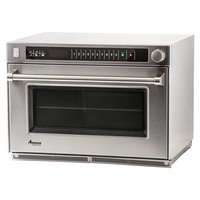
Heavy Duty Commercial Steamer Microwave Oven, 208/240V, 3.5 kW
$4,997.00 /ea
Free Shipping
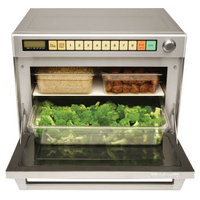
Heavy Duty Commercial Steamer Microwave Oven, 208/240V, 2.1 kW, Sonic Steamer
$4,060.01 /ea
Free Shipping
Helpful Resources
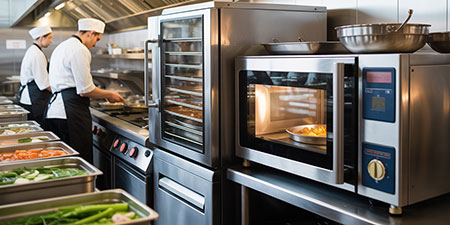
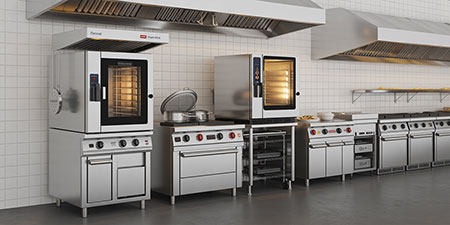

Best Commercial Food Steamers
A commercial steamer cooks with saturated steam rather than dry heat, so vegetables hold their color, seafood stays moist, and rice and frozen sides reach serving temperature in minutes without added fat. That is why steamers anchor prep in school and hospital kitchens, cafeterias, banquet halls, and seafood or vegetable heavy menus.
Three technologies share the category. Convection steamers move steam through an open cavity at low pressure and handle mixed and delicate loads. Pressure steamers cook sealed for the fastest batch times on dense and frozen product. Microwave steamers cook portions to order at a counter. Units run on gas, electricity, or a building steam line, in countertop and floor models.
We feature top-quality brands such as AccuTemp, Amana, Cleveland Range, Panasonic, Southbend, and Vulcan, and strive to provide the most competitive prices available.
Benefits of Commercial Steamers
Steam moves heat faster than an oven and cooks without oil, so batch times and shrink both drop and portions plate the same late in a rush as early. A steamer also frees range space for work that truly needs a burner, and on a batch cooking line it pairs naturally with steam kettles.
Boilerless, or connectionless, countertop convection steamers fill from a reservoir and skip the plumbed boiler, cutting water use and daily upkeep, while kitchens with a house steam line can feed cabinets from steam generators instead.
What to Look for in a Commercial Steamer
Match the technology, the fuel, and the water treatment to the room before comparing cabinets.
- Convection, pressure, or microwave: convection for mixed and delicate loads, pressure for the fastest dense and frozen batches, microwave for portions to order.
- Boiler or boilerless: a plumbed boiler sustains all day output, a boilerless reservoir unit installs almost anywhere and needs less upkeep.
- Compartments and pan capacity: multi compartment cabinets cook separate items at once without flavor transfer, each compartment rated by the standard pans it holds.
- Gas, electric, or direct steam: propane covers sites off the gas main, direct steam is cheapest where a building steam line exists.
- Countertop or floor: countertop units fit a line or satellite station, floor models carry cafeteria and banquet volume.
- Water quality: steam equipment scales badly on hard water, so plan for treated supply and easy descaling.
- Controls: manual timers keep it simple, programmable controls hold repeatable times for a rotating crew.
Shop Commercial Steamers Today
Compare restaurant steamers by technology, fuel, compartment count, and footprint to find the unit that fits the menu and the room, and see combi ovens if the station also has to roast and bake.