What Makes a Restaurant Accessible?
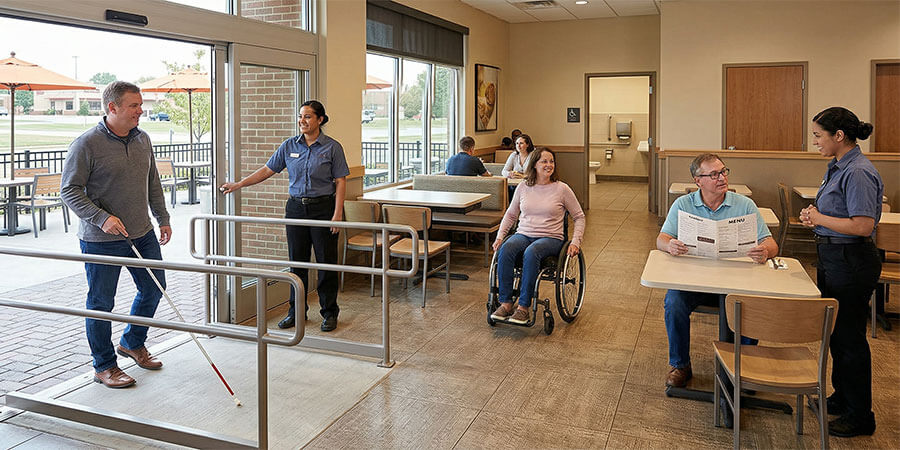
Table of Contents
Make restaurant accessibility stronger by improving routes, service habits, communication, and restroom usability instead of focusing on ramps alone
Restaurant accessibility is easy to oversimplify. People often reduce it to a ramp at the entrance or one accessible parking space, but guests experience accessibility through the whole visit: arrival, entry, seating, ordering, restroom use, staff interaction, communication, and the way the restaurant responds when a guest needs support.
That is why a more accessible restaurant is not only a building question. It is also a service question. The strongest operators think about layout, communication, and daily operating habits together instead of treating accessibility like a one-time fixture upgrade.
Physical Access Starts Before The Guest Reaches The Table
ADA Title III guidance is the right anchor here because restaurants are public accommodations. In practical terms, that means the guest's experience begins before the chair, before the menu, and often before the door.
The access questions usually begin with:
- Can the guest reach the entrance without avoidable barriers?
- Does the entry route work predictably?
- Is the doorway and path inside usable without unnecessary obstruction?
- Can the guest move through the dining space without feeling like an exception to the layout?
This is why accessibility should never be discussed only as an interior design detail. For many guests, the hardest part is getting into the space comfortably in the first place.
Seating Layout Matters As Much As The Entrance
Many restaurants become difficult not because they intended to exclude anyone, but because the seating plan drifted toward density and away from usability.
| Layout Question: | Why It Matters: |
| Are routes between tables actually usable? | Guests and staff both need clear movement paths |
| Can some tables be approached and used comfortably? | A technically open room can still be hard to use |
| Does the host stand know where accessible seating options are? | Prevents awkward improvisation at the door |
| Do temporary setups block routes? | Seasonal or overflow layouts often create new barriers |
This is one reason accessibility has to be treated as a living operations issue. Furniture moves, host procedures shift, and temporary setups can quietly undo a space that looked acceptable on paper.
If layout and outdoor routes are part of the issue, Al Fresco Dining for Restaurants is a useful related read.
Restroom Accessibility Shapes The Whole Experience
For many guests, restroom usability is the moment that confirms whether the restaurant actually thought through accessibility or only talked about it.
That is why restroom accessibility deserves attention not just for stall width and door movement, but also for the smaller operating details that affect real usability:
- Reach to soap, paper towel, and tissue dispensers
- Clear maneuvering space
- Practical placement of fixtures and accessories
- Easier-to-use hardware and controls
- A restroom that is maintained well enough to stay usable
The ADA design standards are the right legal framework for new construction and alterations, while existing restaurants may also be dealing with barrier-removal expectations framed around what is readily achievable. The practical lesson is still simple: if the restroom setup creates unnecessary friction, the whole restaurant starts feeling less accessible.
For adjacent restroom decisions, How to Choose a Hand Soap Dispenser for Your Business and Commercial Toilet Paper Dispensers and Holders are the most natural internal companions.
Communication Access Matters Just As Much As The Built Space
ADA's effective communication guidance is especially useful because it pushes the conversation beyond architecture. A guest can physically enter the restaurant and still have a poor experience if communication barriers are left entirely to chance.
In practical restaurant terms, that can mean:
- Menus that are hard to navigate or access
- Staff who are unsure how to respond when communication support is needed
- Ordering conversations that become rushed or awkward
- A lack of flexibility when a guest needs a different format or a little more time
This is not about turning every server into a disability specialist. It is about making the restaurant easier to use by reducing unnecessary friction in communication.
It also means the restaurant should not assume one communication style works equally well for every guest. A little more time, clearer wording, a more readable menu format, or a calmer ordering moment can make a much larger difference than operators expect.
Service Habits Are Part Of Accessibility Too
Restaurants sometimes focus so much on design that they forget service behavior can either support or undermine the whole effort.
Examples include:
- Whether the host handles accessible seating calmly and confidently
- Whether staff ask useful questions without becoming intrusive
- Whether the team understands how to interact appropriately with service animals under ADA rules
- Whether the pace of service allows guests to communicate needs without being rushed
This is one reason accessibility should be part of training, not just part of renovation.
If service consistency is a broader challenge, Restaurant Safety Procedures supports the same larger idea: the guest experience depends on the system, not only the fixtures.
Service Animals, Policies, And Staff Confidence Need To Be Clear
ADA's service-animal guidance is one of the clearest examples of why policy clarity matters. Staff should not be improvising their way through a service-animal interaction in front of the guest.
The practical value of clear training here is that it reduces both confusion and embarrassment. Teams do better when they know the basic limits, the basic questions allowed in certain situations, and the difference between certainty and guesswork.
This is not only a legal risk issue. It is also a hospitality issue. Confused staff often create the very discomfort that better training would have prevented.
That is why service-animal readiness should be treated like any other recurring guest-service scenario. If the policy only exists as a vague memory or a manager-only rule, it is much more likely to break down in front of the guest.
Sensory And Cognitive Accessibility Still Matter
Accessibility is not only about wheeled mobility or fixture dimensions. Guests may also be affected by noise, lighting, pace, crowding, or the clarity of the ordering process.
That means restaurants can improve accessibility by looking at:
- Overly loud or chaotic environments
- Needlessly confusing waiting or check-in patterns
- Service interactions that move too fast for the guest to respond comfortably
- Lighting choices that make menus or movement harder than necessary
The point is not to make every restaurant silent or identical. It is to reduce avoidable friction and to recognize that accessibility is experienced differently by different guests.
That can influence reservation handling and seating decisions too. In some restaurants, a quieter section, a more predictable table location, or a slightly less chaotic wait process can make the entire visit easier without changing the core concept of the space.
Accessibility Improves When The Team Reviews The Guest Journey As A Whole
The best restaurant accessibility improvements usually come from following the guest journey from start to finish:
- Arrival
- Entry
- Seating
- Ordering
- Restroom use
- Payment and departure
When you look at the whole path, it becomes easier to see where the restaurant still creates unnecessary difficulty. That is usually more useful than focusing on one fixture in isolation.
| Guest Journey Step: | Useful Review Question: |
| Arrival | Can the guest approach and enter without avoidable barriers? |
| Seating | Are accessible seating options obvious and usable? |
| Ordering | Can the guest communicate and review the menu comfortably? |
| Restroom use | Is the restroom actually usable in practice, not only on paper? |
| Departure | Can the guest leave as easily as they arrived? |
Online And Pre-Visit Information Matter Too
Accessibility also starts before the guest physically arrives. If the restaurant's website, reservation flow, or staff communication gives no useful guidance about routes, seating, or support, the guest may already be doing extra work before the meal begins.
That does not mean every restaurant needs an exhaustive accessibility page. It does mean clear pre-visit information can reduce uncertainty, especially for guests who need to plan routes, restrooms, or seating conditions in advance.
This is another example of why accessibility is partly an information design issue, not only a construction issue.
For some guests, the quality of that pre-visit information changes whether the visit feels possible in the first place. That is a strong reminder that accessibility is not only about what happens after the host says hello.
The Most Accessible Restaurants Usually Feel Normal, Not Performative
That is the real goal. A guest should not feel like the restaurant is making them navigate a special exception process just to have dinner.
The strongest accessible restaurants usually feel ordinary in the best possible way: routes are usable, restrooms are practical, communication is calmer, policies are clearer, and staff know how to help without turning the interaction into a spectacle.
That is what makes accessibility feel real.
It is also what makes accessibility sustainable for the business itself. A restaurant that treats accessibility as part of normal hospitality is much more likely to keep those habits in place than one that treats them as a rare special case. The most effective improvements are often the ones that become part of everyday service culture.
Frequently Asked Questions
What makes a restaurant accessible?
A more accessible restaurant combines usable routes, practical seating, better restroom usability, clearer communication, and staff who know how to support guests without guesswork. Accessibility is not only about entry ramps. It is about the entire dining experience.
Is restaurant accessibility only about wheelchair access?
No. Wheelchair access is important, but accessibility also includes communication, restroom usability, service-animal handling, sensory considerations, and how easy the restaurant is to navigate and use overall.
Why do restrooms matter so much in restaurant accessibility?
Because restroom usability often determines whether the whole visit feels workable. A restaurant may look accessible at the entrance but still create serious friction if restroom layout, fixture placement, or maintenance make the space hard to use.
Do staff procedures affect accessibility too?
Yes. Service habits, host procedures, communication style, and policy clarity all shape accessibility in practice. A well-designed room can still feel difficult if staff are unsure how to support guests.
What should restaurants know about service animals?
Staff should be trained on the restaurant's responsibilities under ADA guidance and should not improvise or rely on assumptions in front of guests. Clear policy knowledge helps avoid both confusion and poor guest experience.
How can a restaurant improve accessibility without a full renovation?
Many useful improvements come from layout review, clearer seating plans, better communication practices, stronger restroom fixture choices, and staff training. Not every accessibility improvement starts with construction.
Related Resources
- How to Choose a Hand Soap Dispenser for Your Business - Useful when restroom usability and fixture placement are part of the review.
- Commercial Toilet Paper Dispensers and Holders - Restroom dispenser selection can affect ease of use and maintenance.
- Restaurant Safety Procedures - Staff systems and daily procedures shape the guest experience too.
- Patio Seating That Attracts More Customers - Outdoor routes and seating layouts matter for accessibility as well.
Share This!