Restaurant Safety Procedures
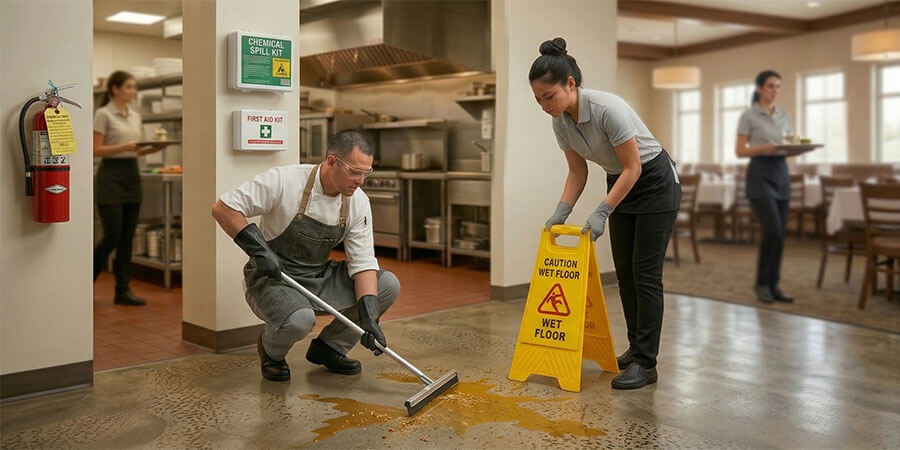
Table of Contents
Build safer restaurant operations by turning training, fire readiness, floor control, PPE, and reporting into everyday procedures
Restaurant safety is broader than kitchen hazards alone. It includes the back of house, the front of house, storage, cleaning chemistry, slip prevention, fire response, customer-facing traffic flow, and the way your team is trained to respond when something goes wrong.
That is why restaurant safety procedures work best when they are written as operating habits instead of vague reminders to "be careful." A strong safety system tells staff what to do, what equipment to use, what to report, and what should never be improvised.
Start With Written Procedures Staff Can Actually Follow
The strongest safety procedures are clear enough to survive a busy shift.
That usually means documenting:
- Opening and closing safety checks
- Spill and floor-response expectations
- Fire and evacuation responsibilities
- Hot-equipment and sharp-tool handling standards
- Chemical handling and labeling rules
- PPE expectations by task
- Injury and incident reporting steps
If the safety program only lives in a manager's head, it does not really exist. It has to be clear enough that a new shift lead can run it, a new employee can follow it, and a busy team can still use it when the pace gets uncomfortable.
Restaurant Safety Includes Front Of House As Well As Back Of House
One reason older safety articles often miss the mark is that they focus only on kitchen heat and knives. Those matter, but they are not the full picture.
| Area: | Safety Focus: | Common Miss: |
| Kitchen | Burns, cuts, chemicals, lifting, equipment condition | Treating risk as normal because the pace is fast |
| Dining room | Slips, traffic flow, spills, customer movement | Waiting too long to address small floor hazards |
| Restrooms | Slip risk, cleaning chemical use, supply checks | Treating the restroom as separate from the safety system |
| Receiving and storage | Lifting, carts, clutter, box handling | Letting deliveries create blocked paths and strain risk |
That is why a strong restaurant safety procedure should cover the whole building, not just the line. A manager who only writes kitchen rules usually leaves the customer and service side of the risk picture far too loose.
Training Has To Be Repeated, Not Assumed
OSHA's hazard-communication and PPE guidance both reinforce a practical point that applies broadly in restaurants: workers need information, training, and the right equipment to handle risks correctly.
That means restaurant safety training should cover:
- What hazards exist in the role
- What PPE is required and when
- How to use equipment correctly
- What products or chemicals should never be mixed
- What to do in a fire, spill, injury, or contamination event
It also means safety training should not be limited to day one. The safest restaurants reinforce procedures over time instead of assuming one orientation session solved it forever. When procedures change, equipment changes, or new risk patterns show up, training needs to follow.
Fire Procedures Need To Be Specific
Fire safety is one of the clearest places where vague advice fails.
OSHA's portable fire extinguisher standard supports several practical basics that belong in restaurant procedures: extinguishers should be accessible, maintained, and paired with employee education on extinguisher use and the hazards involved where employees are expected to use them.
In restaurant terms, your procedure should make it clear:
- Where extinguishers are located
- Who is expected to use them and under what circumstances
- When staff should evacuate instead of trying to fight a fire
- How gas or power shutdown responsibilities are handled if that applies to the site
- How the evacuation and reporting chain works
A restaurant should not discover its fire plan during the fire. The safer operation is the one where expectations have already been made visible, practiced, and understood before the emergency shows up.
Floor Safety Still Deserves Constant Attention
Restaurant safety procedures should assume that wet floors, clutter, cords, mats, and traffic conflicts will happen. The real question is whether the team responds fast enough and consistently enough.
Useful procedure language usually covers:
- Immediate spill response
- Wet-floor signage and area protection
- Keeping walk paths clear
- Mat placement and replacement when damaged
- Regular checks in restrooms and entry areas
This is one reason a restaurant-wide safety post needs to connect with cleaning procedures. A good floor-control routine is both a sanitation habit and an injury-prevention habit. The floor does not care whether the danger began as a hygiene issue or a traffic-flow issue. It still creates the same injury opportunity.
For the broader cleaning system underneath those procedures, Restaurant Cleaning 101 is the best companion resource.
Chemical Handling Procedures Should Never Be Casual
OSHA's Hazard Communication standard is directly relevant here because restaurants use degreasers, sanitizers, disinfectants, delimers, and other products that can create worker-safety problems if handled carelessly.
At minimum, restaurant procedures should cover:
- Labeled secondary containers
- Access to safety data sheets
- Who mixes and replaces solutions
- What products should not be mixed
- What PPE is required for stronger chemistry or cleanup tasks
This is also why stronger is not automatically better. The right chemical used the right way is safer and more effective than overusing the wrong one. If the team is guessing about labels, dilution, or compatibility, the procedure is too weak.
PPE Expectations Should Be Tied To Tasks, Not Left To Memory
OSHA's PPE overview reinforces the practical basics restaurants need: PPE should fit the task, fit the worker, be maintained properly, and be supported with training.
That means restaurant safety procedures should explicitly address the tasks that require protection, such as hot-pan handling, chemical mixing, stronger cleaning work, or body-fluid cleanup. If a task truly needs gloves, eye protection, mitts, aprons, or other gear, the procedure should say so directly instead of assuming staff will remember the expectation under pressure.
This matters because restaurants often rely on memory for PPE far too often. Staff remember until the rush gets bad, then shortcuts begin. The better system makes the expectation visible before the shortcut becomes normal.
Managers Need A Safety Walk-Through Before Problems Escalate
One of the simplest upgrades a restaurant can make is to stop treating safety as purely reactive. The strongest operators do not wait for the injury, the complaint, or the near miss to tell them where the weak spot is.
They look for it first.
That kind of walk-through does not need to be long to be useful. It should check whether extinguishers are accessible, whether floor conditions are drifting, whether chemical stations are labeled correctly, whether PPE is available where tasks actually happen, and whether equipment or storage conditions are creating obvious strain or traffic problems.
The point is not to add another form for the sake of paperwork. The point is to catch the drift early enough that the team does not get used to it.
Lifting, Carrying, And Repetitive Work Belong In The Safety System Too
Not every restaurant injury is dramatic. OSHA's ergonomics guidance makes the broader point clearly: risk rises with awkward posture, heavy items, repetitive movement, and forceful exertion.
In a restaurant, that means procedures should also address:
- Safer lifting and carrying expectations
- Receiving and stock movement
- Use of carts or team lifts when needed
- Storage heights for heavier items
- Repeated prep work and awkward reach setups
This matters for both kitchens and storage areas. Safety procedures should protect people from routine wear-and-tear injuries as well as the obvious accident risks. The goal is not only to reduce major incidents. It is also to reduce the daily strain that slowly wears teams down.
Incident Reporting Should Be Clear, Fast, And Non-Negotiable
One of the biggest gaps in restaurant safety programs is that hazards are noticed but not reported early enough.
The procedure should make it easy to answer a few basic questions:
- What should be reported immediately
- Who receives the report
- What gets taken out of service right away
- What needs documentation and follow-up
- When management is expected to review repeat issues
This matters because slippery thresholds, damaged cords, unstable shelving, recurring chemical confusion, and near misses all tend to become "normal" when the reporting path is unclear. Once that happens, the safety problem is no longer just the hazard itself. It is also the culture around it.
Food Safety Procedures Still Sit Inside The Larger Safety System
Restaurant safety is not identical to food safety, but the two overlap constantly.
CDC's current norovirus guidance reinforces several points that belong in restaurant procedures: sick food workers should stay away from food handling, handwashing with soap and water matters, and vomiting or diarrheal incidents need a separate cleanup response rather than a casual wipe-down.
That is why most restaurants need clear procedures for:
- Sick-worker reporting
- Contamination-event response
- Handwashing support and supply checks
- Discarding exposed food or service items when contamination risk is present
If you need the food-safety side in more detail, Food Safety Tips for Commercial Kitchens and Food Safety Guide are the best companion resources.
A Better Daily Restaurant Safety Checklist
| Procedure Area: | Daily Control: |
| Floors and traffic | Clean spills fast, protect wet areas, keep walk paths open |
| Fire readiness | Keep extinguishers accessible and staff aware of response roles |
| Chemicals | Label products, maintain SDS access, use the right PPE |
| PPE and hot work | Match gear to task and reinforce hot-zone habits |
| Reporting | Escalate hazards, faulty equipment, and incidents early |
| Food safety crossover | Keep sick-worker, contamination, and handwashing procedures active |
This kind of table is useful because it turns broad safety language into repeatable daily controls. It is not the whole system, but it gives the team a short operational baseline that can actually survive the rush.
Near Misses Should Change The Procedure, Not Just The Mood
Restaurants often talk about accidents only after someone is clearly hurt. That misses a huge amount of useful information.
Near misses matter because they show you where the system almost failed: the tray that nearly slipped on a damp threshold, the mislabeled chemical bottle someone caught in time, the unstable shelf that was noticed before it collapsed, or the server who almost turned into a hot pan because the path was blocked.
When those moments get ignored, the restaurant loses one of its best chances to improve the procedure before the same pattern produces an actual injury. A strong safety culture treats near misses as free warnings, not as lucky escapes that can be forgotten.
The Best Safety Procedures Feel Normal During Service
That is the real test. A safety system should not feel like an extra lecture layered on top of real restaurant work. It should feel like the way the restaurant already operates when it is being run well.
When the procedures are written clearly, reinforced regularly, and tied to the actual hazards staff face every shift, the restaurant becomes safer without becoming slower or more theatrical about it.
Frequently Asked Questions
What should restaurant safety procedures cover?
Strong procedures should cover staff training, slips and floor control, fire readiness, chemical handling, PPE, hot-equipment and sharp-tool handling, reporting expectations, and food-safety crossover issues like contamination events and sick-worker response. The best systems cover the whole restaurant, not just the kitchen line.
How often should restaurant safety training happen?
At minimum, staff need clear training when they start and reinforcement when procedures, equipment, or roles change. In practice, the safest restaurants treat training as ongoing rather than assuming orientation alone is enough.
What is the biggest mistake in restaurant safety programs?
Leaving key procedures too vague. If staff do not know who responds to spills, who handles chemicals, when to evacuate instead of fighting a fire, or how to report equipment problems, the system is too weak to hold up under pressure.
Do restaurant safety procedures need to include front-of-house staff too?
Yes. Restaurant safety is not only a back-of-house issue. Dining-room traffic, restrooms, spills, customer movement, carrying hot plates, and entry conditions all belong in the safety system too.
Why do chemical rules matter so much in restaurant safety?
Because degreasers, sanitizers, disinfectants, and other cleaning products can harm workers if they are mislabeled, mixed incorrectly, or used without the right protection. OSHA's hazard communication and PPE guidance make that especially relevant in foodservice settings.
How does food safety connect to restaurant safety procedures?
They overlap constantly. Sick-worker response, contamination-event cleanup, handwashing, and safe discard decisions protect both staff and guests. Strong operators treat food safety and worker safety as connected systems rather than separate conversations.
Related Resources
- Restaurant Kitchen Hazards and How to Avoid Them - Back-of-house hazard control for slips, cuts, burns, chemicals, and equipment issues.
- Restaurant Cleaning 101 - Cleaning procedures that support safer operations across the whole building.
- Food Safety Tips for Commercial Kitchens - Daily food-safety habits that overlap with safety procedures.
- Food Safety Guide - Broader foodservice compliance and sanitation framework.
- Safety & Security - Product category for workplace safety tools, signs, and related support items.
Share This!