Restaurant Inventory Management Tips That Actually Work
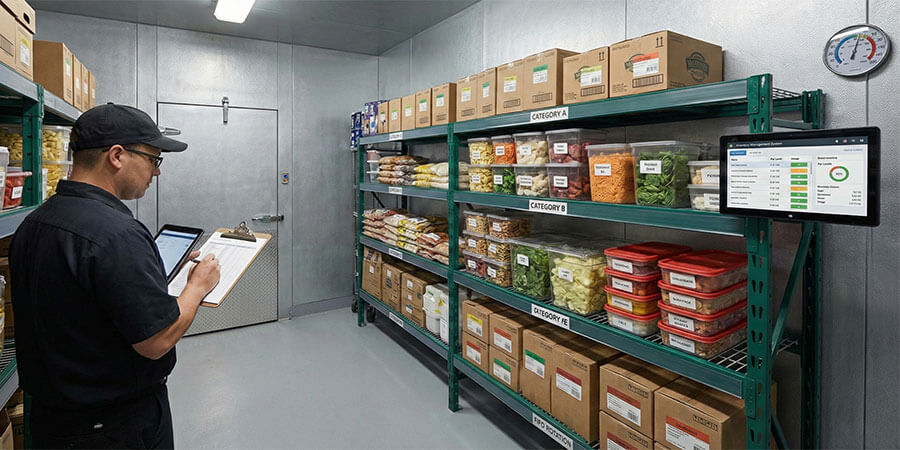
Table of Contents
How to count stock, set par levels, track COGS, and decide exactly how much inventory your restaurant should carry
Inventory management is one of the highest-leverage habits in restaurant operations. This post covers the core systems that keep food costs in check: how to count inventory correctly, how to set par levels based on real sales data, how FIFO rotation works in practice, how to calculate COGS, and how much stock you should actually be carrying at any given time. Backed by current industry data from the NRA and ReFED.
Best For: Restaurant owners, kitchen managers, and operators who want tighter control over food costs and stock levels
User Intent: Informational - practical inventory management systems and methods for restaurant operators
Poor inventory management doesn't announce itself. It shows up quietly - in food cost percentages that creep above target, in prep cooks pulling items from the walk-in that should have been used two days ago, in the mid-service scramble when something runs out that shouldn't have. By the time you notice the problem, you've already lost the margin.
The good news is that inventory management is a learnable system, not a talent. The operators who do it well aren't necessarily smarter - they've just built consistent habits around counting, tracking, and acting on what the numbers tell them. This post breaks down those habits into practical steps you can implement without overhauling your entire operation.
Why Inventory Management Directly Affects Your Bottom Line
Food cost is the clearest window into how well your inventory system is working. According to the NRA's 2025 Operations Data Abstract (covering 2024 data), limited-service restaurants averaged 32.4% of sales on food costs, while full-service restaurants came in at 32.0%. Those numbers look stable on the surface, but they mask a significant spread between operators.
The same NRA data shows that full-service restaurants with higher annual sales volumes reported a 31.0% food cost ratio, compared to 33.7% for operators below that threshold. Higher-volume operators also reported 4.3% pre-tax income versus just 1.1% for lower-volume operators. The gap isn't explained entirely by purchasing power - it's also explained by tighter systems.
Food waste compounds the problem. ReFED's 2025 U.S. Food Waste Report found that the US wastes 63 million tons of food annually - roughly 25% of the entire food supply. Within the foodservice segment, 70% of waste comes from plate waste (customer-side), with roughly 30% driven by operational factors - forecasting errors, over-purchasing, poor storage, and prep inefficiency. ReFED's earlier analysis (2023) found that every dollar invested in food waste reduction returns fourteen dollars in cost savings - making inventory management one of the highest-return habits a restaurant can build.
| Metric: | Data Point: | Source: |
| Limited-service food cost % | 32.4% of sales | NRA, 2025 Operations Data Abstract |
| Full-service food cost % (overall) | 32.0% of sales | NRA, 2025 Operations Data Abstract |
| Full-service food cost % (higher-volume operators) | 31.0% of sales | NRA, 2025 Operations Data Abstract |
| Full-service food cost % (lower-volume operators) | 33.7% of sales | NRA, 2025 Operations Data Abstract |
| US annual food waste | 63 million tons (25% of food supply) | ReFED, 2025 U.S. Food Waste Report |
| Foodservice waste from plate waste | 70% | ReFED, 2025 |
| Foodservice waste from operational factors | ~30% | ReFED, 2025 |
| ROI on food waste reduction investment | 14x return per dollar invested | ReFED, 2023 |
How to Count Inventory the Right Way
Most restaurants count inventory wrong - or not at all. A weekly physical count is the foundation of everything else. Without it, you're managing by feel, and feel is expensive.
Count at the same time every week. The most common approach is counting at the end of business on Sunday or before opening on Monday, before any new deliveries arrive. Consistency matters more than the specific day - you need an apples-to-apples comparison week over week.
Count in the same order every time. Build a standardized count sheet organized by storage location: walk-in cooler, walk-in freezer, dry storage, reach-ins, and any secondary storage areas. Counting in a fixed sequence reduces errors and speeds up the process once your team gets used to it.
Use the right tools. A clipboard and a printed count sheet work fine. So does a tablet with inventory software. What doesn't work is counting from memory or estimating. Portion scales are worth having on hand for items counted by weight - proteins especially, where a few ounces of variance per unit adds up fast across a full count.
Two-person counts improve accuracy. One person counts, one person records. It takes a little longer but catches errors that a solo count misses. For high-value items like proteins and specialty ingredients, a second set of eyes is worth the time.
Organize your storage to make counting faster. Commercial shelving with clear zones for each product category - proteins, dairy, produce, dry goods - makes counts faster and reduces the chance of missing something tucked in the wrong spot.
Setting Par Levels Based on Real Data
A par level is the minimum quantity of an item you need on hand to get through your ordering cycle without running out. Setting par levels correctly is what separates reactive purchasing (ordering when you notice you're low) from proactive purchasing (ordering based on what you know you'll need).
Start with your sales data. Pull your POS reports for the past four to eight weeks and calculate how much of each ingredient you use per day, on average. Factor in your busiest days - if Friday and Saturday account for 40% of your weekly volume, your par levels need to reflect that.
Build in a safety buffer. A common formula: par level = (average daily usage x days between orders) + safety stock. If you order twice a week and use 10 pounds of a protein per day, your par level before ordering is 35-40 pounds - five days of usage plus a small buffer for variance.
Adjust seasonally. Par levels set in January won't be right in July. Review them at least quarterly, or whenever your menu changes significantly.
Track what you actually use versus what you ordered. The gap between those two numbers is where waste hides. If you're consistently ordering more than you use, your par levels are too high. If you're running out before the next delivery, they're too low.
FIFO Rotation - Simple in Theory, Harder in Practice
First-in, first-out (FIFO) is the principle that older stock gets used before newer stock. Every food handler knows the concept. Far fewer operations actually enforce it consistently.
The breakdown usually happens at receiving. When a delivery arrives mid-service or at a busy time, it's tempting to just stack new product in front of old. That's how you end up with items expiring behind newer stock.
Make FIFO physical, not just policy. Day-of-the-week stickers and product labels on every prepped item and every opened package remove the guesswork. When everything is dated, rotation becomes automatic - staff don't have to remember which container came in first.
Organize storage so FIFO is the path of least resistance. Shelves should be loaded from the back, with older product pulled to the front. Food storage containers with lids in standardized sizes make stacking and rotating easier, and clear containers let staff see what's inside without opening everything.
Check dates during every count. Your weekly inventory count is also your weekly freshness audit. Any item approaching its use-by date should be flagged for immediate use or cross-utilization before it becomes waste.
Calculating COGS and Using It to Manage Costs
Cost of goods sold (COGS) is the actual cost of the food and beverage you sold during a given period. It's the most direct measure of how well your inventory system is working.
The formula: COGS = Beginning Inventory + Purchases - Ending Inventory
Here's how it works in practice: if you started the week with a certain inventory value, received deliveries during the week, and ended with a lower inventory value, the difference (plus purchases) is what you sold. Divide that COGS number by your revenue for the week to get your food cost percentage.
Track COGS weekly, not monthly. Monthly COGS gives you a report card. Weekly COGS gives you a steering wheel. If your food cost percentage spikes in a given week, you can investigate immediately - was it a receiving error, a portioning problem, unusual waste, or theft? - rather than discovering the problem 30 days later.
Compare COGS to your menu pricing. If your COGS is running higher than your menu was designed to support, something is off - either your purchasing costs have risen, your portions are inconsistent, or your waste is higher than expected. The guide to pricing menu items covers how to build food cost targets into your pricing from the start.
Proper refrigeration protects your COGS. Spoilage is a direct COGS hit. The commercial refrigeration guide covers temperature management and equipment selection for keeping perishables at safe, quality-preserving temperatures.
How Much Inventory Should a Restaurant Carry?
This is one of the most common questions operators have, and the honest answer is: as little as you can get away with while never running out of anything.
Excess inventory ties up cash, increases spoilage risk, and creates storage problems. Too little inventory means running out mid-service, emergency purchasing at higher prices, and 86'd menu items. The goal is the minimum viable stock level that keeps your operation running smoothly.
A practical target for most restaurants: two to four days of inventory on hand for perishables, and one to two weeks for dry goods and non-perishables. High-volume operations with reliable daily deliveries can run leaner. Smaller operations with less frequent deliveries need more buffer.
Factors that affect how much you should carry:
- Delivery frequency - More frequent deliveries allow lower on-hand inventory
- Menu complexity - More menu items mean more SKUs to track and more spoilage risk
- Storage capacity - Your walk-in and dry storage space sets a physical ceiling
- Supplier reliability - If your suppliers occasionally miss deliveries, carry more buffer
- Seasonal demand swings - Build up inventory before predictable busy periods
According to Lightspeed's 2022 State of the Global Hospitality Industry report, 51% of operators surveyed used inventory tools specifically to reduce food cost and waste. The operators who carry the right amount of inventory - not too much, not too little - are the ones who've built systems to know what "right" actually looks like for their specific operation.
For a broader look at how inventory connects to overall food cost strategy, see how to keep restaurant food costs low and ways to reduce food waste. For the operational side of running a tight kitchen, restaurant management tips covers workflow, staffing, and food safety systems that complement good inventory habits. And if you're building out your food safety protocols alongside your inventory system, restaurant food safety tips is worth a read.
Frequently Asked Questions
How much inventory should a restaurant carry?
Most restaurants should aim for two to four days of perishable inventory on hand, and one to two weeks for dry goods. The right number depends on your delivery frequency, storage capacity, and menu complexity. The goal is the minimum stock level that keeps you from running out - excess inventory increases spoilage risk and ties up cash.
How do you do restaurant inventory correctly?
Count at the same time every week, in the same order, using a standardized count sheet organized by storage location. Use two people when possible - one counts, one records. Weigh proteins and other high-value items rather than estimating. Compare your count to the previous week and to your purchasing records to catch discrepancies early.
How do you account for inventory in a restaurant?
Use the COGS formula: Beginning Inventory + Purchases - Ending Inventory = Cost of Goods Sold. Track this weekly and divide by your revenue to get your food cost percentage. Compare that percentage to your menu's target food cost to identify whether you have a purchasing, portioning, or waste problem.
What is FIFO and why does it matter for restaurants?
FIFO stands for first-in, first-out - the practice of using older stock before newer stock. It matters because it directly reduces spoilage. The most effective way to enforce FIFO is to date-label everything and organize storage so older product is always at the front. Without consistent rotation, newer deliveries get used first and older items expire in the back.
What are par levels and how do I set them?
A par level is the minimum quantity of an item you need on hand before placing an order. Set them by calculating your average daily usage from POS data, multiplying by the days between orders, and adding a safety buffer. Review par levels quarterly and whenever your menu or sales volume changes significantly.
How does inventory management affect food costs?
Directly and significantly. According to the NRA's 2025 Operations Data Abstract, full-service restaurants with higher sales volumes reported food costs 2.7 percentage points lower than smaller operators - a gap that reflects tighter systems, not just purchasing power. ReFED's 2025 data found that roughly 30% of foodservice waste comes from operational factors like over-purchasing and poor storage - all of which inventory management addresses.
What tools help with restaurant inventory management?
At minimum: a standardized count sheet, a scale for weighing proteins, date labels for all prepped items, and a consistent weekly counting schedule. Lightspeed's 2022 global hospitality survey found that 51% of operators used dedicated inventory tools to reduce food cost and waste. Software that integrates with your POS adds the most value because it ties purchasing and usage data together automatically.
Related Resources
- How to Keep Restaurant Food Costs Low - Broader food cost strategy including menu engineering and purchasing
- 5 Ways Your Restaurant Can Reduce Food Waste - Waste reduction tactics that complement a strong inventory system
- Restaurant Management Tips - Kitchen workflow, staffing, and operational efficiency
- Guide to Pricing Menu Items - How to build food cost targets into your menu pricing
- Commercial Refrigeration Guide - Equipment selection for keeping perishables at safe temperatures
Share This!