Food Safety Tips for Commercial Kitchens: What Your Staff Should Do Every Shift
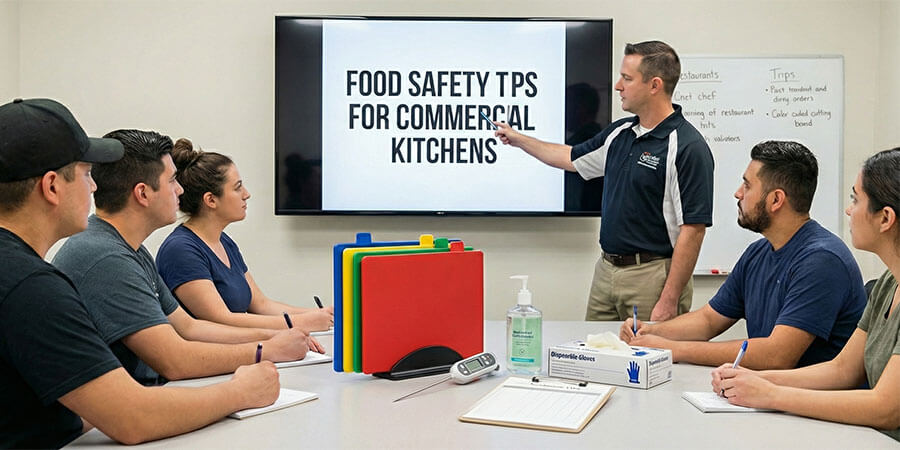
Table of Contents
The daily habits that prevent foodborne illness, protect your customers, and keep your kitchen out of the headlines
About 800 foodborne outbreaks are reported to the CDC every year, and most happen in restaurants. The gap between a safe kitchen and a dangerous one usually isn't equipment or inspections - it's the habits your staff practice (or skip) on every single shift. This post covers the practical, daily-action food safety habits that matter most, from handwashing to cooling protocols to what health inspectors actually look for.
Food safety isn't a once-a-year training topic. It's a collection of small decisions made dozens of times per shift - whether to wash hands before touching ready-to-eat food, whether to check the walk-in temp before service, whether to label that container before sliding it onto the shelf. Those decisions compound. Get them right consistently and you protect your customers, your staff, and your business. Get them wrong repeatedly and the consequences can be severe.
The CDC estimates 48 million Americans get sick from foodborne illness each year, with 128,000 hospitalized and 3,000 deaths. A single outbreak can cost a restaurant anywhere from four thousand to 2.2 million dollars, according to CDC research. That range reflects everything from lost revenue and legal fees to the reputational damage that follows a news story with your restaurant's name in it.
For a full framework covering HACCP principles, ServSafe certification, and the complete food lifecycle from receiving to service, the Food Safety Guide is the right resource. This post focuses on something narrower: the specific habits your team should be doing every shift, starting today.
Handwashing Is the Single Most Impactful Practice - and the Most Skipped
The data here is uncomfortable. According to CDC EHS-Net research published in 2024, food workers wash their hands when they should only about 1 in 3 times. Only 1 in 4 workers wash hands after handling raw meat. And contaminated hands account for 9 out of 10 outbreaks where food was contaminated by workers.
That's not a knowledge problem. Most kitchen workers know they're supposed to wash their hands. It's a habit and culture problem - and it's fixable.
When hands must be washed:
- After touching raw meat, poultry, or seafood
- After using the restroom
- After touching the face, hair, or body
- After handling garbage or cleaning chemicals
- After handling money
- After sneezing or coughing
- Before putting on gloves and after removing them
- Before touching ready-to-eat food
The mechanics matter too. Proper handwashing takes at least 20 seconds with soap and warm water - not a quick rinse. Hand sinks should be positioned where staff actually work, stocked with soap and paper towels at all times, and used exclusively for handwashing (not rinsing produce or dumping ice). A hand sink that's inconvenient to reach is a hand sink that doesn't get used.
Disposable gloves are a useful tool, but they're not a substitute for handwashing. Gloves need to be changed between tasks - especially after handling raw proteins - and hands should be washed before putting on a fresh pair.
Temperature Monitoring: Check It, Record It, Act on It
The FDA Food Code sets clear standards: cold foods must stay at or below 41°F, and hot foods must be held at 135°F or above. The range between those two numbers - 40°F to 140°F - is the danger zone where bacteria can double every 20 minutes, according to USDA research.
The problem is that temperature failures are often invisible. CDC EHS-Net research found that 1 in 7 restaurants stored foods in refrigerators above 41°F. Those kitchens weren't necessarily negligent - they just weren't checking consistently enough to catch the problem before it became a risk.
What a solid temperature routine looks like:
- Check walk-in and reach-in refrigerator temps at the start of every shift and log them
- Verify hot holding equipment reaches 135°F before service begins
- Use a calibrated probe thermometer to check internal food temps - not just the equipment gauge
- Record everything. A temperature log is your evidence that you caught a problem (or that you didn't have one)
For a deeper look at cold holding requirements, safe thawing methods, and what to do when temps are out of range, the temperature requirements blog covers the specifics.
Cross-Contamination Prevention: Separate Everything That Needs to Stay Separate
Cross-contamination is how raw chicken ends up on a salad. It happens through direct contact (raw meat touching ready-to-eat food), through surfaces (a cutting board used for raw proteins then used for vegetables), and through hands (touching raw meat then touching a prep surface without washing).
The prevention system is straightforward, but it requires consistent execution.
Color-coded cutting boards are the most practical tool for preventing surface cross-contamination. A common system: red for raw meat, yellow for raw poultry, blue for raw seafood, green for produce, white for dairy and ready-to-eat foods. The system only works if everyone uses it the same way, every time. Cutting boards should be sanitized between uses and replaced when they develop deep grooves that harbor bacteria.
Separate tools for separate tasks. Knives, tongs, and prep containers that touch raw proteins shouldn't touch ready-to-eat foods without being washed and sanitized first. This sounds obvious, but in a busy service it's easy to grab the nearest tool without thinking.
Storage order in the walk-in is a cross-contamination issue too. Raw proteins should always be stored below ready-to-eat foods, with raw poultry on the lowest shelf. If raw chicken drips onto a container of cooked pasta, that's a contamination event - and it's entirely preventable with proper storage positioning.
Proper Storage and FIFO: The Habits That Prevent Waste and Illness
FIFO - First In, First Out - is the inventory rotation principle that keeps older product moving before newer product. It's simple in theory and easy to skip in practice, especially during a busy receiving day.
The habit: when new product arrives, move existing stock to the front and put new stock behind it. Every container going into storage should be labeled with the date it was prepared or opened. Without labels, FIFO is guesswork.
Day-of-the-week labels are the most efficient labeling tool for high-volume kitchens - color-coded by day, easy to apply, immediately readable. Food storage containers with tight-fitting lids protect stored food from contamination and make stacking and organizing easier.
Storage rules that matter:
- Label everything with prep date and use-by date
- Store raw proteins below ready-to-eat foods (always)
- Keep dry storage off the floor (6 inches minimum)
- Don't store food near cleaning chemicals or equipment
- Check expiration dates during every receiving delivery
Cooling Protocols: Why Slow Cooling Causes Outbreaks
Improper cooling is one of the most common causes of foodborne illness in restaurants - and one of the most preventable. CDC research tracked 504 outbreaks over 10 years caused by hot food cooled too slowly. The same research found that 4 in 10 restaurants placed hot foods in containers deeper than 3 inches, which dramatically slows the cooling process.
The FDA Food Code requires cooked food to cool from 135°F to 70°F within 2 hours, then from 70°F to 41°F within an additional 4 hours. That's a 6-hour total window. A large pot of soup placed directly in the walk-in in a deep container will not meet that timeline - the center of the food stays in the danger zone for too long.
Cooling methods that actually work:
- Divide large batches into shallow containers (2-3 inches deep maximum)
- Use an ice bath - place the container in a larger container filled with ice and water, stirring frequently
- Use a blast chiller if your kitchen has one
- Spread food out on sheet pans to increase surface area
- Never cover hot food before it reaches 70°F - trapping heat slows cooling
The cooling log is as important as the cooling method. Record the time food went into cooling and the temperature at the 2-hour mark. If it hasn't hit 70°F by then, you have a decision to make - and you need the data to make it.
Cleaning vs. Sanitizing: They're Not the Same Thing
This distinction trips up even experienced kitchen staff. Cleaning removes visible dirt and food residue. Sanitizing reduces bacteria to safe levels. You need both, in that order - sanitizing a surface that hasn't been cleaned first is largely ineffective because organic matter protects bacteria from the sanitizer.
The practical sequence: wash with detergent and hot water, rinse, then apply sanitizer at the correct concentration and let it air dry. The concentration matters - too weak and it doesn't work, too strong and it can leave chemical residue on food-contact surfaces. Test strips should be used to verify sanitizer concentration every time a solution is mixed.
Cleaning chemicals should be stored separately from food and food-contact surfaces, clearly labeled, and used according to manufacturer instructions. For a full breakdown of cleaning schedules, sanitizer types, and the difference between sanitizing and disinfecting, the cleaning and sanitizing blog covers all of it in detail.
Food Safety Quick Reference
| Practice: | What To Do: | How Often: | Why It Matters: |
| Handwashing | 20 seconds with soap and warm water | Before and after every task involving food or contamination risk | Contaminated hands cause 9 in 10 worker-related outbreaks |
| Refrigerator temp check | Verify 41°F or below, log the reading | Start of every shift | 1 in 7 restaurants store food above 41°F |
| Hot holding temp check | Verify 135°F or above before service | Before service begins | Bacteria multiply rapidly below 135°F |
| FIFO rotation | Move older stock forward, label new stock with date | Every receiving delivery | Prevents serving expired or spoiled food |
| Sanitizer concentration | Test with test strips, adjust as needed | Every time a new solution is mixed | Wrong concentration means ineffective sanitizing |
| Cross-contamination check | Verify color-coded boards in use, raw proteins stored below ready-to-eat | Ongoing during prep | Prevents raw protein contamination of ready-to-eat foods |
| Cooling log | Record time and temp at 2-hour mark | Every time hot food is cooled | Ensures food passes through the danger zone safely |
| Glove changes | Change between tasks, wash hands before new pair | Every task change involving different food types | Gloves transfer contamination if not changed |
Staff Training and Certification: The Multiplier
Individual habits matter. But the kitchen that consistently executes food safety practices is one where the manager has built a culture around it - and where staff have the knowledge to understand why the habits matter, not just what to do.
CDC research found that restaurants with certified kitchen managers have fewer outbreaks and better inspection scores. That's not surprising. A certified manager understands the science behind the rules, can train staff more effectively, and is more likely to catch problems before they become incidents.
A CDC EHS-Net study found that fewer than half of restaurant managers, food workers, and servers reported receiving food allergy training at their current workplace. That's a significant gap - food allergy reactions can be life-threatening, and the kitchen is where cross-contact prevention happens.
What effective food safety training looks like:
- New hire orientation covers the basics before anyone touches food
- Regular refreshers (monthly or quarterly) keep habits sharp
- Managers lead by example - if the manager skips handwashing, staff will too
- Training covers the "why" behind each practice, not just the "what"
- Allergen protocols are covered explicitly, not assumed
Certification programs like ServSafe provide structured training and nationally recognized credentials. Many states require at least one certified food protection manager per establishment. Check your local health department requirements.
What Health Inspectors Actually Look For
Health inspections aren't random. Inspectors follow a structured process focused on the practices most likely to cause foodborne illness. Knowing what they prioritize helps you focus your own monitoring.
High-priority violations (the ones that can result in immediate closure or critical citations):
- Improper cold or hot holding temperatures
- Improper cooling of cooked foods
- Bare-hand contact with ready-to-eat foods
- Sick employees working with food
- Contaminated food or food-contact surfaces
Common violations that add up:
- No date labels on stored food
- Sanitizer concentration out of range
- Hand sink blocked, missing soap, or used for other purposes
- Raw proteins stored above ready-to-eat foods
- No temperature logs or incomplete records
The best way to prepare for an inspection is to run your kitchen as if an inspector is there every day. That means temperature logs are current, labels are on everything, hand sinks are accessible and stocked, and staff are following the protocols they were trained on.
If you want to understand the full regulatory framework - HACCP plans, food handler permits, and what the FDA Food Code requires at each stage of food handling - the Food Safety Guide covers all of it.
Frequently Asked Questions
How often should commercial kitchen staff wash their hands?
Every time there's a contamination risk - after handling raw proteins, after using the restroom, after touching the face or hair, after handling garbage, and before putting on gloves. CDC EHS-Net research found workers wash hands when they should only about 1 in 3 times, which means most kitchens have significant room to improve. The goal is making handwashing automatic, not something staff have to remember to do.
What temperature should a commercial refrigerator be set to?
41°F or below, per the FDA Food Code. In practice, most operators aim for 38°F to 40°F to give a buffer against door openings and temperature fluctuations. Check and log refrigerator temps at the start of every shift - CDC research found 1 in 7 restaurants store food above 41°F, often without realizing it.
What's the difference between cleaning and sanitizing?
Cleaning removes visible dirt and food residue using detergent and water. Sanitizing reduces bacteria to safe levels using a chemical solution. You need to clean before you sanitize - sanitizer applied to a dirty surface is largely ineffective because organic matter protects bacteria. The correct sequence is: wash, rinse, sanitize, air dry.
How do you prevent cross-contamination in a commercial kitchen?
Use color-coded cutting boards and keep them dedicated to specific food types. Store raw proteins below ready-to-eat foods in the walk-in. Change gloves and wash hands between tasks involving different food types. Sanitize prep surfaces between uses. The system only works if everyone follows it consistently - one person skipping the protocol can undo the whole system.
What is the danger zone for food temperature?
The danger zone is 40°F to 140°F - the temperature range where bacteria multiply most rapidly. USDA research shows bacteria can double every 20 minutes in this range. The FDA Food Code requires cold foods to stay at or below 41°F and hot foods to be held at 135°F or above. Food should spend as little time as possible in the danger zone.
How quickly does cooked food need to be cooled?
The FDA Food Code requires cooked food to cool from 135°F to 70°F within 2 hours, then from 70°F to 41°F within an additional 4 hours - a 6-hour total window. Use shallow containers (no deeper than 2-3 inches), ice baths, or a blast chiller to hit those targets. CDC research tracked 504 outbreaks over 10 years caused by food cooled too slowly.
Do all restaurant employees need food safety certification?
Requirements vary by state and locality, but most jurisdictions require at least one certified food protection manager per establishment. Individual food handler cards or certificates are required for all staff in many states. Check with your local health department for the specific requirements in your area. Beyond compliance, CDC research shows restaurants with certified managers have fewer outbreaks and better inspection scores.
Related Resources
- Food Safety Guide - Full framework covering HACCP, ServSafe, food lifecycle safety, and regulatory requirements
- Commercial Blast Chiller Guide - Equipment that moves hot batches through the danger zone fast, with a probe record
- Temperature Requirements for Restaurants - Deep dive on cold holding, safe thawing, and what to do when temps are out of range
- Cleaning, Sanitizing & Disinfecting: What's the Difference - Understanding the distinction between cleaning, sanitizing, and disinfecting in commercial kitchens
- Hand Sinks - Dedicated handwashing stations for commercial kitchens
- Cutting Boards - Color-coded boards for cross-contamination prevention
- Food Storage Containers - Labeled, stackable containers for FIFO storage systems
Share This!