What Is a Ghost Kitchen? The Delivery-Only Restaurant Model Explained
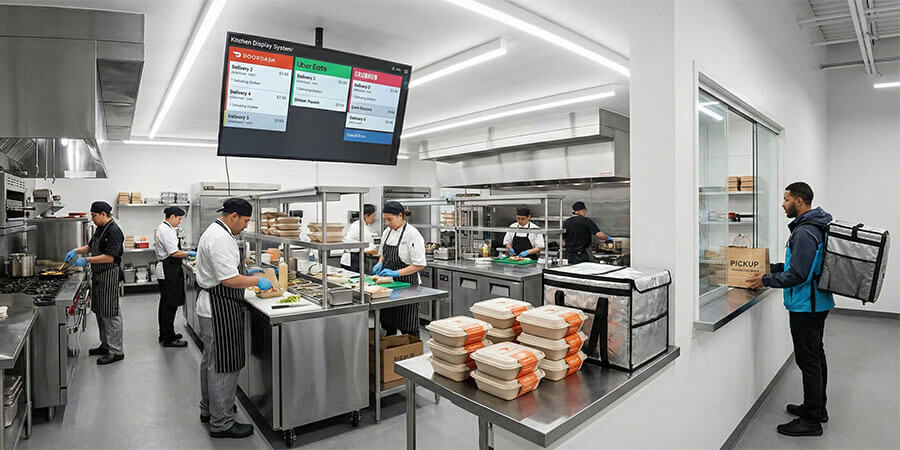
Table of Contents
A ghost kitchen is a professional cooking facility that produces food exclusively for delivery - no dining room, no walk-in customers, no front-of-house staff. This post explains what ghost kitchens are, how they work, the different business models available, who they're best suited for, and what equipment and technology you'll need to run one.
The restaurant industry has quietly undergone one of its biggest structural shifts in decades. Nearly 75% of all restaurant traffic now happens off-premises, according to the National Restaurant Association's 2025 Off-Premises Restaurant Trends report. Delivery, takeout, and curbside pickup aren't just add-ons anymore - they're the core of how millions of people eat.
Ghost kitchens exist because of that shift. They strip the restaurant model down to its essential function - cooking great food - and remove everything else. No dining room. No host stand. No tables to turn. Just a kitchen, a menu, and a stream of delivery orders.
If you've heard the term and wondered what it actually means, this post breaks it down: the definition, the different models, who's using them, and what you need to get started.
Ghost Kitchens Defined - What They Are, Why They Exist, and Why the Name Keeps Changing Across the Industry
A ghost kitchen is a commercial kitchen that prepares food exclusively for delivery or takeout orders. There's no physical storefront for customers to walk into. The restaurant exists online - on delivery apps, a website, or a branded ordering page - and the kitchen is the only real-world presence.
You'll see this concept called several things depending on who's talking about it:
- Ghost kitchen - the most common term in the U.S.
- Cloud kitchen - popular in tech and startup circles, emphasizing the digital-first nature
- Dark kitchen - common in the UK and Europe
- Virtual kitchen - sometimes used interchangeably, though this term can also refer to a virtual brand operating out of an existing restaurant
The terminology gets slippery, but the core idea is consistent: food production happens in a real kitchen, orders come in digitally, and customers never set foot in the facility.
Virtual Restaurant vs. Ghost Kitchen
These two terms often get confused. A virtual restaurant is a delivery-only brand - it's a concept, a menu, a name. A ghost kitchen is the physical facility where that food gets made. A single ghost kitchen can host multiple virtual restaurant brands simultaneously, which is part of what makes the model so flexible.
How Ghost Kitchens Work: The Order Flow
The operational model is straightforward once you see it laid out. Here's how a typical ghost kitchen processes an order:
- A customer browses a delivery app (DoorDash, Uber Eats, Grubhub) or a branded website and places an order
- The order routes to the kitchen's point-of-sale or kitchen display system
- Kitchen staff prepare the food, package it for delivery, and mark it ready
- A delivery driver - either from the platform or an in-house fleet - picks up the order and delivers it
- The customer receives their food, typically without ever knowing where the kitchen is located
There's no front-of-house choreography. No servers, no hosts, no bussers. The entire customer-facing experience happens through a screen, which means the kitchen can focus entirely on speed and food quality.
Speed matters more than most operators expect. The NRA's 2025 Off-Premises Restaurant Trends report highlights that delivery customers consistently rank speed and accuracy as their top priorities when ordering food online. That's not a preference - it's a baseline expectation.
Ghost Kitchen Business Models: Which One Fits Your Operation?
Not all ghost kitchens are structured the same way. There are four main models, each with different tradeoffs around cost, control, and flexibility.
| Model: | How It Works: | Flexibility: | Control: | Setup Time: | Best For: |
| Commissary / Shared Kitchen | Rent time or space in a licensed shared facility | High | Low | Fast | Testing a concept, low-volume operators |
| Dedicated Rental | Lease a purpose-built ghost kitchen unit from a provider | Medium | Medium | Medium | Operators ready to scale without building |
| Build-Your-Own | Lease or own a standalone space and outfit it as a ghost kitchen | Low | High | Slow | Established operators with volume to justify it |
| Multi-Brand Kitchen | One kitchen runs multiple virtual brands simultaneously | Medium | High | Medium | Maximizing revenue per square foot |
Commissary kitchens are the lowest-friction entry point. You rent time in a shared, licensed commercial kitchen - often by the hour or shift. You bring your ingredients, use the equipment, and leave. It's ideal for testing a concept before committing to a lease.
Dedicated rental units are purpose-built ghost kitchen spaces offered by companies that develop and manage these facilities. You get your own space with more control than a commissary, but without the capital investment of building from scratch.
Build-your-own gives you the most control over layout, equipment, and branding, but it requires the most upfront work. This model makes sense once you've validated your concept and have the order volume to justify a dedicated space.
Multi-brand operations are worth understanding even if you're starting with a single concept. Running two or three virtual brands out of one kitchen - each with its own menu and delivery app presence - is one of the most effective ways to increase revenue without increasing overhead proportionally.
Who Opens Ghost Kitchens?
The ghost kitchen model attracts a wide range of operators, not just tech-backed startups.
New food entrepreneurs are drawn to ghost kitchens because the barrier to entry is significantly lower than opening a traditional restaurant. Startup costs are a fraction of what a full-service restaurant requires, since there's no dining room to build out, no front-of-house staff to hire, and no expensive real estate in a high-foot-traffic location.
Existing restaurant operators use ghost kitchens to expand their delivery reach without opening new locations. A restaurant doing strong dine-in business might launch a ghost kitchen in a different neighborhood to capture delivery demand there.
Food truck operators sometimes use ghost kitchens as a home base - a licensed, stable kitchen for prep work and off-season operations when the truck isn't running.
Caterers find ghost kitchens useful for handling overflow volume or testing retail-facing concepts alongside their catering business.
The common thread is that all of these operators are chasing the same consumer behavior. Two-thirds of Gen Z and millennials say takeout is essential to their lifestyle, per the NRA's 2025 research. Mobile ordering is used by 57% of adults overall, climbing to 74% among millennials and 65% among Gen Z. The demand is there - ghost kitchens are one way to meet it.
Equipment and Technology: What You Actually Need
Ghost kitchens run leaner than traditional restaurants, but they still require the right equipment and systems. The specifics depend on your menu, but here's a practical overview of what most operations need.
Cooking Equipment
Your cooking setup should match your menu tightly. Ghost kitchens don't have the luxury of excess equipment - every piece needs to earn its space. Common equipment includes commercial ranges, convection ovens, fryers, and prep tables sized to your volume.
One option worth knowing about: ventless cooking equipment. If your kitchen space has limited or no hood ventilation, ventless fryers, ovens, and steamers can be a practical solution. Our ventless cooking equipment guide covers what's available and how to choose the right setup.
Packaging
Packaging is more important in a ghost kitchen than in a traditional restaurant because the food has to survive a delivery trip and still look and taste good when it arrives. Invest in quality to-go containers and take-out packaging that hold heat, prevent sogginess, and present well when opened.
Insulated delivery bags are worth having on hand too, especially if you're managing your own drivers or doing any catering-adjacent work.
Technology Stack
The technology layer is where ghost kitchens live or die. You need:
- A point-of-sale system that integrates with delivery platforms so orders flow directly to the kitchen without manual entry
- A kitchen display system (KDS) to manage order queues and timing
- Delivery platform accounts on DoorDash, Uber Eats, Grubhub, or whichever platforms your target customers use
- A direct ordering channel - your own website or app - to reduce dependence on third-party platforms over time
For a deeper look at the technology side, the restaurant technology guide covers POS systems, KDS options, and delivery integrations in detail.
For the full equipment and setup checklist, the ghost kitchen startup guide walks through everything step by step.
The Delivery Platform Question
Ghost kitchens are almost entirely dependent on delivery platforms to reach customers - at least at the start. DoorDash, Uber Eats, and Grubhub give you immediate access to a large pool of delivery customers without having to build your own audience from scratch.
The tradeoff is commission fees. Third-party delivery platforms typically charge between 15% and 30% per order. That's a significant cut, and it's one of the most important numbers to understand before you build your pricing and menu.
65% of limited-service operators now offer delivery, according to the NRA's 2025 data. That means the platforms are crowded, and standing out requires strong photography, competitive pricing, and consistent ratings.
Most successful ghost kitchen operators treat third-party platforms as a customer acquisition channel rather than a permanent home. The goal is to build enough brand recognition that customers start ordering directly - through your own website or app - where you keep more of the margin. The online ordering guide covers how to set up and optimize direct ordering channels.
Frequently Asked Questions
What's the difference between a ghost kitchen and a virtual restaurant?
A ghost kitchen is the physical facility - the actual kitchen space where food is prepared. A virtual restaurant is the brand or concept - the menu, name, and online presence. One ghost kitchen can run multiple virtual restaurant brands at the same time.
Do ghost kitchens need a health department license?
Yes. Ghost kitchens are commercial food production facilities and must meet all local health department requirements, including proper licensing, inspections, and food handler certifications. The requirements vary by city and state, so check with your local health department early in the planning process.
Can an existing restaurant open a ghost kitchen?
Absolutely - and many do. Existing restaurants often launch ghost kitchen operations to expand their delivery footprint into new neighborhoods without opening a full second location. Some run additional virtual brands out of their existing kitchen during off-peak hours.
How do ghost kitchens get customers if there's no storefront?
Primarily through delivery apps like DoorDash, Uber Eats, and Grubhub, which surface your menu to customers already browsing for food. Social media, especially Instagram and TikTok, is also a major discovery channel. Over time, operators build direct ordering channels to reduce platform dependence.
What kind of food works best in a ghost kitchen?
Menus that travel well and can be prepared quickly tend to perform best. Burgers, wings, bowls, sandwiches, pizza, and Asian-inspired dishes are common ghost kitchen categories. Foods that get soggy, lose texture, or require tableside preparation are harder to execute well in a delivery context.
Is a ghost kitchen cheaper to start than a traditional restaurant?
Generally, yes - significantly so. You're not paying for a dining room build-out, front-of-house furniture, or a high-foot-traffic lease. The exact savings depend on your market and the model you choose. The ghost kitchen startup guide breaks down the cost categories in detail.
What's the outlook for ghost kitchens in 2026 and beyond?
The market is growing. Earlier industry projections estimated ghost kitchens could capture up to 50% of the drive-thru and takeaway foodservice market by 2030, and recent market research from HTF Market Intelligence puts the sector's compound annual growth rate at approximately 15% through 2032. The off-premises dining trend driving that growth shows no signs of reversing - nearly 75% of all restaurant traffic already happens off-premises.
Related Resources
- How to Open a Ghost Kitchen in 5 Simple Steps - Complete startup guide covering planning, equipment, technology, and launch
- Ghost Kitchen Pros and Cons - Detailed breakdown of the advantages and disadvantages of the ghost kitchen model
- Restaurant Online Ordering Guide - How to set up and optimize direct ordering channels for your operation
- Restaurant Technology Guide - POS systems, kitchen display systems, and delivery platform integrations explained
- How to Write a Restaurant Business Plan - Step-by-step guide to building a business plan for any restaurant concept
Share This!