5 Ways Your Restaurant Can Reduce Food Waste
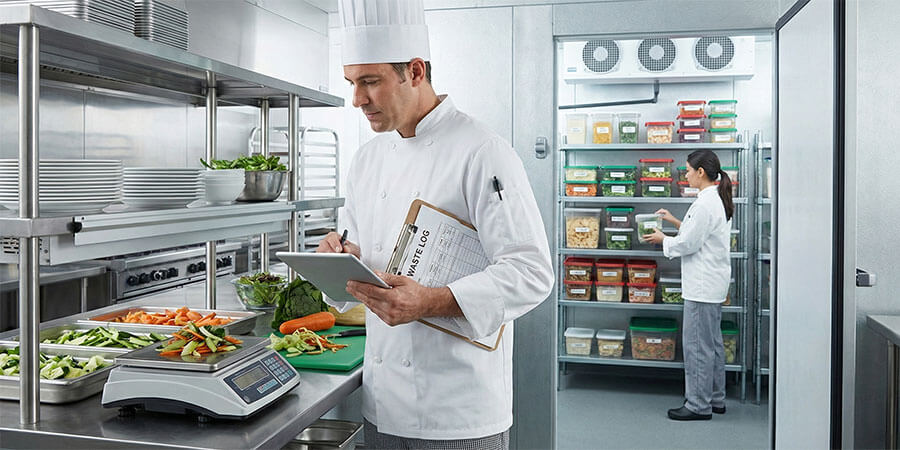
Table of Contents
Operational systems that cut waste, lower food costs, and protect your margins
The foodservice industry generated twelve and a half million tons of surplus food in 2024, and the vast majority went straight to landfill. For every dollar invested in food waste reduction, restaurants typically see around eight times the return in cost savings, according to the National Restaurant Association. This post covers five operational systems that make the biggest difference: waste tracking, storage discipline, portion control, ingredient cross-utilization, and ordering tightness.
Food waste isn't an environmental problem first - it's a profit problem. When your kitchen throws away food, you're discarding money you already spent on purchasing, labor, and storage. The math is unforgiving: food costs already consume roughly thirty-two percent of restaurant sales, and industry-average pre-tax margins sit at just three to five percent. There's no room for waste to be an afterthought.
Commercial kitchens waste five to fifteen percent of all food purchased, often without realizing it, according to research from waste tracking technology providers. That's not a rounding error - it's a meaningful slice of your food budget disappearing before it ever reaches a plate.
If you've already read our overview of how to lower restaurant food costs, you know waste reduction is one of several levers you can pull. Here, we focus entirely on the operational infrastructure that makes waste reduction stick - the systems, tools, and habits that turn good intentions into measurable results.
Start by Measuring What You Throw Away
You can't fix what you don't track. Most kitchens have a vague sense that waste is "a problem," but without data, you're guessing at solutions.
Give every station a simple sheet - or a dedicated container on a scale - where staff record what gets thrown away, how much, and why. Even a week of data reveals patterns that are invisible otherwise. Categories worth tracking:
- Spoilage - ingredients that expired before use
- Prep trim - usable portions lost during cutting and processing
- Cooking errors - burned, over-seasoned, or otherwise unsalvageable items
- Plate returns - food customers leave behind
- Overproduction - batches made in excess of demand
The return on this effort is significant. The National Restaurant Association, citing ReFED research from April 2024, found that tracking food waste can cut food costs by two to six percent. For a high-volume operation, that percentage translates directly to recovered margin - from a clipboard and a scale.
What Waste Audits Actually Reveal
Most operators who run their first waste audit are surprised by where the losses concentrate. ReFED's 2025 data on the U.S. foodservice sector breaks it down clearly:
| Waste Category: | Share of Total Foodservice Waste: | Primary Driver: |
| Plate waste (customers) | 69.6% (8.72M tons) | Over-portioning, menu mismatches |
| Overproduction | 11.9% (1.49M tons) | Poor forecasting, no par discipline |
| Catering overproduction | 9.0% (1.13M tons) | Inaccurate event estimates |
| Spoilage and other | ~9.5% | Storage failures, ordering errors |
Nearly seventy percent of restaurant food waste is plate waste - food that customers don't finish. That's a portioning and menu problem, not a storage problem. Without tracking, you'd never know where to focus.
AI-powered waste monitors and dedicated waste tracking software can automate this process, using cameras and scales to log waste in real time. But a manual log works fine to start. The goal is data, not technology.
Fix Your Storage Before You Fix Anything Else
Poor storage is a silent profit killer. Ingredients get pushed to the back of the walk-in, forgotten, and eventually thrown away. Proper storage discipline prevents spoilage before it starts.
FIFO Is Non-Negotiable
First In, First Out means new deliveries go to the back and older stock moves to the front. It sounds obvious, but it breaks down fast without consistent enforcement. Label every container with the receiving date and use-by date so the rotation is visible at a glance. Day-of-the-week stickers and date labels make this easy and inexpensive to maintain across every shelf and container.
Organize for Visibility
Items that can't be seen get forgotten. A few rules that prevent this:
- Group similar products together
- Keep high-turnover items at eye level
- Never stack containers so deep that the back row disappears
- Clear-label everything - no unlabeled mystery containers
A well-organized walk-in isn't just efficient - it's a spoilage prevention system.
Containers and Shelf Life
Proper food storage containers with tight-fitting lids protect ingredients from cross-contamination, moisture loss, and odor transfer. They also stack cleanly, which makes organization easier to maintain.
For operations that prep several days in advance or buy proteins in bulk, vacuum packaging machines remove air from ingredients and significantly slow oxidation and bacterial growth - adding days of usable shelf life to expensive items.
For the full framework on safe storage temperatures, cross-contamination prevention, and labeling requirements, the food safety guide covers these standards in detail. And if your storage areas are disorganized at a structural level, commercial shelving designed for walk-ins and dry storage can make FIFO rotation physically easier to maintain.
Right-Size Your Portions
Nearly seventy percent of restaurant food waste is plate waste, per ReFED 2025. Customers aren't finishing what you're serving them. That's a signal worth acting on.
Standardize Every Recipe
A recipe that says "a handful of cheese" or "season to taste" isn't a recipe - it's a suggestion. Every dish should have documented weights and volumes for every component, detailed enough that any trained cook can replicate it exactly. This protects both consistency and cost.
Put portion scales at every station that handles proteins, cheese, or other high-cost ingredients. Scales eliminate the drift where portions creep up over time because no one's checking. Measuring cups and portion spoons handle sauces, sides, and garnishes with the same precision.
Prep Ahead, Not During Service
When line cooks are in the weeds during a Friday dinner rush, they're not thinking about ounces. Pre-portioned proteins, pre-measured sauce containers, and pre-cut vegetables remove the decision entirely. Consistency improves, and so does speed.
Watch What Comes Back
If the same item comes back half-eaten night after night, the portion is too large. Reducing it by an ounce or two often goes unnoticed by customers - and it cuts both food cost and waste disposal cost simultaneously. Train servers to note what customers leave behind and report patterns to the kitchen.
Cross-Utilize Ingredients to Minimize Dead Stock
Every unique ingredient on your menu is a spoilage risk. The more items that appear in only one dish, the more likely you are to end up with partial quantities that expire before you can use them.
Design your menu around ingredient overlap. A roasted vegetable that appears in a salad, a grain bowl, and a side dish is far less likely to go to waste than one that anchors a single entree. This isn't about limiting creativity - it's about building a menu where ingredients work hard across multiple applications.
Trim and scraps deserve the same attention. A few high-value examples:
- Vegetable trimmings → stock
- Bread ends → croutons or breadcrumbs
- Overripe fruit → sauces or compotes
- Day-old baked goods → bread pudding or French toast
These applications require planning - build them into your prep schedule - but they convert what would be waste into usable product.
Audit your ingredient list regularly. Count how many menu items each ingredient appears in. Anything that shows up in only one dish is a candidate for either cross-utilization or removal. If you can't find a second application for it, consider whether that dish is worth the spoilage risk.
The menu pricing guide covers ingredient overlap as part of a broader menu engineering framework - worth reading if you're redesigning your menu with cost efficiency in mind.
Tighten Your Ordering with Par Levels and Frequency
Over-ordering is one of the most common and most preventable sources of waste. When you buy more than you can use before items expire, you're paying twice - once to purchase the food, and again to dispose of it.
Set Par Levels for Every Ingredient
A par level is the maximum quantity you should have on hand between deliveries. It's calculated from your actual usage data, not from gut feel. When you receive a delivery, you're topping up to par - not ordering a fixed amount regardless of what's already in the walk-in. A few principles:
- Review pars at least quarterly - a level that works in July doesn't work in January
- Adjust whenever you add or remove menu items (changing one dish changes the math for every ingredient in it)
- Compare pars against actual waste data from your tracking log
Order More Frequently for Perishables
Twice-weekly deliveries of proteins and produce often cost less overall than weekly bulk orders, even if the per-unit price is slightly higher. Smaller, more frequent orders mean fresher product, less spoilage, and less cash tied up in inventory sitting in your walk-in.
Communicate with Suppliers
If you know a slow week is coming - a holiday, a local event that pulls traffic away, a private dining room that's dark - tell your rep before you order. Most suppliers can adjust quantities or hold a delivery. The ones who can't are worth reconsidering.
For a deeper look at the systems behind inventory management - including how to track usage, set reorder points, and reduce shrinkage - see our guide on restaurant inventory management.
Systems only work if people use them. The best waste tracking log in the world does nothing if staff treat it as optional. Post weekly waste totals in the kitchen so the numbers are visible. Train on the "why" - staff who understand that food costs consume thirty-two percent of sales and that margins are three to five percent are more likely to care about a dropped protein than staff who've only been told "don't waste food." Assign ownership at each station and recognize improvement when the numbers move. Culture is the infrastructure that makes everything else function.
For shift-level techniques - trim tracking, plate audits, and ordering discipline in the moment - the kitchen hacks post covers the tactical side of waste reduction that complements these operational systems.
Frequently Asked Questions
How much can a restaurant realistically save by reducing food waste?
The National Restaurant Association, citing ReFED data from April 2024, found that for every dollar invested in food waste reduction, restaurants typically see around eight times the return in cost savings. Tracking food waste alone can cut food costs by two to six percent - and the investment required is often just a scale, a log, and consistent staff training.
What percentage of restaurant food waste is plate waste?
According to ReFED's 2025 analysis of the U.S. foodservice sector, nearly seventy percent of restaurant food waste is plate waste - food that customers don't finish. That works out to roughly eight and a half million tons annually. The implication is that portion sizing and menu design are the highest-leverage places to start, not just storage and ordering.
What's the easiest first step to reduce food waste?
Start with a waste log. Give each station a sheet to record what gets thrown away, how much, and why. Even one week of data reveals where losses concentrate - whether it's spoilage in the walk-in, over-portioning at the grill, or a menu item that customers consistently don't finish. You can't prioritize solutions without knowing the problem.
Does reducing food waste require expensive technology?
No. A scale, a waste log, and consistent FIFO labeling cost almost nothing and deliver real results. AI-powered waste monitors and inventory management software can accelerate the process, but they're not prerequisites. Many operators achieve significant waste reduction with manual systems before ever investing in technology. Start simple, build habits, then add tools if the volume justifies it.
How does menu design affect food waste?
Significantly. Every ingredient that appears in only one dish is a spoilage risk - if that dish sells slowly, the ingredient expires before you use it. Menus designed around ingredient overlap reduce dead stock and give you more flexibility to use trim and partial quantities across multiple applications. Fewer unique ingredients also means simpler ordering and less complexity in the walk-in.
How often should restaurants review their par levels?
At minimum quarterly, and whenever you notice a consistent pattern of either running out or throwing away. Par levels set in summer don't account for winter traffic patterns. A new menu item that uses an existing ingredient changes the math for that ingredient's par. Treat par levels as living numbers, not set-and-forget targets.
What's the difference between pre-consumer and post-consumer food waste?
Pre-consumer waste happens in the kitchen - spoilage, prep trim, cooking errors, overproduction. Post-consumer waste is plate waste - food that customers don't finish. Both matter, but they require different solutions. Pre-consumer waste is addressed through better storage, ordering, and prep systems. Post-consumer waste is addressed through portion sizing, menu design, and monitoring what comes back on plates. ReFED's 2025 data shows post-consumer waste is by far the larger category, making it the higher-priority target for most operations.
Related Resources
- How to Lower Restaurant Food Costs - The hub post covering eight cost control strategies, including waste reduction as part of a broader profitability framework
- Tips for Managing Your Restaurant Inventory - Deep dive into inventory systems, par levels, and stock rotation practices
- Guide to Pricing Menu Items at Your Restaurant - Menu engineering and ingredient cost analysis to build a more profitable, lower-waste menu
- Food Safety Guide - Storage temperatures, labeling requirements, and FIFO protocols that underpin waste prevention
- Food Storage Containers & Lids - Commercial-grade containers for organized, FIFO-ready storage
Share This!