Choosing a Commercial Dishwasher
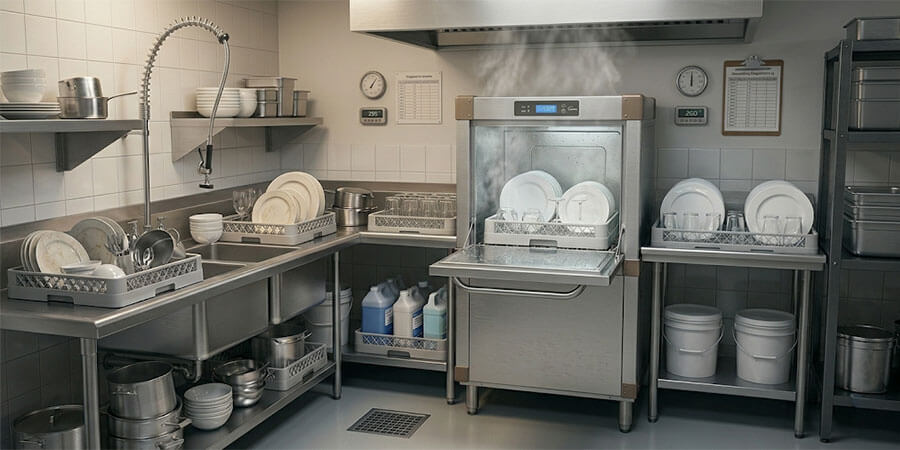
Table of Contents
Choose a commercial dishwasher more confidently by matching machine type, sanitizing method, and capacity to the way your kitchen actually works
Commercial dishwashers are one of those purchases that look straightforward until the machine has to keep up with a real service rhythm. The question is not only whether the unit washes dishes. It is whether it fits the actual pace, wares, space, and sanitation process of the kitchen that will depend on it every day.
That is why the best commercial dishwasher is not simply the biggest or the cheapest one. It is the one that matches the operation's dish load, its available space, its sanitizing method, and the way dishes move through the kitchen from dirty landing zone to clean storage.
Start With The Type Of Dishwasher The Operation Actually Needs
Commercial warewashing equipment does not all solve the same problem. A small cafe, a busy table-service restaurant, a banquet operation, and a healthcare dining environment will not always need the same machine style.
| Dishwasher Type: | Best Fit: | Why It Matters: |
| Undercounter dishwasher | Smaller operations or lower-volume service | Compact footprint and simpler placement |
| Door-type / pass-through dishwasher | Mid-volume restaurant kitchens | Faster throughput and better dishroom flow |
| Conveyor dishwasher | Higher-volume kitchens, banquet, institutional use | Stronger output at scale |
| Glasswasher | Bars or glass-heavy beverage operations | Better fit for delicate glassware and bar rhythm |
This is the first decision because machine type changes everything else that follows, including throughput expectations, dishroom layout, and what kind of landing, stacking, or drying area the room needs around it.
For the deeper product-side comparison, the Commercial Dishwasher Guide is the strongest internal next read.
High-Temp And Low-Temp Machines Solve Sanitizing Differently
This is one of the most important distinctions in commercial dishwashing, and it is one of the easiest to oversimplify.
The FDA Food Code is a model code adopted differently by jurisdictions, but its warewashing framework is still useful for understanding the real difference here: some machines sanitize through a hot-water approach, while others rely on chemical sanitizing methods under the applicable equipment and local-code rules.
| Sanitizing Approach: | What It Usually Means In Practice: | Common Tradeoff: |
| High-temp machine | Hot-water sanitizing approach | Often more heat-intensive and sometimes more demanding install context |
| Low-temp machine | Chemical sanitizing approach | Ongoing chemical use and a different service routine |
That does not make one universally better. It means the kitchen has to choose based on utilities, local requirements, ventilation context, and how comfortable the team is with the machine's daily operating routine.
The sanitizing method matters because it affects installation, throughput feel, and ongoing operating expectations - not just the machine spec line.
For some buyers, the more useful comparison is between commercial and residential dishwashing equipment rather than between two commercial machine formats.
Capacity Has To Match Peak Demand, Not A Calm Hour
One of the easiest ways to buy the wrong dishwasher is to size it to an average period instead of the real rush.
That means you should be asking:
- How many racks or wares hit the machine during the busiest stretch?
- How much glassware, flatware, and dishware turnover happens at once?
- Does the machine need to support bar, dining room, and prep support together?
- How much backup landing space and clean-side space is available?
The machine is only one part of the warewashing system. If the surrounding workflow cannot keep up, the kitchen still feels backed up even if the unit itself is technically capable.
The Dishroom Layout Around The Machine Matters Just As Much
This is where a lot of dishwasher purchases become frustrating. Operators focus on the box and forget the path around the box.
The stronger warewashing setup usually includes space for:
- Dirty landing
- Scrap or pre-rinse activity
- Rack staging
- Clean unloading or drying area
- Easy movement back to service or storage
That is why even the right dishwasher can feel wrong if the dishroom or back line has no realistic space for the staff to work around it.
For the broader room-planning side, How Restaurants Keep Dishes Clean and Sanitized is the strongest internal companion.
Utility Fit And Daily Requirements Need To Be Checked Early
Dishwashers are not only throughput decisions. They are also utility and facilities decisions.
That means it is important to confirm:
- Electrical requirements
- Water supply and pressure expectations
- Drainage realities
- Any vent, steam, or space implications for the chosen machine style
This matters because the machine may look perfect until the installation or operating context turns out to be harder than expected. In many kitchens, the “best” dishwasher is the one that fits both the service load and the room's real infrastructure.
That is also why dishmachine selection should be treated as part of the dishroom plan, not only as a machine decision. If the warewashing station cannot support the drain, water, heat, chemical, and rack-flow needs around the machine, the room still underperforms no matter how capable the unit is on paper.
Rack Size, Ware Mix, And Throughput Have To Be Considered Together
Another reason dishwashers get mis-sized is that operators focus on a throughput number without thinking hard enough about the kinds of wares actually being washed.
That matters because:
- Bar glassware behaves differently from plates and flatware
- Pots, pans, and heavier wares can change rack flow completely
- Some kitchens need more flexibility in what goes through the machine than others do
This is one reason some operations rely on more than one warewashing approach across the building. The best question is not simply “how many racks per hour?” It is “what kind of wares are hitting the machine during the hardest part of the day?”
Ongoing Costs Still Matter After The Purchase
The dishwasher decision does not end with the quote or the installation.
The operation still has to live with:
- Water use
- Energy use
- Chemical use where relevant
- Staff time
- Maintenance needs
This is one reason operators should think beyond the sticker price. The machine that looks simpler to purchase may still become the more frustrating machine to run if it is a bad fit for volume, ware mix, or service rhythm.
Displays, Gauges, And Readable Information Still Matter
Operators and managers often want to know whether the machine gives a clear indication that it is operating where it should.
The clearest way to frame it is not to overstate one universal requirement. It is to say that operators should choose a machine with clear, readable information that supports monitoring, sanitation confidence, and local compliance checks where applicable.
That can include:
- Clear temperature or cycle information
- Readable controls
- Easy-to-check status indicators
- A machine that does not make daily verification harder than it needs to be
This is one of those details that feels minor until the machine is actually in daily use.
Home-Use Search Intent Needs A Careful Answer
Commercial dishwasher questions sometimes overlap with home-use curiosity, and the best response is still a careful one.
Commercial dishwashers are built for a different environment, different throughput expectations, and often different installation assumptions than residential units. That is why the home-use question is usually not “Can it wash dishes?” It is “Does the building, utility setup, and daily use pattern really make this a sensible fit?”
That is also why a commercial-versus-residential comparison is often more useful than trying to answer the whole home-use question inside this post.
The Better Purchase Usually Comes Down To Fit, Not Features
Operators often want a list of the best features. What usually matters more is whether the machine fits the operation's real sanitizing method, ware volume, space, and utility setup.
That is why the most practical dishwasher checklist usually sounds like this:
| Buying Question: | Why It Matters: |
| What machine type fits the volume? | Prevents overbuying or underbuying |
| Which sanitizing method fits the operation? | Shapes install and daily use |
| Can the room support the machine well? | Avoids dishroom bottlenecks |
| Does the utility setup actually fit it? | Prevents install-stage surprises |
| Is the machine easy to monitor and use? | Helps staff keep it running correctly |
That is what makes the purchase feel smart after the novelty wears off.
It also makes the choice easier to defend internally. A dishwasher that fits the room, the wares, and the sanitizing workflow will usually create fewer downstream headaches than a machine chosen mostly by top-line features or price pressure alone.
A Strong Dishmachine Choice Usually Improves The Whole Back Line
The dishwasher is easy to treat like one isolated machine decision. In practice, a strong dishmachine choice often improves the rhythm of the whole back line.
When the warewashing system works well, the staff spends less time waiting on clean wares, less time working around dirty-rack backups, and less time improvising around a dishroom bottleneck. That is one reason the machine should be judged as part of the whole service system and not only as a piece of equipment with a spec sheet.
Frequently Asked Questions
How do I choose a commercial dishwasher?
Start with machine type, sanitizing method, real dish volume, and the layout around the machine. The strongest purchase is the one that fits the kitchen's actual service rhythm and utility context, not just the one with the longest features list.
What is the difference between a high-temp and low-temp commercial dishwasher?
In general, one sanitizes through a hot-water approach and the other through a chemical sanitizing approach. That difference changes the machine's daily operating style, utility implications, and sometimes the surrounding install considerations.
What type of commercial dishwasher is best for a restaurant?
That depends on volume and workflow. Smaller operations may do well with undercounter machines, mid-volume restaurants often look at door-type or pass-through machines, and higher-volume operations may need conveyor-style warewashing. There is no universal best type for every kitchen.
Does dishwasher size matter as much as speed?
Yes, because capacity only helps if it matches the real peak load and the surrounding dishroom flow. A machine that is technically fast can still create a bottleneck if the landing, staging, and unloading setup are weak.
Are commercial dishwashers suitable for home use?
Sometimes people ask that, but commercial units are built for a different environment and often different installation assumptions. The more useful question is whether the home or mixed-use setting actually supports the machine's utility, space, and operating demands sensibly.
What is the biggest mistake when buying a commercial dishwasher?
One of the biggest mistakes is focusing only on the machine and not the warewashing system around it. Capacity, sanitizing method, room flow, utilities, and ease of use all matter together.
Related Resources
- Commercial Dishwasher Guide - Broader dishwasher types, sizing, and commercial buying factors.
- Commercial vs Residential Dishwashers Guide - Useful if the search starts with home-use curiosity or mixed-use comparison.
- How Restaurants Keep Dishes Clean and Sanitized - More on warewashing process and sanitation practice.
- Commercial Dishwashers - Product category for machine formats and capacity ranges.
- Undercounter Dishwashers - Direct category for smaller-footprint machine options.
Share This!