How to Clean a Commercial Griddle
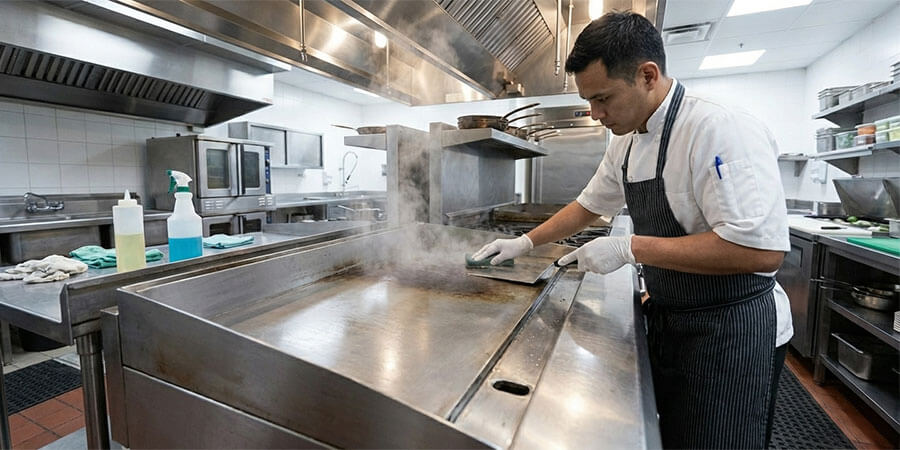
Table of Contents
Step-by-step griddle cleaning instructions, maintenance schedules, and seasoning tips for commercial kitchens
A properly cleaned griddle ensures even heat distribution, prevents flavor transfer between foods, and extends equipment life. Clean your griddle after every service shift using a scraper, water, and cloth. Deep clean weekly with a grill brick or griddle pad. Season steel griddles with oil after each cleaning to prevent rust and maintain nonstick properties. Chrome griddles require gentler cleaning to protect the plated surface.
Commercial griddles see heavy use throughout service. Eggs, bacon, pancakes, burgers, and sandwiches leave behind grease, food particles, and carbonized residue that builds up quickly. Without proper cleaning, this buildup creates hot spots, causes food to stick, transfers unwanted flavors, and eventually damages the cooking surface.
Regular cleaning takes 10-15 minutes after each shift and keeps your griddle performing at its best. This guide covers daily cleaning, deep cleaning, seasoning, and special care for chrome griddles.
Why Griddle Cleaning Matters
Neglecting griddle cleaning creates problems that affect food quality, equipment lifespan, and kitchen safety:
- Uneven heating: Grease and carbon buildup insulates portions of the griddle, creating hot and cold spots
- Food sticking: Carbonized residue and damaged seasoning cause food to stick and tear
- Flavor transfer: Yesterday's fish residue affects today's pancakes
- Shortened equipment life: Grease buildup leads to corrosion and surface pitting
- Fire hazard: Accumulated grease near burners increases fire risk
- Health code violations: Visible buildup fails health inspections
A clean griddle heats evenly, releases food cleanly, and produces consistent results shift after shift.
Tools and Supplies Needed
Gather these items before you begin:
Essential Tools:
- Griddle scraper (metal for steel griddles, plastic for chrome)
- Grill brick or pumice stone (for steel griddles only)
- Griddle pads or screens (abrasive cleaning pads)
- Clean cloths or towels
- Squeeze bottle for water
- Heat-resistant gloves
Supplies:
- Cooking oil (vegetable, canola, or shortening for seasoning)
- Commercial griddle cleaner (optional, for deep cleaning)
- Paper towels
Optional Time-Savers:
- Grill & griddle release sheets - PTFE sheets that prevent sticking and reduce cleaning time
- Griddle cover (protects surface when not in use)
Shop cleaning accessories:
- Grill & Griddle Accessories - Scrapers, brushes, pads, and screens
How to Clean a Commercial Griddle: Daily Cleaning (6 Steps)
Perform this cleaning routine after every service shift while the griddle is still warm. A warm griddle (around 300-350F) makes cleaning easier because grease and residue haven't fully hardened.
Step 1: Scrape the Surface
Using a metal griddle scraper, push all food debris, grease, and carbonized bits toward the grease trough. Work in long, overlapping strokes from the back of the griddle to the front.
Scraping tips:
- Hold the scraper at a 30-45 degree angle for best results
- Apply firm, consistent pressure
- Overlap each stroke to avoid leaving strips of residue
- Push debris into the grease trough, not off the sides
Step 2: Add Water to Loosen Residue
Squirt water onto the warm griddle surface. The water will steam and help loosen stuck-on food and grease. Use enough water to create steam across the entire surface, but don't flood the griddle.
Important: Never pour cold water onto a very hot griddle (above 400F). The thermal shock can warp the cooking surface. Let the griddle cool to 300-350F first.
Step 3: Scrub with a Griddle Pad
Place a griddle pad or screen on the wet surface. Using your scraper or a pad holder, scrub the entire surface in circular motions. The combination of water, heat, and abrasion removes remaining grease and light carbon buildup.
For stubborn spots, let the water and heat work for 30-60 seconds before scrubbing again.
Step 4: Scrape and Wipe Clean
Scrape the loosened residue and dirty water toward the grease trough. Then wipe the surface clean with a dry cloth or paper towels.
Repeat steps 2-4 if the surface still shows residue. A clean griddle should appear uniform in color with no visible buildup.
Step 5: Season the Griddle
While the griddle is still warm, apply a thin layer of cooking oil across the entire surface. Use a cloth or paper towel to spread the oil evenly.
Seasoning creates a protective layer that:
- Prevents rust and corrosion
- Provides a nonstick cooking surface
- Protects the steel from moisture damage
Use high smoke point oils like vegetable oil, canola oil, or shortening. Avoid olive oil and butter, which have lower smoke points and can leave residue.
Step 6: Clean the Grease Trough
Remove and empty the grease trough. Wipe it clean with a paper towel or wash with soap and water if heavily soiled. Replace it before the next service.
Dispose of grease properly. Never pour grease down drains. Collect in a grease container for proper disposal or recycling.
Deep Cleaning a Commercial Griddle (Weekly)
Perform a deep cleaning weekly, or more often if your griddle sees heavy use. Deep cleaning removes carbonized buildup that daily cleaning misses.
When to Deep Clean
- Weekly as part of regular maintenance
- When you notice uneven heating or hot spots
- When food starts sticking despite regular seasoning
- Before your health inspection
- When switching between very different menu items (fish to breakfast, for example)
Deep Cleaning Steps
1. Heat the griddle to 300-350F
A warm surface makes cleaning easier, but not so hot that it's dangerous to work with.
2. Apply griddle cleaner (optional)
Commercial griddle cleaners break down heavy grease and carbon. Apply according to manufacturer instructions. Let it work for the recommended time (usually 5-10 minutes).
3. Scrub with a grill brick
For steel griddles, a grill brick (pumice stone) removes heavy carbon buildup. Work in small circular motions, applying moderate pressure. The brick will wear down as it removes buildup.
Do not use grill bricks on chrome griddles. They will scratch and damage the chrome plating.
4. Scrape and rinse
Scrape all residue toward the grease trough. Rinse with clean water and wipe dry.
5. Repeat if necessary
Heavily soiled griddles may need multiple passes. Continue until the surface appears clean and uniform.
6. Season thoroughly
Apply a generous coat of oil and let it heat until it smokes slightly, then wipe off excess. This rebuilds the seasoning layer removed during deep cleaning.
How to Season a Commercial Griddle
Proper seasoning creates a polymerized oil layer that protects the steel and provides nonstick properties. A well-seasoned griddle is easier to clean and produces better cooking results.
When to Season
- After every cleaning (light seasoning)
- After deep cleaning (full seasoning)
- When food starts sticking
- On new griddles before first use
Seasoning Steps
1. Clean the griddle thoroughly
Seasoning only works on a clean surface. Any residue will be sealed under the oil layer.
2. Heat to 350-400F
The griddle needs to be hot enough to polymerize the oil but not so hot that it smokes immediately.
3. Apply a thin layer of oil
Pour a small amount of high smoke point oil onto the surface. Spread evenly with a cloth or paper towels, using heat-resistant gloves.
4. Let it smoke, then wipe
Allow the oil to heat until it begins to smoke lightly (about 10-15 minutes). Wipe off excess oil with a clean cloth.
5. Repeat for new griddles
New griddles or heavily stripped surfaces benefit from 2-3 seasoning cycles to build up a proper layer.
Best Oils for Seasoning
| Oil Type: | Smoke Point: | Notes: |
| Flaxseed oil | 225F | Best for building durable seasoning, but more expensive |
| Vegetable oil | 400-450F | Most common choice, readily available |
| Canola oil | 400F | Good balance of cost and performance |
| Shortening | 360F | Traditional choice, creates good seasoning |
| Grapeseed oil | 420F | High smoke point, neutral flavor |
Avoid olive oil (low smoke point) and butter (burns easily, leaves residue).
Chrome Griddle Care
Chrome-plated griddles require different cleaning methods than steel griddles. The chrome surface is harder and more nonstick than steel, but it can be damaged by abrasive cleaning.
What NOT to Use on Chrome Griddles
- Grill bricks or pumice stones (scratches chrome)
- Metal scrapers (use plastic instead)
- Abrasive pads or steel wool
- Harsh chemical cleaners
Chrome Griddle Cleaning Steps
1. Let the griddle cool slightly
Chrome griddles clean best at 300-350F. Cooler than steel griddles to prevent water from flashing to steam too quickly.
2. Wipe with a damp cloth
Most residue comes off chrome with just a damp cloth. The smooth surface releases food more easily than steel.
3. Use a plastic scraper for stuck-on food
For stubborn spots, use a plastic scraper designed for chrome surfaces. Metal scrapers will scratch and damage the plating.
4. Clean with mild detergent if needed
For grease buildup, use a mild dish soap solution. Rinse thoroughly and wipe dry.
5. Polish with a soft cloth
Chrome griddles don't need seasoning like steel. Instead, polish with a clean, dry cloth to restore shine.
Chrome vs. Steel Griddles
| Feature: | Steel Griddle: | Chrome Griddle: |
| Nonstick | Requires seasoning | Naturally nonstick |
| Cleaning | Grill brick, metal scraper | Soft cloth, plastic scraper |
| Seasoning | Required after each cleaning | Not required |
| Heat distribution | Even when seasoned | Slightly faster heat transfer |
| Durability | Very durable | Chrome can chip or peel if damaged |
| Cost | Lower | Higher |
| Best for | High-heat searing, heavy use | Delicate foods, easy cleaning |
Griddle Maintenance Schedule
Follow this schedule to keep your griddle in optimal condition:
| Task: | Frequency: | Notes: |
| Scrape surface | During service | Between different food items |
| Daily cleaning (6 steps above) | After every shift | While griddle is warm |
| Season with oil | After every cleaning | Prevents rust, maintains nonstick |
| Empty grease trough | Daily | Dispose of grease properly |
| Deep cleaning | Weekly | More often for heavy use |
| Inspect for damage | Weekly | Check for warping, hot spots, rust |
| Check thermostat accuracy | Monthly | Use infrared thermometer |
| Professional inspection | Annually | For gas lines, burners, controls |
Troubleshooting Common Griddle Problems
Food Sticks to the Griddle
Causes:
- Inadequate seasoning
- Griddle too hot or too cold
- Carbon buildup creating rough spots
- Damaged cooking surface
Solutions:
- Deep clean and re-season the griddle
- Verify thermostat accuracy with an infrared thermometer
- Use appropriate cooking temperature for the food
- Check for surface damage that may need repair
Uneven Heating or Hot Spots
Causes:
- Grease buildup insulating portions of the surface
- Warped griddle plate
- Burner issues (gas griddles)
- Heating element problems (electric griddles)
Solutions:
- Deep clean to remove buildup
- Check for warping by placing a straightedge across the surface
- Have burners or elements inspected by a technician
Rust Spots Appearing
Causes:
- Inadequate seasoning after cleaning
- Water left on surface
- Storing griddle in humid environment
- Chrome plating damage (chrome griddles)
Solutions:
- Always season immediately after cleaning
- Wipe completely dry before seasoning
- Use a griddle cover when not in use
- For rust spots, scrub with grill brick, rinse, and re-season thoroughly
Griddle Smokes Excessively
Causes:
- Too much oil applied during seasoning
- Carbonized grease buildup
- Oil residue in grease trough
Solutions:
- Apply thinner oil layers when seasoning
- Deep clean to remove carbon buildup
- Clean grease trough thoroughly
Using Release Sheets to Reduce Cleaning Time
Grill and griddle release sheets create a nonstick barrier between food and the cooking surface. These PTFE-coated sheets are especially useful for clamshell griddles, panini presses, and high-volume operations.
Benefits of Release Sheets
- Faster cleaning: Food doesn't contact the griddle surface directly
- Less buildup: Grease and carbon don't accumulate as quickly
- Equipment protection: Reduces wear on cooking surfaces
- Consistent results: Prevents sticking without extra oil
When to Use Release Sheets
- Clamshell griddles and panini presses (top plate)
- High-volume sandwich operations
- Cooking delicate items that stick easily
- When you need to minimize cleanup time between orders
Release sheets are reusable and can be wiped clean between uses. Replace when they show wear or no longer release food cleanly.
Frequently Asked Questions
How often should I clean my commercial griddle?
Clean your griddle after every service shift using the 6-step daily cleaning process. This takes 10-15 minutes and prevents buildup from hardening. Deep clean weekly with a grill brick to remove carbonized residue that daily cleaning misses.
Can I use water on a hot griddle?
Yes, but let the griddle cool to 300-350F first. Water on a very hot griddle (above 400F) can cause thermal shock that warps the cooking surface. At 300-350F, water creates steam that helps loosen residue without damaging the griddle.
What is the best way to season a commercial griddle?
After cleaning and drying, apply a thin layer of high smoke point oil (vegetable, canola, or shortening) while the griddle is warm (350-400F). Let the oil heat until it smokes lightly, then wipe off excess. This creates a polymerized layer that prevents rust and provides nonstick properties.
How do I clean a chrome griddle without scratching it?
Never use grill bricks, metal scrapers, or abrasive pads on chrome griddles. Instead, wipe with a damp cloth while warm. For stubborn residue, use a plastic scraper designed for chrome surfaces. Clean with mild dish soap if needed, rinse thoroughly, and polish with a soft dry cloth.
Why does food stick to my griddle even after seasoning?
Food sticking usually indicates inadequate seasoning, carbon buildup, or incorrect temperature. Deep clean the griddle to remove any buildup, re-season with 2-3 coats of oil, and verify your cooking temperature with an infrared thermometer. Griddles that are too hot or too cold both cause sticking.
How do I remove rust from a steel griddle?
Scrub rust spots with a grill brick or pumice stone until the rust is removed. Rinse the area with water and wipe dry. Apply multiple coats of seasoning oil, heating between each coat, to rebuild the protective layer. Regular seasoning after each cleaning prevents rust from forming.
What temperature should I clean my griddle at?
Clean at 300-350F for both steel and chrome griddles. This temperature keeps grease soft enough to remove easily but is cool enough to work safely. Never scrape a cold griddle (residue is too hard) or a very hot griddle (risk of burns and warping from cold water).
How do I dispose of griddle grease properly?
Never pour grease down drains. Collect used grease in a heat-safe container and dispose through a licensed grease hauler or recycling service. Many areas have cooking oil recyclers that accept restaurant grease. Keep disposal receipts for health department records.
Related Guides
- Commercial Griddle Buying Guide - Choose the right griddle for your operation
- Commercial Cooking Equipment Guide - Overview of all cooking equipment types
Shop Commercial Griddles and Accessories
Keep your griddle clean and performing at its best:
- Commercial Grills & Griddles - Full selection of griddles and grills
- Countertop Gas Griddles - Gas-powered countertop griddles
- Countertop Electric Griddles - Electric countertop griddles
- Teppanyaki & Drop-In Griddles - Built-in and display griddles
- Grill & Griddle Accessories - Scrapers, brushes, pads, and cleaning tools
- Grill & Griddle Release Sheets - PTFE sheets for easier cleaning
Share This!