Gas Fryers vs Electric Fryers: Which Is Right for Your Commercial Kitchen?
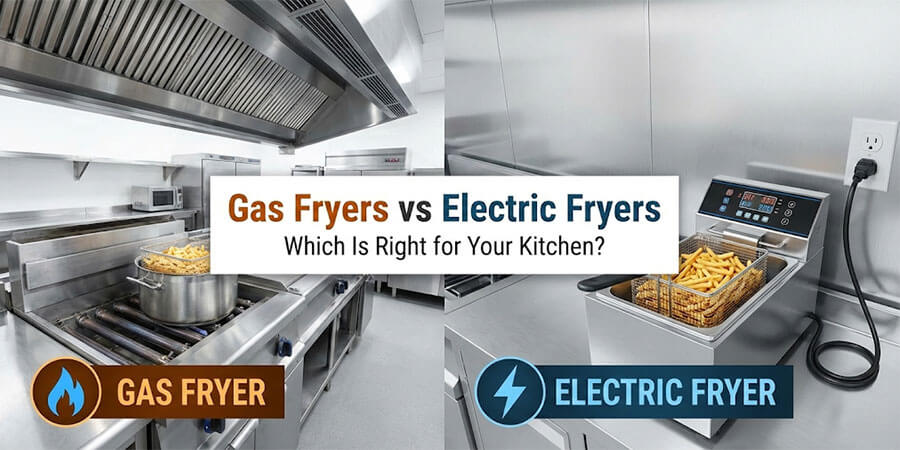
Table of Contents
A practical breakdown of how each fryer type performs so you can make the right call for your operation
Choosing between a gas and electric commercial fryer comes down to your kitchen's infrastructure, volume demands, and energy setup. This post breaks down how each type works, where each excels, and what to consider before you buy.
Fryers are one of the hardest-working pieces of equipment in any commercial kitchen. They're also one of the most energy-intensive - and the choice between gas and electric affects everything from your utility bills to your hood requirements to how fast you can recover between batches.
Neither type is universally better. The right answer depends on your kitchen's infrastructure, your menu, and how you operate. This post walks through the key differences so you can make a clear-eyed decision.
How Each Type Works: The Heating Fundamentals
Understanding the mechanics helps explain why gas and electric fryers behave differently in practice.
Gas fryers use burners positioned below or alongside the fry pot. Heat transfers through the pot walls and, in tube-style designs, through submerged heat exchanger tubes running through the oil. The combustion process generates significant heat quickly, which is why gas fryers are known for fast recovery after loading cold product.
Electric fryers use resistive heating elements submerged directly in the oil. Because the elements are in direct contact with the oil, heat transfer is highly efficient - there's no combustion byproduct to exhaust, and less heat escapes into the surrounding kitchen environment. That direct contact also gives electric fryers more precise temperature control.
Fryer Styles: Open Pot, Tube, Flat Bottom, and Ribbon
The gas vs. electric decision intersects with fryer style, and it's worth knowing the difference:
Open pot fryers have a simple, open fry pot with no internal tubes. They're easy to clean and work well for light-breaded or battered foods. Most electric fryers use this design. Tube fryers run heat exchanger tubes through the bottom of the fry pot. The "cold zone" below the tubes catches sediment and protects oil quality. These are common in gas fryer models and well-suited for breaded proteins that shed crumbs.
- Flat bottom fryers have a flat heating surface and are designed for delicate items like donuts or tortilla chips that float.
- Ribbon element fryers use a ribbon-shaped electric element for more even heat distribution across the pot floor.
Matching the fryer style to your menu matters as much as the fuel type. For a deeper look at fryer styles and sizing, the Commercial Fryer Buying Guide covers both in detail.
Performance: Heat-Up, Recovery, and Temperature Control
Day-to-day performance is where operators feel the difference most.
Heat-up time is comparable between the two types. According to the Department of Energy's Federal Energy Management Program (December 2023), most commercial fryers - gas or electric - preheat in under 15 minutes. The gap that used to favor gas has narrowed considerably with modern electric designs.
Recovery time after loading cold product is where gas fryers traditionally have an edge. High-BTU gas burners can restore oil temperature quickly between batches, which matters in high-volume operations where the fryer rarely gets a break. Electric fryers have improved here, but a gas fryer with a large burner output still recovers faster under sustained load.
Temperature precision favors electric. Because the heating element is submerged in the oil and responds directly to a thermostat, electric fryers hold tighter temperature windows. That consistency shows up in product quality - less variation in cook times and color across a shift.
One often-overlooked stat: fryers are actively cooking only about 25% of their operating time, spending the other 75% at idle (DOE FEMP, December 2023). That idle period is where energy efficiency differences really add up, which brings us to the next section.
Energy Efficiency: What the Numbers Actually Show
This is where the comparison gets specific - and where ENERGY STAR data is worth knowing.
To earn ENERGY STAR certification, electric fryers must meet a cooking efficiency of at least 83%. Gas fryers must meet at least 50% (EPA/ENERGY STAR, current). That gap reflects the fundamental physics: electric heating is more direct, with less energy lost to exhaust and ambient heat.
ENERGY STAR certified gas fryers are approximately 30% more efficient than standard gas models. Certified electric fryers are approximately 17% more efficient than standard electric models (EPA/ENERGY STAR, current). So upgrading from a standard gas fryer to a certified one delivers a bigger relative efficiency gain than the same upgrade on the electric side.
For idle energy use, ENERGY STAR sets maximum rates of 9,000 Btu/hr for gas fryers and 800 watts for electric fryers (EPA/ENERGY STAR, current). Electric fryers idle at a fraction of the energy draw.
Annual consumption figures from the DOE FEMP (December 2023) for ENERGY STAR fryers processing 150 lbs of food per day: electric fryers consume approximately 15,063 kWh per year, while gas fryers consume approximately 1,090 therms per year. Converting those to comparable units depends on your local utility rates - but the raw consumption figures show that gas fryers use a different energy currency entirely, which is why the comparison isn't as simple as "electric uses less."
Gas vs. Electric Fryer Comparison at a Glance
| Factor: | Gas Fryer: | Electric Fryer: |
| Cooking efficiency (ENERGY STAR minimum) | ≥50% | ≥83% |
| Idle energy draw (ENERGY STAR max) | ≤9,000 Btu/hr | ≤800 watts |
| Heat-up time | Under 15 min | Under 15 min |
| Recovery speed | Faster under high volume | Good; slower under sustained load |
| Temperature precision | Good | Excellent |
| Ventilation required | Yes - exhaust hood required | May qualify for ventless setup |
| Infrastructure needed | Gas line + hood | Adequate electrical service |
| Best fryer style pairing | Tube fryers common | Open pot common |
| Ideal for | High-volume, hood-equipped kitchens | Smaller ops, ventless, precise cooking |
Installation and Infrastructure Requirements
This is often the deciding factor - not performance, but what your building can support.
Gas fryers require a natural gas or propane line with adequate capacity, a properly sized exhaust hood, and makeup air to replace what the hood exhausts. If your kitchen already has gas infrastructure and a hood, adding a gas fryer is straightforward. If you're building from scratch or retrofitting, the hood and gas line installation adds significant complexity.
Electric fryers need adequate electrical service - typically 208V or 240V single-phase or three-phase, depending on the fryer's wattage. In older buildings, the electrical panel may need an upgrade. On the upside, electric fryers may qualify for ventless operation with a built-in filtration system, which opens up locations that can't support a traditional hood. If you're exploring that option, the Ventless Cooking Guide is a good starting point.
Portability is another consideration. Electric fryers are easier to relocate since they don't require a fixed gas connection. That flexibility matters for catering operations, ghost kitchens, or any setup where equipment placement might change.
When to Choose Gas vs. When to Choose Electric
Neither type wins outright. Here's a practical decision framework:
Choose a gas fryer when:
- Your kitchen already has gas lines and a commercial exhaust hood
- You run high-volume service with continuous frying and need fast recovery
- You're frying heavily breaded proteins and want a tube-style fryer's cold zone
- Your local gas rates make gas the more economical fuel source
Choose an electric fryer when:
- You don't have gas infrastructure or want to avoid hood installation
- You need precise temperature control for delicate or specialty items
- You're operating in a ventless or limited-ventilation environment
- Your volume is moderate and recovery speed isn't a primary concern
- You're setting up a satellite kitchen, food truck, or catering operation
If you're still working out the right capacity for your operation, the post on what size commercial fryer your kitchen needs walks through the volume math.
Maintenance Considerations
Both fryer types require consistent maintenance, but the specifics differ.
Gas fryers have burners and ignition components that need periodic inspection. Burner ports can clog with grease and debris, affecting flame quality and efficiency. The exhaust system - including the hood and filters - requires regular cleaning. Tube-style gas fryers have more surface area inside the pot, which means more thorough boil-outs to keep the tubes clean.
Electric fryers have fewer combustion components to maintain, but the heating elements themselves can fail and require replacement. Sediment buildup around elements can reduce efficiency and shorten element life, so regular boil-outs matter here too.
Oil management is critical for both types. Fryers spend 75% of their operating time at idle (DOE FEMP, December 2023), and hot oil degrades faster when it's sitting unused. Filtering oil daily and monitoring oil quality extends oil life and protects food quality regardless of fuel type. The Fryer Oil Filtration Guide covers filtration systems and best practices in depth.
For a full maintenance checklist covering both gas and electric fryers, the post on deep fryer maintenance tips is worth bookmarking.
Frequently Asked Questions
Is a gas or electric fryer better for a restaurant?
It depends on your kitchen's setup and volume. Gas fryers recover heat faster under heavy load and work well in kitchens already equipped with gas lines and exhaust hoods. Electric fryers offer better temperature precision, lower idle energy draw, and may work in ventless environments. Neither is universally better - the right choice depends on your infrastructure, menu, and service volume.
Do electric fryers heat up slower than gas fryers?
Not significantly. According to the DOE FEMP (December 2023), most commercial fryers - gas or electric - preheat in under 15 minutes. The bigger difference shows up in recovery time after loading cold product, where high-BTU gas fryers can have an edge in high-volume operations.
What is the difference between an open pot and a tube fryer?
Open pot fryers have a simple, unobstructed fry pot - easy to clean and good for lightly breaded items. Tube fryers run heat exchanger tubes through the bottom of the pot, creating a "cold zone" below the tubes where food particles settle without burning. Tube fryers are better for heavily breaded proteins. Most electric fryers use open pot designs; tube fryers are more common in gas models.
Are electric fryers more energy efficient than gas fryers?
By cooking efficiency percentage, yes. ENERGY STAR requires electric fryers to meet at least 83% cooking efficiency versus 50% for gas fryers (EPA/ENERGY STAR, current). Electric fryers also idle at much lower energy draw - ENERGY STAR caps electric fryer idle at 800 watts versus 9,000 Btu/hr for gas. However, the total energy cost comparison depends on your local utility rates for electricity versus gas.
Can I use an electric fryer without a hood?
Possibly. Some electric fryers are designed for ventless operation with built-in filtration systems that capture grease-laden air without a traditional exhaust hood. Not all electric fryers qualify - you need a unit specifically rated for ventless use and must follow local code requirements. Gas fryers always require exhaust ventilation. See the Ventless Cooking Guide for more detail.
What is an infrared fryer?
Infrared fryers use infrared burners rather than conventional gas burners or electric elements. The infrared technology heats oil more evenly and can improve efficiency compared to standard gas designs. They're less common than conventional gas or electric fryers but worth considering if you're evaluating high-efficiency gas options.
How do I know what size fryer I need?
Fryer sizing is based on the pounds of food you need to fry per hour during peak service. A general rule is that a fryer can process roughly half its oil capacity in food per load. For a detailed breakdown of how to calculate the right capacity for your volume, see the post on commercial fryer sizing.
Related Resources
- Commercial Fryer Buying Guide - Comprehensive guide to fryer types, features, and selection criteria
- Fryer Oil Filtration Guide - How to extend oil life and protect food quality with the right filtration system
- Ventless Cooking Guide - Equipment options for kitchens without traditional exhaust hoods
- What Size Commercial Fryer Does Your Kitchen Need? - Volume-based fryer sizing explained
- Gas vs Electric Griddle: Which Is Best? - The same fuel-type comparison applied to commercial griddles
Share This!