What to Look for in a Commercial Vacuum Cleaner
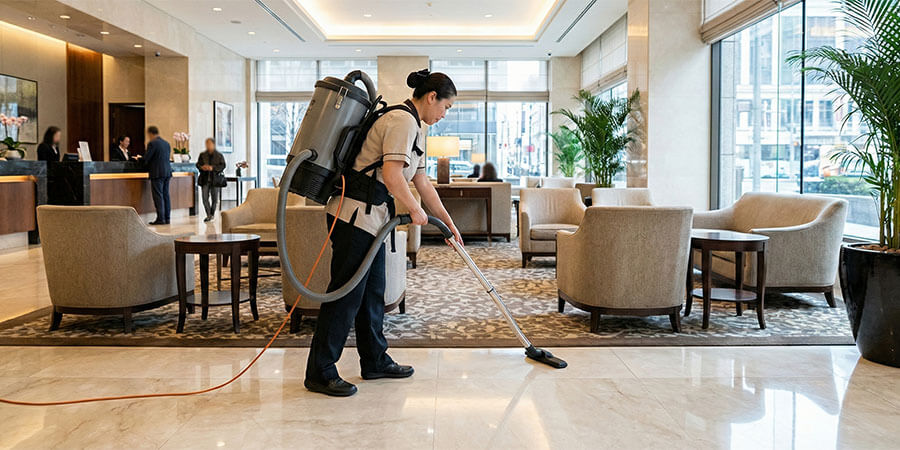
Table of Contents
The right vacuum type, filtration, and certification make a measurable difference in how well your commercial space stays clean
Commercial vacuums are not oversized home appliances - they're purpose-built machines with different types, certifications, and filtration standards designed for daily heavy use. This post covers vacuum types for different commercial environments, HEPA filtration, CRI certification tiers, noise considerations for hospitality, and maintenance practices that extend equipment life.
Cleanliness is not a background detail in hospitality - guests notice it immediately and judge the operation by it. For restaurants, hotels, and commercial kitchens, that starts with your floors. For carpeted dining areas and entry zones, daily vacuuming plus extra passes in high-traffic periods is a practical baseline.
The vacuum you use determines how effectively you clean, how much dirt actually gets removed versus redistributed into the air, and how long the machine itself lasts under commercial demand. Consumer-grade vacuums can wear out quickly in daily commercial duty cycles, while properly maintained commercial models are built for heavier, longer service. Here's what separates the right choice from an expensive mistake.
Matching the Vacuum Type to Your Space
The first decision is vacuum type, and it matters more in a commercial setting than you might expect. Each type has different weight, maneuverability, noise output, and surface capabilities that determine where it performs best.
Upright vacuums are the standard for large, open carpeted areas - dining rooms, conference rooms, hotel lobbies. They clean wide paths efficiently with 12-18 inch cleaning heads but are less maneuverable around table legs and tight corners. Commercial uprights weigh 12-20 pounds with cord lengths of 40-50 feet.
Backpack vacuums are the restaurant and hospitality workhorse. Worn on the back, they distribute their 8-12 pound weight ergonomically and free up both hands for hose and wand control. That makes them dramatically faster in complex environments - around tables, under booths, along stairs, and in tight corridors. Commercial models come with 50-foot cords and specialized restaurant tool kits designed for food service environments.
Canister vacuums roll on the floor while you work with a lightweight wand. They're versatile across hard floors, carpets, and above-floor surfaces like drapes and upholstery. Hotel housekeeping teams and mixed-surface environments benefit most from canisters, which weigh 15-25 pounds and offer strong suction with lower noise than many uprights.
Wet/dry vacuums handle what others can't - liquid spills, post-dishwasher floor water, bar area cleanup, and heavy debris. Their 5-20 gallon tanks make them essential for kitchens and prep areas where moisture is constant. The tradeoff is higher noise, greater weight, and less suitability for routine carpet cleaning.
| Type: | Weight: | Cord Length: | Noise Level: | Best Commercial Use: |
| Upright | 12-20 lbs | 40-50 ft | 67-75 dBA | Large carpeted dining rooms, lobbies |
| Backpack | 8-12 lbs | 50 ft | 69-72 dBA | Restaurants, hotels, tight spaces, stairs |
| Canister | 15-25 lbs | 30-50 ft | 65-75 dBA | Hard floors, hotel rooms, mixed surfaces |
| Wet/Dry | 15-40 lbs | 20-35 ft | 75-85 dBA | Spills, kitchen floors, bar areas |
Browse commercial vacuum cleaners by type to see what's available for your specific environment.
Filtration and Indoor Air Quality
A vacuum that picks up dirt but blows fine particles back into the air isn't actually cleaning - it's redistributing contaminants. In a restaurant, that means food allergens, dust, and bacteria can become airborne during cleaning and settle on surfaces where food is prepared or served.
HEPA filtration captures 99.97% of particles at 0.3 microns - the particle size that's hardest to trap. This standard is defined by the US Department of Energy and verified by the EPA. Particles both larger and smaller than 0.3 microns are actually captured at even higher efficiency, making HEPA the gold standard for indoor air quality during cleaning.
Why this matters in foodservice: Food allergens like peanut proteins, gluten, and shellfish particles travel on fine dust that standard filters pass right through. The CDC estimates 48 million Americans get sick from foodborne illness annually, and restaurants are a leading venue for outbreaks. HEPA filtration prevents your cleaning process from becoming part of the contamination problem. For a deeper look at the difference between cleaning, sanitizing, and disinfecting, each step has specific standards that affect food safety outcomes.
The Sealed System Distinction
A HEPA filter alone isn't enough. If air can leak around the filter through gaps in the vacuum housing, fine particles bypass the filter entirely. Look for vacuums with a sealed filtration system - this means all air entering the machine must pass through the filter before exiting. The distinction between "has a HEPA filter" and "true sealed HEPA" is the difference between a marketing claim and actual filtration performance.
Understanding CRI Certification
The Carpet and Rug Institute Seal of Approval program is the carpet industry's independent, science-based certification framework for vacuum cleaners. It tests three things that matter to commercial buyers:
- Soil removal - how much dirt the vacuum actually extracts from carpet under standardized test conditions
- Dust containment - how effectively the vacuum limits fine-particle emissions during operation
- Carpet appearance retention - how well carpet texture and appearance hold up after repeated passes
The Three Tiers
| Tier: | Soil Removal: | What It Means: |
| Bronze | Baseline pass | Entry-level commercial; passes all three tests |
| Silver | Higher than Bronze | Mid-range commercial; better cleaning per pass |
| Gold | Highest performance | Best cleaning effectiveness; ideal for high-traffic hospitality |
Why CRI matters for commercial buyers: A Gold-certified vacuum is independently verified to remove more soil per pass while controlling fine-particle emissions. For restaurants and hotels where guest perception of cleanliness directly affects revenue, that third-party verification is worth seeking out. CRI certification is often used as one input in LEED-oriented cleaning programs, alongside low-noise and filtration criteria.
Noise Levels and Daytime Cleaning
Noise is a practical constraint that limits when and where you can vacuum. In a hotel, vacuuming at 80 dBA outside a guest room is a complaint waiting to happen. In a restaurant, running a loud wet/dry vac during service ruins the dining atmosphere.
OSHA sets the legal ceiling at 90 dBA for 8-hour exposure (29 CFR 1910.95), with an action level of 85 dBA that triggers mandatory hearing conservation programs. Most commercial vacuums operate well below these limits, but the differences between types still matter operationally.
A practical daytime target is 70 dBA or below - roughly equivalent to the volume of a normal conversation. Vacuums in this range are commonly preferred for daytime hospitality cleaning because they reduce disruption for guests and staff. At 68-70 dBA, a commercial upright or backpack vacuum can operate during early service prep or late checkout with less disturbance.
How vacuum types compare on noise:
- Uprights and backpacks in the 67-72 dBA range are suitable for daytime use in most hospitality settings
- Canisters vary widely from 65-75 dBA depending on motor design and sound insulation
- Wet/dry vacuums at 75-85 dBA are best reserved for kitchen hours or post-close cleanup when noise isn't a concern
If you vacuum during business hours - and most commercial operations do - noise level should be a primary specification in your buying decision, not an afterthought.
Durability and Maintenance
Commercial vacuums face demands that consumer machines aren't built for. Daily use across thousands of square feet, exposure to food debris and moisture, and the inevitable rough handling of a busy kitchen or housekeeping crew all take their toll. A well-maintained commercial vacuum can provide years of reliable service under these conditions, while a poorly matched or neglected machine fails much sooner.
Bag vs. bagless is a bigger decision in commercial settings than residential:
| Factor: | Bagged: | Bagless: |
| Filtration hygiene | Dust stays sealed during disposal | Emptying releases a cloud of fine particles |
| Allergen containment | Better for allergy-sensitive environments | Re-releases allergens on emptying |
| Ongoing cost | Bag replacement (recurring) | No bag cost, but filter replacement required |
| Commercial preference | Growing in hospitality and healthcare | More common in residential settings |
| Emptying protocol | Replace when 2/3 full | Empty after each use in commercial settings |
For restaurants and hotels where indoor air quality affects the guest experience, bagged systems provide cleaner disposal and better allergen containment. The recurring cost of replacement bags is a minor operating expense compared to the air quality tradeoff.
Keeping Your Vacuum Running
Consistent maintenance extends equipment life and prevents the gradual performance decline that leads operators to think their vacuum is "wearing out" when it actually just needs service:
- Bags - replace when 2/3 full; overfilling reduces suction and strains the motor
- Filters - check monthly; replace every 3-6 months under heavy commercial use
- Brush rolls - inspect monthly; clear tangled hair and debris; replace bristle strips annually
- Belts - inspect quarterly; replace annually or when slipping
- Hoses - check for blockages after each use in food service environments
One food-service-specific practice that often gets missed: clean and sanitize detachable tools and contact surfaces after use in kitchen areas, and follow the manufacturer's guidance for hose and interior cleaning. Combining vacuuming with the rest of your commercial kitchen cleaning routine helps ensure the vacuum itself does not become a contamination source.
Frequently Asked Questions
What is the best vacuum type for a restaurant?
Backpack vacuums are the most popular choice for restaurants because they're light (8-12 lbs), highly maneuverable around tables and booths, and fast to operate in tight spaces. For large, open dining rooms with wall-to-wall carpeting, an upright vacuum covers more ground per pass. Most restaurants benefit from having both - a backpack for daily detail work and an upright for broad carpet cleaning.
What does CRI certification mean on a vacuum cleaner?
CRI (Carpet and Rug Institute) certification means the vacuum has been independently tested for soil removal effectiveness, dust containment, and carpet fiber preservation. Bronze, Silver, and Gold tiers indicate increasing cleaning performance. A CRI-certified vacuum is verified to clean effectively without damaging carpet or releasing dust back into the air.
Do I need a HEPA vacuum for my restaurant?
HEPA filtration is strongly recommended for any restaurant, especially those serving guests with food allergies. HEPA filters capture 99.97% of particles at 0.3 microns, preventing food allergens and fine dust from being redistributed into the air during cleaning. Look for sealed HEPA systems - not just vacuums with a HEPA filter installed - to ensure air can't bypass the filtration.
How loud are commercial vacuum cleaners?
Most commercial uprights and backpack vacuums operate between 67-72 dBA - roughly the volume of a normal conversation. Wet/dry vacuums are louder at 75-85 dBA. For hotels and restaurants that need to vacuum during business hours, look for models rated at 70 dBA or below, which is the industry benchmark for daytime hospitality cleaning.
How long should a commercial vacuum cleaner last?
Service life depends on duty cycle, environment, and maintenance discipline. Commercial vacuums are designed to outlast consumer units in heavy-use settings because they use sturdier motors, housings, and components. Regular filter and bag changes, brush roll maintenance, and airflow checks are the biggest predictors of long service life.
Should I choose a bagged or bagless commercial vacuum?
For restaurants and hospitality, bagged vacuums are generally the better choice. Bags seal dust and allergens during disposal, preventing the particle cloud that occurs when emptying a bagless canister. The ongoing cost of replacement bags is minimal compared to the air quality and allergen containment benefits, especially in food service environments.
How often should restaurant floors be vacuumed?
Industry best practices recommend vacuuming dining areas at least daily, with additional passes in high-traffic zones like entrances and waiting areas as needed. Using entrance mats at every door significantly reduces the volume of tracked-in dirt that reaches your dining room and kitchen floors.
Related Resources
- Commercial Vacuum Cleaners - Browse commercial vacuums by type, filtration, and features
- Floor Care Equipment and Supplies - Complete selection of commercial floor care equipment
- Entrance and Carpet Floor Mats - Reduce tracked-in dirt and debris at every door
- Commercial Kitchen Cleaning Tips - Practical cleaning practices for commercial kitchens
- Cleaning, Sanitizing, and Disinfecting - Understanding the critical differences between each cleaning step
Share This!