Food Mill vs Food Processor: What Are the Differences?
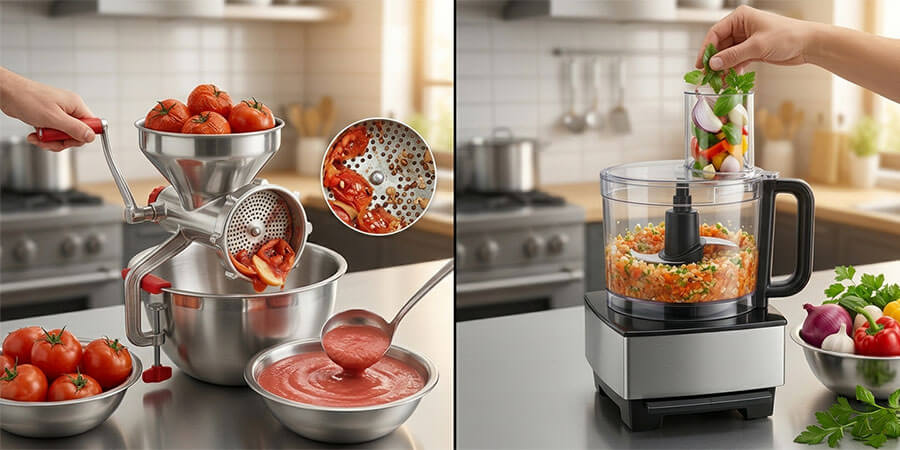
Table of Contents
Choose the right prep tool by comparing how food mills and food processors handle texture, separation, speed, and different kitchen tasks
Food mills and food processors both break food down, but they do not produce the same result and they do not solve the same prep problem. That is exactly why this comparison matters so much. If you choose the wrong one, the issue usually is not power. It is that the tool does not produce the texture or separation you were actually trying to get.
That is also why this page has so much potential. People searching for “food mill vs food processor” are usually not only shopping. They are trying to understand what a food mill actually does, whether a processor can replace it, and what happens when the recipe depends on skins, seeds, smooth puree, or the ability to prep in larger batches.
A Food Mill Separates While It Purees
This is the core difference.
National Center for Home Food Preservation instructions are useful here because they show the food mill doing the exact job it is best known for. In tomato juice and tomato sauce preparation, NCHFP directs cooks to press heated tomatoes through a sieve or food mill to remove skins and seeds. That is a strong functional description of what makes a food mill unique.
| Tool: | Main Job: | Best Known Strength: |
| Food mill | Mashes and presses food through a perforated plate | Purees while separating skins, seeds, or fibrous solids |
| Food processor | Cuts and processes food with rotating blades | Versatility, speed, chopping, mixing, and broader prep tasks |
That separation step is what makes a food mill feel so different in practice. It is not simply reducing food into smaller pieces. It is also filtering the final texture through the disk.
For the deeper product-side overview, Food Mill Guide is the strongest internal companion resource.
A Food Processor Breaks Down Food, But It Does Not Automatically Strain It
A food processor is often the more versatile machine, but that versatility comes from cutting and blending action rather than built-in separation.
That means it is usually better at:
- Chopping vegetables
- Mixing fillings
- Shredding or slicing with attachments
- Pureeing softer mixtures quickly
- Handling broader batch-prep jobs
What it does not automatically do is remove skins or seeds just because it has pureed the food. If you need that kind of separation, you usually need an additional straining step after the processor has done its work.
That is the biggest reason these two tools should not be treated as if they are interchangeable just because both can make something smoother.
Texture Is The Real Decision Point
When people compare food mills and food processors, they often think they are comparing convenience. They are really comparing end result.
| If You Want... | Better First Tool: |
| Smooth puree with skins and seeds removed | Food mill |
| Fast chopping or broad prep versatility | Food processor |
| Chunkier control with attachments | Food processor |
| A mashed or strained finish | Food mill |
This is why a food mill keeps showing up in tomato and puree conversations. It is built to create a smoother finished product while doing some of the separation work at the same time.
Food Mills Usually Win On Tomatoes, Purees, And Similar Jobs
The NCHFP tomato guidance is one of the cleanest practical examples because it reflects exactly what many cooks want from a food mill: puree plus separation.
That makes food mills especially useful for:
- Tomato juice
- Tomato sauce
- Mashed potatoes with a smoother finish
- Applesauce-style work
- Purees where skins, seeds, or fibrous solids are unwanted
The value is not only that the result is smoother. It is that the tool makes the separation step feel more integrated instead of forcing you to puree first and strain second.
That is one reason food mills still matter even in kitchens full of more modern electric prep tools.
Food Processors Usually Win On Versatility And Volume Prep
Food processors matter because they do more jobs well enough to earn counter or prep-table space in a lot of kitchens.
They are commonly chosen when the real need is:
- Chopping onions, herbs, or vegetables quickly
- Shredding or slicing with attachments
- Mixing fillings or spreads
- Blitzing softer mixtures
- Handling prep tasks that are about speed more than refined final texture
This is also why a food processor can look like a better purchase in the abstract. It often feels like the more versatile machine. That can be true, but versatility is not the same thing as being the best at every texture-specific job.
If you are comparing broader prep-equipment choices, the most useful adjacent decisions are whether you need a processor, a blender, or a straining-first tool in the first place.
A Food Processor Is Not The Best Stand-In For A Food Mill When Separation Matters
This is where people often get frustrated. A processor can puree, but once the skins, seeds, or fibrous solids are blended in, they are still there unless you add another step.
That means if your recipe depends on a cleaner, more strained finish, the processor may create more work rather than less. The puree can still be usable, but the result is different and the workflow becomes less direct.
This is why the question “Can I use a food processor instead of a food mill?” is best answered with another question: do you care about separation, or only about reducing the food into smaller pieces? If separation matters, the answer is usually no, not cleanly.
Meat Grinding Questions Need A Different Kind Of Caution
Search behavior around this topic often blends together food mills, food processors, and meat grinding. That is where the comparison needs to stay careful.
NCHFP guidance on ground or chopped meat is useful because it reminds us that meat handling is its own food-safety workflow - choose fresh, chilled meat, follow safe handling steps, and treat grinding or chopping as a controlled preparation process rather than an improvisation.
That means two things here:
- A food mill is not the tool for grinding meat.
- Meat chopping or grinding should be treated as a different equipment and food-safety decision than puree or straining work.
This distinction matters because a lot of search traffic around food processors and meat grinding is really asking about safe handling and the right tool for the right product, not whether every prep tool should be expected to do everything.
The Cleanup And Workflow Feel Different Too
These tools do not only differ in result. They also differ in how the work feels.
A food mill often feels slower but more purpose-built. It is better when the recipe genuinely needs that strained, pressed finish.
A food processor often feels faster and more efficient for general prep, especially when the kitchen is trying to move through a larger number of tasks in one session.
That means the better choice can change depending on whether the kitchen values:
- One very specific result
- A broader set of prep functions
- Less additional straining work
- Faster overall prep with more versatility
This is also why many kitchens keep both. They are not duplicates. They are answers to different prep questions.
A Food Mill Alternative Still Changes The Result
Some people are really asking whether they can avoid buying a food mill at all. Sometimes they can. But the substitute usually changes the workflow or the texture.
That is why substitutes should be thought of as workarounds, not perfect equivalents. A blender, processor, sieve, ricer, or strainer may get you somewhere close depending on the recipe, but they do not all produce the same finish.
If substitution is the real question, Food Mill Substitutes Guide is the best internal next step.
The Better Question Is What Finish You Need Most Often
If the kitchen regularly needs smooth tomato work, sauces, fruit purees, or potato-style mashed textures with natural separation, a food mill has a very clear place.
If the kitchen regularly needs chopping, slicing, shredding, mixing, and broader prep flexibility, the food processor usually earns its space more easily.
That is the real choice. Not which tool is more modern or more powerful, but which one creates the result you actually need often enough to justify owning it.
For maintenance and cleanup support, a simple cleaning routine matters just as much as choosing the right texture tool in the first place.
Frequently Asked Questions
What is a food mill used for?
A food mill is mainly used to mash and press food through a perforated plate so the final result becomes smoother while skins, seeds, or fibrous solids are left behind. It is especially useful for sauces, tomato work, purees, and similar jobs where separation matters.
Is a food mill the same as a food processor?
No. A food processor uses blades to chop, puree, shred, or mix food, while a food mill presses food through a disk and naturally separates some unwanted solids at the same time. They may both make food smoother, but they do not create the same result.
Can I use a food processor instead of a food mill?
Sometimes, but only if you do not need the food mill's separation effect. A processor can puree food, but it does not automatically remove skins or seeds. If the recipe depends on that cleaner finish, the substitution usually creates extra work or a different result.
What works better for tomato sauce - a food mill or a food processor?
A food mill is usually the cleaner fit when you want smoother tomato sauce with skins and seeds removed as part of the process. NCHFP tomato instructions specifically use a sieve or food mill step for that kind of result.
Can a food mill grind meat?
No. A food mill is not the right tool for grinding meat. Meat grinding or chopping is a separate food-safety and equipment question, and if that is the real task, it should be handled with the right tool and proper food-safety care.
What is the biggest difference between a food mill and a food processor?
The biggest difference is separation. A food mill purees while removing some solids like skins and seeds. A food processor is more versatile for prep, but it breaks food down without automatically straining it.
Related Resources
- Food Mills & Accessories - Category page for food mills and related accessories.
- Commercial Food Processors - Category page for processor formats and capacities.
- Commercial Blender Buying Guide - Helpful for adjacent puree and blending decisions.
- How Do You Clean a Food Mill - Practical maintenance support if you already own one.
Share This!