Air Curtain Merchandisers for Grab-and-Go
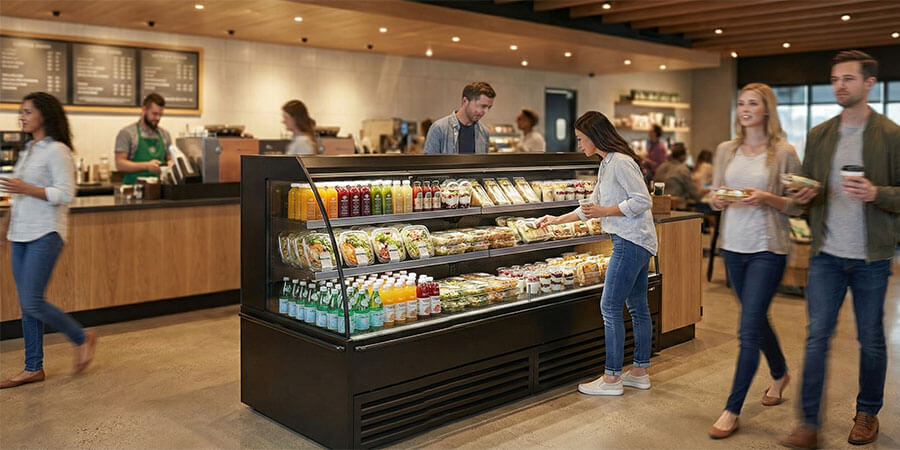
Table of Contents
Use open-air merchandising the right way: better visibility and faster shopping without sacrificing product quality or daily workflow
Open-air merchandisers can increase impulse buys because customers can grab items quickly. This post explains when they work best, how to stock them, and how to avoid common performance mistakes.
At its core, an air curtain merchandiser is a refrigerated display that stays open to the customer. Instead of a door, it uses a controlled flow of cold air at the opening to help keep product at temperature.
That open design is the entire point: better visibility and faster shopping. But it also creates new operational requirements. If you stock it poorly or place it in the wrong spot, performance drops and product quality suffers.
This post focuses on practical use. If you are comparing refrigeration display formats in general, start with the Merchandising Refrigeration Guide.
Air Curtain Merchandiser vs "Air Curtain" at the Door
Some searches use the term "air curtain" to mean an air door at the entrance. That is different equipment.
- Air curtain merchandiser: open refrigerated display for packaged grab-and-go
- Commercial air curtain (air door): airflow barrier for doors and entrances
If your goal is entry protection for a cafe or storefront, use the Commercial Air Curtain Buying Guide instead.
What Air Curtain Merchandisers Are Best For
Air curtain merchandisers work best for:
- Packaged drinks and sealed items
- Pre-wrapped grab-and-go foods
- Fast-turn products where customers want to browse quickly
They are generally not the right choice for items that need tight temperature stability with frequent long browsing time.
What to Stock (and What Not to Stock)
Air curtain merchandisers are built for quick shopping, not long holding.
Best matches:
- Sealed beverages
- Packaged snacks
- Pre-wrapped grab-and-go that turns quickly
Riskier matches:
- Items that dry out or soften when exposed
- Items that require very tight temperature control while guests browse
When in doubt, use open-air for the fastest-turn packaged items and use an enclosed merchandiser for everything else.
If you are trying to decide whether you should use open-air at all, start by browsing the Air Curtain Merchandisers category and compare it against glass door options.
Why Open-Air Visibility Can Increase Sales
Open-air cases reduce friction. Customers can see the product instantly and take it without opening a door.
The operational benefit is speed: faster decisions and faster checkout flow.
If you want to improve display fundamentals across multiple equipment types, Food Display Cases: How to Choose the Right One is a helpful reference.
Placement and Environment Matter More Than People Expect
Where you place an air curtain merchandiser can decide whether it performs well.
Avoid:
- Direct HVAC vents blowing into the opening
- Exterior doors with frequent warm air exchange
- High-heat equipment nearby
- Traffic patterns where customers linger and block airflow
If you need a "grab and go" effect, place the case where customers naturally pause to decide, not where they cluster.
If your location has high door traffic and you are also considering entrance air doors, Commercial Air Curtains is a helpful category to understand that separate solution.
Seasonal Reality: Open-Air Performs Differently in Summer
Open-air cases are more sensitive to warm, humid conditions.
Practical steps that help:
- Tighten restock staging so the opening is not exposed longer than necessary
- Use shorter hold windows for the most sensitive items
- Keep the warmest shelf as a fast-turn section
The point is not to fight physics. The point is to operate the case within its strengths.
Rotation and Restock: How to Keep "Fresh" Looking Product
Open cases sell with appearance. If the front row looks tired, customers assume the whole case is tired.
Practical habits:
- Rotate from back to front so older product sells first
- Re-face shelves during slow moments
- Restock smaller amounts more often to keep the case looking full
These habits are merchandising, but they also support performance because the case stays within its intended load.
Temperature Checks and Product Policy
Open-air cases can have warmer and colder spots. The operational answer is not guessing. It is checking.
Practical habits that protect you:
- Define a simple temperature check schedule for the case
- Identify the warmest shelf area and treat it as a "fast turn" zone
- Use a clear discard or pull policy when product quality drops
The goal is consistency. If staff are unsure whether something is "still fine," the system needs a clearer rule.
Shrink, Waste, and How Organization Prevents Both
Open-air cases can increase sales, but they can also increase shrink if you do not manage them.
Practical controls:
- Keep a clear "fast turn" section for items that sell quickest
- Avoid filling the case with slow movers just to make it look full
- Pull and reset shelves instead of letting half-empty packaging linger
The best-performing cases look full because they are planned, not because they are overstocked.
Merchandising That Makes the Case Feel Full (Without Overloading)
Customers buy faster when the case feels abundant and organized.
Simple rules:
- Group by intent (drinks together, snacks together, meal items together)
- Put the highest-margin or most popular items at easy reach
- Keep labels facing forward and product aligned
If you need dividers, shelf rails, or display accessories to keep it clean, Air Curtain Merchandiser Accessories is the best starting point.
One practical decision is vertical vs horizontal format. Vertical cases can show more SKUs in a smaller footprint, while horizontal cases can make browsing feel easier in tight cafe lines. The key is to match format to traffic flow so customers can grab quickly without blocking the opening.
If your operation is still experimenting, start with your fastest sellers and expand slowly. A smaller, well-run case usually outperforms a larger, poorly managed one.
Stocking and Facing: The "Full Case" Rule
Air curtain merchandisers tend to perform best when properly stocked.
Key habits:
- Keep items within the load line and do not over-stack
- Face product so customers can scan quickly
- Restock in small batches to reduce warm air exposure
- Rotate consistently so older product sells first
Your goal is a case that looks full without blocking airflow paths.
Stage Restocks to Reduce Temperature Swings
If staff restock by holding the case open while they search for product, the case will struggle.
Simple habits that help:
- Stage product before opening the case area
- Restock one shelf at a time
- Keep a clean, labeled staging spot for backup product
A Comparison Table: Air Curtain vs Glass Door Merchandisers
Use this table to choose the right display style for the job.
| Display Type: | Best For: | Operational Watch-Out: |
| Air curtain merchandiser (open) | Fast-turn, packaged grab-and-go | Sensitive to placement, airflow, and stocking discipline |
| Glass door merchandiser | Longer browsing, better temperature control | Door opening creates its own temperature swings; requires door cleaning and maintenance |
If you are comparing glass door refrigeration, Glass Door Merchandiser Refrigerators is a good starting point.
A Simple Care Schedule Table
| Task: | Frequency: | Why It Matters: |
| Face product and wipe edges | Per shift | Keeps the case selling and signals freshness |
| Clear clutter at opening | Per shift | Protects airflow and temperature stability |
| Clean shelf surfaces | Daily | Prevents residue and odor buildup |
| Deep clean corners and rails | Weekly | Prevents hidden buildup that makes the case look dirty |
| Check lights and signage | Weekly | Visibility is part of the sales lift |
Daily Care: Keep It Selling and Keep It Stable
Air curtain merchandisers fail in predictable ways: fogging, inconsistent cold zones, and messy shelves.
Daily habits:
- Wipe shelves and edges so the case stays visually clean
- Keep the opening clear of packaging and clutter
- Check product rotation and remove anything past its hold limit
Weekly habits:
- Deep clean shelf surfaces and corners
- Confirm lights and signage work (visibility is part of the value)
If you use signage, shelf dividers, or add-ons to keep the case organized, start with Air Curtain Merchandiser Accessories.
Train Staff on One Simple Rule: Don't Break the Air Curtain
Most air curtain problems are caused by well-meaning staff doing "quick" actions that add up.
Train one rule and it fixes multiple issues:
- Do not block the opening with boxes, bags, or staged product
Then reinforce it with habits:
- Restock from a side staging area, not from the floor
- Keep shelves faced so customers do not dig and linger
- Do not overfill past the load line
When staff know what not to do, the case performs better without constant troubleshooting.
When to Choose Glass Door Instead
If customers need longer browse time, or if your product mix includes slower-turn items, glass doors usually create a more stable environment.
Use open-air for fast-turn, sealed grab-and-go. Use glass doors when you need better temperature control and longer hold windows.
Common Mistakes That Hurt Performance
- Treating the case like a storage fridge (overloading and stacking)
- Placing it under vents or near a door
- Letting the case look messy (customers stop trusting freshness)
- Restocking warm product during peak without staging
Most problems improve when you tighten placement, stocking, and restock rhythm.
Frequently Asked Questions
What is an air curtain merchandiser?
It is an open refrigerated display case that uses a controlled curtain of cold air at the opening to help maintain temperature while customers grab items quickly.
Are air curtain merchandisers good for cafes?
They can be, especially for sealed drinks and packaged grab-and-go items. Cafes often benefit because the open design makes browsing fast and keeps lines moving.
Why do air curtain merchandisers work best when stocked?
Proper stocking supports airflow patterns and keeps the case visually appealing. The key is to stay within the load line and avoid over-stacking that blocks airflow.
Where should you place an air curtain merchandiser?
Away from HVAC vents, exterior doors, and heat sources. Placement should support airflow stability and keep customers from lingering directly in front of the opening.
How do you keep an open merchandiser from looking messy?
Face product frequently, use simple dividers or shelf organization, and restock in small batches. A clean, organized case signals freshness.
Should I use an air curtain merchandiser or a glass door merchandiser?
Choose air curtain for fast-turn grab-and-go and maximum visibility. Choose glass door if you need tighter temperature control and longer browsing time.
Related Resources
- Merchandising Refrigeration Guide - Compare display formats and buying considerations
- Air Curtain Merchandisers - Browse common open-air case styles
- Air Curtain Merchandiser Accessories - Add-ons for organization and presentation
- Food Display Cases: How to Choose the Right One - General merchandising principles
- Commercial Air Curtain Buying Guide - Entry air doors (different equipment than refrigerated merchandisers)
- Glass Door Merchandiser Refrigerators - Enclosed merchandiser format for tighter temperature control
Share This!