Tilting Skillet Uses and Benefits
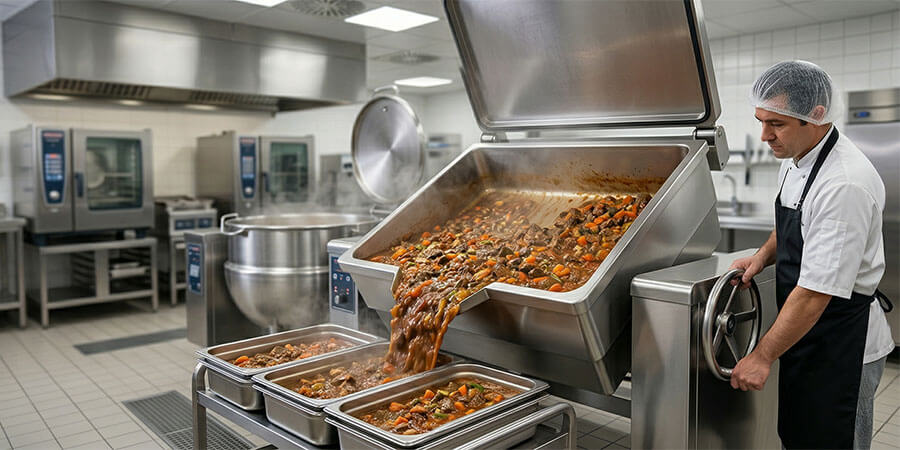
Table of Contents
See where a tilting skillet fits best by comparing its batch-cooking strength, transfer ease, and menu flexibility to the way your kitchen works
A tilting skillet is one of those pieces of equipment that can look highly specialized until you see what it replaces in a busy kitchen. Once you understand the jobs it can handle - braising, sauteing, simmering, griddling, boiling, batch finishing, and easier product transfer - it starts to make more sense why schools, hospitals, cafeterias, correctional kitchens, and some restaurants often use them.
But that does not mean every kitchen needs one. The smarter question is whether the skillet's size, format, and batch-cooking style actually fit your menu and production rhythm. A tilting skillet is at its best when a kitchen is cooking volume, moving product repeatedly, and benefiting from one large piece of equipment that can take on several different jobs without constant pan swapping.
What A Tilting Skillet Actually Is
Tilting skillets are often grouped with braising pans or tilting braising pans. In practical terms, they are large, heated, shallow cooking vessels with a wide pan surface and a mechanism that lets the pan tilt forward for easier pouring, transfer, or cleaning.
That combination matters because it changes how the work feels in a large kitchen. Instead of constantly lifting heavy stockpots or transferring hot product with repeated scooping and repositioning, the operator can cook in one vessel and move product forward more deliberately.
| Equipment Trait: | What It Means In Practice: |
| Wide cooking surface | Better contact area for browning, sauteing, and batch cooking |
| Deep enough for liquids | Useful for braising, simmering, and one-vessel dishes |
| Tilting mechanism | Easier transfer, draining, and cleaning |
| Large batch capacity | Strong fit for volume-oriented production |
This is the core reason people ask what a tilt skillet is used for. It is not only a pan. It is a volume-friendly cooking station that can replace several repetitive steps in the right kitchen.
For the product-side category, Braising Pans & Tilting Skillets are the strongest direct follow-up.
Tilting Skillets Usually Matter Most In Batch Cooking
Tilting skillets earn their value when the kitchen needs to produce larger quantities without turning every recipe into a multi-pot juggling act.
That is why they are often strongest in operations making:
- Large-volume breakfast items
- Braised proteins
- Rice, grains, or pasta-support dishes
- Soups, sauces, or stews in moderate depth
- Batch sauteed vegetables
- Mixed-menu items for cafeterias and institutions
The value is not only volume. It is also fewer handoffs. The more steps that stay inside one piece of equipment, the more consistent the station tends to feel during service or production.
A Tilting Skillet Is Not Just For Braising
One of the biggest misunderstandings about this equipment is that the name “braising pan” makes people think it only does braising.
It can often handle:
- Browning
- Pan-frying
- Griddling-style cooking
- Simmering
- Stewing
- Batch holding for short controlled windows
That range is what gives it real value. In some kitchens, the skillet is not the hero because it does one thing nobody else can do. It is the hero because it does several daily jobs well enough to simplify the line.
| Common Kitchen Task: | Why A Tilting Skillet Can Work Well: |
| Batch braising | Broad heated surface plus liquid capacity |
| Large saute runs | Wide pan area and easier stirring space |
| Breakfast production | Strong fit for volume eggs, potatoes, or protein work |
| Sauce and stew production | One-vessel cooking with easier transfer afterward |
Transfer And Pouring Are A Bigger Advantage Than Buyers Expect
This is one of the real quality-of-life benefits that the old style sales copy usually overhyped without explaining clearly.
The tilt mechanism matters because moving hot product out of a large vessel is one of the more awkward parts of batch cooking. The skillet's ability to tilt changes how the crew handles:
- Product transfer into pans
- Draining
- Sauce movement
- Portioning support during batch production
- Cleaning after heavy use
That does not eliminate normal kitchen caution around hot food. But it can reduce the amount of repeated lifting and awkward repositioning a team has to do compared with relying on separate heavy pots and pans for the same volume.
That workflow change matters more than it sounds on paper. A kitchen may be perfectly capable of producing the same recipe in stockpots or a series of saute pans, but the transfer step is where labor pressure and inconsistency often start showing up. The more often the crew can cook, finish, and move product through one controlled vessel, the smoother the station usually feels.
The Best Fit Is Usually Institutional Or High-Volume Service
This is where tilting skillets usually make the most sense operationally.
They are often a strong fit for:
- Schools
- Hospitals
- Hotels
- Correctional or campus dining
- Banquet and catering production kitchens
- High-volume scratch kitchens with repeatable large-batch menu items
That does not mean restaurants cannot use them well. It means the benefits are easiest to justify when the kitchen repeatedly cooks volume and the skillet can stay busy enough to earn its footprint.
If the kitchen is much tighter or more compact, Choosing Equipment for a Small Commercial Kitchen is a useful comparison read because high-capacity gear still has to fit the room.
Size, Utility, And Footprint Still Decide The Purchase
The biggest mistake with a tilt skillet is assuming that versatility alone justifies it.
The real questions are:
- Do you have enough volume to use it often?
- Does the floor space make sense?
- Will the utility setup support it?
- Is your menu broad enough - or repetitive enough - to make the skillet valuable?
This is where buyers should stay practical. A large piece of multipurpose equipment is still the wrong purchase if it ends up underused or shoved into a workflow that does not actually benefit from it.
It also helps to think about what the skillet would replace on a normal day. If the answer is several repeated pot, pan, and transfer steps, the case gets stronger. If the answer is very little that happens often enough to matter, the skillet can become more impressive on paper than useful on the line.
Tilting Skillets Can Replace Some Tasks, But Not Every Piece Of Equipment
A common buying mistake is expecting one piece of flexible equipment to erase the need for the rest of the line.
Tilting skillets can reduce dependence on:
- Large stockpots
- Multiple saute pans for some batch work
- Some braising vessels
- Certain griddle-style batch tasks
But they do not make the rest of the kitchen irrelevant. You still need the right support around them, including prep flow, pan management, holding, and the right complementary line equipment.
That is one reason they should be evaluated as part of the system rather than as an isolated “miracle” purchase.
For comparison logic around other large-batch cooking tools, How to Choose the Right Steam Kettle is the most useful internal companion.
Cleaning And Reset Are Part Of The Value Equation
Operators often focus on cooking features first, but cleanup and reset matter a lot when a single unit carries several batch-cooking jobs in a day.
The skillet's tilt can help with:
- Emptying product more cleanly
- Draining liquid or grease
- Reaching more of the cooking surface during cleanup
- Resetting between runs more predictably
That matters most in kitchens that need to run multiple batches or meal periods from the same piece of equipment. If the reset takes too long, the versatility starts losing value. If the reset is manageable, the skillet becomes easier to use for more than one job in a shift.
This is one reason operators should think about cleanup access during evaluation rather than only after install. A unit that is technically versatile but awkward to drain, wipe, and reset between batches can still frustrate the team in daily use.
When A Tilting Skillet Usually Makes Sense
| If Your Kitchen Needs... | Tilt Skillet Usually Makes More Sense: |
| Large batch volume | Yes |
| Frequent one-vessel braising or saute work | Yes |
| Easier transfer from vessel to pan | Yes |
| Small line with little unused floor space | Maybe not |
| Highly specialized a la minute cooking only | Usually less so |
This is the real decision frame. A tilting skillet is strongest when it helps a kitchen do repeated batch work more smoothly. It is weaker when the menu or service model never asks it to do enough to justify the footprint.
That is also why the best justification is usually a workflow justification, not a feature justification. If the skillet reduces repeated pan changes, repeated transfers, and repeated lifting in a way the kitchen feels every day, the value becomes much easier to defend.
Frequently Asked Questions
What is a tilting skillet used for?
A tilting skillet is used for large-batch braising, sauteing, simmering, stewing, griddling-style cooking, and easier product transfer. Its value comes from combining a wide heated surface with enough depth and tilt control to handle multiple batch-cooking jobs in one vessel.
Is a tilting skillet the same as a braising pan?
In commercial kitchen language, the two terms are often used very closely. Many operators treat tilting skillets and braising pans as the same general family of equipment because both refer to a large heated vessel designed for batch cooking and easy forward tilt transfer.
What kinds of kitchens benefit most from a tilt skillet?
High-volume kitchens usually benefit most, especially schools, hospitals, hotels, banquet operations, and other facilities producing repeatable large-batch menu items. Some restaurants use them well too, but the value is easiest to justify when the skillet stays busy.
Can a tilting skillet replace other equipment?
It can replace some batch-cooking tasks that would otherwise be spread across stockpots, saute pans, or separate braising vessels, but it does not replace the need for the rest of the line. It works best as part of a broader system.
Why is the tilt feature so important?
The tilt feature makes transfer, draining, and cleanup easier in high-volume cooking. It helps reduce repeated heavy lifting and awkward movement when moving hot product out of the vessel and into pans or service containers.
What is the biggest mistake when buying a tilting skillet?
Assuming versatility alone justifies the purchase. The smarter test is whether the kitchen has the volume, floor space, utilities, and menu pattern to keep the unit busy enough to earn its footprint.
Related Resources
- Braising Pans & Tilting Skillets - Category page for commercial tilting skillets and braising pans.
- How to Choose the Right Steam Kettle - Strong batch-cooking comparison for kitchens evaluating other high-volume vessels.
- Choosing Equipment for a Small Commercial Kitchen - Useful when footprint and production balance are part of the decision.
- Commercial Kitchen Organization Systems - Helpful when batch equipment changes storage, staging, and movement patterns.
Share This!