Commercial Microwave Guide
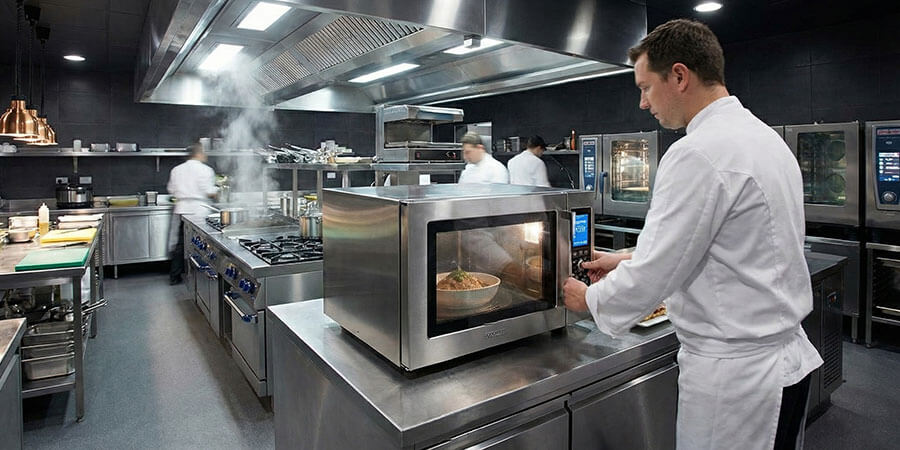
Table of Contents
Speed and efficiency for warming, steaming, and rapid cooking
Commercial microwave ovens are essential tools for speed and efficiency in professional kitchens, far surpassing their residential counterparts in durability, power, and speed. Unlike home models that rely on turntables and lower wattage, commercial microwaves utilize stirrers for even energy distribution and heavy-duty magnetrons designed for continuous use. From quickly steaming vegetables and melting butter to rethermalizing soups and defrosting proteins, these units keep high-volume lines moving. While standard microwaves excel at moist-heat tasks, specialized high-speed rapid cook ovens combine microwave energy with convection or impingement to toast, brown, and crisp food in record time. Categorized by control type (dial vs. push button) and usage duty (light, medium, heavy). They are built without turntables, using motor-driven stirrers to distribute energy evenly, and feature stainless steel interiors for easy sanitation and durability.
Types of Microwaves by Control
The primary distinction for operators is how they interact with the machine. The choice between dial and push-button controls often dictates workflow speed and consistency.
Dial Control Microwaves
Dial control microwaves are the epitome of simplicity. They feature a single rotary timer knob, typically marked in 10-second to 1-minute increments, that operators twist to set the cook time.
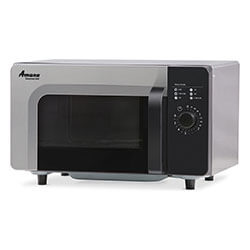
- Best Uses: Break rooms, self-service stations, low-volume kitchens, or tasks with variable times (like melting butter).
- Key Features: Mechanical timer (usually 6-10 minutes max), single power level (usually 100%), rugged durability.
- Pros: Extremely easy to use (no training required), durable mechanism, reliable for basic tasks.
- Cons: Less precise timing (hard to set exactly 15 seconds), no programmable memory, cannot execute multi-stage cooking.
Push Button (Digital) Microwaves
Push button microwaves feature digital keypads that allow for precise time entry and, crucially, programmable menu presets. These units can store specific cook times and power levels for different menu items (e.g., "Button 1 = Breakfast Sandwich").
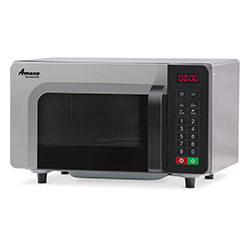
- Best Uses: Fast food chains, busy restaurants, convenience stores, and operations requiring standardized results across multiple locations.
- Key Features: Programmable memory pads, LED displays, multi-stage cooking (e.g., defrost then cook), x2 quantity buttons. Some models feature Braille-enabled touchpads for accessibility.
- Pros: Guarantees consistent results regardless of operator, faster workflow (one-touch start), precise control.
- Cons: Slightly more complex to program initially, higher cost than basic dial models.
Microwave Duty Ratings
Once you've chosen a control style, selecting the right "Duty" rating is critical. Duty ratings are determined by wattage and daily usage volume. Undersizing a microwave leads to slow service and premature component failure.
Light-Duty Microwaves
Light-duty models are designed for occasional use, typically in non-critical environments. They often look similar to residential units but lack the turntable and have commercial certification.
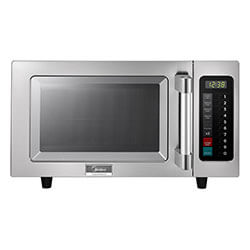
- Wattage: < 1,000 Watts
- Usage: < 50 uses per day
- Best For: Office break rooms, concession stands, waitress stations for warming desserts, low-volume reheating.
- Construction: lighter gauge stainless steel or plastic exterior, single magnetron.
Medium-Duty Microwaves
Medium-duty microwaves are the standard for most general restaurant tasks. They offer faster heating speeds and more robust construction for back-of-house environments.
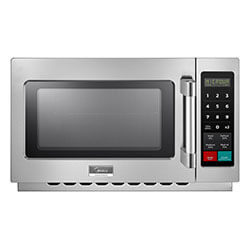
- Wattage: 1,000 - 1,700 Watts
- Usage: 50 - 150 uses per day
- Best For: Cafes, casual dining restaurants, pastry shops, convenience stores.
- Construction: Stainless steel interior/exterior, more durable door latches, better cooling systems for magnetrons.
Heavy-Duty Microwaves
Heavy-duty microwaves are powerhouses built for continuous, rapid-fire operation. They often feature dual magnetrons (top and bottom feeding) for incredibly fast and even heating without the need for stirring.
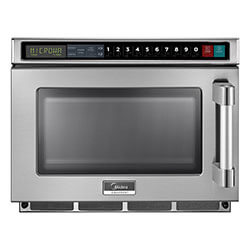
- Wattage: 1,700 - 3,000+ Watts
- Usage: 150+ uses per day (Continuous use)
- Best For: QSR (Quick Service Restaurants), busy steakhouses (steaming veggies), large cafeterias, stadiums.
- Construction: Heavy gauge stainless steel, dual magnetrons, stackable designs, removable air filters, robust metal handles.
High Speed & Rapid Cook Ovens
While technically microwaves, High Speed (or Rapid Cook) Ovens are in a category of their own. They combine microwave energy with other heat sources—usually convection (hot air) and impingement (jet air)—to cook food 10-15x faster than conventional ovens while browning and crisping the exterior.
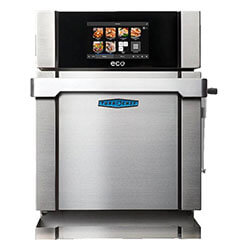
- Technology: Microwave (heats inside) + Impingement/Convection (browns outside).
- Best Uses: Toasting sub sandwiches, baking pizzas in minutes, finishing appetizers, breakfast sandwiches.
- Why Choose This: Standard microwaves make bread soggy; Rapid Cook ovens make it crispy.
- Features: Catalytic converters (often ventless operation), USB menu programming, touchscreen interfaces, metal-cookware compatibility (specific models).
Features & Accessories
Microwave Shelving
Counter space is premium real estate in commercial kitchens. Microwave Shelving is a heavy-duty, wall-mounted solution designed specifically to hold the weight of commercial microwaves (often 40-80+ lbs).
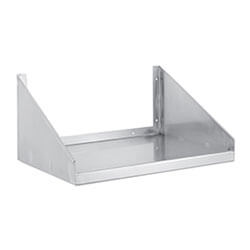
- Construction: 18 or 16-gauge stainless steel.
- Design: Often includes a marine edge to contain spills and a grommet hole for power cord management.
- Benefit: Frees up valuable prep table space while keeping the microwave at a convenient eye-level height.
Programmable Features
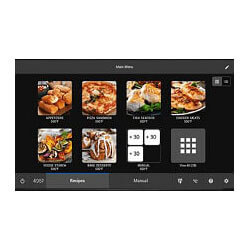
- USB Connectivity: Allows multi-unit chains to program menu settings on a computer and upload them via USB flash drive to ensure consistency across all locations.
- Multi-Stage Cooking: Programmable cycles that change power levels automatically (e.g., high power to defrost, then medium power to heat through).
- Quantity Pad (x2): Automatically adjusts cook time for double portions without guesswork.
Stackability
Many heavy-duty and some medium-duty microwaves are designed with flat tops and reinforced chassis to be stacked two high. This effectively doubles your throughput capacity without increasing the linear footprint on your cookline.
Selecting the Right Microwave
Production Volume
Be honest about your usage. Using a light-duty microwave in a heavy-duty application (like a busy burger chain) will result in slow cook times and a voided warranty when the magnetron burns out from overheating.
- < 50 times/day: Light Duty
- 50-150 times/day: Medium Duty
- 150+ times/day: Heavy Duty
Food Quantity & Chamber Size
Consider the physical size of the food you heat.
- Platters: Requires a wider cavity (0.8 - 1.2 cu. ft.).
- Single Portions/Subs: Compact footprints (0.6 cu. ft.) are sufficient and save space.
- Bulk Steaming: Large capacity heavy-duty steamers (1.6+ cu. ft.) can hold two full-size steam table pans. > Pro Tip: If you need to accommodate full-size 1/1 GN steam table pans, look for microwaves with at least 1.2 cu. ft. capacity. Smaller 0.8 cu. ft. models typically only fit half-size pans.
Electrical Requirements
- Light/Medium Duty: Typically use standard 120V / 15A or 20A plugs (NEMA 5-15P or 5-20P).
- Heavy Duty/High Speed: Often require 208V/240V connections (NEMA 6-20P or 6-30P) to deliver the high wattage output. Always check your kitchen's available voltage and amperage before purchasing.
Installation & Maintenance
Clearance & Airflow
Microwaves generate significant heat during operation.
- Air Intakes: Ensure air vents (usually on the back or sides) are not blocked.
- Clearance: Most manufacturers recommend 2-4 inches of clearance around the sides and top.
- Shelving: If using a microwave shelf, ensure it is deep enough to allow airflow behind the unit.
- Placement Warning: Avoid placing microwaves next to fryers (grease intake) or steamers (moisture intake). Both can clog filters rapidly and corrode internal components.
Filter Cleaning
Heavy-duty microwaves often have removable air filters on the front intake.
- Task: Remove and wash these filters weekly (or daily in greasy environments).
- Why: Clogged filters restrict airflow, causing the magnetron to overheat and fail - a leading cause of service calls.
Interior Cleaning
- Daily: Wipe down spills immediately. Food residue absorbs microwave energy, which can cause "arcing" or burn spots on the interior cavity/ceiling plate.
- Ceiling Plate: Many commercial units have a removable splatter shield on the ceiling; remove and wash this daily to protect the antenna.
Frequently Asked Questions
Can I use a residential microwave in my restaurant?
No. Residential microwaves are not NSF-certified for sanitation, voiding health inspections. They are also not built for commercial duty cycles and will fail quickly, often voiding the manufacturer's warranty if used commercially.
What does "Wattage" mean for cooking?
Wattage equals power. Higher wattage means faster cooking. A 1000W microwave might take 60 seconds to heat a soup; a 2000W unit could do it in 25-30 seconds.
Can I put metal in a commercial microwave?
Generally, no. Metal reflects microwaves and causes arcing. However, some Rapid Cook/High Speed ovens are designed to handle specific metal pans. Always check the operator's manual.
Why don't commercial microwaves have turntables?
Turntables are mechanical failure points. Commercial units use motor-driven stirrers (hidden in the top or bottom) to bounce energy around the cavity, ensuring even heating without moving parts in the food zone.
Do I need a hood for a commercial microwave?
Standard microwaves typically do not require a hood. Rapid Cook ovens usually have catalytic converters allowing them to be "ventless," but local codes vary. Always verify with your local inspector.
Shop Microwaves
- Commercial Microwave Ovens - Full selection of commercial units
- High Speed & Rapid Cook Ovens - For toasting, browning, and speed
- Dial Control Microwaves - Simple, durable operation
- Push Button Microwaves - Programmable consistency
- Microwave Shelving - Wall-mount storage solutions
Related Guides
- Commercial Pizza Oven & Equipment Guide - Overview of all pizza oven types
- Commercial Shelving Guide - Storage solutions for kitchens
Share This!