Adding Crepes to Your Restaurant Menu
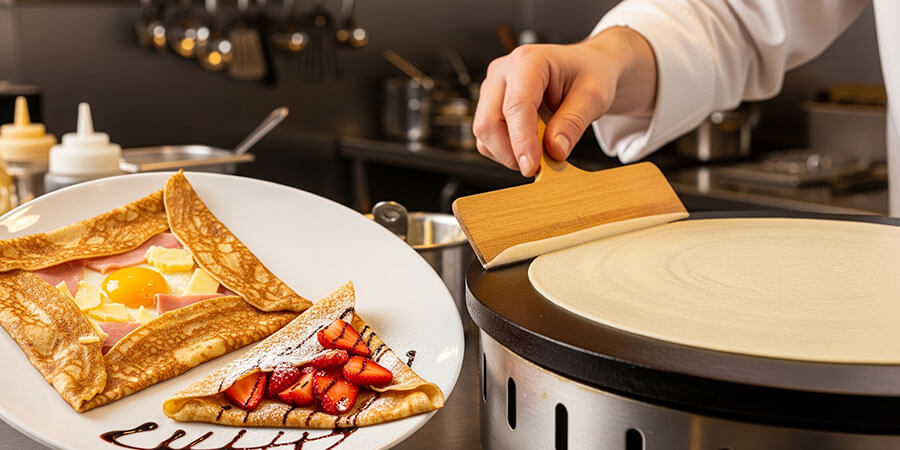
Table of Contents
Maximize Profit Margins and Menu Flexibility with a Single Versatile Item That Works Across Every Daypart from Breakfast Through Dessert
Crepes offer restaurant operators a rare combination of high profit margins, minimal equipment investment, and exceptional menu versatility. This post explores why crepes make business sense for operations ranging from casual cafes to upscale dining rooms, covering equipment needs, sweet versus savory applications across dayparts, menu positioning strategies, and the cultural storytelling that helps market this classic French preparation to American diners.
Restaurant operators constantly search for menu items that deliver strong margins while appealing to diverse customer preferences. Crepes check both boxes. These thin French pancakes require minimal ingredients, cook in under two minutes, and adapt to virtually any flavor profile from breakfast through dessert service.
The business case strengthens when you examine current market conditions. Morning meal traffic at restaurants rose in Q1 2025 - the first increase since Q2 2023 - according to Circana's "Eating Patterns in America" report from September 2025. Meanwhile, the global savory breakfast items market reached five point seven billion in 2025 and projects to hit thirteen point eight billion by 2033 at a twenty-one point four percent compound annual growth rate, per HTF Market Intelligence data from October 2025.
Consumer spending on food and beverages rose three percent year-over-year through the first half of 2025, according to Circana. Diners are spending, and they're seeking menu items that feel special without premium pricing. Crepes deliver that perceived value while maintaining food costs well below industry averages. Quick-service restaurants achieve six to ten percent profit margins with food costs of twenty to twenty-five percent, according to Leverage Buying Group's 2025 Restaurateur Benchmark Guide. A basic crepe batter costs significantly less, giving operators substantial margin flexibility for premium fillings and toppings.
Why Crepes Make Business Sense for Your Operation
Low ingredient costs create exceptional margin opportunities. A basic crepe requires flour, eggs, milk, butter, and salt. That's it. Even with premium fillings like fresh berries, artisanal cheeses, or quality proteins, your total food cost per plate stays well below the commonly cited industry benchmark of thirty to thirty-five percent of revenue. Many operators report crepe food costs between fifteen and twenty percent, leaving room for competitive pricing or enhanced profitability.
Speed of service matches modern expectations. Ninety percent of morning meals are prepared in less than fifteen minutes, according to Circana's "Future of Morning" report from November 2024. Commercial crepe machines operate at four hundred to four hundred fifty degrees Fahrenheit, cooking each crepe in one to two minutes. A single-burner machine produces thirty to sixty crepes per hour, while double-burner units reach sixty to one hundred twenty crepes hourly. This throughput supports both quick breakfast service and steady lunch or dinner volume.
Menu versatility spans every daypart without additional equipment. The same crepe machine and basic batter formula works for:
- Breakfast and brunch - Sweet crepes with fruit, chocolate, whipped cream, or maple syrup
- Lunch service - Savory galettes with ham, cheese, eggs, vegetables, or seafood
- Dinner applications - Sophisticated savory preparations with proteins, sauces, and seasonal ingredients
- Dessert offerings - Flambéed preparations, ice cream accompaniments, or elegant plated desserts
This flexibility matters when you're managing limited kitchen space or testing new concepts. One piece of equipment opens multiple revenue opportunities across different meal periods.
Broad demographic appeal reduces menu risk. Crepes attract health-conscious diners seeking lighter options, families looking for customizable choices that please both adults and children, brunch crowds chasing photo-worthy presentations, and fine dining guests who appreciate classic French technique. Few menu items cross this many customer segments effectively.
Limited-time offer potential drives repeat visits. Limited-time offer launches increased nineteen percent year-over-year, according to National Restaurant Association and Technomic data from 2025. Crepes excel as seasonal specials because you can rotate fillings and toppings without retraining staff or investing in new equipment. A spring asparagus and gruyere galette becomes a summer heirloom tomato and basil version, then transitions to fall apple cinnamon for minimal cost and maximum menu excitement.
Sweet Versus Savory - Covering Every Daypart
Breakfast and Brunch Sweet Applications
Morning service favors sweet crepes that compete with pancakes, waffles, and French toast while offering a lighter, more refined alternative. Classic combinations include fresh berries with whipped cream, chocolate hazelnut spread with sliced bananas, lemon juice with powdered sugar, or caramelized apples with cinnamon. These preparations require minimal prep work beyond washing fruit and maintaining quality toppings.
The presentation advantage matters for brunch service. A properly folded crepe with artful topping placement photographs better than standard pancake stacks, driving social media sharing that functions as free marketing. Comfort-driven dining and global flavors are key themes in the National Restaurant Association's 2026 What's Hot Culinary Forecast, with operators embracing nostalgia and "flavor escapism." Sweet crepes tap into this trend while maintaining operational simplicity.
Lunch and Dinner Savory Preparations
Savory crepes, traditionally called galettes when made with buckwheat flour, transform lunch and dinner service. Understanding the distinction helps you position menu items accurately and speak to guests who know the difference.
| Feature: | Crêpe (Wheat Flour): | Galette (Buckwheat Flour): |
| Primary flour | All-purpose wheat | Buckwheat |
| Flavor profile | Mild, slightly sweet | Nutty, earthy |
| Texture | Delicate, lacy | Heartier, crispier edges |
| Typical use | Sweet fillings, desserts | Savory fillings (ham, cheese, egg) |
| Color | Light golden | Darker brown |
| Gluten content | Contains gluten | Naturally gluten-free (if pure buckwheat) |
| Best dayparts | Breakfast, brunch, dessert | Lunch, dinner |
Standard wheat flour crepes work equally well for savory applications when you want a more neutral base.
Popular savory combinations include:
- Ham, gruyere, and egg - the classic "complète" that anchors French creperies
- Spinach, mushroom, and goat cheese for vegetarian appeal
- Smoked salmon, cream cheese, and fresh dill targeting brunch and lunch crowds
- Ratatouille vegetables with herbs de Provence for seasonal summer menus
- Chicken, bacon, and ranch-style sauce adapting American flavor preferences
Local sourcing ranks as the number one macro trend for 2025-2026, according to the National Restaurant Association's What's Hot 2026 report from November 2025. Savory crepes showcase local ingredients beautifully. Partner with regional farms for seasonal vegetables, local dairies for artisanal cheeses, and nearby producers for specialty items that differentiate your menu while supporting community relationships.
Dessert Service Opportunities
Dessert crepes command premium pricing while maintaining low food costs. Tableside flambé preparations like Crepes Suzette create theater that justifies higher check averages. Simpler applications work equally well - crepes filled with ice cream and drizzled with chocolate sauce, or folded around sweetened cream cheese and fresh fruit compote.
The global food trucks market valued at two point seven one billion in 2025 projects growth to four point one seven billion by 2034, according to Fortune Business Insights data from January 2026. Mobile operators and food trucks particularly benefit from dessert crepes because the equipment footprint stays small while the perceived value remains high. A crepe station at a food truck or festival booth attracts crowds and generates strong per-transaction revenue.
Setting Up Your Crepe Station
Essential Equipment and Workspace Requirements
The crepe machine forms your foundation. Commercial units feature flat, round cooking surfaces typically fifteen to sixteen inches in diameter. Gas and electric models both perform well, with choice depending on your existing kitchen infrastructure and utility costs. Single-burner machines suit cafes, food trucks, and operations testing crepe programs. Double-burner units support higher-volume breakfast service or dedicated creperies.
Temperature control matters significantly. Quality machines maintain consistent four hundred to four hundred fifty degree heat across the entire cooking surface, preventing hot spots that create uneven cooking. Look for units with precise thermostatic controls rather than simple high-low switches.
Supporting accessories streamline production:
- Batter spreaders create the characteristic thin, even crepe
- Offset spatulas enable clean flipping and folding
- Wooden crepe spatulas prevent surface scratching while allowing delicate maneuvering
- Batter dispensers ensure portion control and speed service
Beyond the crepe machine itself, standard kitchen equipment handles preparation. Large mixing bowls for batter, batter dispensers for consistent portioning, and quality spatulas and turners round out your needs. Total equipment investment remains modest compared to other menu additions requiring specialized cooking apparatus.
Workspace and Production Flow
A compact station works effectively. Position your crepe machine on a stable counter with adequate ventilation overhead. Allow workspace on both sides - one for batter and raw preparation, the other for finished crepes and plating. Many operators use a small warming drawer or covered hotel pan to hold finished crepes during high-volume service.
Basic technique requires minimal training. Staff learn to ladle batter onto the hot surface, spread it quickly in a circular motion using the wooden spreader, cook for thirty to sixty seconds until edges lift, flip carefully, cook the second side for another thirty to sixty seconds, then slide onto a plate for filling and folding. Most kitchen staff master the technique within a few hours of practice.
Batter preparation follows straightforward ratios. A basic sweet crepe batter uses one cup flour, two eggs, half a cup milk, half a cup water, and two tablespoons melted butter with a pinch of salt. Savory versions reduce or eliminate sugar. Mix until smooth, refrigerate for at least thirty minutes to allow gluten to relax, and the batter holds for up to two days. This make-ahead capability smooths morning prep and supports consistent quality.
Integration with Existing Equipment
Crepes complement rather than compete with existing breakfast equipment. Operations running waffle makers or countertop griddles add crepes to expand menu variety without cannibalizing sales. Each item attracts different customer preferences and occasions.
The minimal footprint matters for space-constrained kitchens. A single-burner crepe machine occupies roughly the same counter space as a standard toaster, making it viable even in tight quarters. This accessibility allows smaller operations to offer a menu item that feels upscale and specialized without major kitchen reconfiguration.
The Story Behind the Crêpe
Understanding crepe history gives you powerful marketing and menu storytelling tools. Staff who can share the cultural background create memorable guest experiences, while menu descriptions that reference tradition add perceived value without increasing costs.
Crepes originated in thirteenth-century Brittany, France. The region's rocky soil grew buckwheat more successfully than wheat, leading resourceful cooks to create thin pancakes from buckwheat flour. These original versions, called galettes, became a staple food for Breton peasants and farmers. The word "crêpe" derives from the Latin "crispa" meaning curled or wrinkled, which evolved through Old French "crespe" to describe the delicate, slightly irregular edges of a properly cooked crepe.
Wheat flour crepes emerged in the fifteenth century as wheat became more widely available and affordable. The lighter, more delicate wheat versions gained popularity among wealthier classes, eventually becoming the foundation for sweet crepes while buckwheat galettes remained the traditional savory preparation. This distinction persists in France today, where creperies typically offer both wheat crepes for dessert and buckwheat galettes for savory meals.
Crepes Suzette, created in 1895, brought theatrical flair to crepe service. Legend credits Henri Carpentier, a young waiter at the Café de Paris in Monte Carlo, with accidentally creating the flambéed orange sauce while preparing crepes for the Prince of Wales. Whether historically accurate or culinary mythology, the story illustrates how crepes transitioned from peasant food to elegant restaurant fare.
American awareness of crepes grew significantly through Julia Child's influence. Her 1961 cookbook "Mastering the Art of French Cooking" and her television show "The French Chef," which debuted in 1963, introduced French cooking techniques to American home cooks and inspired restaurant operators to add French preparations to their menus. Crepes benefited from this cultural moment, establishing themselves in American dining consciousness as sophisticated yet approachable.
La Chandeleur, celebrated February second in France, centers entirely on crepes. This traditional holiday, also called Candlemas, marks the midpoint between winter solstice and spring equinox. French families make crepes to celebrate the return of longer days, with the round, golden crepes symbolizing the sun. Tradition holds that you should flip the crepe with your right hand while holding a gold coin in your left to ensure prosperity for the coming year. This cultural touchpoint gives operators a ready-made February promotion opportunity with built-in storytelling.
Use this history strategically. Train servers to mention Brittany origins when guests ask about galettes. Reference La Chandeleur in February menu promotions. Include brief historical notes on menu descriptions to add interest and justify pricing. The story transforms a simple menu item into a cultural experience that guests remember and share.
Building Your Crepe Menu Strategy
Menu Positioning and Pricing Approach
Decide whether crepes function as a specialty or a menu section. Smaller operations often succeed with three to five crepe options - perhaps two sweet for breakfast, two savory for lunch, and one dessert version. This focused approach maintains simplicity while offering enough variety to attract repeat visits. Larger operations or dedicated brunch concepts might develop entire crepe sections with eight to twelve options spanning sweet and savory applications.
Pricing should reflect the perceived value rather than just food cost. While your actual food cost might run fifteen to twenty percent, guests perceive crepes as special-occasion items or upscale alternatives to standard breakfast fare. This perception supports pricing comparable to or slightly above your pancake or omelet offerings despite lower ingredient costs. Review our restaurant menu pricing guide for detailed strategies on value-based pricing approaches.
Menu descriptions matter significantly. Compare "Crepe with strawberries and cream" to "Fresh strawberries and vanilla whipped cream folded in a delicate French crepe, finished with powdered sugar." The second version justifies higher pricing and creates appetite appeal through sensory language and cultural reference. Invest time in menu copywriting or consult our restaurant menu design guide for proven description techniques.
Limited-Time Offers and Seasonal Rotation
Crepes excel as seasonal specials because you can change fillings and toppings without retraining staff or modifying core recipes. Spring might feature asparagus and gruyere galettes or lemon curd and blueberry sweet crepes. Summer brings heirloom tomato and basil savory versions or peach and cream dessert options. Fall transitions to butternut squash and sage galettes or apple cinnamon sweet crepes. Winter supports heartier combinations like ham and cheese or chocolate and peppermint.
This rotation strategy keeps regular customers engaged while allowing you to test new flavor combinations with minimal risk. Track sales data for each seasonal offering to identify winners worth adding to your permanent menu. The pandemic's evolution of breakfast demonstrated that customers value menu variety and novelty, making seasonal rotation a proven strategy for maintaining interest.
Testing and Scaling Your Crepe Program
Start small if you're uncertain about demand. Add two or three crepe options to your existing breakfast or brunch menu rather than launching a full crepe program immediately. This approach lets you gauge customer response, train staff gradually, and refine recipes before expanding. Monitor sales data for at least four to six weeks before making expansion decisions.
Consider timing when you introduce crepes. Brunch service typically shows the highest acceptance for new breakfast items, while lunch crowds might need more education about savory galette options. Align your launch with slower periods when staff have bandwidth to learn new techniques without service pressure.
Menu placement influences trial rates. Position crepes prominently on your menu rather than burying them in a miscellaneous section. If you're testing limited options, consider a small call-out box or featured items section that draws attention. Visual menu design significantly impacts ordering patterns, as detailed in our menu design guide.
Track not just sales volume but also customer feedback and server observations. Are guests asking questions about preparation? Do certain flavor combinations generate repeat orders? Is there confusion about the difference between sweet and savory options? This qualitative data informs menu refinement and staff training priorities.
Adapting to Your Concept and Customer Base
Fine dining operations might offer one or two sophisticated crepe preparations - perhaps a savory first course galette with seasonal ingredients or an elegant dessert crepe with tableside flambé service. Focus on premium ingredients, refined technique, and theatrical presentation that justifies higher price points.
Casual and family-friendly concepts benefit from broader crepe menus with clear sweet versus savory divisions. Offer customization options that let guests build their own crepes from a selection of fillings and toppings. This approach appeals to families with children and creates perceived value through choice.
Breakfast and brunch specialists should consider making crepes a signature item with dedicated menu real estate. Develop a range of options from simple and affordable to premium and indulgent. Consider offering a crepe flight - three small crepes with different toppings - that encourages trial and social media sharing.
Food trucks and mobile operations find crepes particularly advantageous due to minimal equipment needs and strong visual appeal. The cooking process itself attracts crowds, and the quick preparation time supports high-volume service at festivals and events. Focus on a tight menu of three to five options that you can execute consistently under mobile conditions.
Understanding when to refresh your overall menu helps you time crepe additions strategically. Our post on when to change your restaurant menu provides frameworks for menu evolution that complement crepe program development.
Managing Costs and Maximizing Profitability
Ingredient Sourcing and Inventory Management
Flour, eggs, and milk form your base costs. These staples benefit from existing supplier relationships and bulk purchasing. A single batch of batter uses minimal quantities, and the batter holds refrigerated for up to two days, allowing you to prepare in advance during slower periods rather than during peak service.
Premium fillings and toppings create your differentiation and margin opportunities. Fresh berries, artisanal cheeses, quality chocolate, and specialty ingredients justify higher menu prices while still maintaining favorable food cost ratios. Source these items seasonally when prices drop and quality peaks. Local sourcing not only aligns with the top macro trend for 2025-2026 but often provides better pricing than national distributors for seasonal produce.
Portion control prevents margin erosion. Use standardized ladles or batter dispensers to ensure consistent crepe sizes. Measure fillings and toppings by weight or volume rather than eyeballing quantities. Small portion creep - an extra ounce of cheese here, a few more berries there - compounds across hundreds of servings to significantly impact profitability.
Labor Efficiency and Cross-Training
Crepe preparation requires skill but not extensive culinary training. Line cooks, prep staff, and even front-of-house team members can learn basic technique quickly. This flexibility allows you to cross-train staff for crepe station coverage during peak periods without hiring specialized personnel.
Batch preparation streamlines service. Batter mixing, fruit washing and slicing, cheese portioning, and sauce preparation all happen during prep periods rather than during service. This front-loading of labor means your crepe station operates efficiently during rush periods with minimal active prep work beyond cooking and plating.
The speed of crepe cooking - one to two minutes total - means one trained staff member can handle significant volume on a single-burner machine. Double-burner units allow one person to manage even higher throughput, making crepes labor-efficient compared to made-to-order omelets or other egg preparations requiring constant attention.
Waste Reduction and Sustainability
Crepes generate minimal waste. Batter uses whole ingredients with no trimming or processing waste. Fillings and toppings can incorporate items already in your inventory for other menu applications, reducing the need for single-use specialty ingredients that risk spoilage.
Imperfect crepes - those with tears, uneven cooking, or cosmetic flaws - work perfectly well for family meal or staff training rather than becoming waste. The thin profile means even mistakes represent minimal ingredient loss compared to thicker pancakes or waffles.
Sustainable sourcing resonates with customers and often improves margins. Local eggs, regional dairy products, and seasonal produce from nearby farms frequently cost less than national brand equivalents while providing marketing value and supporting community relationships. Frame these choices in menu descriptions and marketing materials to enhance perceived value.
For comprehensive cost management strategies that complement your crepe program, review our guide on how to lower restaurant food costs for proven techniques applicable across your entire operation.
Frequently Asked Questions
What's the difference between a crepe and a pancake?
Crepes are much thinner than pancakes, contain no leavening agents like baking powder, and have a delicate, slightly crispy texture compared to the fluffy, cake-like texture of pancakes. The batter is more liquid, and crepes cook quickly on a flat surface rather than a griddle. This thinness allows crepes to be folded or rolled around fillings, while pancakes typically serve as a base for toppings.
Do I need special equipment to make crepes in a commercial kitchen?
A dedicated commercial crepe machine produces the best results with its flat, evenly heated cooking surface and precise temperature control. However, you can test crepe recipes on a flat-top griddle or large skillet before investing in specialized equipment. Commercial crepe machines range from single-burner units suitable for cafes and food trucks to double-burner models for high-volume breakfast service. Browse commercial crepe machines and crepe machine accessories to understand equipment options.
Can I make crepe batter ahead of time?
Yes, crepe batter actually improves when made ahead. Mix the batter and refrigerate for at least thirty minutes and up to two days before cooking. This resting period allows the flour to fully hydrate and the gluten to relax, resulting in more tender crepes. Bring batter to room temperature and whisk briefly before using, as ingredients may separate during storage.
What's the difference between a crepe and a galette?
Traditional French galettes use buckwheat flour and serve as savory preparations, while crepes use wheat flour and can be either sweet or savory. Buckwheat galettes have a nutty, earthy flavor that pairs well with cheese, eggs, and vegetables. In practice, many American restaurants use the terms interchangeably or use wheat flour for both sweet and savory applications. The distinction matters most if you're marketing authentic French preparations or want to highlight buckwheat's unique flavor and nutritional profile.
How do I price crepes on my menu?
Price crepes based on perceived value rather than just food cost. While crepe ingredients are inexpensive, customers view them as special-occasion items or upscale alternatives to standard breakfast fare. Price comparable to or slightly above your pancake, waffle, or omelet offerings. Factor in premium fillings and toppings when setting prices - a simple lemon and sugar crepe should cost less than one featuring fresh berries and house-made whipped cream. Consider your overall concept, target demographic, and local market when establishing price points.
What are the most popular crepe flavors for restaurants?
For sweet crepes, classic combinations include fresh strawberries with whipped cream, chocolate hazelnut spread with bananas, lemon juice with powdered sugar, and caramelized apples with cinnamon. Savory options typically feature ham and cheese, spinach and mushroom, smoked salmon with cream cheese, or eggs with various vegetables and proteins. The most successful menus offer both familiar classics that appeal to first-time crepe eaters and more adventurous combinations that attract food enthusiasts and repeat customers.
How many crepes can one person make per hour?
A trained staff member using a single-burner commercial crepe machine can produce thirty to sixty crepes per hour, depending on skill level and recipe complexity. Double-burner machines increase output to sixty to one hundred twenty crepes hourly. These numbers assume batter is pre-made and fillings are prepped and portioned. Actual service speed depends on how quickly you can plate and garnish finished crepes, not just cooking time.
Related Resources
- Commercial Crepe Machines & Makers - Single and double-burner units for every operation size
- Restaurant Menu Pricing Guide - Value-based pricing strategies for new menu items
- Restaurant Menu Design Guide - Proven techniques for menu layout and descriptions
- Menu Boards & Covers - Professional menu presentation materials
Share This!