What to Look for When Buying Gelato Dipping Cabinets
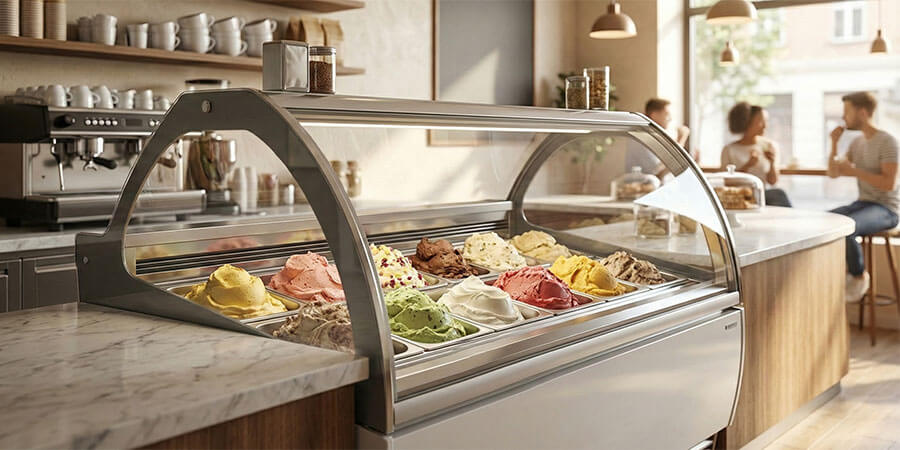
Table of Contents
Gelato stays softer, warmer, and denser than ice cream - and that changes everything about your display cabinet
Gelato requires different display conditions than ice cream - warmer serving temperatures, tighter humidity control, and cabinets designed for a denser product with less air content. This post covers temperature requirements, cabinet sizing, display styles, humidity management, and energy efficiency so you can choose equipment that keeps your gelato at its best.
The US gelato market reached $3.58 billion in 2024 and is projected to grow at 4.2% annually through 2033 (Grand View Research, December 2025). That growth is driven by consumer demand for artisanal, premium frozen desserts - and for operators, it represents a real revenue opportunity. But gelato is not ice cream, and the equipment that displays it needs to reflect those differences.
Gelato contains less fat, less air, and serves at a warmer temperature than ice cream. Those three factors mean a general-purpose ice cream dipping cabinet may not give you the precision your gelato needs. The wrong cabinet doesn't just affect presentation - it changes the texture, flavor, and shelf life of your product. Here's what to evaluate before you buy.
Temperature Requirements for Gelato Display
Temperature is the single most important factor in gelato quality, and it's where gelato and ice cream diverge the most.
Ice cream is served cold and firm. In practice, many operators target about 6°F to 10°F for dip-and-serve ice cream. That colder range works for ice cream's higher fat content and heavier air incorporation - but it's often too cold for gelato.
Gelato is served warmer and softer. In practice, many shops serve gelato around 10°F to 22°F - significantly warmer than ice cream. That warmer range is what gives gelato its characteristic dense, smooth, almost elastic texture. Serve it too cold and it loses that signature mouthfeel. Serve it too warm and it degrades quickly.
The differences come down to composition. Gelato uses more milk than cream, which lowers its fat content. It's also churned at a slower speed, incorporating far less air. The result is a denser product that needs to be warmer to be scoopable and flavorful.
| Attribute: | Gelato: | Ice Cream: |
| Milkfat content | 4-8% | 10-16% (min. 10% per FDA) |
| Overrun (air content) | 15-30% | 50-90% |
| Serving temperature | 10°F to 22°F | 6°F to 10°F |
| Storage temperature | 0°F or colder | Typically well below 0°F for hard storage |
| Texture at serving temp | Dense, smooth, elastic | Lighter, creamier, firmer |
Sources: FDA 21 CFR § 135.110; Park et al. 2015 (PMC4726959)
What this means for your cabinet: You need a display case with precise digital temperature controls that can hold a warmer range than a standard ice cream freezer. A cabinet locked at 0°F will make your gelato too hard to scoop and strip away the texture customers expect. Look for units with adjustable temperature ranges that reach into the teens and low twenties. For a full comparison of frozen dessert storage and serving temperatures across gelato, ice cream, frozen yogurt, and sorbet, the ice cream freezer buying guide breaks it down in detail.
Sizing Your Cabinet for the Space
Space efficiency is one of the biggest practical concerns for operators adding gelato to an existing menu - and it's the most common question from buyers evaluating these cabinets. The standard gelato pan holds 5 liters, so capacity is measured in pan count rather than cubic feet.
Countertop Models
Countertop gelato cabinets typically hold 3-4 standard 5-liter pans and measure roughly 26 inches wide. Their depth is the key advantage - as little as 10 inches for some models, compared to 46-47 inches for floor units. That compact footprint makes them viable for coffee shops, bakeries, and restaurants that want to offer gelato without dedicating major floor space.
Floor Models
Freestanding cabinets range from about 28 inches wide (4 pans) up to 71 inches (13-14 pans). The depth of floor models - typically 30-47 inches including the sneeze guard - is the primary space constraint. These units need clearance behind them for ventilation and on at least one side for service access.
| Cabinet Type: | Width Range: | Pan Capacity: | Best For: |
| Countertop (small) | ~26 in. | 3-4 pans (5L) | Coffee shops, bakeries, limited counter space |
| Mid-size floor | 28-50 in. | 4-9 pans (5L) | Small gelato shops, restaurants adding dessert |
| Full-size floor | 50-71 in. | 9-14 pans (5L) | Dedicated gelato shops, high-traffic operations |
How to estimate your pan count: A standard 5-liter gelato pan holds roughly 80-100 servings depending on scoop size. If you're running 6-8 flavors in rotation, a 9-pan cabinet gives you room for your active menu plus a couple of backup flavors. Smaller operations with 3-4 core flavors can work comfortably with a countertop unit. You can browse gelato dipping cabinets by pan count and width to find models that fit your specific space.
Factor in adjacent counter space for toppings, scoops and dippers, and point-of-sale equipment. Operators building a full dessert station around their display often find that house-made waffle cones add meaningful margin to each sale.
Display Styles and Glass Options
The display style of your cabinet affects customer experience, product visibility, and how well the unit handles ambient conditions.
Curved glass is the traditional gelato shop aesthetic. The rounded front panel gives customers a wide viewing angle and creates the classic European gelato counter look. Curved glass cases tend to be slightly deeper and are standard on most full-size floor models.
Flat glass offers a more modern, streamlined appearance and is common on mid-size and countertop units. Flat panels are easier to clean and typically cost less to replace if damaged.
Flip-top and low-glass designs prioritize access speed over visual presentation. These are common in high-throughput settings where operators need to scoop quickly without reaching over or around a tall glass panel. They're less effective as visual merchandising tools but more practical in fast-paced environments.
Glass Quality Matters More Than Style
Regardless of curve or angle, the glass construction directly affects performance:
- Double-glazed (insulated) glass adds a layer of insulation that reduces cold air loss and prevents condensation from fogging the display. This is especially important in humid environments or locations near cooking equipment where warm, moisture-heavy air is constant.
- Single-pane glass is cheaper but fogs more easily, forces the compressor to work harder, and can develop condensation that obscures your product - exactly the opposite of what a display case should do.
If product visibility is a priority - and for gelato, it almost always is - double-glazed glass pays for itself in customer engagement.
How Humidity and Climate Affect Your Cabinet
This is an often-overlooked factor, especially for operators in coastal, tropical, or high-humidity regions - or anyone placing a gelato cabinet near a kitchen.
Commercial display cases are rated under controlled ambient conditions. Those lab conditions may not match real kitchens or storefronts. If your location regularly runs hot or humid - a common reality in southern and coastal states, or in any space near cooking equipment - your cabinet has to work harder to maintain temperature, and condensation becomes a real problem.
Condensation is not just cosmetic. Fogged glass hides your product from customers, which defeats the purpose of a display case. But moisture buildup also creates microbial growth risk on surfaces, increases energy consumption as the compressor cycles more frequently, and can cause ice formation on interior components.
Forced Air vs. Static Cooling
The cooling method your cabinet uses determines how well it handles humidity:
- Forced air (ventilated) cooling circulates cold air continuously inside the cabinet, reducing humidity and preventing condensation. This is the recommended choice for humid environments, high-traffic locations, and any cabinet that gets opened frequently throughout the day.
- Static cooling relies on natural air circulation. It's quieter and can be gentler on products that dry out easily, but temperature differences between the top and bottom of the case can lead to condensation and ice formation - particularly in humid conditions.
If you operate in a humid climate or place your cabinet near cooking equipment, prioritize forced-air cooling and double-glazed glass. Those two features together address the most common humidity-related problems operators report.
Energy Efficiency and Maintenance
Gelato dipping cabinets are not ENERGY STAR certified. The ENERGY STAR program for commercial refrigerators and freezers explicitly excludes dipping cabinets and open-top display cases from its certification scope (DOE/FEMP). This means you can't rely on the ENERGY STAR label when comparing units - you'll need to evaluate energy efficiency through other indicators.
Look for R-290 refrigerant. Newer commercial gelato cabinets increasingly use R-290 (propane) refrigerant, which has a Global Warming Potential of 3.3 compared to 3,922 for older R-404a refrigerant. Beyond the environmental benefit, R-290 systems tend to run more efficiently, which translates to lower operating costs over the life of the unit.
Other efficiency indicators to check:
- Wattage rating - comparable-size cabinets can range from under 300W to over 700W depending on insulation quality, compressor efficiency, and refrigerant type
- NSF and ETL certification - these confirm the unit meets sanitation and electrical safety standards (since ENERGY STAR doesn't apply)
- Self-defrosting capability - reduces maintenance burden and prevents ice buildup that degrades performance over time
Routine Care
Gelato cabinets require consistent upkeep to maintain temperature accuracy and product quality. Clean condenser coils quarterly to prevent airflow restrictions. Check door gaskets monthly for wear that lets warm air infiltrate. Wipe interior surfaces daily to prevent buildup, and verify your digital temperature reading against a separate thermometer periodically to catch calibration drift early.
For the broader serving setup, keeping your dipper wells clean and properly supplied is just as important as cabinet maintenance - cross-contamination between flavors is a common customer complaint that's easily prevented with proper scoop management.
Frequently Asked Questions
What temperature should a gelato dipping cabinet be set to?
Most operators set their gelato dipping cabinets between 10°F and 22°F for serving. This is warmer than ice cream's ideal range of 6-10°F. The exact setting depends on your specific product - gelato with higher fat content can be served slightly colder, while lower-fat recipes need the warmer end of the range to maintain their characteristic smooth texture.
Can I display gelato in a regular ice cream dipping cabinet?
Technically yes, if the cabinet has adjustable temperature controls that reach the warmer range gelato requires. However, standard ice cream cabinets are designed for colder holding temperatures and may not maintain the 10-22°F range as precisely. A cabinet built for gelato will have better temperature control in that specific range and is a better long-term investment if gelato is a core part of your menu.
How many pans do I need for a gelato operation?
It depends on your flavor rotation. Most small-to-mid gelato operations run 6-8 flavors, which means a 9-pan cabinet provides enough space for your active menu plus backup flavors. Dedicated gelato shops offering 12 or more flavors should look at full-size floor models with 13-14 pan capacity. Countertop units with 3-4 pans work for restaurants adding gelato as a dessert option alongside other items.
What is the difference between forced air and static cooling in gelato cabinets?
Forced air cooling circulates cold air continuously, maintaining even temperatures and reducing humidity inside the cabinet. Static cooling relies on natural air circulation and tends to be quieter, but can create temperature differences between the top and bottom of the case. Forced air is the better choice for humid environments, locations near cooking equipment, and high-traffic operations where the cabinet gets opened frequently.
Does humidity affect gelato display cases?
Yes, significantly. Many display cases perform best in moderate indoor conditions, and hotter or more humid environments can cause condensation on the glass, increase compressor workload, and lead to ice formation inside the cabinet. Double-glazed glass and forced-air cooling are two of the most effective features for managing humidity.
Are gelato dipping cabinets ENERGY STAR certified?
No. The ENERGY STAR program for commercial refrigerators and freezers explicitly excludes dipping cabinets and open-top display cases. When comparing energy efficiency, look for R-290 refrigerant, lower wattage ratings relative to cabinet size, and NSF/ETL certification as quality indicators instead.
What size gelato cabinet fits on a countertop?
Countertop gelato cabinets typically measure about 26 inches wide and hold 3-4 standard 5-liter pans. Their depth can be as compact as 10 inches for some models, making them viable for narrow counters and small service areas. These are ideal for coffee shops, bakeries, and restaurants that want to offer gelato without dedicating significant floor space.
Related Resources
- Ice Cream Freezer Buying Guide - Complete temperature and storage comparison for gelato, ice cream, frozen yogurt, and sorbet
- Soft Serve Machine Buying Guide - Equipment selection for adding soft serve alongside your gelato operation
- Gelato Dipping Cabinets - Browse gelato display cases by size, style, and capacity
- Ice Cream Dipping Cabinets - Full selection of dipping cabinets for frozen desserts
- How to Make the Perfect Waffle Cone - Pair your gelato display with house-made waffle cones
Share This!