How to Choose the Best Bakers Scale
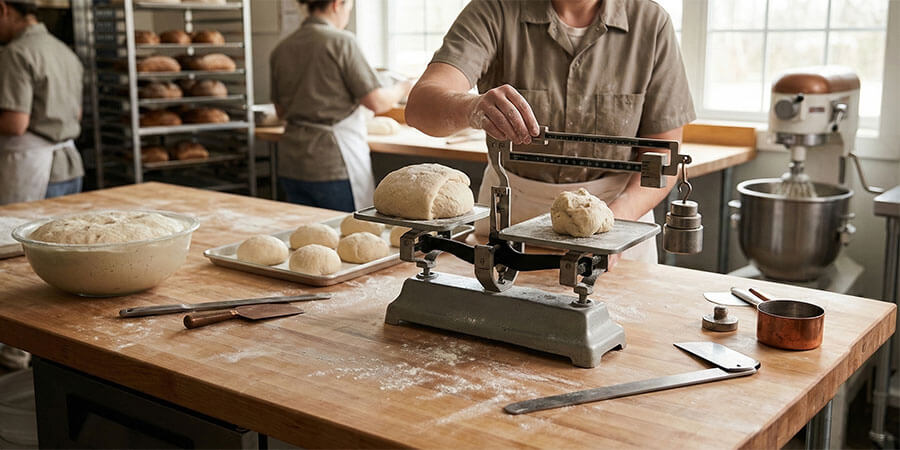
Table of Contents
Pick A Bakers Scale That Improves Accuracy, Fits Your Batch Sizes, And Holds Up To Daily Bakery Workflow
The right bakers scale does more than display a number. It protects consistency, reduces waste, speeds prep, and keeps recipes repeatable across different staff and shifts.
That matters because weighing ingredients is one of the simplest ways to control variation in baking. NIST's updated Metric Kitchen guidance emphasizes that measuring ingredients by weight improves accuracy and repeatability, which is exactly why bakery operations lean on scales instead of relying on cups and visual estimates.
If you are choosing a bakers scale for a new bakery or replacing an older unit, the decision should focus on workflow first: what you weigh, how much you weigh, how often you weigh, and how much precision the product actually demands.
Start With What The Scale Will Measure Most Often
Not every bakery uses a scale the same way. One operation may weigh flour, sugar, and bulk dough all day. Another may need fast ingredient scaling for pastry and decorating work. Those are different jobs.
Use cases usually fall into these buckets:
- Ingredient scaling for batch prep
- Dough portioning for bread or pizza-style production
- Small-batch pastry and decorating work
- General kitchen weighing for prep and receiving
If you choose a scale without defining the primary job, you can end up with a unit that is technically accurate but frustrating in practice.
That is why bakery owners should think in terms of station purpose instead of generic equipment needs. A scale used at the dough bench may be asked to do a very different job than one used in pastry prep or packaging.
| Use Case: | What Matters Most: | Common Mistake: |
| Bulk ingredient weighing | Higher capacity, sturdy platform, easy readability | Buying a precision-first scale that tops out too low |
| Dough portioning | Durable platform, stable readout, easy cleanup | Over-focusing on tiny increments you do not need |
| Pastry / small-batch work | Fine resolution, reliable tare, compact footprint | Choosing a large bakery scale for delicate measuring |
| General bakery prep | Unit switching, tare, visibility with bowls | Ignoring workflow and operator visibility |
If you want a broader equipment context, the Commercial Scale Guide is the best overall reference point in the catalog.
Accuracy And Capacity Need To Be Balanced
One of the most common buying mistakes is assuming that the most accurate scale is automatically the best scale.
It is not. Accuracy has to be considered alongside capacity.
In practical terms:
- Higher-capacity scales are usually better for larger ingredient loads and dough handling.
- Finer-resolution scales are better for smaller quantities where small changes matter more.
That tradeoff is normal. The right question is not "What scale is most accurate?" It is "What level of accuracy do I need at the capacity I actually use?"
| Priority: | Better Fit: | Why: |
| Large dough loads | Higher-capacity bakery scale | Supports larger bowls, tubs, or dough portions |
| Ingredient prep for standard recipes | Mid-capacity scale with strong tare function | Good balance of speed and accuracy |
| Small pastry measurements | Finer-resolution scale | Better for small additions and tight tolerance work |
| Mixed-use kitchen prep | Flexible unit switching and clear display | Easier for staff to use across tasks |
Nature's 2024 editorial commentary on baking and measurement reinforces the same idea in broad terms: quantities and precision are central to predictable baking results. That does not mean every bakery needs the most sensitive scale on the market. It means the scale needs to match the precision the product requires.
Choose The Scale Type That Fits The Bakery Workflow
The old "digital vs analog" conversation is still useful, but only if it connects back to how the scale will actually be used.
Digital scales
Digital scales are often favored for ease of reading, unit switching, and tare functions. They are usually the easiest choice for operations that want speed and repeatability.
Mechanical / beam-style baker scales
Traditional bakers dough scales still appeal to some operations because they are sturdy, familiar, and less dependent on power. They can be a good fit when the workflow is simple and heavily centered on dough portioning.
General commercial kitchen scales
Some bakeries do not need a dedicated baker's dough scale for every station. Depending on the workflow, a broader kitchen scale or portion scale can cover some tasks more efficiently.
That is why it helps to compare the whole scale department, not just one subcategory. Relevant starting points include Bakers Dough Scales, Commercial Food & Kitchen Scales, and Portion Scales.
Make Tare, Readability, And Cleanup Non-Negotiable
Many scale buying decisions get too technical and skip the features that make the unit usable every day.
Three practical features matter in almost every bakery:
Reliable tare
Tare is what makes scaling into bowls and tubs efficient. If the tare function is awkward or unreliable, staff waste time and make more mistakes.
Readable display
The display has to stay visible even when a large bowl or ingredient tub is on the platform. A scale that disappears behind the container becomes frustrating immediately.
Easy cleanup
Flour dust, sticky dough, and sugar residue are part of bakery life. If the top or platform is awkward to wipe, staff will avoid cleaning it thoroughly and the scale becomes harder to use.
NIST's 2026 updates on culinary tools and measurement also reinforce a practical point that maps well to bakery operations: the right tools reduce error and improve repeatability. In bakery language, that means the scale should make correct measuring easier, not more complicated.
That is especially important in bakeries where more than one person handles prep. A scale with a clear display and dependable tare function helps recipes stay consistent even when multiple bakers work the same station. The less interpretation a tool requires, the easier it is to maintain the same product from one shift to the next.
Think About Bowl Size, Platform Space, And Counter Footprint
Operators often think about scale capacity and forget scale footprint.
But in a real bakery, physical size affects everything:
- Can the bowl sit securely on the platform?
- Can the operator still read the display?
- Does the scale fit at the prep station without becoming clutter?
- Will staff move it constantly because it is in the way?
If the answer to that last question is yes, the scale is more likely to get bumped, dropped, or stored poorly.
This is one reason bakery equipment should be considered as a system. The same station-planning logic that matters when choosing ovens or mixers also matters here. Related reads like Baking Wars: Convection vs Conventional Ovens and Commercial Convection Oven Buying Guide help frame the broader bakery workflow.
Durability Matters More Than Fancy Features
Scales live in busy prep environments. They get flour on them, bowls dropped on them, and ingredients spilled around them. That is why durability should outrank extra features that sound good but do not improve production.
Look for a scale that:
- Feels stable on the counter
- Has a platform that is easy to wipe down
- Handles daily use without constant recalibration headaches
- Uses controls staff can understand quickly
The kitchen is not a showroom. A scale that looks advanced but slows the team down is the wrong scale.
This is also where buying habits matter. If the scale is going to live near flour, sugar, dough, and frequent wiping, simple controls and sturdy construction usually beat a feature list that staff will never use. The better the scale fits the station, the longer it tends to stay accurate and useful.
If your bakery is still building out its core equipment mix, related posts like 8 Products You Need to Start Your Own Bakery can help prioritize purchases around actual production needs.
Buy For The Recipes You Run Now, Not The Ones You Might Run Later
It is easy to overbuy equipment in the name of flexibility. But with scales, that often means paying for capability you do not actually use while making daily tasks harder.
Ask these questions before buying:
- What is the most common ingredient or dough weight I will measure?
- Do I need fine resolution, higher capacity, or both in different stations?
- Will this scale stay in one place or move around the bakery?
- Does the team need multiple units or just one dependable primary unit?
Sometimes the answer is one scale. Sometimes it is a two-scale strategy: one for bulk and one for precision work. That is often a better workflow than forcing one unit to do everything.
It also gives you a better path for growth. If the bakery expands into new product lines later, you can add a second scale for that specific job instead of compromising the daily work of the main station. Buying for real production today usually leads to a cleaner equipment plan tomorrow.
Frequently Asked Questions
What is the best scale for bakers?
The best bakers scale is the one that matches your actual bakery workflow. For some bakeries that means a higher-capacity dough scale. For others it means a digital scale with strong tare, clear readability, and enough precision for ingredient work. There is no single best option for every operation.
Why do bakers prefer weighing ingredients instead of measuring by volume?
Weighing improves consistency and repeatability. NIST's culinary measurement guidance specifically supports measuring by mass for better accuracy, which is especially important in baking where small variations can change texture and performance.
What should I look for in a bakers scale?
Focus on accuracy, capacity, tare, readability, platform size, cleanup, and durability. The right mix depends on whether you weigh bulk dough, ingredients, or smaller pastry quantities most often.
Are digital bakers scales better than mechanical ones?
Not automatically. Digital scales are often easier for tare, unit switching, and readability, while mechanical baker scales can still work well for specific dough-focused tasks. The right choice depends on workflow, not trend.
How much capacity does a bakery scale need?
Enough to cover your most common bowl, dough, or ingredient load without forcing awkward workarounds. Capacity should be chosen together with accuracy, since those two factors usually trade off to some degree.
Can one scale handle every bakery task?
Sometimes, but not always. Many bakeries do better with one scale for larger prep and a second for smaller, more precise work. That can be more efficient than trying to force one unit to cover every job.
Related Resources
- Commercial Scale Guide - Compare scale types, use cases, and buying factors
- Bakers Dough Scales - Browse bakery-specific scale options
- Commercial Food & Kitchen Scales - See the broader scale department and related categories
- Portion Scales - Useful for smaller prep and ingredient control tasks
Share This!