Commercial Toilet Paper Dispensers and Holders
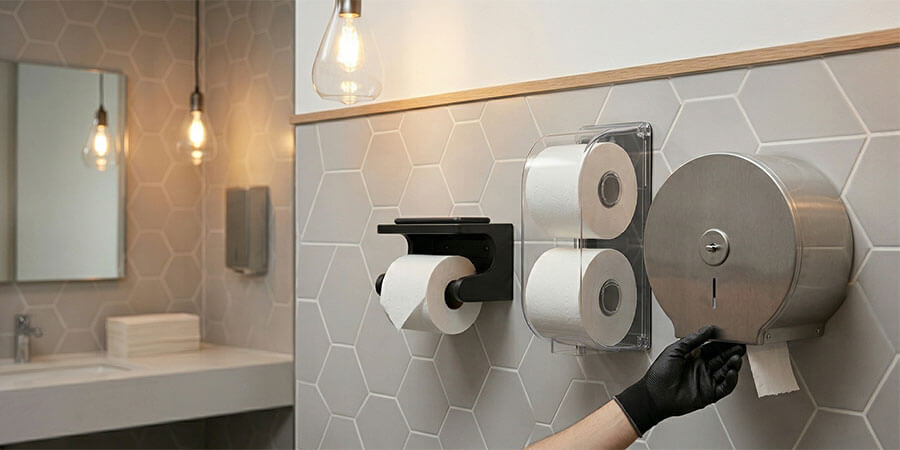
Table of Contents
Choose a better restroom tissue setup by matching dispenser type, roll format, placement, and maintenance demands to your facility
Commercial toilet paper dispensers seem like a small purchasing decision until they start creating daily problems. Then they become a facilities issue fast. A bad fit can mean more frequent refills, more waste, poor roll compatibility, awkward restroom layouts, guest frustration, and more maintenance time than the team wants to spend on something this basic.
That is why the best commercial toilet paper dispenser is not simply the one with the lowest price or the nicest finish. It is the one that matches your traffic, your restroom layout, your preferred roll format, and the level of servicing you actually want the team to manage.
Start With Traffic And Maintenance Expectations
The easiest way to choose the wrong dispenser is to start with appearance instead of usage.
In a low-traffic restroom, a simple standard-roll holder may be perfectly reasonable. In a higher-traffic restaurant or shared commercial facility, that same choice can become a constant refill problem. That is why traffic and maintenance expectations should answer the first question.
| Restroom Reality: | Better Dispenser Direction: |
| Lower traffic and simpler upkeep | Standard or compact formats can work |
| Moderate to high traffic | Higher-capacity or multi-roll formats often make more sense |
| Facilities that want fewer service calls | Enclosed, higher-capacity, easier-to-monitor dispensers are often stronger |
| Multi-property standardization goals | Consistent roll format and dispenser family matter more than decorative variation |
This is also where many facilities teams think about standardization. The stronger the match between roll format and dispenser format across the building, the easier refills and supply planning become.
Not All Toilet Paper Holders Are The Same Size
One of the most common sources of confusion around toilet paper holders is the assumption that any roll will fit any dispenser. That is not how commercial restroom setups work.
Compatibility usually depends on:
- Roll diameter
- Core size
- Roll width
- Whether the dispenser is built for one roll, two rolls, or a high-capacity format
That is why restroom teams run into trouble when they buy tissue and dispenser hardware separately without thinking about the format as a system. A dispenser should be chosen around the paper format you want to standardize, not around looks alone.
The Main Commercial Dispenser Types Most Facilities Compare
| Dispenser Type: | Best Fit: | Main Advantage: |
| Standard single-roll holder | Lower traffic or smaller restrooms | Familiar and simple |
| Dual-roll holder | Moderate traffic and fewer changeouts | Backup roll available immediately |
| Jumbo-roll dispenser | Higher traffic and fewer refill trips | More capacity per refill |
| Multi-roll or stub-roll system | Facilities trying to reduce waste and partial-roll loss | Better paper utilization |
| Enclosed high-capacity dispenser | Busy public restrooms and easier tamper control | Cleaner appearance and more protection |
This is the real answer behind many "types of toilet paper holders" searches. The important distinction is not only what the holder looks like. It is how much paper it holds, how it is serviced, and how well it matches the restroom's actual traffic pattern.
Capacity Usually Matters More Than Style In Commercial Restrooms
Style is not meaningless, especially in guest-facing restaurants. But capacity is usually the bigger operations decision.
Higher-capacity dispensers tend to help when:
- Restroom traffic is steady or unpredictable
- Staff want fewer refill interruptions
- The operation wants to reduce the chance of an empty roll during peak periods
- Management is trying to standardize across several restrooms or properties
That does not mean every restroom needs the largest dispenser possible. It means a dispenser should be chosen for how the restroom is actually used instead of how tidy it looks when empty.
This is one of the main reasons facilities teams compare holder types so closely. If a restroom runs out too often during peak periods, the problem is rarely solved by nicer hardware alone. It is usually solved by choosing a dispenser and paper format that match the traffic better.
Enclosed Vs. Open Designs Change Maintenance And Appearance
This is another choice that looks small until the restroom is in real use.
Open designs can be simpler and more familiar, but they expose the roll more and may not be the strongest choice in busier or more public-facing environments.
Enclosed designs usually protect the roll better, often support higher capacity, and can make the restroom feel more orderly from a guest perspective. They can also help reduce tampering in some settings.
The right choice depends on the restroom environment, not just the dispenser style catalog.
Roll Change Logic Affects Waste More Than Many Buyers Expect
One reason facilities teams care so much about dispenser style is that different systems handle partial rolls differently.
Some formats are simple but can leave more half-used roll transitions behind. Others are built to reduce waste by letting a second roll stage in the unit or by using the remaining paper more efficiently before the next roll takes over. That is why operations that want lower maintenance and better usage often look beyond the most familiar open holder format.
This is less about novelty and more about labor. The more often staff are dealing with awkward half-roll situations, the more time the restroom system is quietly taking back from the operation.
Placement Matters More Than People Expect
Search behavior around dispenser placement in restaurants is not random. Placement really does matter.
A restroom tissue dispenser should be easy to reach, easy to reload, and positioned in a way that works with the stall layout rather than fighting it. In guest-facing commercial restrooms, placement also has to support general accessibility and ease of use.
That does not mean one universal mounting rule solves every layout. It means the dispenser should be selected and placed as part of the restroom's real dimensions, wall space, reach, and maintenance access.
This is one of the easiest places where operators discover too late that the hardware they bought works poorly in the actual stall.
It is also where restaurants can unintentionally create a maintenance problem for themselves. A dispenser that is technically installed but awkward to refill, awkward to reach, or too close to other stall elements may keep creating small frustrations long after the purchase is forgotten.
Tamper Resistance And Downtime Matter In Busier Restrooms
In higher-traffic public restrooms, the best dispenser is often the one that prevents small disruptions from becoming daily annoyances.
That can include:
- Better roll protection
- More controlled access to the paper
- Fewer opportunities for partial-roll waste
- Easier staff visibility into low-paper conditions
This is where enclosed and higher-capacity designs often become more attractive. They are not only about appearance. They are also about reducing the chances that the restroom becomes a maintenance distraction in the middle of service.
Maintenance And Refills Should Feel Predictable, Not Annoying
Facilities teams often care less about the dispenser's appearance than about how irritating it is to service.
The strongest dispenser setups usually make it easier to:
- See when paper is running low
- Refill quickly
- Use a standard roll format across multiple restrooms
- Reduce partial-roll waste
- Keep the restroom looking consistently stocked
This is why a lower-maintenance dispenser is often the better long-term choice even if it is not the most minimal-looking one.
It also explains why facilities teams often prioritize visibility and access when they standardize. A dispenser that is slightly less decorative but much easier to inspect and refill can be the smarter commercial choice because it prevents more empty-roll moments and reduces service interruptions.
If you are also reviewing the broader restroom-support setup, a coordinated paper, soap, and towel strategy usually matters more than any single fixture choice alone.
A Better Way To Choose A Dispenser For Restaurants
Restaurants should usually think about this purchase through four questions:
- How much traffic does this restroom really see?
- What paper format do we want to standardize around?
- How often do we want staff refilling this?
- What will work best in the actual stall layout?
If you answer those four clearly, the dispenser decision gets much easier.
| Decision Question: | Why It Matters: |
| Traffic level | Determines whether capacity should outweigh simplicity |
| Paper format | Prevents roll-compatibility problems |
| Service expectations | Shapes refill frequency and labor burden |
| Stall layout and placement | Prevents awkward or hard-to-use installations |
This is also why buying "the best commercial toilet paper dispenser" in the abstract is not very useful. The best one is the one that fits your restroom pattern, not the one with the broadest marketing claim.
Restaurants Usually Benefit From Standardization More Than Variety
It may be tempting to treat each restroom differently, but operations usually get easier when tissue, dispensers, soap, and paper towel systems follow a more consistent logic.
Standardization helps with:
- Purchasing
- Refills
- Training
- Spare parts and replacements
- Inspection and restroom checks
That does not mean every restroom must look identical. It means the underlying supply logic should be simpler than many operations make it.
That logic matters even more when restaurants manage multiple restrooms, multiple shifts, or multiple properties. Once different restroom formats start taking different paper sizes, different servicing routines, and different replacement parts, the purchasing and maintenance side gets more complicated than it needs to be.
That is why a slightly less flashy but more standardized restroom setup is often the smarter commercial decision. The guest rarely notices the purchasing elegance behind it, but the team notices immediately when refills, training, and stocking become easier.
For the broader restroom-supply side, Restroom Supplies, Commercial Paper Towel Dispensers, and Janitorial Supplies are the most natural category follow-ups.
Frequently Asked Questions
What are the main types of commercial toilet paper dispensers?
The main types most facilities compare are standard single-roll holders, dual-roll holders, jumbo-roll dispensers, multi-roll or stub-roll systems, and enclosed higher-capacity dispensers. The right choice depends on traffic, refill frequency, and the roll format you want to use consistently.
Are all toilet paper holders the same size?
No. Commercial dispensers vary by roll diameter, core size, roll width, and overall capacity. That is why the tissue format and the dispenser format should be chosen together rather than separately.
What toilet paper dispenser is best for high-traffic commercial restrooms?
Higher-capacity formats such as jumbo-roll, multi-roll, or other enclosed high-capacity dispensers are often better suited to higher-traffic spaces because they reduce refill frequency and help the restroom stay stocked during busy periods.
Why do facilities teams care so much about dispenser compatibility?
Because the wrong match creates daily problems - poor fit, wasted partial rolls, more refill interruptions, and inconsistent supply purchasing. Compatibility affects both maintenance time and restroom reliability.
What should restaurants consider when placing a toilet paper dispenser?
Placement should support reach, stall layout, and maintenance access while still making sense for the actual restroom dimensions. The dispenser should feel easy to use and easy to service, not squeezed into the only remaining wall space.
Is a higher-capacity dispenser always better?
Not automatically. It is usually better in higher-traffic or lower-maintenance environments, but smaller restrooms with lighter use may do fine with simpler formats. The better choice depends on how the restroom is actually used.
Related Resources
- How to Choose a Hand Soap Dispenser for Your Business - A useful companion post for restroom and handwashing-station planning.
- Commercial Toilet Paper Dispensers & Holders - Category page for commercial restroom tissue dispensers.
- Restroom Supplies - Broader restroom-support category for commercial facilities.
- Commercial Paper Towel Dispensers - Helpful if you are standardizing the full handwashing and restroom station.
- Janitorial Supplies - Broader cleaning and restroom-maintenance category support.
Share This!